1.40-1.43 - Ionic bonding and giant ionic lattice properties
Ionic compounds form when electrons are transferred from metal atoms to non-metal atoms. The oppositely charged ions produced are held together by electrostatic attractions in a giant repeating lattice, and that structure explains their melting points and electrical conductivity.
Electron transfer in dot-and-cross diagrams
In this lesson, dot-and-cross diagrams show only the outer electrons. One symbol, such as a dot, is used for the non-metal's original electrons and the other symbol, such as a cross, is used for the metal's original electrons. The symbols track where the electrons came from; the electrons themselves are not different types.
For the required ionic examples, use the group number to decide how many outer electrons move:
| element group | what usually happens in this model | ion formed |
|---|---|---|
| Group 1 metal | loses 1 outer electron | 1+ ion |
| Group 2 metal | loses 2 outer electrons | 2+ ion |
| Group 3 metal | loses 3 outer electrons | 3+ ion |
| Group 5 non-metal | gains 3 electrons | 3- ion |
| Group 6 non-metal | gains 2 electrons | 2- ion |
| Group 7 non-metal | gains 1 electron | 1- ion |
The final diagram should show ions, not atoms. Put square brackets around each ion, write the charge outside the bracket, and show a full outer shell for the negative ion.
[DIAGRAM: asset_name: Ionic bonding and giant ionic lattice properties - diagram 01; asset_slug: c15_ionic_bonding_and_giant_ionic_lattice_properties__diagram_01; recommended_method: image_gen; description: Monochrome dot-and-cross schematic of sodium chloride formation by one electron transfer from sodium to chlorine, showing only outer electrons and bracketed Na+ and Cl- ions.]
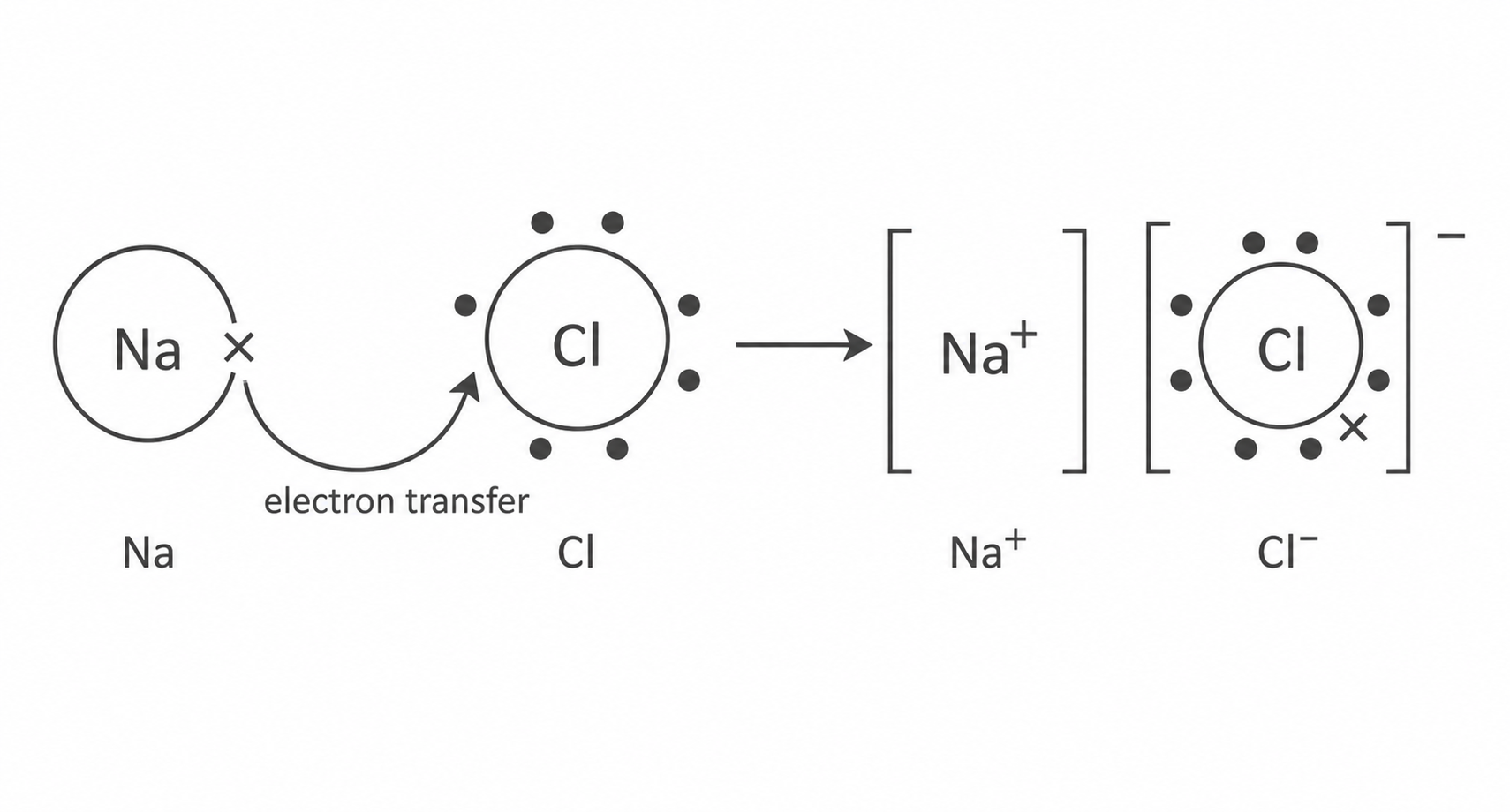
For sodium chloride, sodium transfers one electron to chlorine:
Sodium ion formation
Chlorine gains that electron to complete its outer shell and becomes a chloride ion, Cl-. The compound contains Na+ ions and Cl- ions. In a dot-and-cross diagram, the chloride ion's outer shell has seven dots from chlorine and one cross from sodium.
For compounds with more than two atoms, the same rule applies. In magnesium chloride, MgCl2, one magnesium atom loses two electrons. Each of two chlorine atoms gains one electron, so the final diagram contains Mg2+ and two Cl- ions.
Ionic bonds as electrostatic attractions
Electron transfer forms positive and negative ions, but the ionic bond is the attraction between those ions.
Ionic Bonding
Ionic bonding is the strong electrostatic attraction between oppositely charged ions.
Electrostatic attraction means attraction between opposite charges. A Na+ ion is attracted to nearby Cl- ions because positive and negative charges attract. The attraction does not depend on which chlorine atom received sodium's electron.
This is why ionic compounds are not made of separate little molecules such as "one Na stuck to one Cl". In solid sodium chloride, each ion is attracted to several oppositely charged ions around it. The ionic bonding extends through the whole structure.
Take care with the word "bond". In this topic, an ionic bond is not a shared pair of electrons. It is also not the transferred electron itself. It is the electrostatic force of attraction between oppositely charged ions.
Giant ionic lattices
An ionic compound forms a giant ionic lattice. "Giant" means the pattern repeats again and again, not that one molecule is unusually large. "Lattice" means a regular arrangement of particles.
In a giant ionic lattice, positive and negative ions alternate. Each positive ion is surrounded by negative ions, and each negative ion is surrounded by positive ions. The attractions act in all directions through the solid.
[DIAGRAM: asset_name: Ionic bonding and giant ionic lattice properties - diagram 02; asset_slug: c15_ionic_bonding_and_giant_ionic_lattice_properties__diagram_02; recommended_method: image_gen; description: Monochrome 3D schematic of a repeating sodium chloride giant ionic lattice with alternating Na+ and Cl- ions and electrostatic attractions between neighbouring oppositely charged ions.]
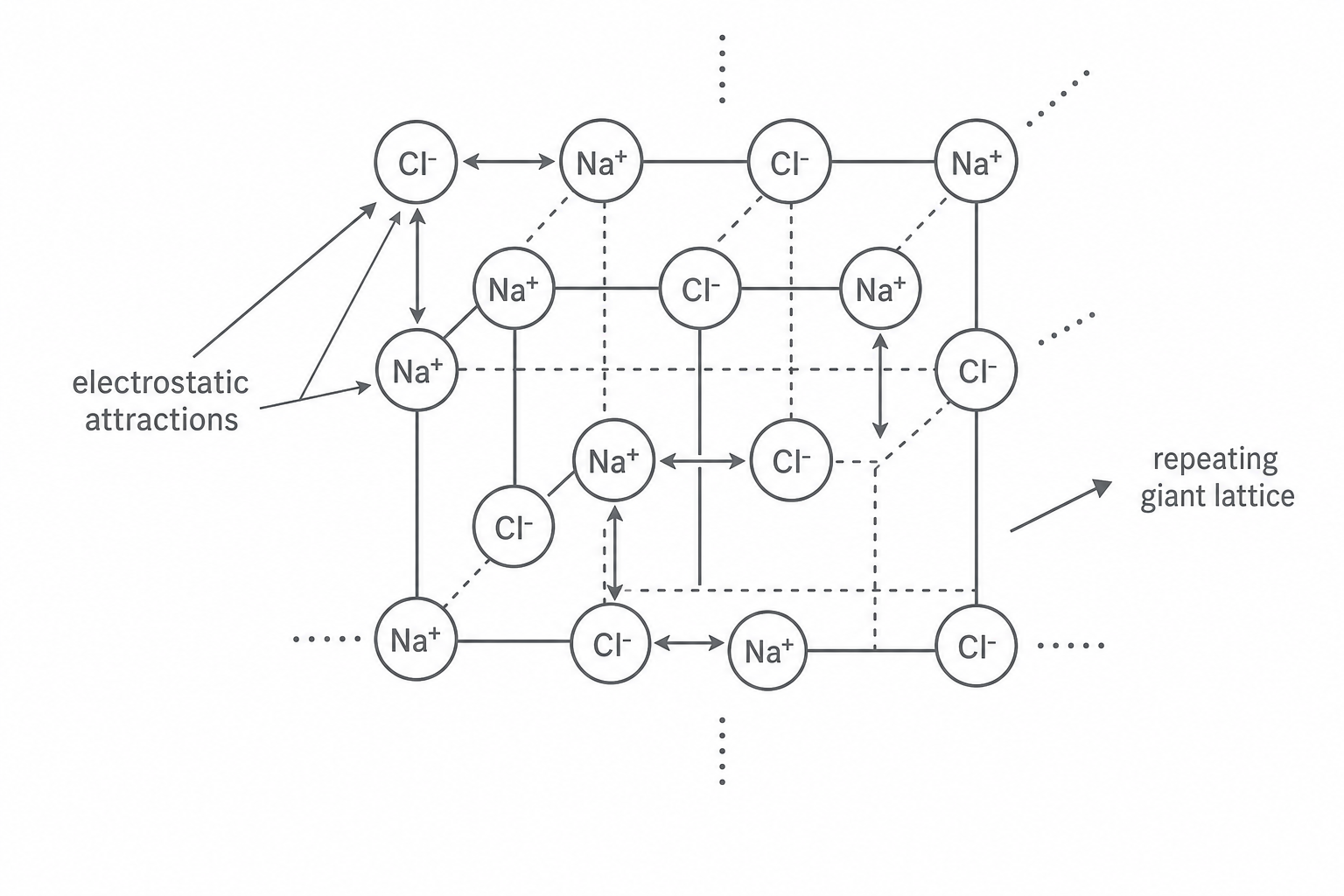
The formula of an ionic compound gives the simplest ratio of ions, not the number of particles in one molecule. Sodium chloride has formula NaCl because the lattice contains Na+ and Cl- ions in a 1:1 ratio. Magnesium oxide has formula MgO because it contains Mg2+ and O2- ions in a 1:1 ratio.
A good exam answer uses the phrase "giant ionic lattice" or "giant ionic structure" and then links it to strong electrostatic attractions between oppositely charged ions.
High melting and boiling points
Ionic compounds with giant ionic lattices usually have high melting points and high boiling points. This is because there are many strong electrostatic attractions between oppositely charged ions throughout the lattice.
When an ionic compound melts, those attractions must be overcome enough for the ions to move past each other. When it boils, even more separation is needed. Both changes require a lot of energy.
The key exam chain is:
- the compound has a giant ionic lattice
- there are many strong electrostatic attractions between oppositely charged ions
- a lot of energy is needed to overcome these attractions
- therefore the melting point and boiling point are high
Do not say that molecules are being separated in a giant ionic compound. Do not say that covalent bonds or intermolecular forces are being broken. Those phrases belong to different structures.
Conductivity in different states
For a substance to conduct electricity, it must contain charged particles that can move through the substance. Ionic compounds contain charged ions, but whether those ions can move depends on the state.
[DIAGRAM: asset_name: Ionic bonding and giant ionic lattice properties - diagram 03; asset_slug: c15_ionic_bonding_and_giant_ionic_lattice_properties__diagram_03; recommended_method: image_gen; description: Monochrome three-panel comparison of solid, molten, and aqueous ionic compound conductivity, showing fixed ions in a solid lattice and mobile ions when molten or dissolved in water.]
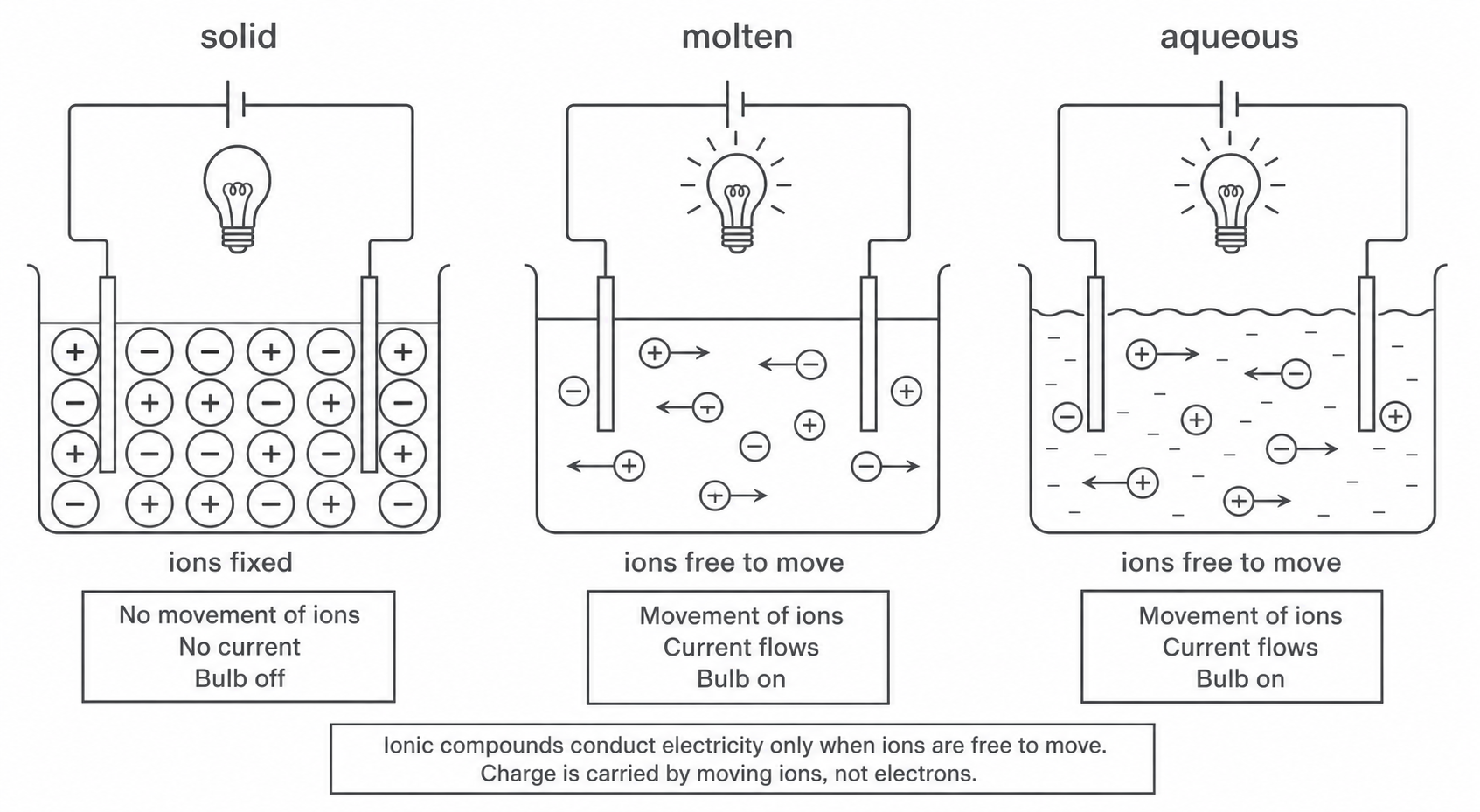
| state of ionic compound | conducts electricity? | reason |
|---|---|---|
| solid | no | ions are fixed in position in the lattice, so there are no mobile charged particles |
| molten | yes | ions are free to move and carry charge |
| aqueous solution | yes | ions are free to move through the water and carry charge |
"Molten" means melted. "Aqueous solution" means dissolved in water. In both cases, the lattice is no longer holding all the ions in fixed positions, so ions can move and a current can flow.
The current in molten or aqueous ionic compounds is carried by moving ions, not by mobile electrons within the liquid or solution. Electrons move in the metal wires of an external circuit, but inside the ionic liquid or solution the mobile charged particles are ions.
Solid ionic compounds do not conduct because their ions are fixed; molten and aqueous ionic compounds conduct because their ions are free to move.
That last sentence is often the difference between a partial answer and full marks. If the question asks why the solid does not conduct but the molten compound does, compare both states explicitly.