P1.4.5 - Geometric sequences and series
A geometric sequence is built by multiplying by the same number each time. That simple repeated multiplication gives you powerful formulae for terms, finite sums, and, when the ratio is small enough, a sum to infinity. In this lesson you will learn how to use those formulae, prove the finite sum formula, recognise when an infinite sum exists, and use logarithms to find the number of terms needed to reach a given sum.
Fixed ratio structure
A sequence is an ordered list of terms. A series is a sum of terms from a sequence. For example,
is a sequence, while
is a series.
Geometric sequence
A geometric sequence is a sequence in which each term is found by multiplying the previous term by a fixed number called the common ratio.
If the first term is a and the common ratio is r, the terms are
The first term has no factor of r yet, so the nth term is
nth term of a geometric sequence
The exponent is n-1, not n, because u_1 = ar^0 = a. This is one of the easiest places to lose a mark.
Worked example: a geometric sequence has u_3 = 12 and u_6 = 96. Find r, a, and a formula for u_n.
Use u_n = ar^{n-1}:
and
Divide the equations to remove a:
so
Therefore r=2. Substitute into ar^2=12:
so
The nth term is
Fixed ratio structure Continued
A negative common ratio is allowed. For example, if a=20 and r=-1/2, the sequence is
The terms alternate in sign because multiplying by a negative number changes the sign each time.
Finite geometric sums
For a geometric series with first term a and common ratio r, the sum of the first n terms is
The Edexcel specification expects you to know the proof of the finite sum formula, not just use the formula.
Start with
Multiply every term by r:
Now subtract the second line from the first. The middle terms cancel:
Factor both sides:
If r \ne 1, divide by 1-r:
Finite geometric sum
When r > 1, you may prefer the equivalent form
It gives the same value, but often avoids a negative numerator and denominator. If r=1, the terms are all a, so the finite sum is simply S_n = na.
Worked example: find the sum of the first 7 terms of
Here a=5, r=3, and n=7. Since r>1, use the form with r-1:
Calculate:
Finite geometric sums Continued
A common mistake is to use the number of written terms rather than the number of terms asked for. In 5+15+45+\cdots, only three terms are shown, but S_7 means the sum of seven terms.
Sum to infinity
An infinite geometric series does not always have a finite sum. The question is whether the partial sums
approach a fixed limit as more terms are added.
Look again at the finite sum formula:
If |r| < 1, then r^n tends to 0 as n becomes very large. The modulus notation |r| < 1 means
So ratios such as 1/2, 0.8, and -1/3 all satisfy |r| < 1.
[DIAGRAM: asset_name: Lesson p1.4.5: Geometric sequences and series - diagram 01; asset_slug: p1_4_5_understand_and_work_with_geometric_sequences_and_series__diagram_01; recommended_method: drawn_math; description: Draw a clean 16:9 two-panel mathematical visual of geometric partial sums. Top panel: for a=1, r=1/2, show partial sums S_1=1, S_2=1.5, S_3=1.75, S_4=1.875 as points on a horizontal number line approaching a dashed vertical limit line labelled S_infinity = 2. Bottom panel: for a=1, r=-1/2, show partial sums 1, 0.5, 0.75, 0.625, 0.6875 alternating around a dashed limit line labelled S_infinity = 2/3. Use direct labels, spacious margins, and NovaLearn styling with white background and #6A6B6E only.]
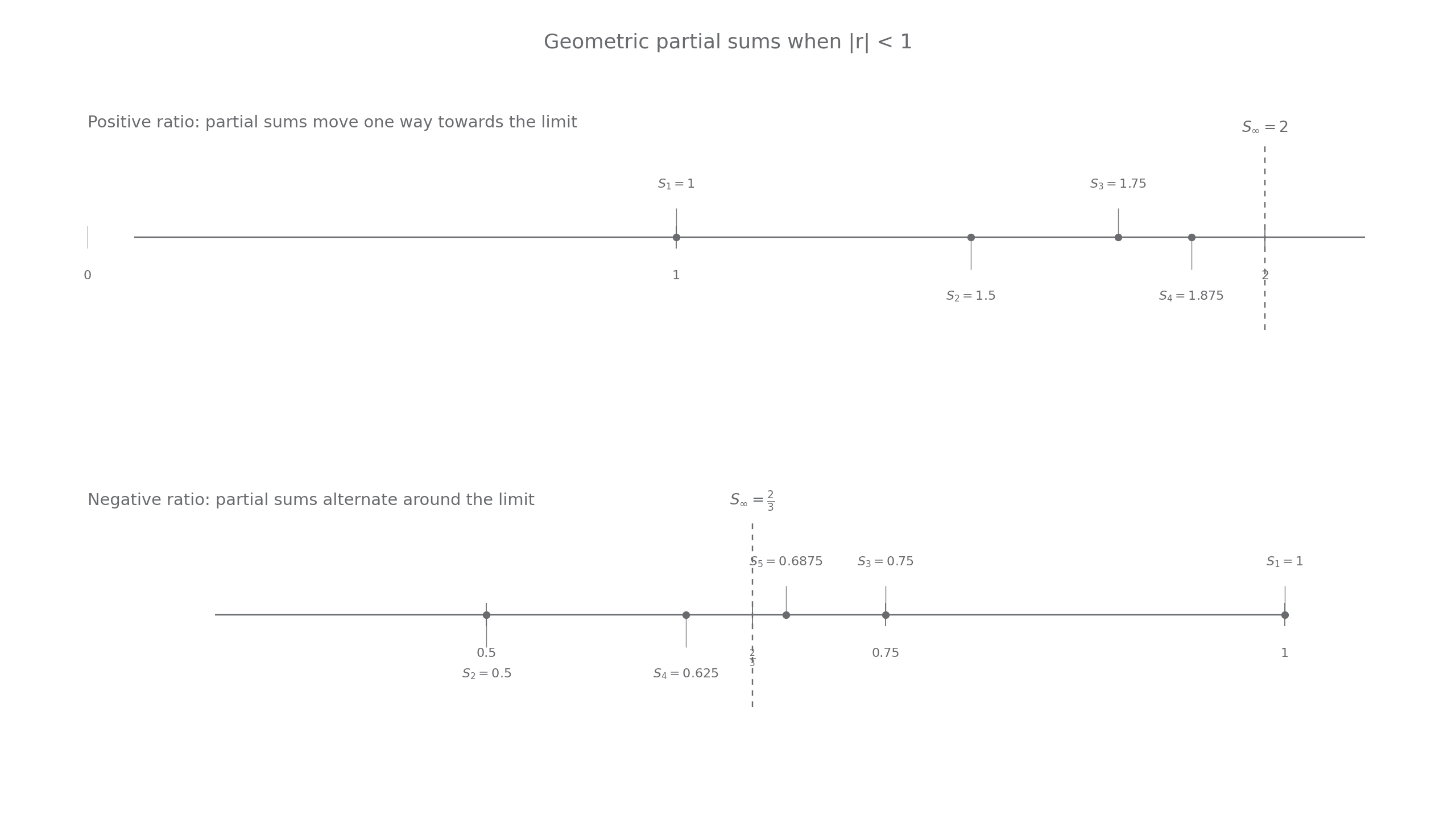
When |r| < 1, the term r^n disappears in the limit, giving
Sum to infinity
The condition matters. If |r| >= 1, the terms do not shrink towards zero, so the geometric series has no finite sum to infinity.
Worked example: find the sum to infinity of
First identify the ratio:
Since
the sum to infinity exists. Use a=18:
Sum to infinity Continued
The phrase "sum to infinity" does not mean "add until the terms look small enough". It means the exact limit of the partial sums, and that limit exists for a geometric series only when |r| < 1.
Working backwards from sums
In exam questions, you are often not handed a and r directly. You may be given a relationship involving S_n or S_\infty and asked to find or prove something about the ratio.
The safest first step is always:
- identify the first term of the series being summed;
- identify the common ratio;
- choose the correct formula.
If a sum starts from the second term of a sequence, then the first term of that series is u_2, not u_1. This was a real source of errors in Edexcel examiner feedback.
Worked example: in a convergent geometric series, the common ratio is r and the sum to infinity is S_\infty. Given that
show that
Use the formulae:
and
Substitute these into the given relationship:
Because the series is convergent, r \ne 1, and for a non-zero series a \ne 0. Cancel the common factor a/(1-r):
Now solve:
so
Therefore
Both values are allowed because both satisfy |r|<1.
Working backwards from sums Continued
Notice the shape of the proof. It is not enough to jump to the answer. A "show that" question needs a clear chain from the given information to the printed result.
Using logs for n
The specification says that, given the sum of a series, you should be able to use logarithms to find n. This happens because n appears in an exponent:
After rearranging, you usually reach an equation or inequality involving r^n. For positive r, use
The logarithm base does not matter as long as you use the same base on the top and bottom.
Worked example: a geometric series has first term 3 and common ratio 0.8. Find the least value of n for which
First write the sum formula:
Since 1-0.8=0.2,
Set up the inequality:
Divide by 15:
Rearrange:
Take logs:
Here log(0.8) is negative. Dividing by it reverses the inequality:
Using a calculator,
So the least integer value is
Explain It Back
Use this as a self-explanation check after the section above. It is for diagnosing what you can already explain, not for learning new material from scratch.
For inequalities with 0<r<1, the reversal of the inequality is not an exam trick; it is just the rule for dividing by a negative number.