P1.2.4 - Simultaneous equations by elimination and substitution
Simultaneous equations ask for values that satisfy two equations at the same time. In this lesson you will learn when elimination is the efficient move, when substitution is the safer move, and how to handle the Edexcel case where one equation is linear and the other contains squared terms. The final answer is usually a pair such as (x, y) = (4, 2), not just a loose list of x values.
What a solution pair means
Simultaneous solution
A simultaneous solution is an ordered pair (x, y) that makes every equation in the system true at the same time.
For example, (4, 2) is a solution of
because substituting x = 4 and y = 2 gives 16 = 16 in both equations. The order matters: (4, 2) means x = 4 and y = 2, not the other way round.
One helpful mental picture is that each equation describes a graph, and simultaneous solutions are intersection points. We will use that idea only to understand what is happening; Edexcel exact-answer questions need algebraic working.
[DIAGRAM: asset_name: Lesson p1.2.4: Solving simultaneous equations by elimination and substitution - diagram 01; asset_slug: p1_2_4_solve_simultaneous_equations_in_two_variables_by_elimination_and_by_substitution__diagram_01; recommended_method: drawn_math; description: Draw a clean coordinate diagram showing the straight line y = 2x + 3 and the parabola y = x^2 - 4x + 8. Mark and label the two intersection points (1, 5) and (5, 13) as solution pairs. Add light dashed guide lines from each point to the axes, axes labelled x and y, and a small note "intersections = simultaneous solutions".]
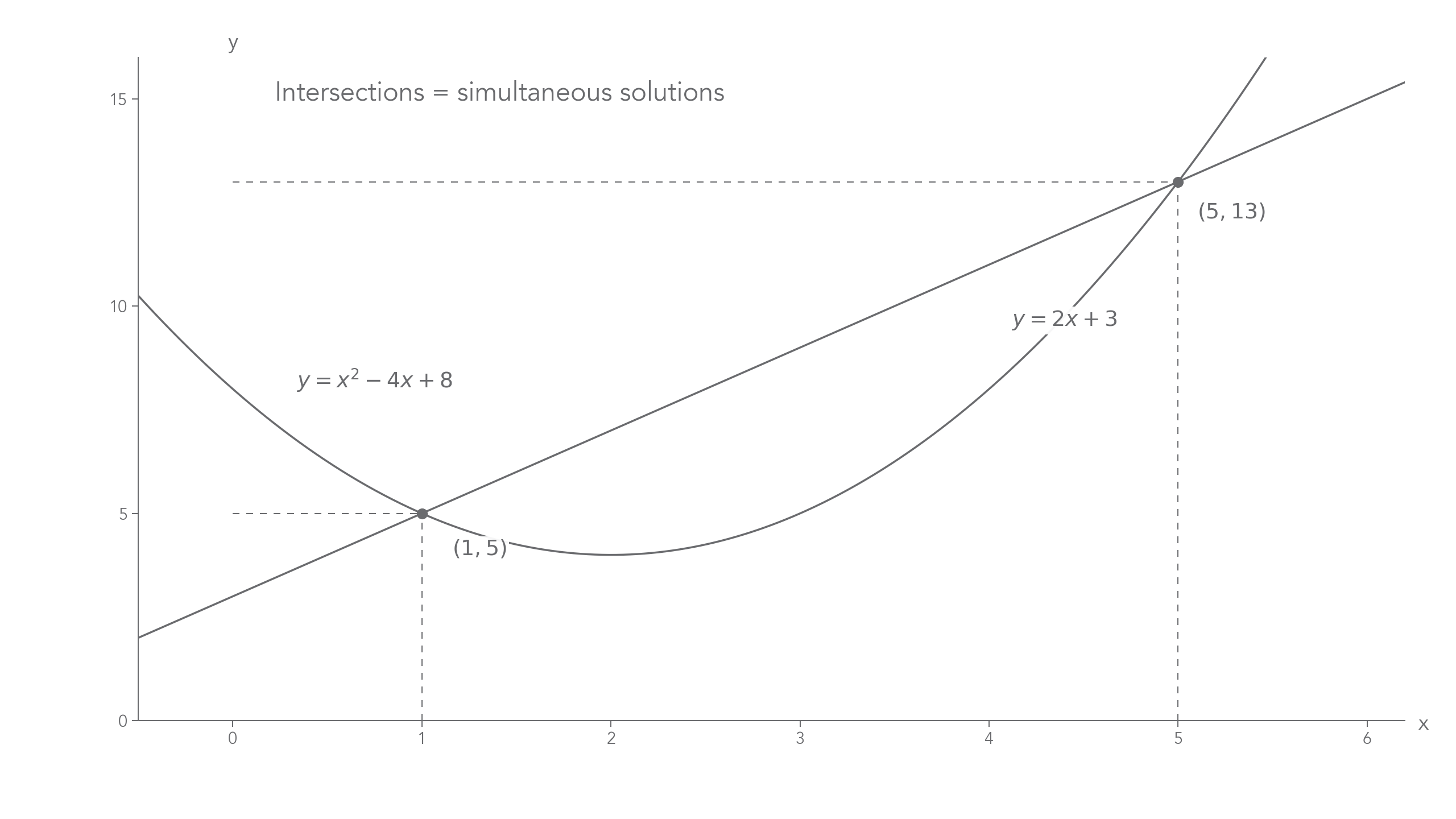
The algebraic aim is to reduce the two-variable problem to one equation in one variable. Elimination does this by adding or subtracting equations. Substitution does it by replacing one variable with an expression in the other variable.
Elimination for two linear equations
Elimination is most efficient when both equations are linear, such as
The method works because if two equations are true, adding or subtracting the same whole equations gives another true equation. The key is to make one variable have equal or opposite coefficients, so that it disappears.
Worked example: solve
The y coefficients are +2 and -2, so adding the equations will eliminate y:
So
Now substitute x = 4 into either original equation. Using the first equation,
Therefore the solution is
Notice that the back-substitution step is not optional. The elimination step found x; the simultaneous solution needs both coordinates.
Elimination for two linear equations Continued
If the coefficients do not already match, multiply one or both equations first. For instance, to eliminate x from 2x + 5y = 17 and 3x - y = 4, you might multiply the first equation by 3 and the second by 2, because both then contain 6x.
Substitution for one linear and one quadratic equation
When one equation is linear and the other is quadratic, start by using the linear equation to make one variable the subject. Then substitute that expression into the quadratic equation. This turns the system into a quadratic equation in one variable.
Worked example: solve
Both equations are already written in terms of y, so the two right-hand sides must be equal:
Rearrange to make a quadratic equal to zero:
So
Now substitute each x value into the simpler linear equation y = 2x + 3:
The solutions are
A common error is to write x = 1, 5 and stop. Those are only the first coordinates; each must be paired with its matching y value.
Substitution for one linear and one quadratic equation Continued
This example has one solution pair because the quadratic has a repeated root. Geometrically, the line touches the parabola at one point, but the exact solution still comes from the algebra.
When squared terms appear in both variables
The specification allows squared terms in one unknown or in both unknowns. If you see something like x^2 - y^2, do not panic: the linear equation can still be used to replace one variable, leaving a single quadratic equation.
Worked example: solve
Use the linear equation to make x the subject:
Substitute this into the quadratic equation:
To avoid fractional slips, multiply by 4 after expanding:
So
Now use the linear equation again:
Therefore
The awkward fraction is not a warning sign by itself. Exact fractional coordinates are normal in A-level algebra.
When squared terms appear in both variables Continued
This is the same core move as before: replace one variable, solve the one-variable equation, then pair each result with the other coordinate.
Choose the method and check the result
Use elimination when both equations are linear and a variable can be removed cleanly by adding or subtracting. Use substitution when one equation is already written as y = ... or x = ..., or when a linear equation can be rearranged before substituting into a quadratic equation.
After substitution, the quadratic tells you how many real solution pairs there can be:
- two distinct real roots usually give two solution pairs
- one repeated real root gives one solution pair
- no real roots gives no real solution pairs
Worked example: determine whether the equations
have any real simultaneous solutions.
Substitute y = x into the second equation:
Rearrange:
The discriminant is
Since the discriminant is negative, the quadratic has no real roots. Therefore the simultaneous equations have no real solution pairs.
Choose the method and check the result Continued
The habit to keep is simple: reduce, solve, pair, check. That sequence is what turns algebraic working into a complete simultaneous solution.
Explain It Back
Use this as a self-explanation check after the section above. It is for diagnosing what you can already explain, not for learning new material from scratch.
Before leaving the lesson, check that you can explain the method, not just copy the algebra. That is the best way to catch whether elimination and substitution feel like two separate tricks or one shared idea.