P1.4.3 - Sigma notation
Sigma notation is a compact way to write a sum whose terms follow a rule. Instead of writing a long line such as 5 + 8 + 11 + 14, you can state the rule, the starting value, and the finishing value in one expression. In this lesson you will learn how to read, expand, evaluate, and write sigma notation accurately.
Read the sigma symbol
The capital Greek letter sigma, Σ, means "sum". It tells you to add the values produced by the expression after the sigma sign.
Sigma notation
A finite sum written in sigma notation has the form
where r is the index, a is the lower limit, b is the upper limit, and f(r) is the summand.
The lower limit tells you the first value of the index. The upper limit tells you the last value of the index. The summand tells you what to substitute into and then add.
In this setting, a sequence is a list of terms, while a series is the sum of terms from a sequence. Sigma notation tells you exactly which terms are being added.
[DIAGRAM: asset_name: Lesson p1.4.3: Sigma notation for sums of series - diagram 01; asset_slug: p1_4_3_understand_and_use_sigma_notation_for_sums_of_series__diagram_01; recommended_method: drawn_math; description: Create a clean 16:9 three-panel notation diagram. Left panel shows sum_{r=2}^{5}(3r-1) with direct labels for upper limit, lower limit/index, and summand. Middle panel expands the allowed index values r=2,3,4,5 to the terms 5,8,11,14 and shows their sum. Right panel shows sum_{r=1}^{n}1 as n copies of 1, ending with sum_{r=1}^{n}1=n. Use only NovaLearn grey on white, spacious margins, and true arrowheads with small target gaps wherever label arrows are used.]
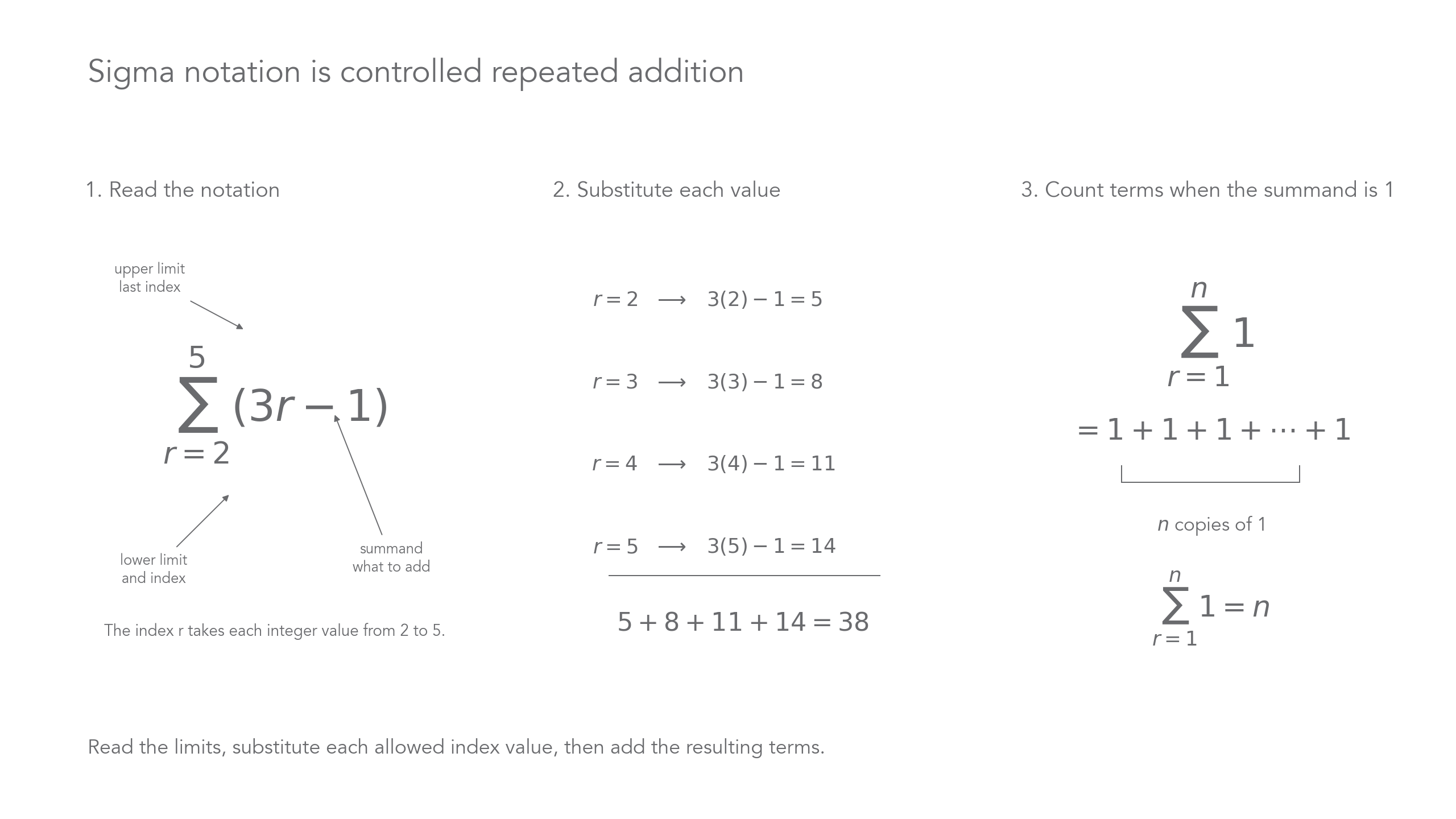
For example,
means substitute r=2, then r=3, then r=4, then r=5 into 3r-1, and add the results:
The index values are integers and the endpoints are included. So r=2 to r=5 gives four terms, not three.
A sigma sum is not found by putting in only the upper limit. It is found by substituting every integer index value from the lower limit to the upper limit and adding all the resulting terms.
Expand and evaluate finite sums
The safest first method is to expand the sigma notation into ordinary addition. This makes the limits visible and avoids most notation errors.
Worked example: find
The index is r, so substitute the integer values 2, 3, 4, 5 into the summand 3r-1.
Now add the terms:
Therefore
Notice the decision point: the lower limit is 2, so the first term is not found by substituting r=1.
Expand and evaluate finite sums Continued
Sigma notation can also start somewhere other than 1.
Worked example: find
The allowed values are j=3,4,5,6, so
Therefore
This example also shows why the index letter matters only inside the summand. The letter j is just the variable being substituted into j^2.
Count terms and use the sum of ones
One official fact for this specification point is
Sum of ones
This is a counting statement. If you add 1 exactly n times, the answer is n:
It also explains constant sums. If the summand is always 5, then you are adding 5 once for every index value.
Worked example: simplify
There are n terms, and each term is 5, so
If the lower limit is not 1, count the terms carefully. From r=a to r=b, inclusive, there are
integer values.
Worked example: find
The index values are
so there are 10-4+1=7 terms. Therefore
Write sums in sigma notation
To write a series in sigma notation, identify two things:
- the formula for the general term;
- the index values that produce the first and last terms.
Worked example: write
in sigma notation.
The terms increase by 3, so one possible formula is
Check it against the first term:
The fifth term is
So one correct sigma form is
This is not the only possible answer. For example,
also gives
The important test is whether the chosen limits and summand generate exactly the required terms.
Write sums in sigma notation Continued
The index letter is a dummy variable. That means
mean the same sum:
Do not change a free letter by accident. In
the index is r; the letter a is a constant unless the question gives it as another variable to sum over.
Use sigma notation in exam work
In exam-style work, sigma notation is often used to set up a sum before a known series method is applied. The notation must show the correct first term, last term, and expression for the general term.
Worked example: a payment in month r is modelled by
pounds, where r=1 is the first month. Write an expression for the total paid from month 1 to month N.
The total is the sum of the monthly payments:
Check the first few terms:
So the sigma expression correctly represents
This kind of setup is useful because it states the whole series compactly. A later arithmetic-series method could then evaluate the sum, but the sigma notation itself has already done the modelling work.
Use sigma notation in exam work Continued
Here are the main checks to apply before you trust a sigma expression:
- Are the lower and upper limits inclusive?
- Does the first index value produce the first term?
- Does the last index value produce the last term?
- Have you substituted only into the index variable?
- If the summand is
1, have you treated the sum as a count of terms?
Explain It Back
Use this as a self-explanation check after the section above. It is for diagnosing what you can already explain, not for learning new material from scratch.