P1.3.4 - Parametric equations in modelling
Parametric equations describe a point by giving both coordinates in terms of a third quantity, called a parameter. In modelling, that parameter often means something real, such as time, angle, or distance travelled. This lesson is about choosing and using parametric equations so that the mathematics keeps the context visible.
The parameter as part of the model
A Cartesian equation such as y = 2x + 1 tells you which points lie on a path. A parametric model gives the coordinates separately:
The same value of the parameter t must be used in both equations. That is what links the two coordinates into one moving point or one position on a shape.
Parametric model
A parametric model gives each coordinate of a point in terms of a shared parameter. In a context, the parameter should have a clear meaning, such as time or angle.
For motion, the parameter is usually time. For a shape, the parameter may be an angle or another quantity that moves a point around the shape. The domain of the parameter is part of the model: it tells you which part of the path or shape is being described.
[DIAGRAM: asset_name: Lesson p1.3.4: Using Parametric Equations in Modelling - diagram 01; asset_slug: p1_3_4_use_parametric_equations_in_modelling__diagram_01; recommended_method: drawn_math; description: Draw a clean 16:9 two-panel mathematical diagram. Left panel: coordinate axes showing constant-velocity motion from A(1,8) at t=0 to B(6,20) at t=5, with equally spaced marked positions for t=0,1,2,3,4,5 along the straight segment, labelled as equal time steps and showing the model x=1+t, y=8+(12/5)t, 0<=t<=5. Right panel: coordinate axes showing the oval shape x=4+3cos(theta), y=2+sin(theta) for 0<=theta<2pi, with direction arrowheads around the curve and labels theta=0, pi/2, pi, 3pi/2, plus a note that the parameter controls position and order on the shape.]
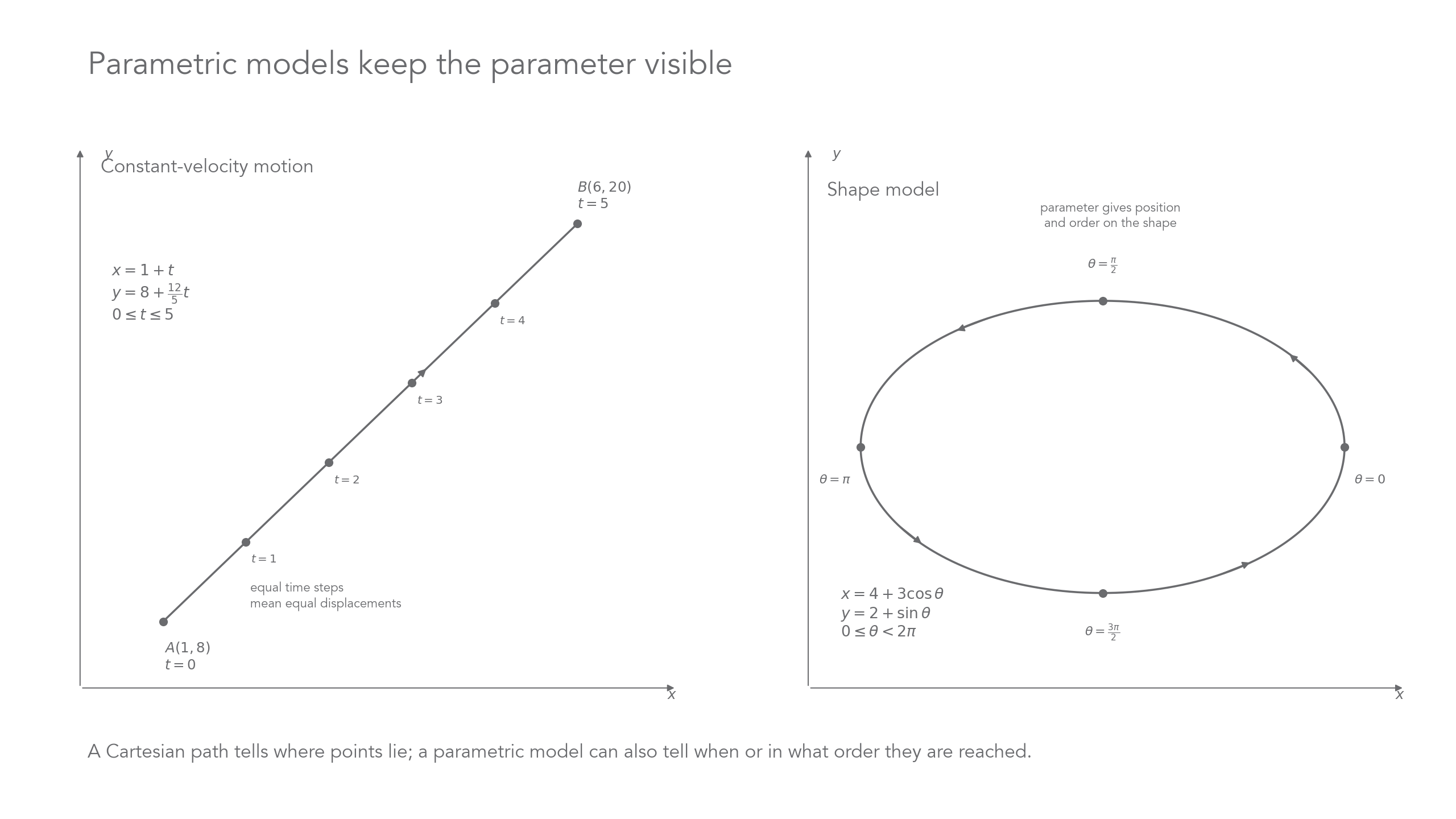
The key modelling question is not just "what curve is this?" It is also "what does the parameter mean, and which parameter values are valid?"
Building a constant-velocity motion model
If an object moves with constant velocity in the coordinate plane, both coordinates change at a constant rate. So the parametric equations are linear in time.
Suppose an object is at (x_0,y_0) when t=t_0. If its horizontal velocity is u and its vertical velocity is v, then
Constant-velocity parametric motion
The constants u and v are velocity components. If x and y are measured in metres and t is measured in seconds, then u and v are measured in metres per second.
Worked example: an object moves with constant velocity from (1,8) at t=0 to (6,20) at t=5. Find parametric equations for the motion.
The change in x-coordinate is
This happens over 5 seconds, so the horizontal velocity component is
The change in y-coordinate is
This happens over 5 seconds, so the vertical velocity component is
Starting from (1,8) at t=0,
The interval 0 <= t <= 5 matters. Without it, the equations would extend the same straight-line motion before the start and after the finish, which may not be part of the real situation.
Using a parametric model
To use a parametric model, usually work through the parameter:
- Use one coordinate equation to find the parameter.
- Check that the parameter value is in the allowed domain.
- Substitute the parameter into the other coordinate equation.
- Interpret the answer with units and context.
Worked example: a drone is modelled by
where x and y are measured in metres and t is measured in seconds. Find the drone's height y when its horizontal coordinate is 11.
First use the x-coordinate equation:
So
This is inside the model domain 0 <= t <= 8, so the model can be used. Now substitute into the y-coordinate equation:
When the horizontal coordinate is 11 m, the model predicts that the height is 10 m.
The domain check is not optional. If the algebra gives a time outside the model domain, the equations may describe an extension of the mathematical line, not the actual modelled motion.
Modelling a shape with a parameter
Parametric equations can also model a shape. In this case the parameter may not be time. For example,
models an oval shape centred at (4,2).
The x equation varies between
so the horizontal range is 1 <= x <= 7. The y equation varies between
so the vertical range is 1 <= y <= 3.
The domain 0 <= theta < 2pi gives one complete trip around the oval without repeating the starting point. If the context were a runner on an oval track, theta could represent angular position around the track. If the context were just the outline of a design, theta might simply be a way to generate the points on the boundary.
Worked example: a decorative arch is modelled by
Find the leftmost and rightmost x-coordinates, and the greatest y-coordinate.
Since -1 <= cos theta <= 1,
So the leftmost x-coordinate is 3, and the rightmost x-coordinate is 7.
Since 0 <= theta <= pi, the value sin theta ranges from 0 up to 1 and back to 0. Therefore
The greatest y-coordinate is 7. The restricted interval matters here: it describes only the upper half of the oval.
Assumptions and limitations
A model is useful because it simplifies reality. That also means a model has assumptions and limitations.
For the constant-velocity model
the main assumption is that both velocity components stay constant. If the object accelerates, slows down, turns, meets air resistance, or is affected by another force, then the model may be unreliable.
For a shape model, the assumptions depend on the context. An oval equation might be a good approximation to a track, a boundary, or a projected path, but the real object may not be exactly oval. The parameter interval may also restrict which part of the shape is actually included.
Use this exam decision checklist:
| Decision | What to check |
|---|---|
| Meaning of parameter | Is it time, angle, distance, or just a dummy parameter? |
| Units | Do x, y, and the parameter have stated units? |
| Domain | Are the parameter values physically or mathematically allowed? |
| Interpretation | Does the answer need coordinates, a time, a distance, or a contextual statement? |
| Limitation | Which simplification could make the model unrealistic? |
Explain It Back
Use this as a self-explanation check after the section above. It is for diagnosing what you can already explain, not for learning new material from scratch.
Before moving on, check that you can explain the role of the parameter without relying on a particular set of numbers.