P1.2.3 - Quadratic functions and graphs
A quadratic function is one of the first places where algebra and graph shape become the same story. In this lesson you will connect the expression ax^2+bx+c with the parabola it draws, use completing the square to find the turning point, use the discriminant to decide how many real roots exist, and solve ordinary and disguised quadratic equations. The aim is not just to get answers, but to choose a method that gives the information the question is really asking for.
Quadratic graph features
A quadratic function has the form
The notation f(x) means "the output of the function when the input is x". The graph of y=f(x) is a parabola.
Quadratic root
A root of f(x) is an x-value for which f(x)=0. On the graph of y=f(x), roots are the x-intercepts.
The coefficient a controls the basic orientation. If a>0, the parabola opens upwards and has a minimum turning point. If a<0, it opens downwards and has a maximum turning point. The constant c gives the y-intercept, because when x=0,
The x-intercepts are different: they come from solving
A quadratic graph can cross the x-axis twice, touch it once, or miss it completely. These three possibilities correspond to two distinct real roots, one repeated real root, or no real roots.
Completing the square
Completing the square rewrites a quadratic so that the squared part is visible. This is useful because a square such as (x-2)^2 is never negative, and because the turning point can be read directly from the completed-square form.
Completed-square form
You do not need to start with the general formula every time. In calculations, it is often clearer to make the square step by step.
Worked example: complete the square for
First factor out the coefficient of x^2 from the x^2 and x terms:
Inside the bracket, half of -4 is -2, so start with (x-2)^2. But
so to keep the expression unchanged we subtract 4 inside the bracket:
Now expand the outer 2 over the constant part:
So
This form shows the turning point immediately. Since (x-2)^2 is smallest when x=2, the minimum value is -5. The turning point is (2,-5), and the axis of symmetry is x=2.
[DIAGRAM: asset_name: Lesson p1.2.3: Quadratic functions, roots, and graphs - diagram 02; asset_slug: p1_2_3_work_with_quadratic_functions_and_their_graphs__diagram_02; recommended_method: drawn_math; description: Draw the graph of y=2x^2-8x+3=2(x-2)^2-5. Mark the vertex (2,-5), the dashed axis of symmetry x=2, the y-intercept (0,3), and the two x-intercepts labelled approximately 0.42 and 3.58. Keep labels light and uncluttered.]
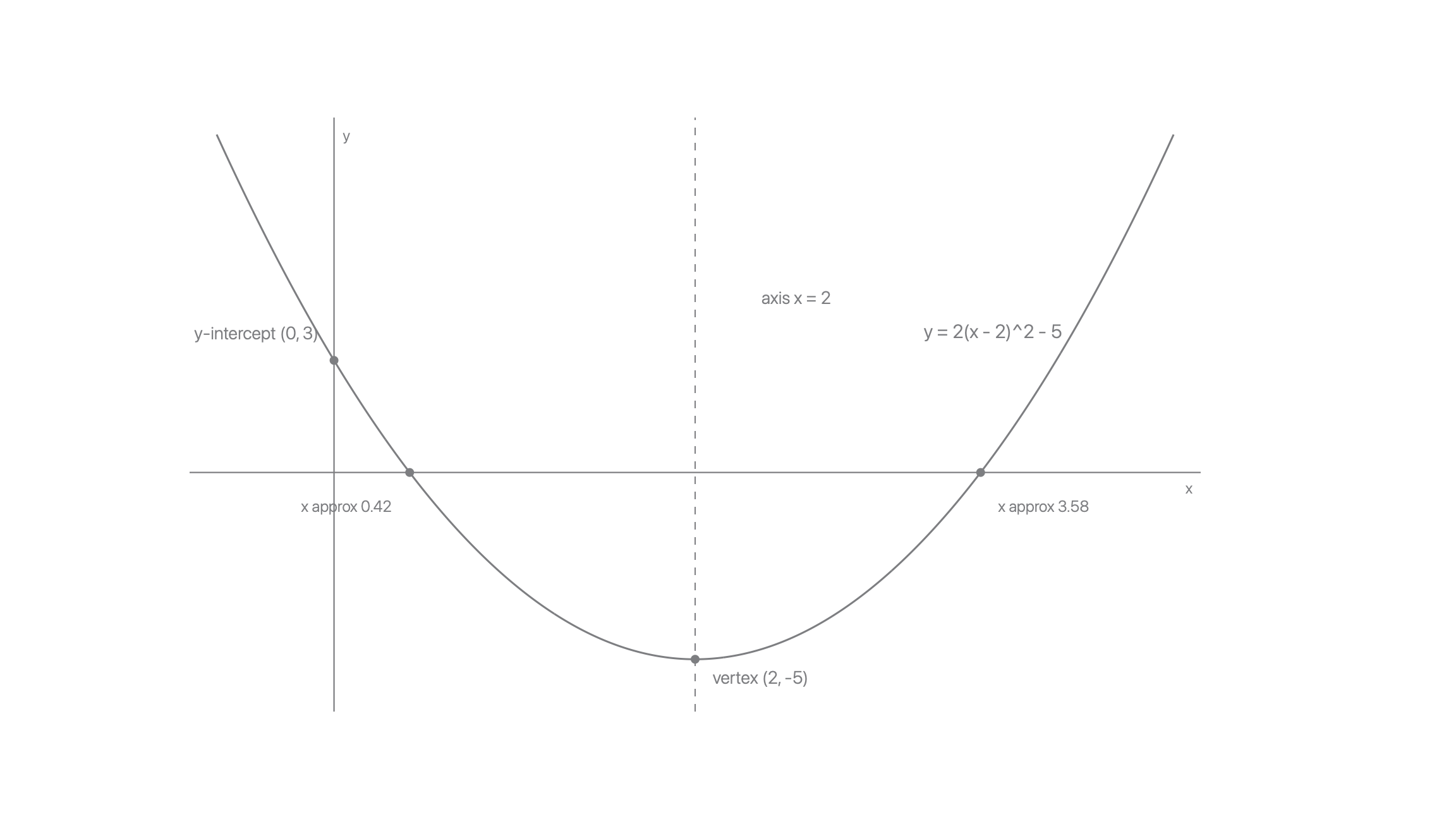
For a completed square in the form
the turning point is (p,q). If the form is y=a(x+p)^2+q, the turning point is (-p,q). This sign is a common source of mistakes.
The discriminant
The discriminant is the part of the quadratic formula under the square root. For
the discriminant is
Discriminant
The sign of D tells you how many real roots the quadratic has.
| Discriminant | Roots of ax^2+bx+c=0 | Graph of y=ax^2+bx+c |
|---|---|---|
D>0 | two distinct real roots | crosses the x-axis twice |
D=0 | one repeated real root | touches the x-axis |
D<0 | no real roots | does not meet the x-axis |
[DIAGRAM: asset_name: Lesson p1.2.3: Quadratic functions, roots, and graphs - diagram 01; asset_slug: p1_2_3_work_with_quadratic_functions_and_their_graphs__diagram_01; recommended_method: drawn_math; description: Draw three side-by-side coordinate axes. On the first, show an upward parabola crossing the x-axis at two points, labelled D>0 and two distinct roots. On the second, show an upward parabola touching the x-axis at its vertex, labelled D=0 and repeated root. On the third, show an upward parabola lying above the x-axis, labelled D<0 and no real roots. Use simple x- and y-axis labels and mark root points where present.]
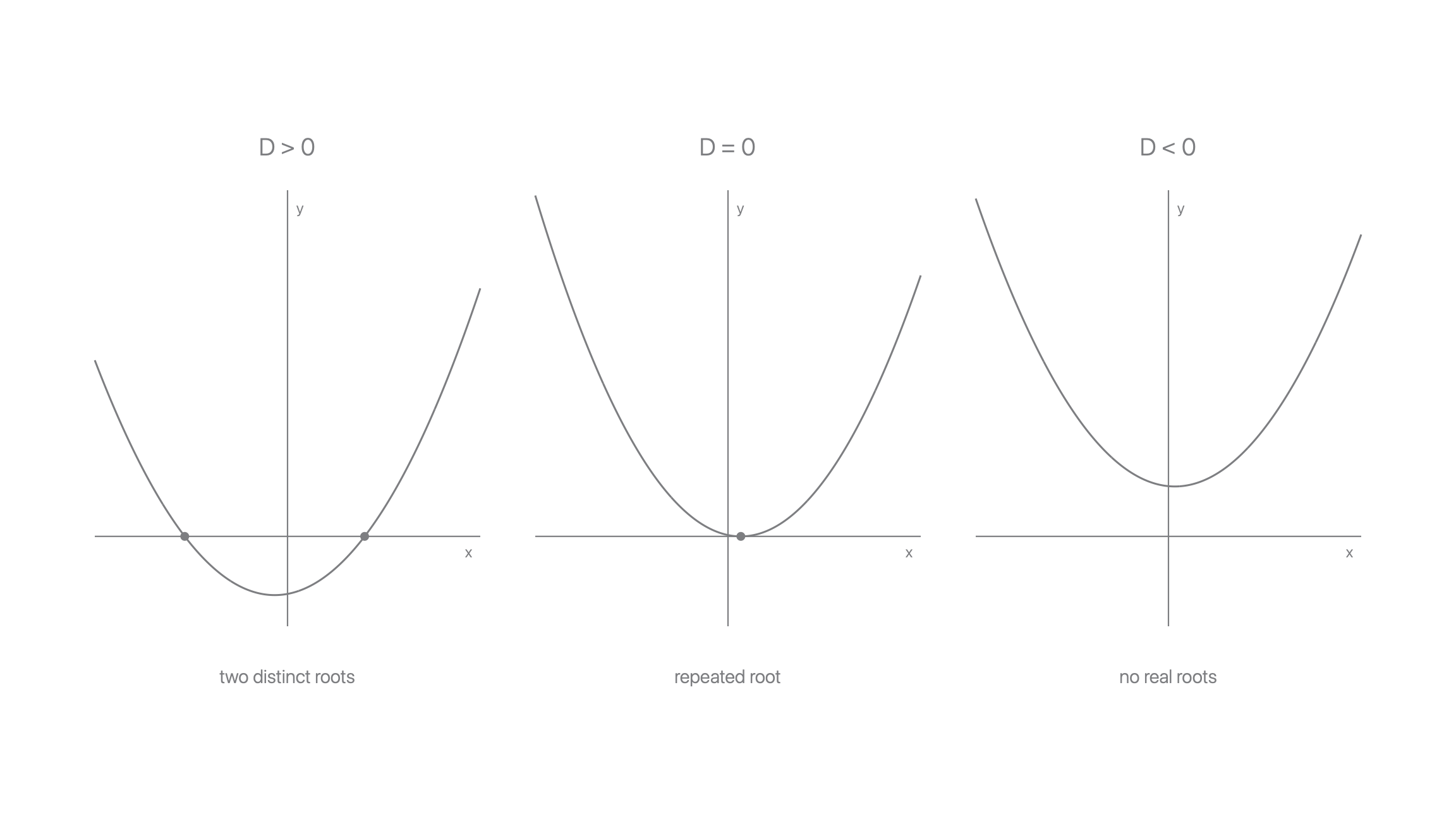
This works because the quadratic formula is
If the square root is of a positive number, there are two real values. If it is zero, the + and - versions give the same root. If it is negative, there are no real roots.
Worked example: determine the number of real roots of
Here a=1, b=-6, and c=10, so
Since D<0, the equation x^2-6x+10=0 has no real roots. The graph of y=x^2-6x+10 does not meet the x-axis.
Completing the square gives the same conclusion:
Since (x-3)^2>=0, the smallest possible value of the function is 1, so the graph stays above the x-axis.
Solving quadratic equations
Edexcel expects you to choose an appropriate method. The main methods are:
| Method | When it is useful |
|---|---|
| Factorisation | The quadratic splits neatly into brackets |
| Quadratic formula | Factorisation is not obvious, or exact surd answers are needed |
| Completing the square | The question asks for it, or the turning point/positivity is useful |
| Calculator | The question allows calculator technology and does not require algebraic working |
If a question says "use algebra", "show each stage", "show that", or "solutions relying entirely on calculator technology are not acceptable", you need visible algebraic working. A calculator may still be useful for checking.
Worked example 1: solve
This factorises:
So
For a product to be zero, at least one factor must be zero:
Therefore
Worked example 2: solve exactly
Here factorisation is not neat, so use the quadratic formula with a=2, b=-4, and c=-1:
Simplify carefully:
So the exact solutions are
Do not round these unless the question asks for decimals. Exact surd form keeps the full information.
Quadratics in a function of the unknown
Some equations are not quadratic in x, but they are quadratic in another expression involving x. The method is to use a temporary variable, solve the quadratic, then substitute back.
The pattern is:
- Choose a temporary variable, such as
u=g(x). - Rewrite the equation as a quadratic in
u. - Solve for
u. - Back-substitute and solve
g(x)=u. - Check that the solutions are valid for the original expression.
Worked example 1: solve
This is quadratic in x^2. Let
Then x^4=u^2, so the equation becomes
Factorise:
So u=1 or u=4. Now substitute back:
Therefore
Worked example 2: solve
Since 4^x=(2^2)^x=2^{2x}=(2^x)^2, this is quadratic in 2^x. Let
Then the equation becomes
Factorise:
So u=3 or u=4. Substitute back:
The equation 2^x=3 gives x=\log_2 3, meaning "the power of 2 that gives 3". The equation 2^x=4 gives x=2. Therefore
The same idea can apply to trigonometric functions such as sin x, exponential functions such as e^x, and logarithmic functions such as ln x. The quadratic step is the same, but the back-substitution step must respect the function. For example, sin x=2 has no real solution, and ln x is only defined for x>0.
Choosing the method
A strong solution often starts by asking what the question wants.
If it asks for roots, solve f(x)=0. If it asks for a turning point, complete the square. If it asks how many real roots exist, use the discriminant. If it asks you to show that a quadratic is always positive or always negative, completed-square form is usually the cleanest route.
Worked example: show that
for all real values of x.
Complete the square:
Using (x-2)^2=x^2-4x+4,
Since (x-2)^2>=0, we have
So 2x^2-8x+13 is always positive. Notice that this proof gives more information than the discriminant alone: it also tells you the minimum value is 5.
Explain It Back
Use this as a self-explanation check after the section above. It is for diagnosing what you can already explain, not for learning new material from scratch.
The most common errors in this topic are sign errors when completing the square, using D=0 for two distinct roots, forgetting the +/- in the formula, and solving a disguised quadratic but not back-substituting.