P1.3.2 - Coordinate geometry of the circle
A circle is the set of all points a fixed distance from one centre. Coordinate geometry turns that idea into algebra, so you can move between an equation, a centre, a radius, a tangent, and a circumcircle. The key skill is not memorising several disconnected tricks: it is recognising when distance, midpoint, gradient, and perpendicularity are telling the same story.
The circle equation as distance
Start with the meaning of a circle. If the centre is C(a,b) and a point on the circumference is P(x,y), then the horizontal change from C to P is x-a, the vertical change is y-b, and the distance CP is the radius r.
[DIAGRAM: asset_name: Lesson p1.3.2: Coordinate geometry of the circle - diagram 01; asset_slug: p1_3_2_understand_and_use_the_coordinate_geometry_of_the_circle__diagram_01; recommended_method: drawn_math; description: Draw a clean coordinate diagram of a circle with centre C(a,b), a point P(x,y) on the circumference, the radius CP=r, and a right triangle showing horizontal distance x-a and vertical distance y-b. Label the resulting relationship (x-a)^2+(y-b)^2=r^2.]
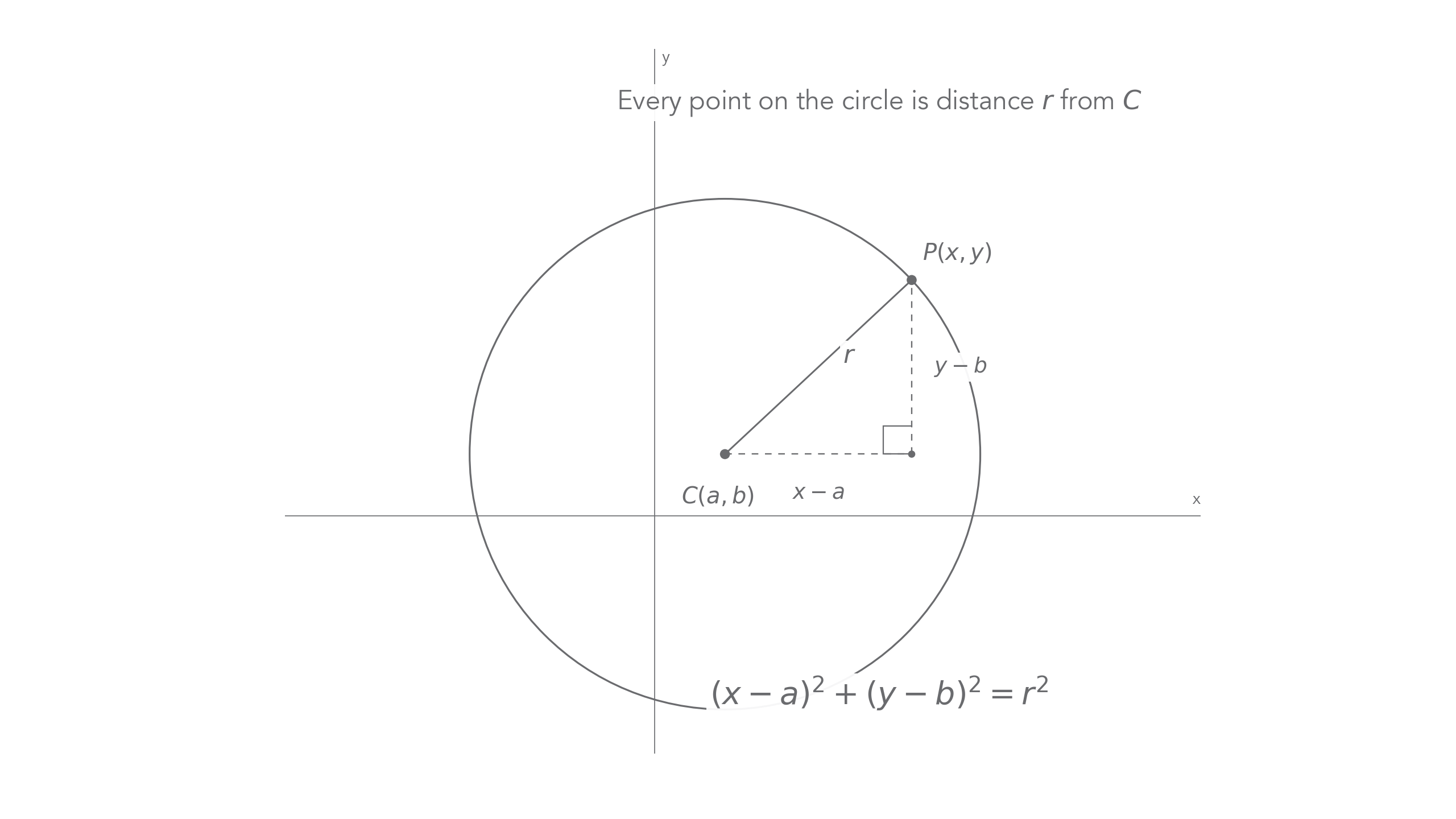
Pythagoras gives the equation.
Equation of a circle
Here (a,b) is the centre and r is the radius. The signs inside the brackets are part of the subtraction from the centre: (x-3)^2 means the x-coordinate of the centre is 3, while (x+3)^2 means the x-coordinate of the centre is -3.
Worked example: find the equation of the circle with centre (-2,3) and radius 5.
Use (x-a)^2+(y-b)^2=r^2, with a=-2, b=3, and r=5.
So the equation is
Worked example: find the centre and radius of
Compare with (x-a)^2+(y-b)^2=r^2.
The centre is (4,-1), because y+1 means y-(-1). The radius is not 18; it is
Completing the square
Edexcel questions often give a circle in expanded form. You need to recover the centre and radius by completing the square on the x terms and on the y terms separately.
The official general form is
Completing the square gives
So the centre is (-f,-g) and
Use that formula as a check, but do not skip the completing-square habit. It shows the geometry and makes sign errors easier to spot.
Worked example: find the centre and radius of
Group the x terms and the y terms:
Complete the square for each pair.
and
Substitute these into the equation:
Move the constants to the other side:
Therefore the centre is (3,-5) and the radius is 4.
The completed-square form shows the geometry. The bracket signs give the centre, and the right-hand side gives r^2, not always r.
A quick way to check this example against the general form is to read 2f=-6, so f=-3, and 2g=10, so g=5. The centre is (-f,-g)=(3,-5). Also r^2=f^2+g^2-c=9+25-18=16, so r=4.
The common trap is to move the added squares in the wrong direction. When you write x^2-6x=(x-3)^2-9, the -9 is part of the expression. It must not disappear.
Finding a circumcircle
A circumcircle is a circle that passes through every vertex of a triangle. Since the centre of a circle is the same distance from all points on the circumference, the centre of a triangle's circumcircle must be equally far from each pair of vertices.
There are two Edexcel-friendly properties to use.
First, the angle in a semicircle is a right angle. In coordinate geometry you often use the same idea in reverse: if a triangle is right-angled, the side opposite the right angle is a diameter of the circumcircle.
Second, the perpendicular from the centre of a circle to a chord bisects the chord. Turning this around for a triangle: each side of the triangle is a chord of the circumcircle, so the centre lies on the perpendicular bisector of each side.
[DIAGRAM: asset_name: Lesson p1.3.2: Coordinate geometry of the circle - diagram 02; asset_slug: p1_3_2_understand_and_use_the_coordinate_geometry_of_the_circle__diagram_02; recommended_method: drawn_math; description: Use a spacious two-panel diagram. Left panel: a right-angled triangle ABC on its circumcircle, with BC labelled as the diameter and centre O as the midpoint of BC. Right panel: a non-right triangle on its circumcircle, with two dashed perpendicular bisectors of sides/chords meeting at centre O. Use direct labels and avoid crowding.]
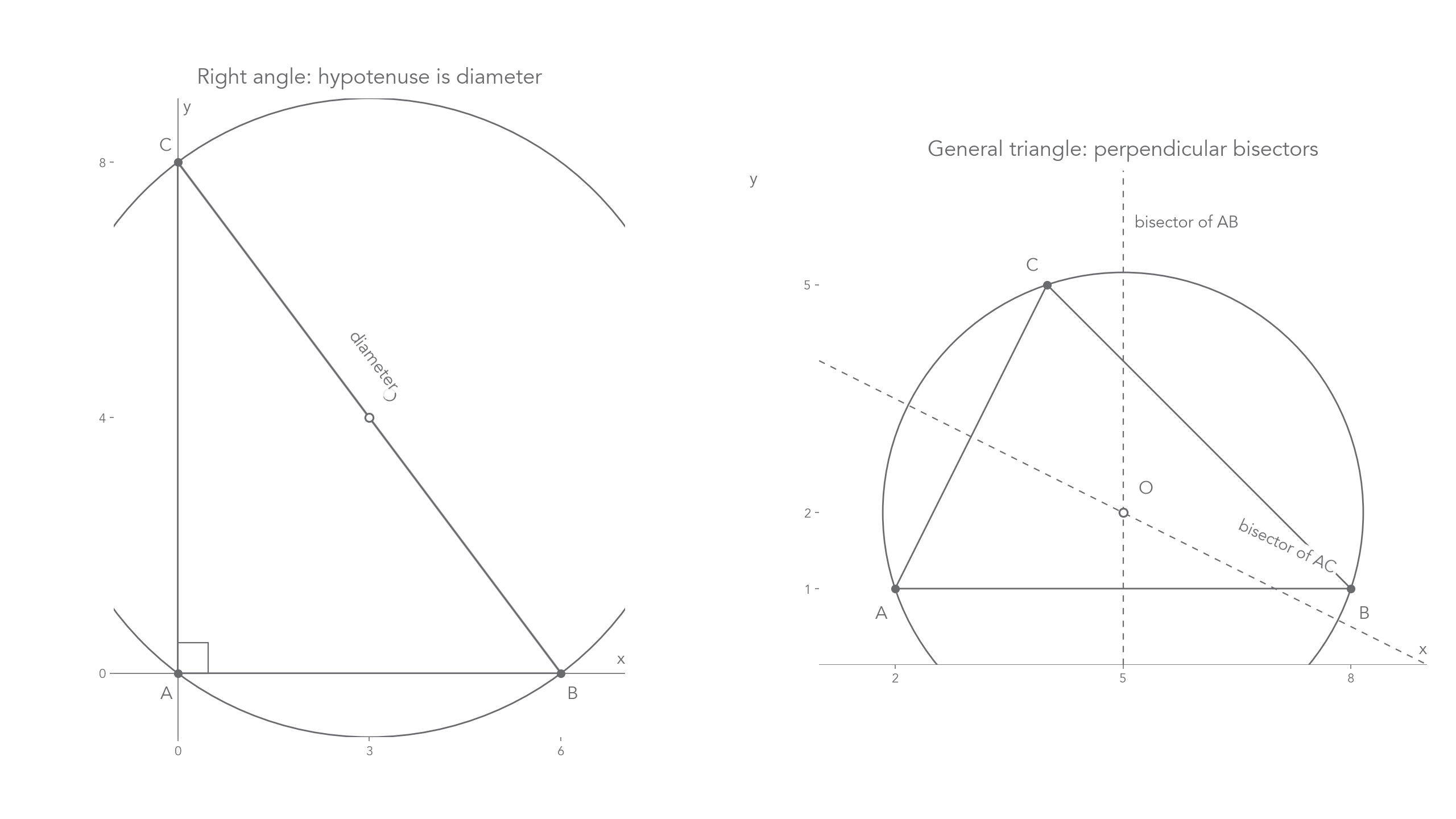
Worked example: find the circumcircle of the triangle with vertices A(0,0), B(6,0), and C(0,8).
The sides AB and AC are perpendicular, so angle A is a right angle. Therefore BC is the diameter of the circumcircle.
The centre is the midpoint of the diameter BC:
The radius is the distance from O to B:
So the circumcircle is
For a non-right triangle, use perpendicular bisectors.
Worked example: find the circumcircle of the triangle with vertices A(2,1), B(8,1), and C(4,5).
Side AB is horizontal, so its perpendicular bisector is vertical. The midpoint of AB is
so the perpendicular bisector of AB is
Now use side AC. Its midpoint is
The gradient of AC is
so the perpendicular gradient is -1/2. The perpendicular bisector of AC is therefore
At the centre, both perpendicular bisectors meet. Put x=5:
so y=2. The centre is (5,2).
Finally,
so the equation is
Tangents from radius gradients
A tangent touches a circle at one point. The key property is that the radius to the point of contact is perpendicular to the tangent.
[DIAGRAM: asset_name: Lesson p1.3.2: Coordinate geometry of the circle - diagram 03; asset_slug: p1_3_2_understand_and_use_the_coordinate_geometry_of_the_circle__diagram_03; recommended_method: drawn_math; description: Draw the circle (x-1)^2+(y-2)^2=25, centre O(1,2), point of contact P(5,5), radius OP, and the tangent at P. Mark the right angle between radius and tangent and label the radius gradient 3/4 and tangent gradient -4/3.]
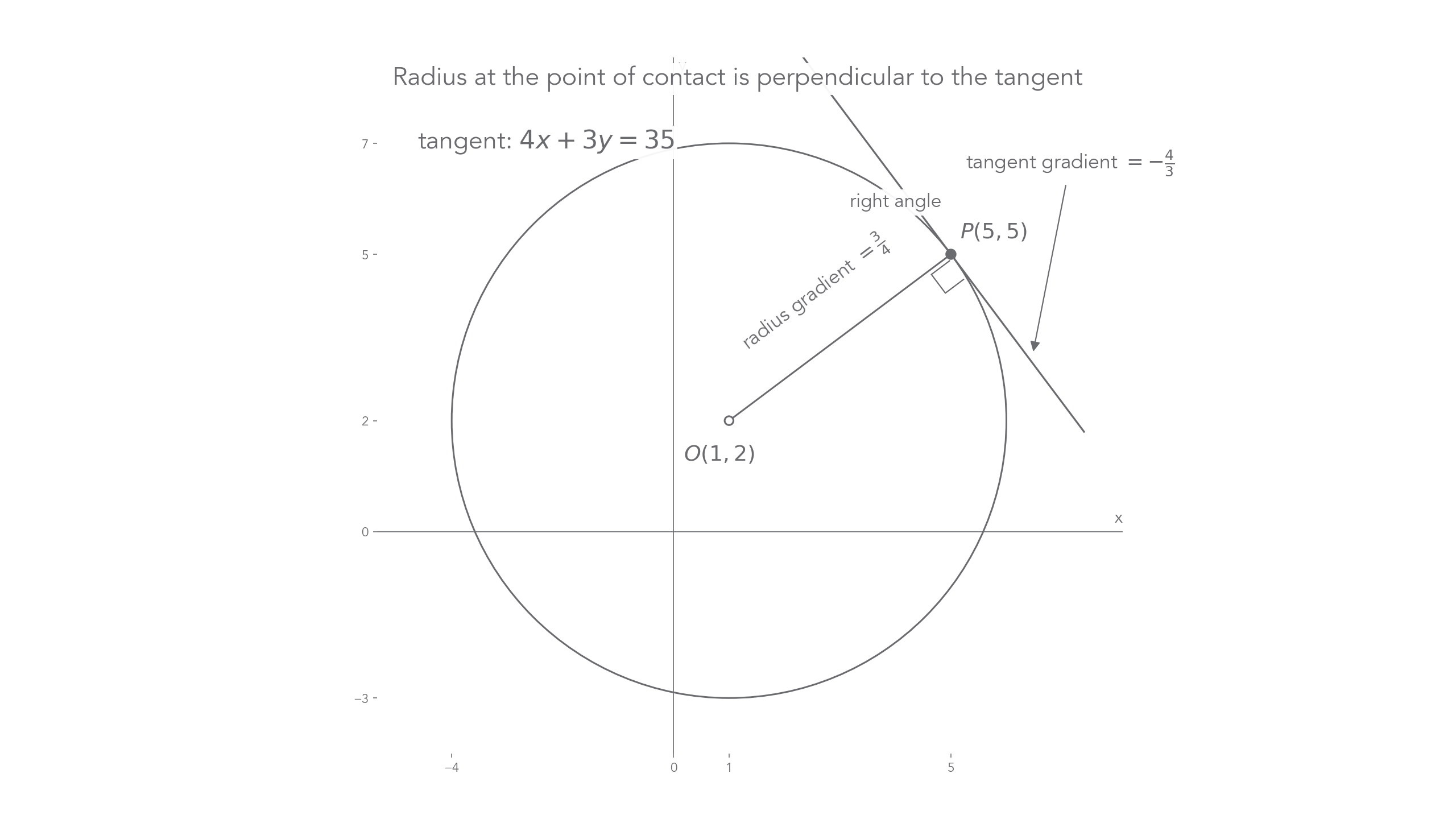
In coordinate form, perpendicular non-vertical lines have gradients whose product is -1. If the radius gradient is m, the tangent gradient is -1/m.
Worked example: find the equation of the tangent to
at the point P(5,5).
The centre is O(1,2). The radius OP has gradient
Therefore the tangent gradient is
Use the point-gradient form through P(5,5):
Multiplying by 3 gives
so one neat form is
If the radius is horizontal, the tangent is vertical. If the radius is vertical, the tangent is horizontal. Those two cases are better handled directly than by trying to take a reciprocal of zero or infinity.
Choosing the method
Circle questions are often short if you choose the right geometric fact. Before doing algebra, ask what the unknown represents.
If the unknown is the centre or radius from an equation, complete the square. If the unknown is a circumcircle through triangle vertices, look for a right angle first; otherwise use perpendicular bisectors. If the unknown is a tangent at a specified point, find the centre, then use the radius gradient and the perpendicular gradient.
Here is the main misconception contrast.
| Situation | Efficient thought | Common error |
|---|---|---|
(x-a)^2+(y-b)^2=r^2 | Centre is (a,b) and radius is r | Taking the bracket signs as the centre signs, or using r^2 as the radius |
| Circumcircle of a triangle | Centre lies on perpendicular bisectors of sides | Assuming the average of all three vertices is the centre |
| Tangent at a point | Radius to the point is perpendicular to tangent | Using the radius gradient as the tangent gradient |
Worked example: decide the method before solving.
Problem: the triangle has vertices A(0,0), B(10,0), and C(0,4). Find its circumcircle.
The efficient observation is that AB is horizontal and AC is vertical, so angle A is a right angle. Therefore BC is a diameter. You do not need two perpendicular bisectors.
Midpoint of BC:
Radius squared:
So the circle is
Explain It Back
Use this as a self-explanation check after the section above. It is for diagnosing what you can already explain, not for learning new material from scratch.
To check that the ideas have joined up, try explaining the role of perpendicular lines without using any formula first.