P1.4.2 - Sequences
A sequence is an ordered list of terms, and the subscript tells you the position of a term in that list. In this lesson you will work with sequences given directly by a formula for the nth term and sequences generated recursively from an earlier term. The goal is not just to make terms, but to decide whether the sequence is increasing, decreasing, or periodic.
Sequence notation and nth-term formulae
A sequence is usually written as
where u_1 is the first term, u_2 is the second term, and u_n is the nth term. The subscript n is a position label. It is not automatically the same as the value of the term.
Sequence
A sequence is an ordered list of numbers. The individual numbers are called terms, and u_n denotes the term in position n.
One way to define a sequence is to give a formula for the nth term. For example,
allows you to find any term directly by substituting the required position for n.
Worked example 1
A sequence is defined by
Find u_1, u_2, and u_5.
Solution
Substitute the term position into the formula.
For the first term,
For the second term,
For the fifth term,
So the requested terms are
Notice that u_5 is not found by putting u=5; it is found by putting n=5.
Recurrence relations
A recurrence relation defines each new term using an earlier term. In this specification the key form is
This means: take the current term x_n, put it into the function f, and the result is the next term x_{n+1}.
Recurrence relation
A recurrence relation gives a rule for moving from one term to another. A starting term, such as x_1, is also needed before the sequence is fully defined.
The starting term matters. The recurrence relation
does not define one unique sequence until you are told a value such as x_1=3.
Worked example 2
A sequence is defined by
Find x_2, x_3, and x_4.
Solution
Use the previous term each time.
For x_2, use x_1=5:
For x_3, use the term just found, x_2=7:
For x_4, use x_3=11:
So
The key decision is what to substitute. In x_{n+1}=2x_n-3, the input is the previous term value, not the position number on its own.
Worked example 3
A sequence is defined by
where k is a positive constant. Given that u_3=6, show that
and hence find k.
Solution
First express u_2 in terms of k:
Now use u_2 to express u_3:
But the question tells us that u_3=6, so
Rearrange to the requested form:
Now solve:
So
Since k is positive,
Increasing and decreasing sequences
A sequence is increasing if every next term is greater than the term before it. It is decreasing if every next term is less than the term before it.
Increasing and decreasing
A sequence is increasing when u_{n+1}>u_n for every relevant positive integer n. It is decreasing when u_{n+1}<u_n for every relevant positive integer n.
[DIAGRAM: asset_name: Lesson p1.4.2: Work with sequences - diagram 01; asset_slug: p1_4_2_work_with_sequences__diagram_01; recommended_method: drawn_math; description: Draw a clean 16:9 three-panel discrete sequence diagram. Panel 1: increasing sequence u_n=2n for n=1 to 6, plotted as separate dots/stems and labelled u_{n+1}>u_n. Panel 2: decreasing sequence v_n=1/(3n+1) for n=1 to 6, plotted as separate dots/stems and labelled v_{n+1}<v_n. Panel 3: periodic order-2 sequence generated by w_{n+1}=1/w_n, w_1=3, showing terms 3, 1/3, 3, 1/3, .... Use spacious margins, direct labels, compact panel titles, no decorative colour, and make clear that sequence terms occur only at whole-number positions.]
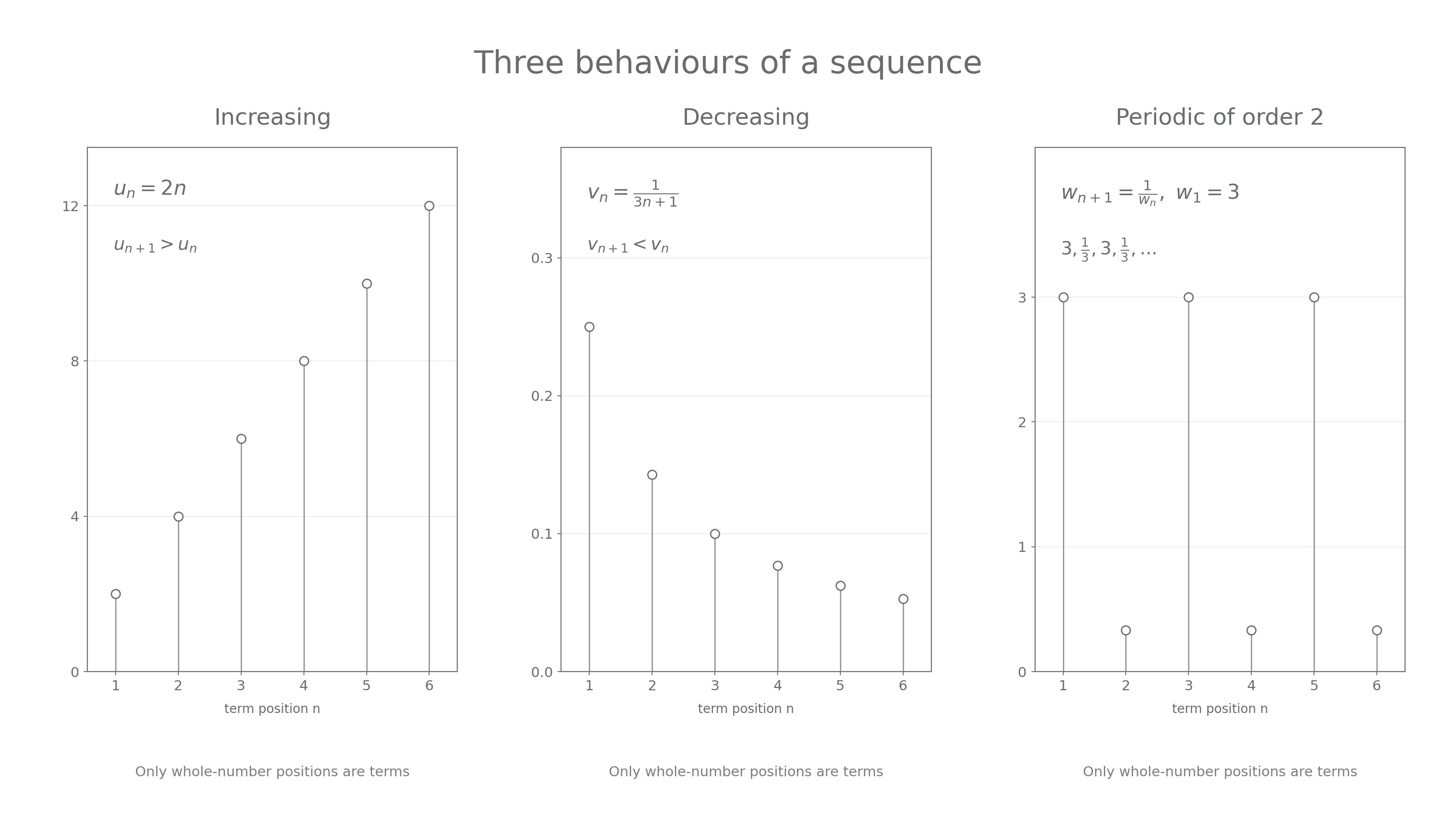
For a sequence given by an nth-term formula, a good test is often to compare u_{n+1} with u_n.
Worked example 4
Show that
is increasing for n\in\mathbb{Z}^+.
Solution
Find the next term in algebraic form:
Compare it with u_n:
Since 2>0, we have
for every positive integer n. Therefore the sequence is increasing.
Worked example 5
Show that
is decreasing for n\in\mathbb{Z}^+.
Solution
The next term is
For positive integer n, both denominators are positive, and
A larger positive denominator gives a smaller positive fraction, so
Therefore
so the sequence is decreasing.
Increasing and decreasing sequences Continued
Do not rely only on the first two or three terms unless the question only asks you to classify from a displayed finite list. For an infinite sequence, increasing or decreasing means the inequality works for every relevant n.
Periodic sequences
A periodic sequence repeats its terms in a cycle. The order, also called the period, is the shortest length of a repeating cycle.
Periodic sequence
A sequence is periodic if its terms repeat in a fixed cycle. The order of the sequence is the smallest positive number of terms in one complete repeating cycle.
For example, the sequence
is periodic of order 2, because the repeating block is
It would be wrong to say the order is 4 just because the first four terms also repeat the pattern. The order is the shortest repeating cycle.
Worked example 6
A sequence is defined by
Find the first five terms and state whether the sequence is periodic.
Solution
Use the previous term each time:
Then
Next,
Then
and
The terms are
so the sequence is periodic of order 2.
Choosing the right test
When you meet a sequence question, first identify how the sequence is defined.
| If you are given... | Do this first | Common trap |
|---|---|---|
an nth-term formula such as u_n=n^2+1 | substitute positions or compare u_{n+1} with u_n | treating it like a recurrence |
a recurrence such as u_{n+1}=f(u_n) | start from the given term and generate terms one by one | substituting n where u_n is needed |
| a repeating list or recurrence cycle | find the shortest repeating block | giving a non-minimal period |
Worked example 7
Classify each sequence as increasing, decreasing, periodic, or none of these.
a_n=10-3nb_1=1,b_{n+1}=1-b_nc_n=n(5-n)
Solution
For a_n=10-3n, find the next term:
Then
Since this is always negative, the sequence is decreasing.
For b_1=1, use the recurrence:
The sequence is
so it is periodic of order 2.
For c_n=n(5-n), generate a few terms carefully:
This is not increasing because c_3 is not greater than c_2. It is not decreasing because c_2 is greater than c_1. There is no repeating cycle shown by the formula here, so from these options it is none of these.
Explain It Back
Use this as a self-explanation check after the section above. It is for diagnosing what you can already explain, not for learning new material from scratch.
That last example is deliberately sneaky. A recurrence of the form r_{n+1}=25/r_n can produce an order-2 sequence for many starting values, but with r_1=5 it becomes constant. Always generate enough terms to check the actual cycle.