P1.3.3 - Parametric equations and Cartesian form
A Cartesian equation links x and y directly, such as y=x^2 or (x-2)^2+(y+4)^2=25. Parametric equations describe a curve differently: they give x and y separately in terms of a shared parameter, usually t or theta. In this lesson you will learn how to read a parametric curve, convert it to Cartesian form, create simple parametric forms for familiar curves, and keep track of the parameter domain.
What a parameter does
In a parametric curve, both coordinates are functions of the same input.
Parametric Equations
Parametric equations for a curve give coordinates in the form x=f(t) and y=g(t), where t is a parameter. Each allowed value of t gives one point (x,y) on the curve.
For example,
does not say that y is directly a function of x at first. It says: choose a value of t, then calculate both coordinates. If t=-2, then
so the point is (-10,12). If t=0, the point is (0,0). If t=2, the point is (10,12). As t changes continuously, these points trace a curve.
[DIAGRAM: asset_name: Lesson p1.3.3: Parametric equations and Cartesian conversion - diagram 01; asset_slug: p1_3_3_understand_and_use_the_parametric_equations_of_curves_and_conversion_between_cartesian_and_parametric_forms__diagram_01; recommended_method: drawn_math; description: Draw a 16:9 two-panel diagram. The left panel shows a parameter line with points t=-2,-1,0,1,2 and the note that one t-value gives one coordinate pair. The right panel shows the curve from x=5t, y=3t^2 with the corresponding points labelled and arrows showing increasing t. Include the Cartesian result 25y=3x^2 as a direct label. Use NovaLearn style.]
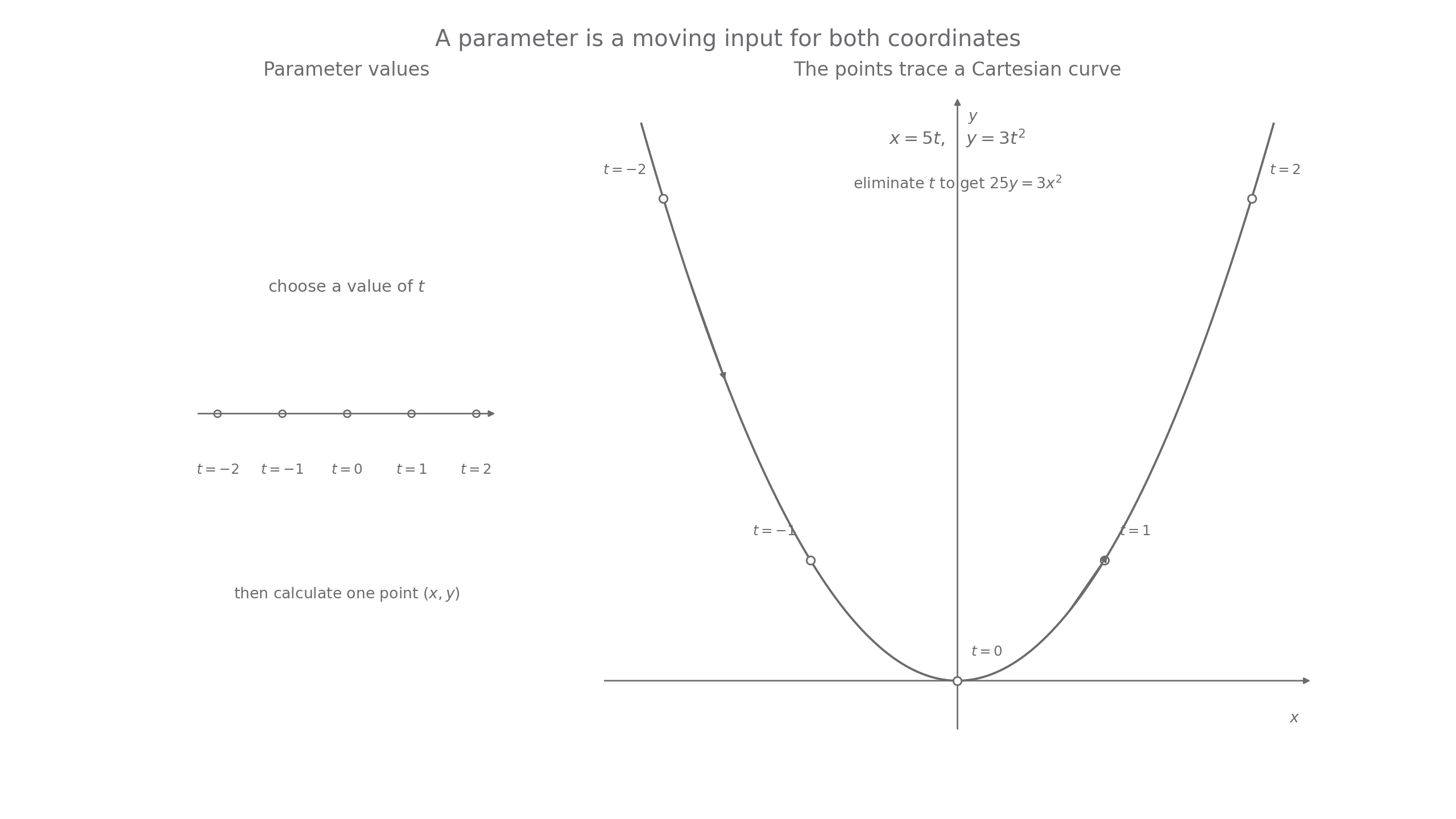
The parameter is not a third coordinate. It is the input that generates the x-coordinate and the y-coordinate together. That is why a parametric equation can also show direction: increasing t tells you the order in which points are traced.
Worked example: find two points on the curve
When t=1,
so the point is (-2,3).
When t=-2,
so the point is (-5,9).
Eliminating a non-trigonometric parameter
To convert from parametric form to Cartesian form, remove the parameter. This is called eliminating the parameter.
The usual method is:
- Rearrange one of the equations to make the parameter the subject.
- Substitute that expression into the other equation.
- Rearrange to give an equation involving only
xandy. - Carry over any restrictions caused by the original parameter domain.
For the earlier example
the first equation gives
Substitute this into y=3t^2:
So
That is the Cartesian equation of the same parabola, provided the intended parameter values trace the whole curve.
Worked example: convert
to Cartesian form.
The x equation is linear in t, so it is the easiest one to rearrange:
Now substitute into the equation for y:
Simplify carefully:
so
To write this as a single fraction,
Expanding the numerator gives
The restriction t\ne 0 also matters. Since t=(x-2)/3, t\ne 0 means x\ne 2. The Cartesian form is therefore
The restriction is not decoration. Without it, the Cartesian equation might appear to allow a point that the original parameter can never produce.
Trigonometric parameters and circles
Some parametric equations use a trigonometric parameter, often written as theta or t. The key identity for circle conversion is
Pythagorean Identity
The basic circle
has centre (0,0) and radius r, because
so
For a circle with centre (a,b) and radius r, use
Worked example: convert
to Cartesian form.
First remove the translations and scale factor:
Now square both and add:
Multiply by 25:
This is a circle with centre (2,-4) and radius 5.
The common error is to use x^2+y^2=25 immediately. That would ignore the centre shift. Always rearrange to isolate cos t and sin t before using the identity.
Creating parametric forms
Conversion also works in the other direction. A Cartesian equation can often be written parametrically by choosing a useful parameter.
The simplest choice for a graph y=f(x) is usually
For example, the Cartesian curve
can be written as
This is not the only possible parametrisation. You could also choose x=3t, which would give
Both describe the same Cartesian curve if the parameter is allowed to range over all real values.
Worked example: give a parametric form for each curve.
For
choose
Then
For
choose
Then
so the equation is satisfied.
For the circle
use the centre-radius structure:
The parameter domain matters
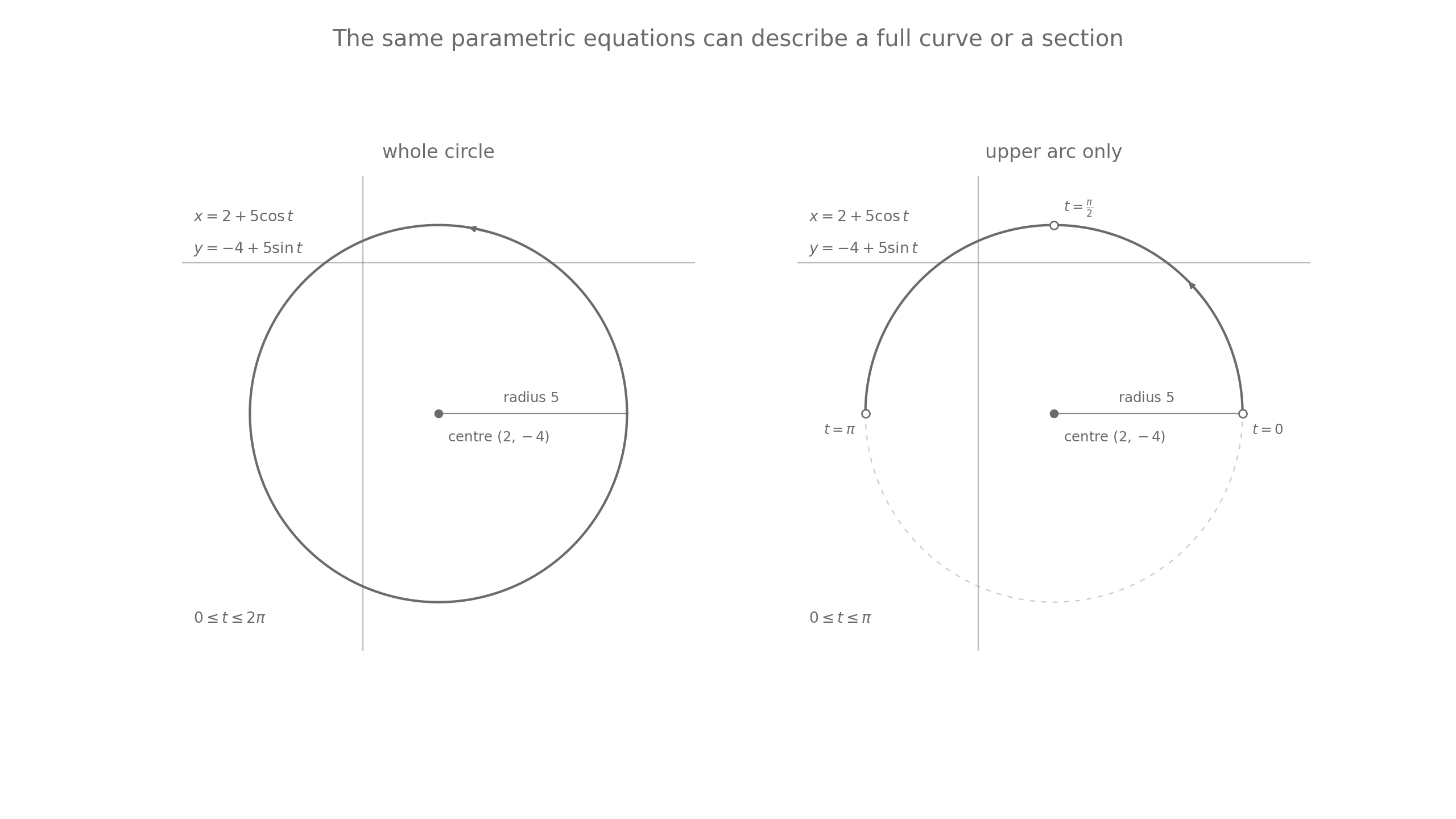
The Cartesian equation tells you the shape. The parameter domain tells you which part of the shape is traced.
[DIAGRAM: asset_name: Lesson p1.3.3: Parametric equations and Cartesian conversion - diagram 02; asset_slug: p1_3_3_understand_and_use_the_parametric_equations_of_curves_and_conversion_between_cartesian_and_parametric_forms__diagram_02; recommended_method: drawn_math; description: Draw a 16:9 two-panel diagram for x=2+5cos t, y=-4+5sin t. The left panel shows 0<=t<=2pi tracing the whole circle with centre (2,-4) and radius 5. The right panel shows 0<=t<=pi tracing only the upper arc, with a faint dashed guide for the rest of the circle and labels t=0, t=pi/2, t=pi. Use NovaLearn style.]
For
the Cartesian equation is
If 0 <= t <= 2pi, the point traces the whole circle once. If 0 <= t <= pi, it traces only the upper semicircle:
- when
t=0, the point is(7,-4); - when
t=pi/2, the point is(2,1); - when
t=pi, the point is(-3,-4).
So the same Cartesian equation can describe a whole circle, while the parametric equations plus their domain can describe a particular arc of that circle.
Worked example: describe the section of the curve
The Cartesian equation is still
But the parameter interval gives
So this is not the whole parabola. It is the section of
where
For this example, the y values also satisfy
but the most direct way to describe the section of the Cartesian curve is the x restriction, because x=5t is one-to-one on the interval.
The parameter domain matters Summary
Eliminating the parameter gives the Cartesian relationship between x and y; the parameter domain tells you which points on that relationship are actually included.
That final distinction is the idea most worth checking in your own words.
Explain It Back
Use this as a self-explanation check after the section above. It is for diagnosing what you can already explain, not for learning new material from scratch.