P1.4.4 - Arithmetic sequences and series
Arithmetic sequences are built by adding the same amount each time. This lesson shows how to move between the terms, the nth term, and the sum of the first n terms, including the proof of the arithmetic-series sum formula that Edexcel expects you to know.
Recognise an arithmetic sequence
An arithmetic sequence is a sequence where the difference between consecutive terms is constant. If the first term is a and the common difference is d, the sequence begins
The common difference can be positive, negative, or zero. For example, 18, 15, 12, 9, ... is arithmetic with a = 18 and d = -3.
Arithmetic sequence
An arithmetic sequence is a sequence in which each term after the first is found by adding the same constant d to the previous term. The constant d is called the common difference.
A sequence is different from a series. A sequence lists terms; a series adds terms. So
is a finite sequence, while
is the corresponding finite series.
Worked example 1: Identify the first term and common difference
The sequence
has first term
The difference from one term to the next is
So the common difference is
Because the same difference appears each time, the sequence is arithmetic.
Find the nth term
The nth term is the term in position n. Since the first term is already a, the second term has one copy of d, the third term has two copies of d, and so on. Therefore the nth term has n - 1 copies of d.
[DIAGRAM: asset_name: Lesson p1.4.4: Arithmetic Sequences and Series - diagram 01; asset_slug: p1_4_4_understand_and_work_with_arithmetic_sequences_and_series__diagram_01; recommended_method: drawn_math; description: Draw a clean 16:9 two-panel NovaLearn-style diagram. Left panel: a row of arithmetic sequence terms labelled a, a+d, a+2d, ..., a+(n-1)d with small equal gaps labelled d and a bracket/label showing there are n-1 gaps from the first term to the nth term. Right panel: the arithmetic series written forwards and backwards in two aligned rows, with vertical pairing marks showing each pair sums to a+l, and the conclusion 2S_n = n(a+l). Use white background, #6A6B6E only, thin lines, direct labels, and spacious margins.]
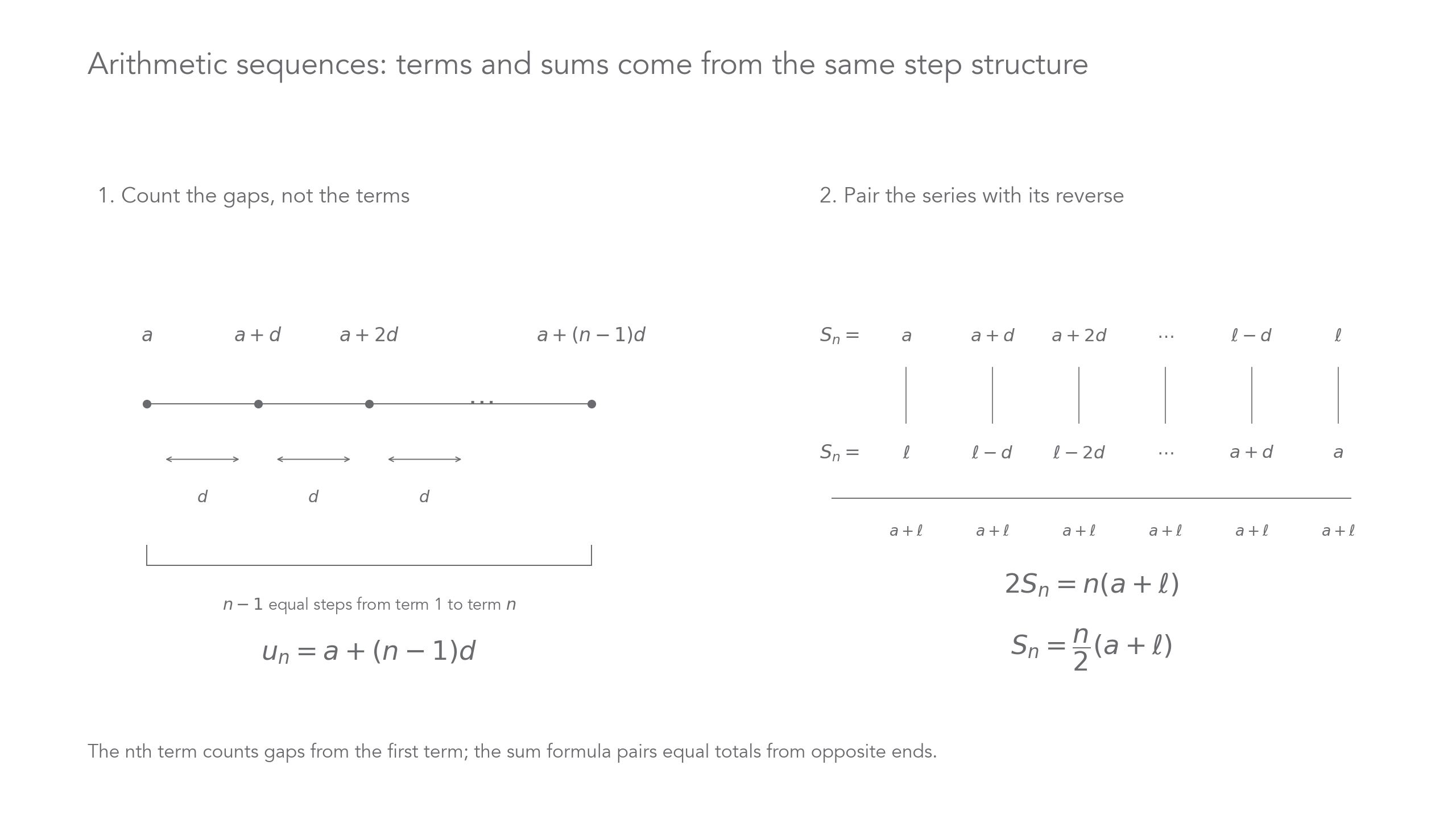
Nth Term Of An Arithmetic Sequence
Here u_n is the nth term, a is the first term, and d is the common difference.
The most common error is to write a + nd. That would give the second term as a + 2d, but the second term should be a + d. Always count the gaps from the first term.
Worked example 2: Find an nth term
Find the 18th term of the arithmetic sequence with first term 12 and common difference 5.
Here
Use the nth-term formula:
So
There are 17 common-difference steps from term 1 to term 18:
The 18th term is
Find the nth term Continued
Sometimes you are given a term and asked to find the position, or given two terms and asked to find a and d. Use the same formula, but treat the unknown as part of the equation.
Worked example 3: Use a known term to find an unknown
An arithmetic sequence has first term 9. Its 21st term is 69. Find the common difference.
Use
Substitute a = 9, n = 21, and u_{21} = 69:
So
Subtract 9:
Hence
Prove the sum formula
For a finite arithmetic sequence, let the last term be l. The first n terms are
The sum of these terms is called S_n.
Write the sum forwards and then backwards:
Now add the two lines term by term. Each vertical pair has the same total, a + l.
There are n pairs, so
Divide by 2:
Since the last term is also
you can substitute this into the first sum formula:
Sum Of An Arithmetic Series
when the first term a, last term l, and number of terms n are known.
when the first term a, common difference d, and number of terms n are known.
The formula for the first n natural numbers is a special case. The series
is arithmetic with first term a = 1, last term l = n, and n terms. Therefore
The arithmetic-series sum works because the first and last terms pair to the same total as the second and second-last terms, and so on.
Worked example 4: Use the sum formula
Find the sum of the first 40 terms of the arithmetic sequence
Here
Use the version involving a, d, and n:
So
The sum of the first 40 terms is
Explain It Back
Use this as a self-explanation check after the section above. It is for diagnosing what you can already explain, not for learning new material from scratch.
The natural-number formula is not a separate trick; it is the same first-plus-last pairing with a = 1 and l = n.
Choose the efficient formula
Both sum formulae are useful, but they are useful in different situations.
Use
when you know the first term, last term, and number of terms.
Use
when you know the first term, common difference, and number of terms.
If you know the first and last term but not n, find n first using
Worked example 5: Find the number of terms before summing
Find the sum of the arithmetic series
First identify the information:
We do not yet know n, so use the last-term formula:
Substitute:
Then
so
Now use the sum formula with first and last terms:
So
Choose the efficient formula Continued
Here is the formula choice in one sentence: if the last term is visible, n/2(a + l) is usually cleaner; if the last term is not visible, n/2(2a + (n - 1)d) avoids an extra step.
Use arithmetic series in context
Edexcel questions often place arithmetic sequences in a short context, such as savings, repayments, theatre rows, or monthly amounts. The mathematics is the same, but you must interpret a, d, n, and S_n correctly.
When a context says the total after N terms is known, set the sum formula equal to that total. If a quadratic equation gives two possible values of N, check which one makes sense in the context.
Worked example 6: Set up a sum equation and choose N
A student saves money each week. In week 1 she saves £15, in week 2 she saves £18, in week 3 she saves £21, and so on. The amounts saved form an arithmetic sequence.
After N weeks she has saved a total of £570.
Find N.
The first term is
and the common difference is
The total after N weeks is
Use the sum formula:
Substitute the known values:
Simplify inside the bracket:
So
Multiply by 2:
Then
Divide by 3:
Factorise:
So
The number of weeks cannot be negative, so
Use arithmetic series in context Continued
A decreasing context needs extra sign care. For example, if payments are 400, 390, 380, ..., then d = -10, not 10. Put the negative common difference inside brackets when using the formula:
That bracket is where many arithmetic errors happen. It is worth writing one intermediate line before expanding.
Check that printed answers are exactly right. In the last question, the printed equation came from
so the bracket and the negative common difference are doing important work. Do not skip straight from substitution to the printed answer unless the intermediate algebra is clear.
Quick Check
Use this as a short comprehension check on the section above.