4.2.2 - The fight or flight response including the role of adrenaline
A perceived threat can trigger rapid neural and hormonal changes before deliberate thought is complete. You will follow the fight-or-flight sequence through the hypothalamus, sympathetic nervous system, adrenal medulla and adrenaline, explaining effects on heart rate, breathing, glucose and digestion. The lesson also examines parasympathetic recovery and evaluates when a response adapted for short-term action becomes unhelpful in modern or prolonged stress.
An acute response to threat
Fight or flight prepares the body for immediate action when danger is perceived.
AO1: Core idea
The fight or flight response is the body's rapid biological reaction to perceived threat. It prepares the person either to confront the danger or move away from it. In AQA biopsychology, the important point is not just that the person feels anxious. The important point is the chain of biological control: the brain detects threat, the sympathetic branch of the autonomic nervous system becomes active, and the adrenal medulla releases adrenaline into the bloodstream.
Fight or flight response
The fight or flight response is an acute stress response in which the body prepares for immediate physical action by increasing arousal, energy supply and alertness.
Adrenaline
Adrenaline is a hormone, also called epinephrine, released mainly from the adrenal medulla. Its role in this topic is to help prepare the body for rapid action during threat.
For AQA, a strong answer uses accurate biological terms:
- Sympathetic branch: the part of the autonomic nervous system that increases physiological arousal.
- Adrenal medulla: the inner part of the adrenal gland that releases adrenaline and noradrenaline.
- Endocrine system: the system of glands that release hormones into the blood.
- Parasympathetic branch: the part of the autonomic nervous system that helps return the body towards a calmer resting state after the threat has passed.
AO2: A quick scenario
Imagine Sam is walking home and hears fast footsteps close behind him. Before Sam has consciously worked out whether there is danger, his body may already show signs of fight or flight: faster heartbeat, quicker breathing, dry mouth, sweating and tense muscles. Those symptoms make sense if you link them to adrenaline and sympathetic arousal, rather than just saying "Sam is nervous".
Exam focus
This topic often rewards the link between a biological process and a visible symptom. "Adrenaline is released" is useful, but a better answer explains what adrenaline does and why that prepares the body for fight or flight.
From threat to adrenaline release
The response links a neural signal from the brain to a hormone carried throughout the body.
AO1: From threat to hormone release
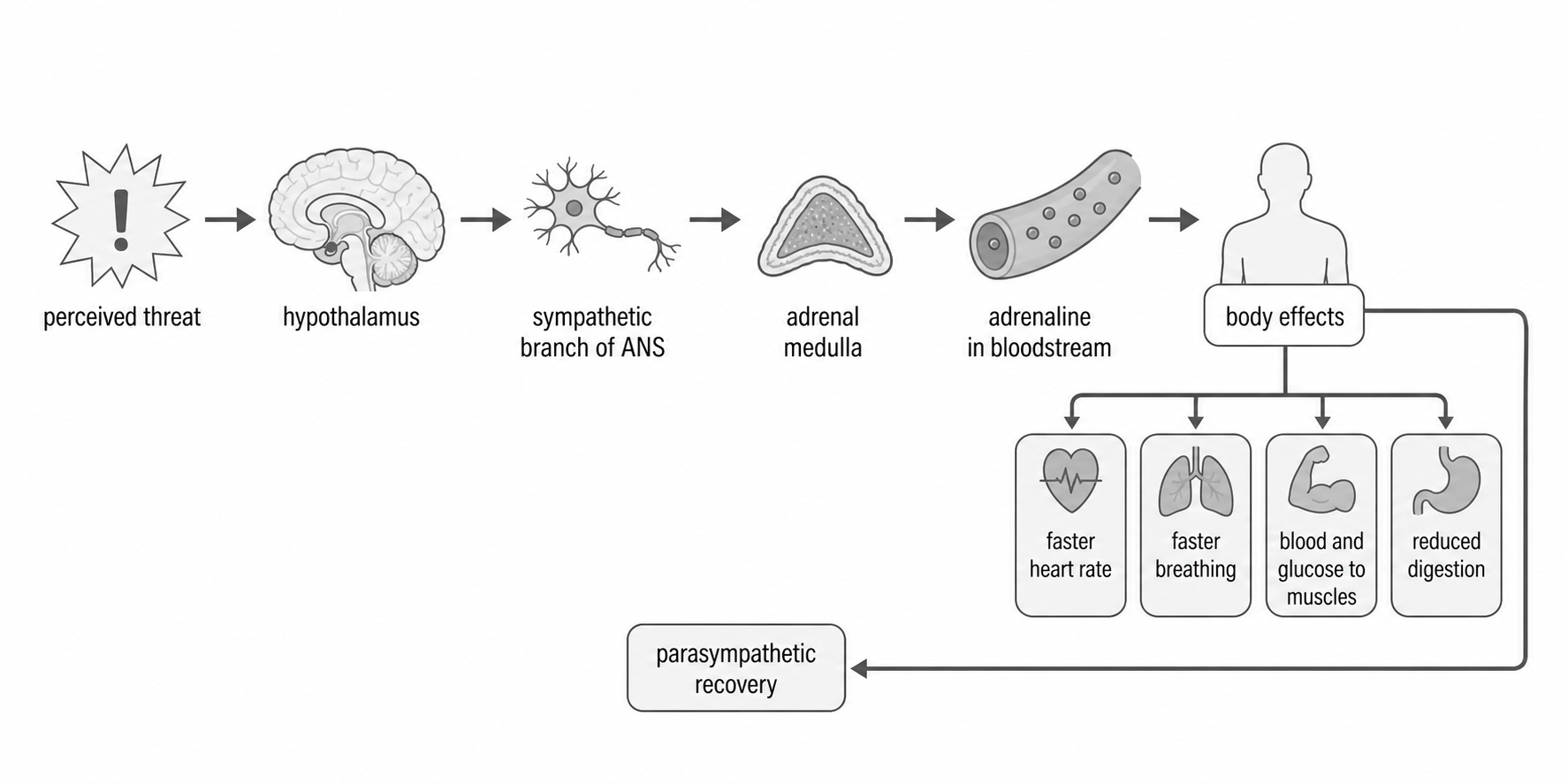
The fight or flight response is a sequence. AQA students sometimes lose marks by listing symptoms without showing how the response is triggered. The chain can be learned as:
- A threat is perceived.
- The hypothalamus coordinates the stress response.
- The sympathetic branch of the autonomic nervous system is activated.
- Sympathetic nerves stimulate the adrenal medulla.
- The adrenal medulla releases adrenaline into the bloodstream.
- Adrenaline produces widespread body changes that prepare for action.
- Once the threat passes, parasympathetic activity helps calm the body.
Sympathomedullary pathway
The sympathomedullary pathway is the short-term stress pathway in which sympathetic nervous system activation stimulates the adrenal medulla to release adrenaline and noradrenaline.
[DIAGRAM: asset_name: Fight or flight biological chain; asset_slug: 4_2_2_04_the_fight_or_flight_response_including_the_role_of_adrenaline__diagram_01; recommended_method: image_gen; description: Fight-or-flight pathway: perceived threat -> hypothalamus -> sympathetic branch of ANS -> adrenal medulla -> adrenaline in bloodstream -> body effects including faster heart rate, faster breathing, blood/glucose to muscles, reduced digestion -> parasympathetic recovery.]
AO1: Why hormones matter here
Neural signals can be very fast but local. Hormones travel in the bloodstream, so they can coordinate a whole-body response. Adrenaline is useful in fight or flight because many parts of the body need to change at the same time: heart, lungs, blood vessels, liver, muscles, pupils and digestive organs.
Adrenaline is therefore not just a "feeling" chemical. It is a chemical messenger that helps turn a detected threat into a coordinated physical response.
Common confusion to avoid
- The sympathetic branch increases arousal during fight or flight.
- The parasympathetic branch helps reduce arousal after the threat.
- The adrenal medulla releases adrenaline. The adrenal cortex is more closely associated with cortisol, which belongs in the later stress physiology topic rather than the core of this lesson.
- AQA uses the term adrenaline. Some medical sources use epinephrine for the same hormone.
Body changes and preparation for action
Sympathetic activation and circulating adrenaline coordinate changes that make oxygen and fuel available for action.
AO1: Coordinated sympathetic and hormonal effects
Adrenaline prepares the body for sudden action by changing where oxygen and energy go. The table describes the overall response. Adrenaline directly contributes to effects such as increased cardiac activity, airway dilation and glucose mobilisation; sympathetic nerves also act directly on organs and glands. Sweating, for example, is mainly driven by sympathetic nerves to sweat glands. Do not treat every effect as a direct action of adrenaline alone.
| Body change | Why it helps fight or flight |
|---|---|
| Heart rate increases | More oxygenated blood can be sent quickly to muscles and the brain. |
| Breathing rate increases | More oxygen enters the lungs and more carbon dioxide can be removed. |
| Blood is redirected away from skin and digestion | Blood supply is prioritised for skeletal muscles and other action systems. |
| Blood glucose increases | More fuel is available for muscle contraction and rapid response. |
| Sweating increases | The body can cool itself during intense action, though this can be unhelpful in some modern settings. |
| Pupils dilate | More light enters the eye, supporting alertness to the environment. |
| Digestion and saliva production are inhibited | Energy is not spent on digestion during immediate threat, which can produce a dry mouth or nausea. |
| Muscle tension increases | The body is physically primed to move, but this may feel like shaking or trembling. |
AO2: Turning symptoms into application
Suppose Amira is about to give a presentation. She notices that her mouth feels dry, her heart is pounding and her hands are shaking. A weak application would say, "This shows fight or flight because she is stressed." A stronger application links each symptom to the biological process:
- Dry mouth: sympathetic arousal reduces watery salivary secretion.
- Pounding heart: adrenaline increases heart rate so oxygenated blood can be delivered faster.
- Shaky hands: adrenaline increases muscle tension and blood glucose, preparing muscles for action, even though Amira does not actually need to run.
Exam focus
When applying this topic to a stem, do not just copy symptoms from the stem. Explain the biological basis of the symptom. That is the difference between spotting fight or flight and showing psychological knowledge.
Psychological threats and recovery
A social or performance threat can trigger arousal, followed by recovery as the threat passes.
AO2: Applying the response to modern stressors
Fight or flight evolved for immediate physical threats, but it can also be triggered by psychological stressors. A student waiting outside an exam hall, a learner taking a driving test, or a performer standing backstage may experience the same biological arousal even though fighting or fleeing would be inappropriate.
Consider this exam-style stem:
Xavier is waiting to give a speech. His heart is pounding, his hands are shaking, he feels sick and his mouth is dry.
You can apply fight or flight like this:
- The perceived threat of public speaking activates Xavier's sympathetic nervous system.
- The hypothalamus triggers the sympathetic branch of the autonomic nervous system.
- Sympathetic nerves stimulate the adrenal medulla to release adrenaline.
- Adrenaline increases heart rate, explaining Xavier's pounding heart.
- Adrenaline increases muscle tension and energy availability, which can contribute to shaky hands.
- Digestion and saliva production are inhibited, helping explain why he feels sick and has a dry mouth.
AO1: Recovery matters
Fight or flight is short-term. Once the threat has gone, the parasympathetic branch helps bring the body back towards baseline. Parasympathetic activity slows the heart and promotes digestion. Breathing settles as overall arousal falls; reduced sympathetic drive and metabolism/clearance of adrenaline also contribute to recovery. The parasympathetic system does not simply remove adrenaline from the blood. This is why someone may feel shaky immediately after a frightening event, then gradually calm down.
Parasympathetic branch
The parasympathetic branch is the part of the autonomic nervous system associated with conserving energy and returning the body towards a calmer resting state after arousal.
Exam focus
AQA has asked scenario questions where students must connect biological mechanisms to symptoms. The best answers usually do three things:
- Name the process, such as sympathetic activation or adrenaline release.
- Link it to a specific symptom in the stem.
- Explain why the body change would be adaptive for action, even if it is unhelpful in the scenario.
Evaluating fight or flight
The response has clear survival value, but the usefulness of arousal depends on context and the person.
AO3: The response has adaptive value
The fight or flight response is useful because it can support survival. Faster heart rate, faster breathing and increased glucose availability make physical action more likely to succeed. This is a strength of the biological explanation: it gives a clear mechanism linking threat perception to behaviour.
However, this strength is context-dependent. The same arousal can be unhelpful in modern situations such as exams, interviews or performances. Sweaty hands, trembling and dry mouth may interfere with performance rather than improve it.
AO3: The model can be reductionist
A biological account explains stress mainly through nervous system and hormone activity. That is scientifically useful because it is precise and measurable. It can also be reductionist if it ignores cognitive appraisal, social support and individual differences in how people interpret threat. Two students may face the same exam hall, but one may appraise it as a manageable challenge while the other appraises it as a serious threat.
AO3: Fight or flight is not the only threat pattern
"Fight or flight" is a memorable phrase, but real threat responses can be more varied. Some people freeze rather than fight or flee. Taylor et al. (2000) also argued that, especially in females, some stress responses may be better described as tend-and-befriend, involving protecting others and seeking social support. This does not mean adrenaline is irrelevant. It means that behaviour under threat is not always captured by two options.
AO3: A balanced exam judgement
A good judgement is not "fight or flight is wrong". The better judgement is:
- As an AO1 account, fight or flight accurately describes a short-term biological arousal pathway involving sympathetic activation and adrenaline.
- As an AO2 tool, it explains many symptoms in scenario questions, such as pounding heart, dry mouth, sweating and shaking.
- As an AO3 account of behaviour, it is incomplete because actual responses to threat can include freezing, social support seeking and cognitive appraisal.