4.2.1 - Humanistic Psychology
Humanistic psychology begins with conscious experience, personal meaning and the capacity for growth rather than treating behaviour as fully determined. You will explore free will, self-actualisation, Maslow's hierarchy of needs, Rogers's ideas of congruence and conditions of worth. The lesson also evaluates whether a holistic and person-centred approach can produce evidence that is both respectful and scientifically persuasive.
The Humanistic Starting Point
Humanistic Psychology is the approach that puts conscious experience, personal meaning and growth at the centre of explaining behaviour. In the AQA Approaches topic, it is useful to treat it as a deliberate contrast with more deterministic approaches: behaviourism explains behaviour through learning history, the biological approach through genes, brain structures and neurochemistry, and psychodynamic theory through unconscious conflict. Humanistic psychologists argue that those explanations can miss the person's lived experience and capacity to choose.
AO1: Free Will And Subjective Experience
Free will
Free will is the idea that people can make conscious choices and are not completely controlled by biological forces, reinforcement history, unconscious conflict or social pressure.
Humanistic Psychology does not claim that people can do absolutely anything. It claims that people are active agents who can make choices within the opportunities and limits of their situation. This matters because the approach is interested in questions such as: "What does this person want to become?", "How do they see themselves?", and "What conditions help or block their growth?"
Humanistic Psychology is also holistic: it tries to understand the whole person rather than reducing behaviour to one small part, such as a neurotransmitter, a learned response or an unconscious impulse. It is often idiographic too, because it values the individual's unique experience rather than only searching for general laws.
AO2: A Quick Contrast
If Talia avoids speaking in class, a behaviourist might focus on past punishment or reinforcement. A biological psychologist might look at inherited anxiety or arousal systems. A humanistic psychologist would ask how Talia experiences the situation: perhaps she wants to contribute, but believes she will only be accepted if she never makes mistakes. That focus on meaning, choice and self-worth is the humanistic route into the same behaviour.
AO3: Why This Starting Point Matters
A strength of this approach is that it gives people agency. It can feel more humane than strongly deterministic accounts because it treats people as capable of reflection and growth. A limitation is that free will and personal meaning are difficult to measure objectively, so the approach is often criticised for being less scientific than approaches built around laboratory experiments or biological measurement.
Self-Actualisation And Maslow's Hierarchy
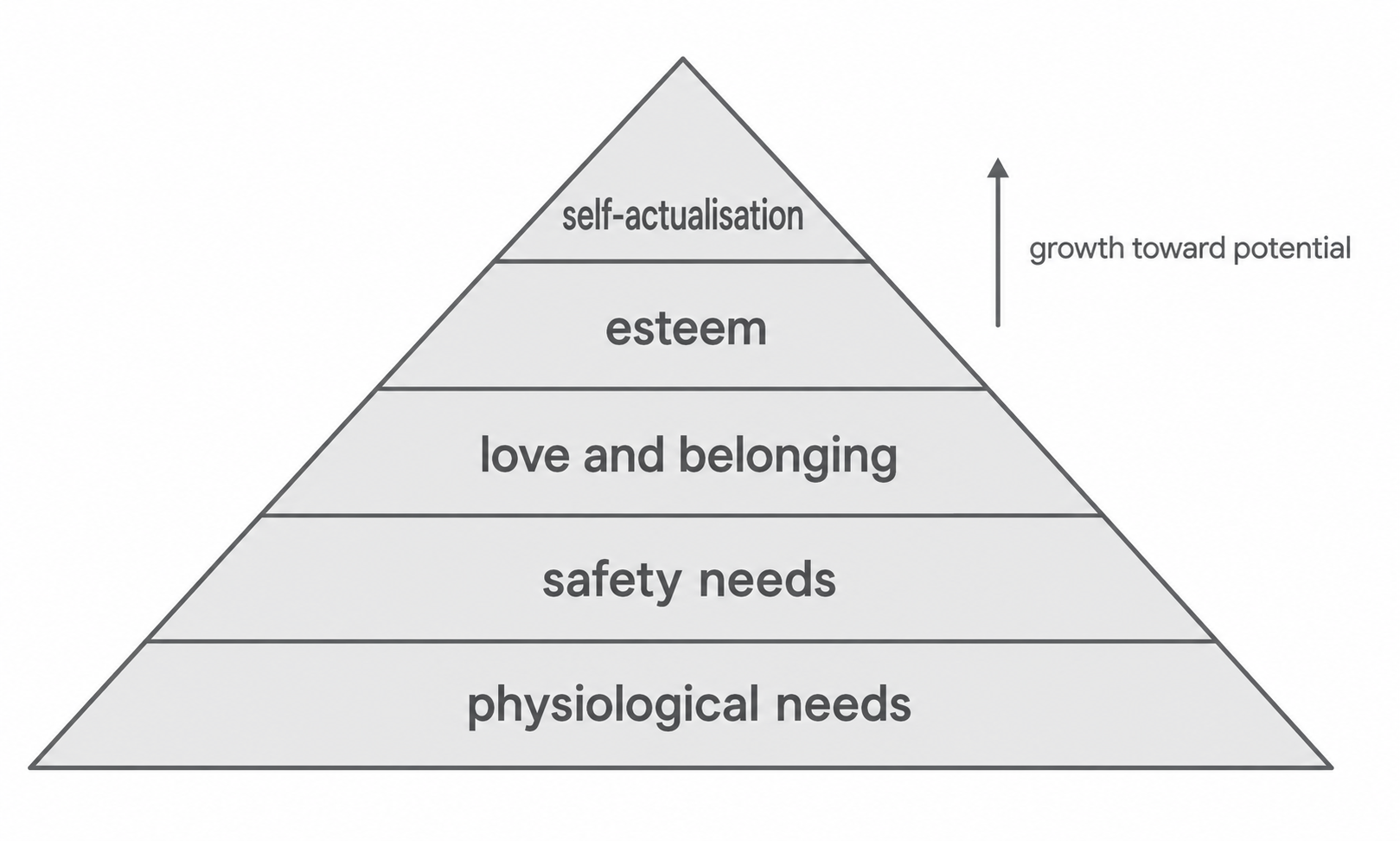
Maslow organised human needs by their relative priority, from survival to fulfilling personal potential.
AO1: Self-Actualisation
Self-actualisation
Self-actualisation is the humanistic idea that people are motivated to grow, develop and fulfil their potential.
Maslow argued that people are not only pushed by biological survival needs. Once important lower needs are sufficiently met, people can become more strongly motivated by growth: creativity, independence, meaningful goals and becoming the kind of person they are capable of becoming.
Maslow's hierarchy of needs is usually taught as five levels:
- Physiological needs: basic survival needs such as food, water, sleep and warmth.
- Safety needs: security, stability, protection and predictability.
- Love and belonging needs: affection, friendship, intimacy and group membership.
- Esteem needs: self-respect, competence, achievement and respect from others.
- Self-actualisation: personal growth and fulfilling one's potential.
Maslow described lower needs as more pre-potent: if a person is starving or unsafe, those needs tend to dominate attention. The hierarchy should not be learned as a rigid staircase where every person must complete one level perfectly before touching the next. It is better to understand it as a pattern of relative priorities.
[DIAGRAM: asset_name: Maslow's hierarchy of needs; asset_slug: 4_2_1_05_humanistic_psychology__diagram_01; recommended_method: image_gen; description: Maslow’s five needs from physiological needs to self-actualisation]
AO2: Applying The Hierarchy
Imagine Karim wants to train as a paramedic but is currently worried about rent and food costs. A humanistic explanation would predict that his physiological and safety needs may dominate for now, making it harder to focus on self-actualisation. If his housing and finances become stable, his motivation may shift toward esteem and self-actualisation: gaining competence, contributing to others and becoming the kind of person he wants to be.
AO3: The Useful But Imperfect Ladder
The hierarchy is memorable and has had wide influence in education, therapy and workplace motivation. However, evidence for a strict hierarchy is mixed. Tay and Diener's cross-national research found that need fulfilment was related to subjective well-being across many countries, which supports the importance of needs, but the different needs were not simply dependent on lower needs being met first. For AQA AO3, that means Maslow's theory is useful as a broad model of motivation but weaker as a precise scientific sequence.
Rogers And Congruence
Carl Rogers developed a humanistic account of personality and therapy that helps explain the AQA terms congruence and conditions of worth. Rogers argued that people have a drive toward growth, but this growth depends on how their self-concept develops through relationships.
AO1: Self-Concept, Ideal Self And Congruence
Congruence
Congruence is a state in which a person's self-image and ideal self are broadly consistent, so the person can accept who they are while still developing.
A simple way to remember Rogers is:
- Self-image: how I see myself now.
- Ideal self: the person I would like to be.
- Congruence: the overlap between the two.
- Incongruence: a mismatch between the two, often linked to anxiety, low self-worth or defensiveness.
For Rogers, psychological health is more likely when people can recognise their real experiences accurately and include them in the self. A congruent person does not have to pretend to be perfect to feel acceptable. An incongruent person may reject or distort parts of their experience because those parts do not fit the person they think they must be.
AO2: Congruence In A Scenario
Niamh sees herself as creative and wants to become a designer. If she chooses design because it fits her own values and feels able to accept setbacks while improving, her self-image and ideal self are reasonably congruent. If she sees herself as "a failure" unless every project is praised, her ideal self has become unrealistic and she is more likely to experience incongruence.
AO3: The Subjective Self
Rogers' theory is strong at explaining the emotional cost of living according to a false self. It can account for why two people in similar situations may experience them differently: what matters is the meaning of the situation to the person. The limitation is that concepts such as the ideal self and congruence are subjective, so researchers must rely heavily on self-report, interviews or therapy material. That makes precise measurement and replication harder.
Conditions Of Worth
Acceptance that depends on meeting other people's standards can change how a person values themselves.
AO1: What Conditions Of Worth Are
Conditions of worth
Conditions of worth are rules a person believes they must meet to be valued, loved or accepted.
Rogers argued that children need positive regard from important people. When that regard is unconditional, the child can feel valued as a person even when specific behaviours are corrected. When regard is conditional, the child may learn that they are only worthwhile if they meet certain standards.
Examples of conditions of worth include:
- "I am lovable only if I get top grades."
- "I am acceptable only if I never seem angry."
- "I matter only if I make my parents proud."
- "I am valuable only when other people approve of my appearance."
The problem is not having goals or standards. The problem is self-worth becoming conditional. A student can value effort without believing they are worthless after one poor mark. Humanistic Psychology predicts that harsh conditions of worth can block self-actualisation because the person chooses for approval rather than growth.
AO2: From Conditions Of Worth To Incongruence
Aisha enjoys drama, but her family only praises academic achievement. Over time she develops the condition of worth "I am worthwhile only if I am the highest achiever." She may deny her interest in drama, feel anxious when she is not perfect, or choose subjects that win approval rather than fit her actual values. In Rogers' terms, her experience and self-concept are becoming incongruent.
AO3: Why This Has Practical Value
This idea has influenced person-centred counselling, where the therapist aims to provide empathy, genuineness and unconditional positive regard. The logic is that a person who feels accepted may become less defensive, examine experiences they previously denied, and move toward greater congruence. This is a practical strength, although the updated AQA 2025 bullet does not require counselling as a separate named topic.
Evaluating Humanistic Psychology
Humanistic explanations highlight agency and personal meaning, but their scientific and cultural limits need scrutiny.
AO3: Strengths
Humanistic Psychology has an important positive contribution: it challenges the idea that human behaviour is fully determined. This makes it attractive in applied settings because it encourages responsibility, reflection and personal growth. It also avoids reductionism by considering motivation, self-concept, relationships and subjective experience together.
It can also explain behaviours that are hard to capture through simple stimulus-response or biological accounts. For example, someone may leave a safe but unfulfilling job to become a nurse, artist or teacher. A humanistic explanation can make sense of this as a movement toward esteem, meaning and self-actualisation, not just external reward.
AO3: Limitations
The main scientific criticism is testability. Free will, self-actualisation and congruence are difficult to operationalise, so the approach is harder to investigate with controlled experiments. This does not make it useless, but it does make it less precise than approaches with measurable variables such as response rates, brain activity or hormone levels.
Maslow's hierarchy also has mixed empirical support. Wahba and Bridwell's classic review reported only partial support for the need hierarchy. Later cross-cultural evidence, such as Tay and Diener's work, supports the importance of need fulfilment for well-being but challenges a strict step-by-step hierarchy. Students should avoid writing that Maslow's hierarchy is "proven"; a stronger AO3 phrase is "useful but not strongly supported as a rigid sequence."
There is also a culture-bias issue. Humanistic Psychology often values individual autonomy, personal fulfilment and becoming one's unique self. Those ideals fit many Western individualist cultures, but they may not map neatly onto collectivist cultures where identity, duty and fulfilment are more strongly tied to family or community. This means universal claims about self-actualisation should be treated cautiously.
Finally, the approach can underplay constraints. Poverty, discrimination, illness, trauma and biological vulnerability can limit choice. A balanced answer should say that Humanistic Psychology rightly highlights agency, but may overestimate how freely people can choose in unequal or difficult circumstances.
Explaining choice and growth
The same visible achievement can reflect growth toward a personally valued goal or an attempt to satisfy conditions of worth; explain the person's motive rather than treating success itself as proof of self-actualisation.
Consider two students who both choose medicine. Noor enjoys biology, values caring for people and regards a difficult training course as a way to develop her potential. This choice can illustrate self-actualisation. Dan enjoys music but believes his parents will accept him only if he becomes a doctor. His identical course choice may instead reflect a condition of worth. If Dan's ideal image of a worthy person conflicts with his experiences and interests, he may become incongruent.
The distinction depends on psychological meaning. A demanding goal is not automatically a condition of worth: it becomes one when personal acceptance depends on meeting it. Likewise, pursuing music is not automatically self-actualisation; the explanation must connect the activity to the person's own potential and growth.
Maslow and Rogers can therefore explain different parts of the same situation. Maslow's hierarchy helps explain why insecurity or unmet belonging needs can dominate motivation. Rogers explains why conditional regard can produce an unrealistic ideal and denial of real experience. A person may pursue growth while still having unmet needs; the hierarchy expresses relative priority rather than a perfect all-or-nothing sequence.
To evaluate this combined explanation, ask what it captures and what would count as evidence against it. It gives meaning to differences hidden by identical behaviour, but private motives and congruence are difficult to measure independently of the person's report. A convincing explanation should not label every outcome as growth after the event.