4.2.2 - The divisions of the nervous system
The nervous system coordinates information from receptors, decisions in the central nervous system and responses throughout the body. You will map the brain and spinal cord, the peripheral and somatic systems, and the autonomic system. Applying the hierarchy to everyday and emergency responses will help you explain both direction of communication and how the divisions work together.
The nervous system as a map
This topic is small, but it is high-value because it gives you the map for the rest of biopsychology. AQA's wording is: the nervous system is divided into central and peripheral, and the peripheral nervous system is divided into somatic and autonomic.
Nervous system
The body's rapid communication network, using specialised nerve cells to send information between the brain, spinal cord and body.
AO1: the required hierarchy
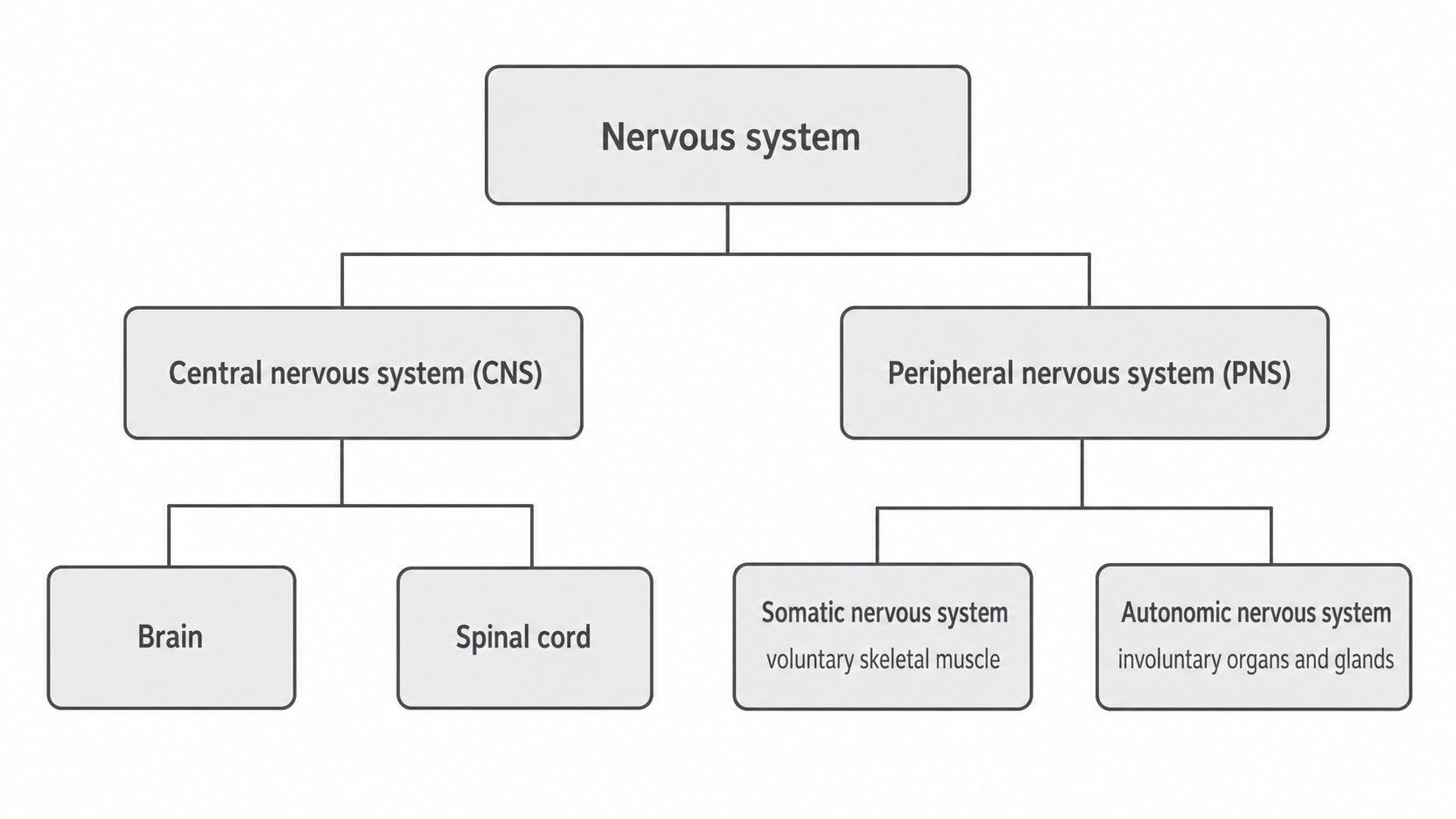
The structure is:
- Nervous system
- Central nervous system (CNS): the brain and spinal cord.
- Peripheral nervous system (PNS): nerves outside the brain and spinal cord.
- Somatic nervous system: the part of the PNS linked to voluntary skeletal-muscle movement and sensory information.
- Autonomic nervous system: the part of the PNS linked to involuntary regulation of internal organs and glands.
[DIAGRAM: asset_name: Divisions of the nervous system hierarchy; asset_slug: 4_2_2_01_the_divisions_of_the_nervous_system__diagram_01; recommended_method: image_gen; description: Hierarchy showing Nervous system splitting into Central nervous system (CNS) and Peripheral nervous system (PNS), CNS splitting into Brain and Spinal cord, and PNS splitting into Somatic nervous system and Autonomic nervous system with brief function labels.]
AO2: why the map matters
If a scenario says that Mia decides to lift her hand, classify it as somatic because it involves voluntary control of skeletal muscles. If it says Mia's heart rate increases before a speech, classify it as autonomic because it involves internal bodily regulation without direct conscious command.
Central nervous system
The brain and spinal cord process information and coordinate responses, including rapid protective reflexes.
Central nervous system (CNS)
The division of the nervous system made up of the brain and spinal cord.
AO1: brain and spinal cord
The brain is the main processing organ. It interprets information, coordinates responses and supports behaviour, cognition and emotion. In AQA biopsychology, later lessons zoom in on localisation of function, but for this lesson the key point is simply that the brain is part of the CNS.
The spinal cord links the brain with the body and can coordinate simple reflex responses. It is not just a cable; it is part of the CNS because it processes and relays information.
AO2: applying the CNS
Imagine Sam touches a very hot mug and pulls his hand away before he has fully thought about it. The spinal cord is involved in the rapid reflex route, and the brain is involved in later conscious awareness of pain and decision-making, such as putting the mug down. The example shows that the CNS is not only "thinking"; it also coordinates rapid protective responses.
AO3: avoiding an oversimplification
Calling the CNS the "control centre" is useful, but it can be misleading if it makes the PNS sound passive. Behaviour usually depends on continuous communication between CNS and PNS: information comes in from the body, is processed, and responses are sent back out. A strong answer treats the divisions as a working system rather than isolated boxes.
Peripheral and somatic systems
Peripheral nerves link the CNS to the body; somatic pathways carry sensory input and control skeletal muscles.
Peripheral nervous system (PNS)
The division of the nervous system made up of nerves outside the brain and spinal cord, carrying messages between the CNS and the rest of the body.
AO1: the PNS is the route network
The PNS connects the CNS to sense organs, muscles, organs and glands. It carries information towards the CNS, such as touch or temperature, and carries instructions away from the CNS, such as movement commands.
Somatic nervous system
The subdivision of the PNS involved in sensory information and voluntary control of skeletal muscles.
The somatic nervous system is the part to think of when a person deliberately moves skeletal muscles: walking, writing, pressing a button, raising a hand, or turning their head towards a sound. It also carries sensory information from receptors to the CNS, so do not reduce it to movement only.
AO2: spotting somatic examples
If a question says Aisha chooses to type an answer, kicks a football, or feels cold air on her skin, the somatic nervous system is relevant because skeletal-muscle movement and sensory information are involved.
AO3: a small precision point
Students often write that the somatic system is simply "conscious". That is a useful shorthand, but it is not perfect. Some somatic pathways can be involved in quick responses without much conscious reflection, and the system also carries sensory messages. In an exam, the safer phrase is voluntary skeletal-muscle movement and sensory information.
Autonomic nervous system
Autonomic pathways regulate internal organs and glands as the body adapts to changing conditions.
Autonomic nervous system
The subdivision of the PNS that regulates internal organs and glands, usually without direct conscious control.
AO1: internal regulation
The autonomic nervous system controls bodily processes such as heart rate, digestion, pupil size, sweating and gland activity. It helps keep the body working automatically while attention is on other things.
You may see the autonomic system described as having sympathetic and parasympathetic branches. That distinction is useful background for the later fight-or-flight lesson, but AQA's requirement here is only that you know autonomic as a subdivision of the PNS and can distinguish it from somatic.
AO2: spotting autonomic examples
If Priya's mouth goes dry before an interview, her pupils widen in a dark room, or her digestion slows when she is anxious, the autonomic nervous system is involved. These changes affect organs and glands rather than deliberate skeletal-muscle movements.
AO3: involuntary does not mean irrelevant to psychology
Autonomic activity is often outside direct conscious control, but it can still be shaped by psychological states. Anxiety, stress, relaxation and learned associations can alter heart rate, sweating or digestion. This is a useful biopsychology link: behaviour and experience are not separate from the body's internal regulation.
Coordination across nervous-system divisions
A single response can involve several divisions in sequence, so classification must explain how the parts communicate.
AO1: compare the terms accurately
| Term | What it includes | Core function |
|---|---|---|
| Central nervous system | Brain and spinal cord | Processing, coordination and relay |
| Peripheral nervous system | Nerves outside the CNS | Communication between CNS and body |
| Somatic nervous system | Part of the PNS | Sensory information and voluntary skeletal-muscle movement |
| Autonomic nervous system | Part of the PNS | Involuntary regulation of organs and glands |
AO2: use the clue words
Look for what the person is doing or what the body is changing:
- Decides, reaches, writes, presses, walks: usually somatic.
- Feels touch, temperature or pain: somatic sensory information.
- Heart rate, pupils, sweating, digestion, glands: usually autonomic.
- Brain, spinal cord, reflex route or processing: CNS.
Integration and limits of a simple hierarchy
A reflex is a rapid, automatic response to a stimulus. Automatic does not always mean autonomic: withdrawing a hand uses skeletal muscles and somatic pathways even though the spinal cord can coordinate the response before conscious choice. Sensory information travels into the CNS, and motor commands return to the muscle through peripheral nerves. Heart-rate changes alongside that response use autonomic pathways.
The division system is useful because it gives psychologists a clear biological vocabulary for applying explanations to behaviour. It also supports more precise AO2: instead of saying "the body reacts", a student can say whether the response involves CNS processing, somatic movement or autonomic regulation.
There are limits. First, real behaviour is integrated. Catching a falling glass needs visual input, CNS processing, somatic movement and possibly autonomic arousal. The categories help analysis, but they should not imply that one part works alone.
Second, the somatic/autonomic distinction can become too reductionist if students treat complex behaviour as only a biological pathway. Psychological meaning matters too: a racing heart before an exam is autonomic, but the trigger may be cognitive appraisal of threat.
Third, some physiology sources discuss the enteric nervous system as part of autonomic control of digestion. That is useful scientific background, but for this AQA lesson the assessed wording is central, peripheral, somatic and autonomic. Do not add enteric detail unless a question specifically invites wider biological knowledge.