4.2.2 - The function of the endocrine system
Hormonal messages travel more slowly than neural impulses but can influence the body for much longer. This lesson traces how glands release hormones into the bloodstream, how target cells respond, and how the pituitary coordinates other glands. You will apply the roles of the thyroid, adrenal glands, pancreas, ovaries and testes, then compare endocrine communication with the nervous system in psychological explanations.
A chemical communication system
The endocrine system is the body's slower, chemical communication system. In Psychology, it matters because hormones can influence arousal, stress, sleep, appetite, mood, development and reproductive behaviour. The key exam move is simple: do not describe hormones as "feelings" or "thoughts". They are biological messengers that help coordinate body systems, and those body changes can affect behaviour.
Endocrine system
The endocrine system is a network of glands and hormone-producing tissues that release hormones into the blood to coordinate activity in target organs and cells.
Gland
A gland is an organ or specialised group of cells that produces and releases a substance. An endocrine gland is ductless: it releases hormones directly into the bloodstream rather than through a tube or duct.
Hormone
A hormone is a chemical messenger made by specialist cells, usually in an endocrine gland, and carried in the blood to other parts of the body.
The diagram shows one common endocrine control chain, not a route followed by every hormone. The hypothalamus links the nervous system to the endocrine system, the pituitary helps regulate several other glands, endocrine glands release hormones, and target cells respond only if they have the right receptors.
[DIAGRAM: asset_name: Endocrine command chain; asset_slug: 4_2_2_03_the_function_of_the_endocrine_system__diagram_01; recommended_method: image_gen; description: A common endocrine control pathway: hypothalamus and pituitary signalling to an endocrine gland, hormones travelling in blood, target cells responding, and feedback returning to the brain/pituitary.]
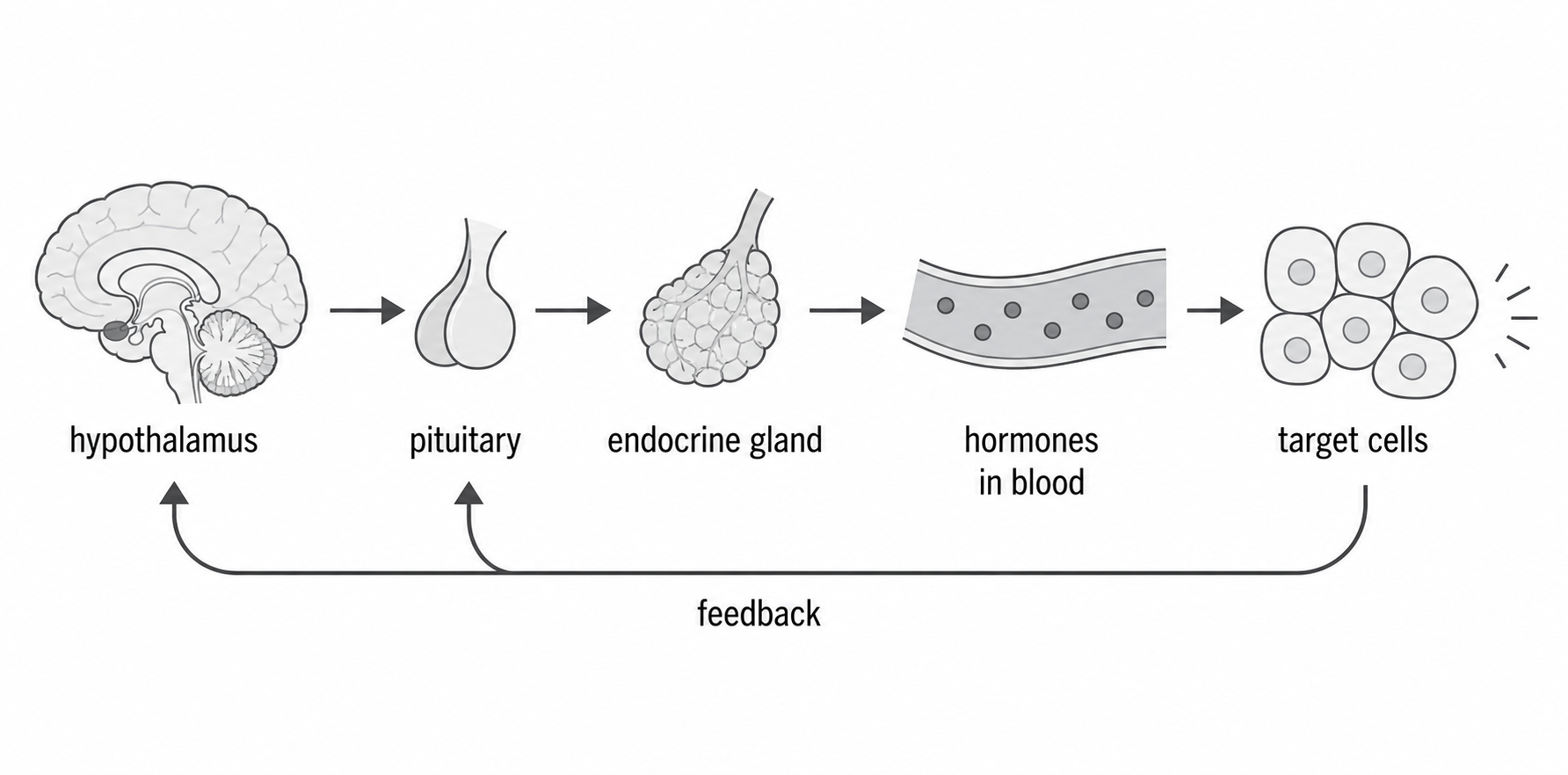
AO1: The endocrine system uses glands and hormones. Glands produce and release hormones; hormones travel in the bloodstream; target cells with matching receptors respond.
AO2: If a student says, "Adrenaline made me panic," improve it to: "The adrenal glands released adrenaline, which changed bodily arousal. The person's interpretation of the situation then contributed to the experience of panic." That keeps the biological mechanism and the psychological context together.
Glands and their hormones
AQA's wording is broad: "glands and hormones". You do not need to memorise every endocrine gland in anatomical detail, but you should be able to explain the principle with accurate examples.
AO1: Major endocrine glands and hormone-producing structures include:
| Gland or structure | Example hormone(s) | Why it matters for behaviour and the body |
|---|---|---|
| Hypothalamus | Releasing and inhibiting hormones | Links the brain with endocrine control by regulating the pituitary gland. |
| Pituitary gland | ACTH, growth hormone and TSH; releases oxytocin and ADH made in the hypothalamus | Often called the "master gland" because several anterior-pituitary hormones stimulate other glands; the hypothalamus regulates its activity. |
| Thyroid gland | Thyroxine and triiodothyronine | Helps regulate metabolic rate, energy use and development. |
| Adrenal glands | Adrenaline, noradrenaline, cortisol | Involved in arousal, stress response, blood pressure and blood glucose regulation. |
| Pancreas | Insulin and glucagon | Helps regulate blood glucose, which is relevant to energy balance and homeostasis. |
| Ovaries and testes | Oestrogen, progesterone, testosterone | Involved in biological sex characteristics, reproduction and some developmental processes. |
The endocrine system is not a single organ. It is a distributed system: glands are spread around the body but work together through blood-borne chemical messages. This is why a gland in one location can influence cells somewhere else.
AO2: After Theo eats a meal, rising blood glucose stimulates pancreatic insulin release. This illustrates a gland responding directly to a change in the blood rather than waiting for a pituitary command. The pituitary coordinates several glands, but is not the sole controller of all endocrine secretion.
How hormones produce effects
Hormones can travel widely in the blood, but they do not affect every cell they pass. A hormone produces an effect only where cells have receptors that fit that hormone. The receptor idea is crucial because it explains specificity: a chemical messenger can circulate around the body but still have targeted effects.
Target cell
A target cell is a cell with receptors for a particular hormone, so it can detect and respond to that hormone.
Endocrine signalling is usually slower than nervous-system signalling because hormones must be released into the blood, transported, and then bind to receptors. However, endocrine effects can last longer than a neural impulse. This is useful for body-wide regulation, such as maintaining homeostasis, supporting growth, coordinating reproduction, and sustaining aspects of the stress response.
Homeostasis
Homeostasis is the maintenance of a stable internal environment, such as keeping blood glucose, body temperature or water balance within a healthy range.
Many endocrine processes use feedback. In negative feedback, the outcome of a process reduces or stops further release. For example, if a hormone has produced enough of an effect, signals can reduce further hormone release so the body does not overshoot. This keeps the endocrine system responsive rather than permanently "on".
AO1: A complete hormone pathway has four steps: secretion by a gland, transport in blood, binding to receptors on target cells, and a response in those cells. Feedback then helps regulate the amount released.
AO2: Sam has eaten a large meal. His pancreas releases insulin, and cells with insulin-sensitive receptors take up more glucose from the blood. Once blood glucose returns closer to its normal range, negative feedback helps reduce further insulin release.
Hormones and psychological interpretation
Biopsychology exam answers often reward students who can move between biology and behaviour without collapsing one into the other. Endocrine activity is biological, but Psychology is interested in how that activity relates to cognition, emotion and action.
AO2 scenario: Nia is about to give a speech. She notices a racing heart and shaky hands, and she interprets these signs as evidence that she is going to perform badly. An endocrine explanation can mention adrenal hormones as part of bodily arousal. A psychological explanation adds interpretation, attention, previous experience and coping strategies. Together, they explain more than either level alone.
This topic also prepares you for the next biopsychology requirement: the fight-or-flight response, including the role of adrenaline. In this lesson, adrenaline is only an example of a hormone released by the adrenal glands. The detailed fight-or-flight sequence belongs to the next lesson.
AO1: Endocrine examples are useful when an answer asks about biological systems, glands, hormones, or body-wide chemical communication.
AO2: Apply endocrine knowledge by naming the gland, naming the hormone where relevant, describing the target/effect, and linking that effect to the scenario.
AO3: Good application avoids biological determinism. Hormones can influence readiness, arousal or bodily state, but they do not automatically decide a person's thoughts or behaviour in every context.
Evaluating hormone–behaviour explanations
Endocrine explanations are valuable because they connect behaviour to measurable biological processes. Hormone levels can often be measured in blood, saliva or urine, and this gives psychologists a more objective way to investigate links between physiology and behaviour than relying only on self-report.
However, endocrine explanations can become too reductionist if they imply that complex behaviour is "just hormones". For example, stress, aggression, attraction, sleep, eating and mood are all affected by social context, learning, cognition and individual differences as well as biological state.
AO3 strength: Endocrine explanations have scientific value because they identify observable mechanisms. A claim such as "the adrenal glands release adrenaline into the bloodstream" is more precise and testable than a vague claim such as "the body becomes emotional".
AO3 limitation: Hormone-behaviour links are often bidirectional. Hormones can affect behaviour, but situations, thoughts and behaviours can also affect hormone release. A stressful appraisal can increase endocrine activity; endocrine arousal can then shape later appraisal. This makes simple cause-and-effect claims risky.
AO3 comparison: Compared with the nervous system, the endocrine system is usually slower and more diffuse, but its effects can be longer-lasting and body-wide. The best biopsychology answers treat the two systems as interacting rather than as separate rivals.
Exam judgement: If a question asks for "the function of the endocrine system", prioritise AO1 accuracy. If a question asks you to apply or evaluate, build from that AO1: gland -> hormone -> bloodstream -> target cells -> effect -> behavioural relevance -> limitation.