4.2.1 - The biological approach
The biological approach traces behaviour to genes, evolution, nervous-system structures and neurochemistry. You will distinguish genotype from phenotype, examine how natural selection can shape behavioural tendencies, and explore how neurotransmitters and cognitive neuroscience link mind to brain. The evidence can be precise and objective, but evaluation asks whether correlations establish cause and whether reducing complex behaviour to one biological mechanism loses important context.
What the biological approach claims
The biological approach explains behaviour by looking for physical mechanisms inside the body. Its central claim is that thoughts, emotions and actions are influenced by genes, brain structures, neural communication, hormones and evolutionary pressures.
Biological approach
The biological approach is an approach in psychology that explains behaviour in terms of biological processes, including genes, the nervous system, brain structures, neurochemistry and evolution.
This does not mean biological psychologists think behaviour is simple. A careful biological explanation usually links several levels:
- A person's genotype gives them inherited biological potential.
- Gene expression and environmental influences help shape the phenotype.
- Biological structures and neurochemistry affect information processing, emotion, motivation and action.
- Behaviour is observed and measured.
[DIAGRAM: asset_name: Biological levels of behaviour; asset_slug: 4_2_1_03_the_biological_approach__diagram_01; recommended_method: image_gen; description: Genetic, brain and chemical levels linked schematically to behaviour]
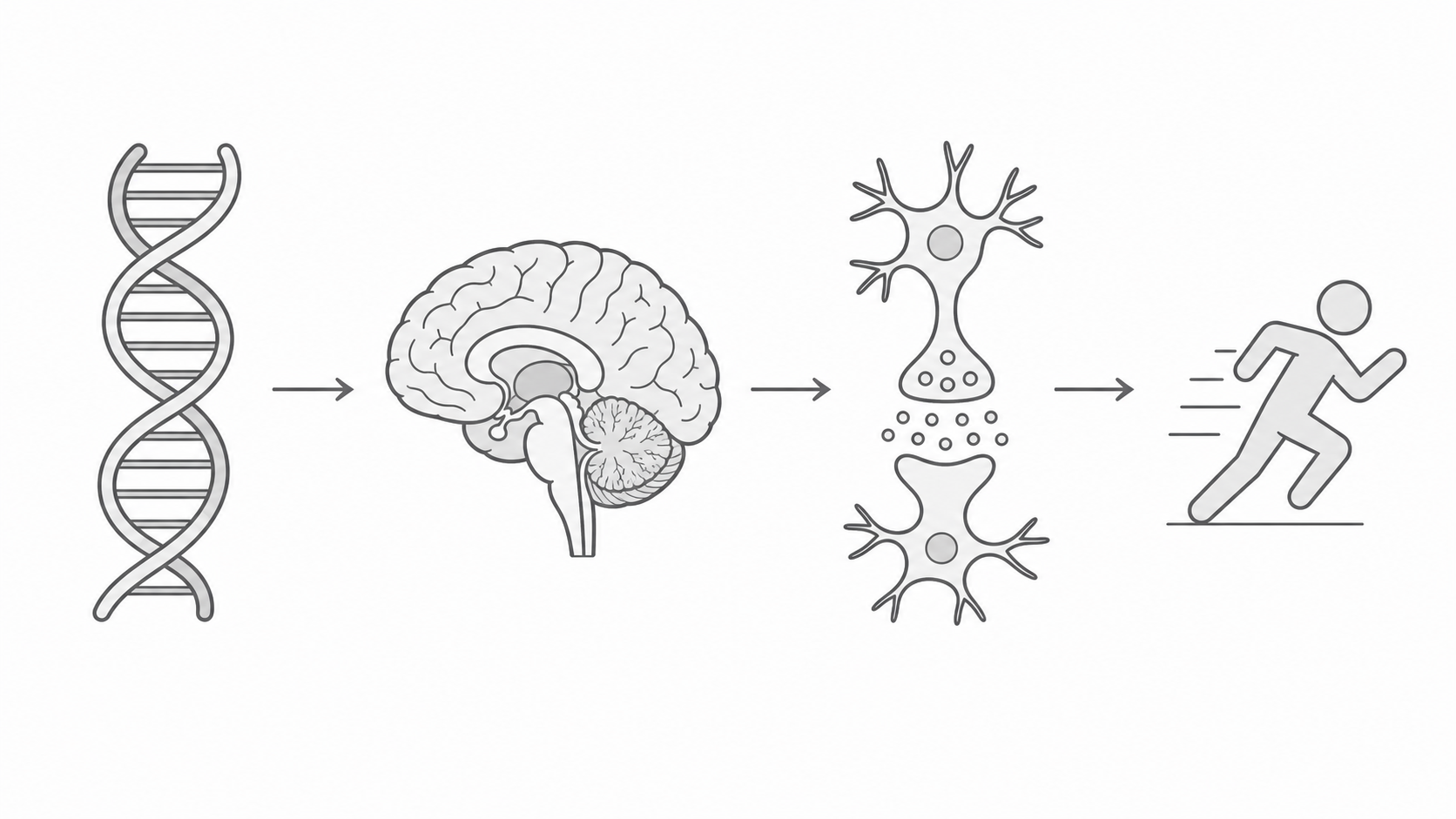
The icons link genetic, structural and chemical levels to behaviour. The arrows simplify possible influences; they do not show an inevitable one-way chain. Experience can alter biology, and the sketch of neural communication is symbolic rather than an anatomical account of a synapse.
AO1: the exam core
For AQA, this lesson has four required clauses:
- the genetic basis of behaviour, including genotype and phenotype;
- evolution as a biological explanation;
- the influence of biological structures and neurochemistry on behaviour;
- cognitive neuroscience.
AO2: applying the approach
Imagine Zara becomes very anxious before presentations. A biological psychologist might ask whether she has an inherited vulnerability to high physiological arousal, whether brain areas involved in threat detection are especially reactive, or whether neurotransmitter activity affects her mood and anxiety. That explanation is different from a behaviourist account, which would focus on learned associations, or a cognitive account, which would focus on thoughts and expectations.
AO3: the first judgement
The biological approach is powerful because it can use scientific tools such as genetic analysis, brain imaging and drug studies. However, it can become reductionist if it explains a complex behaviour only as "genes" or "brain chemistry" and ignores learning, cognition, culture and personal meaning.
Genes, phenotype and evolution
Inherited variation can influence behaviour within a lifetime and change in frequency across generations.
AO1: genotype and phenotype
Gene
A gene is a section of DNA that contributes to inherited characteristics by influencing the production of proteins and biological processes.
Genotype
Genotype is a person's genetic make-up. In psychology, the term is used to describe inherited genetic potential for characteristics or vulnerabilities.
Phenotype
Phenotype is the observable expression of genetic and environmental influences, such as a person's behaviour, traits, appearance or symptoms.
The safest exam phrase is: genotype is potential; phenotype is expression. A genotype may increase the probability of a behaviour or trait, but it does not guarantee it. Most psychological characteristics are polygenic, meaning they are influenced by many genes rather than one "gene for" the behaviour.
The environment also matters. Nutrition, stress, parenting, peer relationships, culture, education and trauma can all affect whether genetic vulnerabilities are expressed. This is why genetic influence should not be presented as genetic inevitability; biological explanations can recognise interaction with the environment.
Gene-environment interaction
Gene-environment interaction means that the effect of genetic vulnerability depends partly on environmental conditions, and the effect of the environment may depend partly on the person's genotype.
AO1: evolution and natural selection
Evolution
Evolution is change in inherited characteristics across generations. In biological psychology, evolutionary explanations propose that some behaviours or psychological mechanisms may have been shaped because they helped ancestors survive or reproduce.
Natural selection
Natural selection is the process by which heritable traits that improve survival or reproductive success become more common in a population over generations.
Natural selection requires inherited variation. If a variant tendency improves survival and reproduction, carriers may leave more offspring who inherit that tendency; across generations it can become more common. An acquired habit is not automatically passed on genetically, and an adaptive story needs evidence rather than simply sounding plausible.
Evolutionary explanations are not about individual choice in one lifetime. They are about inherited tendencies across many generations. For example, rapid fear responses may have been adaptive in ancestral environments because quickly detecting threat increased survival chances. In modern life the same threat system may sometimes be overactive, contributing to anxiety or phobias.
AO2: applying genotype and phenotype
Leah has a family history of depression, which may indicate a genetic vulnerability. However, Leah's actual phenotype depends on much more than that vulnerability. If she experiences chronic stress, poor sleep and little social support, the vulnerability may be more likely to be expressed. If she has stable routines, supportive relationships and effective coping strategies, the same vulnerability may not lead to depression.
AO3: evidence from twins, with caution
Twin studies are often used because identical twins share all of their genes, whereas non-identical twins share about half of their segregating genes on average. If identical twins are more similar for a trait than non-identical twins, this supports a genetic contribution.
Bouchard and colleagues (1990), in the Minnesota Study of Twins Reared Apart, assessed more than 100 sets of reared-apart twins or triplets. The study reported that about 70% of the variance in IQ in their sample was associated with genetic variation. This is useful AO3 evidence that genes can influence psychological characteristics.
The caution is just as important. Heritability is a population statistic, not a statement that 70% of one person's intelligence is "caused by genes". Twin studies can also be affected by assumptions about how similar twin environments are, selective placement in adoption, and the fact that genes and environments often correlate. Biological evidence supports genetic influence; it does not prove genetic destiny.
Biological structures and neurochemistry
Biological explanations connect physical systems and chemical communication with behaviour.
AO1: biological structures
Biological structure
A biological structure is a physical part of the body or nervous system, such as a brain region, neural pathway, gland or receptor system, that can influence behaviour.
In this lesson, do not try to memorise every brain area. The exam point is broader: behaviour can be influenced by the structure and functioning of biological systems. Examples include:
- the amygdala, which is involved in emotional processing and threat responses;
- the hippocampus, which is important for learning and memory;
- the prefrontal cortex, which is involved in planning, inhibition and decision-making;
- endocrine glands, which release hormones that can affect arousal, stress and motivation.
These structures do not work like isolated switches. A behaviour such as aggression, memory or anxiety usually involves networks of regions, chemical signals and environmental triggers.
AO1: neurochemistry
Neurochemistry
Neurochemistry refers to chemical processes in the nervous system, especially the action of neurotransmitters and hormones that affect neural communication and behaviour.
Neurotransmitter
A neurotransmitter is a chemical messenger released by neurons to communicate with other neurons across a synapse.
Neurotransmitters can excite or inhibit the next neuron, making a response more or less likely. For AQA, you do not need a full synaptic transmission lesson here; that is covered later in Biopsychology. What matters is the explanatory principle: changes in chemical communication can affect mood, motivation, attention and behaviour.
Examples often used in psychology include dopamine in reward, motivation and some explanations of schizophrenia, and serotonin in mood and some explanations of depression or OCD. These examples should be handled carefully. A low or high level of one neurotransmitter is rarely a complete explanation by itself.
AO2: using biological structures and neurochemistry
If Ben takes a drug that increases activity in a neurotransmitter system and his symptoms improve, a biological psychologist may infer that neurochemistry is involved in those symptoms. If brain imaging shows a pattern of activity in areas linked to emotion while Ben processes fearful faces, the explanation may also refer to biological structures.
AO3: why this evidence is useful but limited
A strength is that biological explanations can lead to practical applications. If a neurotransmitter system is linked to symptoms, drug therapy may target that system. If a brain area is linked to a cognitive function, rehabilitation may be designed around that knowledge.
A limitation is causal uncertainty. If a brain structure or chemical pattern is associated with a behaviour, it may be a cause, a consequence, or a correlate of that behaviour. For example, brain differences found in people with a disorder may have contributed to the disorder, but they may also have developed after years of stress, medication, learning or lifestyle differences.
Cognitive neuroscience
Cognitive neuroscience investigates how the nervous system supports mental activity.
AO1: what cognitive neuroscience adds
Cognitive neuroscience
Cognitive neuroscience is the scientific study of the neural mechanisms involved in cognition, linking mental processes such as memory, attention, perception and decision-making to brain activity and biological systems.
Cognitive neuroscience sits at the meeting point of the cognitive and biological approaches. The cognitive approach studies internal mental processes; the biological approach asks how those processes are supported by the brain and nervous system.
For example, a cognitive psychologist might ask how working memory holds information temporarily. A cognitive neuroscientist might ask which brain networks are active while someone updates information in working memory, and whether disruption to those networks changes performance.
AO1: methods, kept in scope
Cognitive neuroscience often uses methods such as brain imaging, lesion evidence, EEG/ERP recordings, stimulation methods and computational modelling. You do not need to evaluate each method in detail here because "ways of studying the brain" is a separate Biopsychology lesson. In this lesson, the key point is that cognitive neuroscience uses biological evidence to investigate mental processes scientifically.
AO2: applying cognitive neuroscience
Nina is asked to remember a sequence of letters while ignoring distracting sounds. A cognitive explanation might refer to attention and working memory. A cognitive neuroscience explanation would go further by studying patterns of brain activity while Nina performs the task, then linking those patterns to her accuracy and reaction time.
AO3: strengths and cautions
Cognitive neuroscience is a strength of the biological approach because it provides objective evidence about the brain systems involved in mental processes. It has contributed to areas such as understanding memory, language, attention, criminal behaviour, mental health and brain injury rehabilitation.
However, brain evidence can be overinterpreted. A brain scan showing activation in an area does not mean that area alone "causes" the behaviour. Imaging data usually show correlations between tasks and activity, and the same brain area may be involved in several functions. Strong answers avoid "scan worship": they explain what the method shows and what it cannot prove.
Evaluating the biological approach
Biological explanations need to be judged by the strength of their evidence and the completeness of the account they provide.
AO3: scientific credibility
A major strength is scientific credibility. Biological psychologists can use objective measures such as genetic analysis, brain imaging, hormone levels, drug trials and carefully controlled animal research. These methods can make explanations more testable and replicable than accounts based only on subjective report.
This is especially useful when biological explanations generate predictions. If a drug that changes neurotransmitter activity reliably reduces symptoms, that supports the idea that neurochemistry is involved. If relatives with more genes in common show more similarity on a trait, that supports a genetic contribution.
AO3: real-world applications
The approach has strong practical value. Biological research has contributed to drug therapies, genetic counselling, brain injury rehabilitation, understanding stress responses and improved knowledge of neurological or mental health conditions. Even when a biological treatment is not the whole answer, it can reduce symptoms enough for psychological therapies or social support to work better.
AO3: biological reductionism
The main criticism is biological reductionism. Reducing depression to serotonin, aggression to testosterone, or memory to the hippocampus can make a complex behaviour easier to study, but it may ignore cognition, learning history, trauma, culture, social inequality and personal meaning.
Reductionism is not always bad. Breaking behaviour into smaller biological components can produce clear research and useful treatments. The weakness appears when the smaller component is treated as the whole explanation.
AO3: determinism and nature-nurture
The biological approach is often associated with biological determinism because it emphasises genes, brain systems and neurochemistry. This can underplay free will and responsibility if it is written too strongly.
A more sophisticated evaluation is interactionist. Genes influence behaviour, but environments influence gene expression and biological development. Brain systems shape behaviour, but repeated behaviour and experience can also change the brain. The strongest AQA answers therefore avoid "nature versus nurture" as a simple choice and explain how nature and nurture interact.
AO3: ethical and social sensitivity
Biological explanations can be socially sensitive. If a behaviour is described as genetically influenced, people may wrongly assume it is fixed or use the claim to stigmatise groups. At the same time, biological explanations can reduce blame by showing that some difficulties are not simply a matter of weak willpower. This creates a careful ethical balance: explain biological influence accurately without implying inevitability.
Applying biological explanations
A useful biological application selects the level that explains the stated evidence and avoids assuming a cause that the scenario does not establish.
For example, a family history of anxiety is consistent with an inherited vulnerability, but relatives also share experiences. Say “may suggest a genetic contribution” rather than claiming that family resemblance proves a gene caused the behaviour. To explain why one relative shows symptoms and another does not, connect genotype with environmental influences on phenotype.
A second example concerns a participant performing a memory task during a brain scan. Memory is the cognitive process; recorded activity is biological evidence. Linking task performance to brain networks is cognitive neuroscience. Merely writing “the brain is involved” misses the connection between the mental task and the measured system. An association between activity and performance does not, by itself, establish which direction the causal influence runs.
Medication provides a third kind of clue. If a drug changes chemical signalling and symptoms change, neurochemistry is a relevant explanatory level. This does not prove the original symptoms were caused by a simple chemical deficiency: changing one part of a system can affect a problem with several causes. A study of a drug's effects and a study of the origins of a disorder ask different questions.
Choose the relevant biological mechanism, link it to the particular behaviour, and state only the inference the evidence supports. Evolution is appropriate when the task concerns inherited tendencies and reproductive success across generations, not simply because a person adapts their habits during one lifetime.