4.2.1 - The psychodynamic approach
Freud's psychodynamic approach explains behaviour through unconscious conflict, early experience and the changing balance between id, ego and superego. You will apply defence mechanisms and psychosexual stages, then consider how case evidence supports or challenges the account. Evaluation focuses on testability, psychic determinism, cultural assumptions and the continuing influence of ideas that are difficult to verify scientifically.
Unconscious Conflict
The psychodynamic approach explains behaviour as the result of forces inside the mind that are often hidden from conscious awareness. It is mainly associated with Sigmund Freud, who argued that people are not always aware of the real motives behind their thoughts, emotions and actions.
Psychodynamic approach
An approach in Psychology that explains behaviour in terms of unconscious motives, internal conflict, childhood experience and the way the personality tries to manage anxiety.
Unconscious
The part of the mind containing wishes, memories, fears and conflicts that a person is not directly aware of, but which can still influence behaviour.
Freud described the mind as having different levels:
- Conscious: what a person is currently aware of.
- Preconscious: material that is not in awareness right now but can be brought into awareness, such as a memory or name.
- Unconscious: material kept outside awareness because it is threatening, unacceptable or anxiety-provoking.
[DIAGRAM: asset_name: Freud's psychodynamic map; asset_slug: 4_2_1_04_the_psychodynamic_approach__diagram_01; recommended_method: image_gen; description: Levels of awareness beside the Ego balancing Id, Superego and social reality]
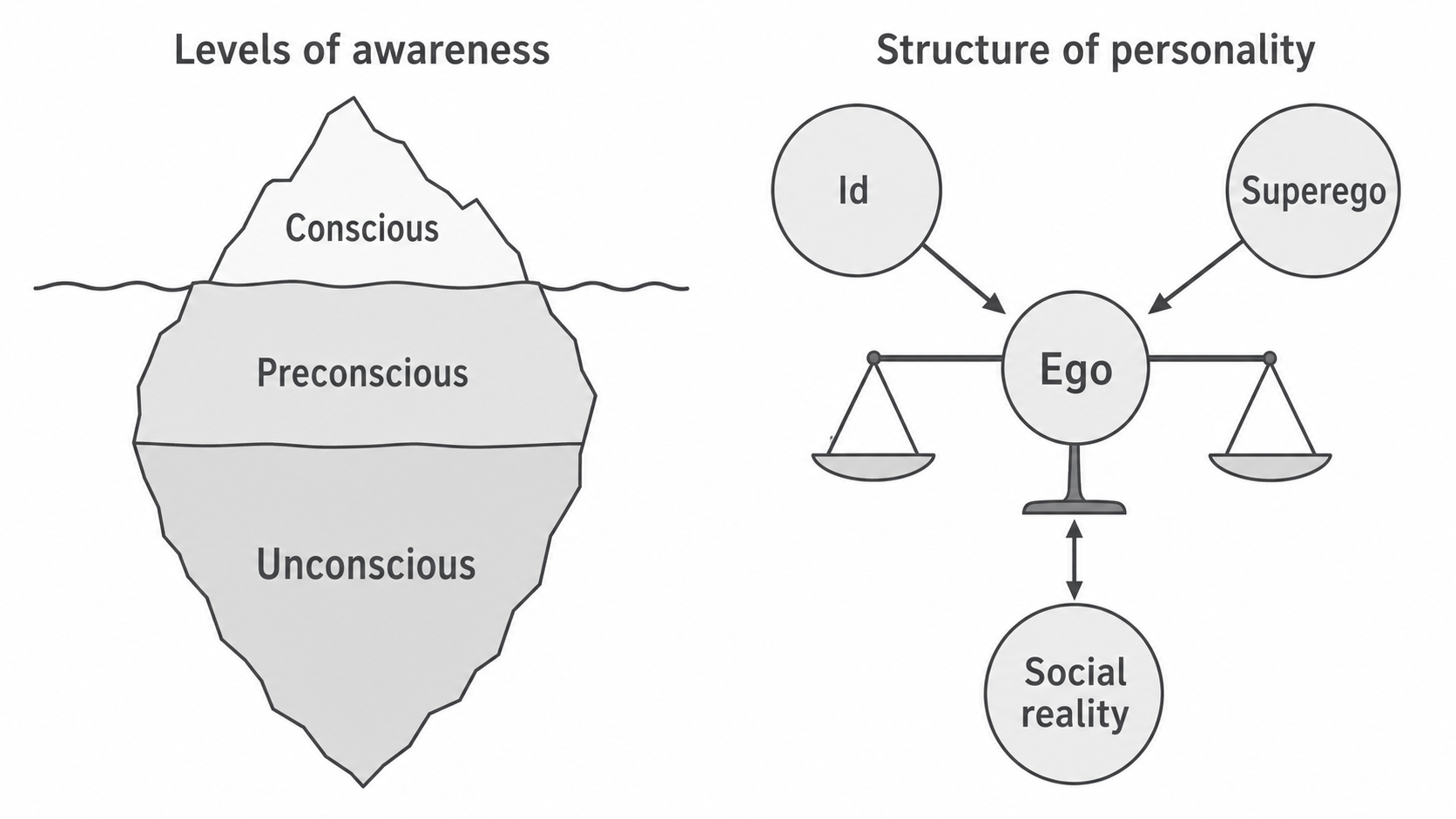
The left panel distinguishes levels of awareness. The right panel previews a different model: the Ego balances Id, Superego and social reality. These are conceptual maps, not locations in the brain; the personality structures are explained in the next section.
AO1: what to know. The core assumption is that much behaviour is psychically determined: it has a psychological cause, even if the person cannot report that cause accurately. For example, a sudden angry outburst might be explained as the expression of an unconscious conflict rather than as a random event.
AO2: how to apply it. If Karim says he is "fine" after a painful break-up but keeps forgetting to reply to messages from his ex-partner, a psychodynamic explanation might look for an unconscious motive: avoiding reminders of distress.
AO3: exam caution. The existence of unconscious processing is not the same as proving Freud's full account of repressed wishes, psychosexual conflict and symbolic symptoms. In evaluation, separate the broad idea that not all mental processing is conscious from the more specific Freudian claims.
The Id, Ego And Superego
Freud's structure of personality explains behaviour as a balance between three parts of the psyche: the Id, Ego and Superego. These are not physical brain structures. They are theoretical parts of personality that help explain inner conflict.
Id
The impulsive part of personality, present from birth, that operates according to the pleasure principle and seeks immediate gratification.
Ego
The rational part of personality that operates according to the reality principle and tries to satisfy the Id in ways that are realistic and socially acceptable.
Superego
The moral part of personality, formed through internalised standards and values, that produces pride when the person meets ideals and guilt when they fall short.
AO1: the three-part conflict.
| Part of personality | Principle | Main demand | Simple exam phrase |
|---|---|---|---|
| Id | Pleasure principle | "I want this now." | Basic instinctive drives and immediate gratification. |
| Ego | Reality principle | "How can this work in the real world?" | Mediates between desire, morality and reality. |
| Superego | Morality principle | "Is this right?" | Conscience, guilt, ideals and internal rules. |
In Freud's account the Id is unconscious and present from birth. The Ego develops as the child encounters reality, often placed around age two; the Superego develops through internalising parental standards, often placed around ages three to six. The Ego and Superego include unconscious processes as well as aspects accessible to awareness, so the three personality structures do not map one-to-one onto conscious, preconscious and unconscious levels.
The Id and Superego often make incompatible demands. The Id may push for immediate satisfaction, while the Superego may condemn the desire as wrong. The Ego tries to reduce the tension by finding a realistic compromise. When the Ego cannot manage the conflict, anxiety increases.
AO2: applying the structure. Leila is furious with a friend who embarrassed her. Her Id pushes her to send a cruel message immediately. Her Superego says this would be wrong and she would feel guilty. Her Ego drafts a calmer message and waits until the next day before sending it. The behaviour is explained as a compromise between impulse, morality and reality.
AO3: a built-in strength and weakness. The model gives a memorable way to apply conflict to everyday behaviour, which is useful for AO2. However, the Id, Ego and Superego are inferred constructs; they cannot be directly observed or measured like reaction time or brain activity.
Defence Mechanisms
When unconscious conflict creates anxiety, Freud argued that the Ego protects the person through defence mechanisms. A defence mechanism reduces anxiety by distorting, blocking or redirecting threatening thoughts and feelings.
Defence mechanism
An unconscious strategy used by the Ego to manage anxiety produced by conflict between the Id, Superego and reality.
AQA names three defence mechanisms: repression, denial and displacement.
| Defence mechanism | AO1 definition | AO2 example |
|---|---|---|
| Repression | Unconsciously blocking unacceptable thoughts, wishes or memories from conscious awareness. | A person has no conscious memory of a frightening incident but feels anxious in similar situations. |
| Denial | Unconsciously failing to accept a threatening reality. | A student insists they are not behind on work despite multiple missed deadlines. |
| Displacement | Redirecting an impulse or emotion from its real target to a safer substitute. | After being criticised by a manager, a worker goes home and snaps at a housemate. |
A missing memory alone does not demonstrate repression: ordinary forgetting and other explanations must be considered. The table shows how Freud might interpret behaviour, not a way to diagnose a person.
AO1: key distinction. Repression is not the same as choosing not to think about something. If a student deliberately puts a worry aside to revise, that is closer to conscious suppression. Repression is unconscious.
AO2: exam move. In a scenario, look for the emotional trigger and the way the person avoids it. If the person cannot accept the truth, think denial. If the person aims emotion at a safer target, think displacement. If the threatening material is kept out of awareness, think repression.
AO3: evaluation link. Defence mechanisms are useful in clinical explanations because they make sense of why people may avoid painful material. The weakness is that they are often identified after the event, so the explanation can become circular: a person forgot because of repression, and we know it was repression because they forgot.
Psychosexual Stages
Freud believed personality develops through psychosexual stages in childhood. At each stage, pleasure-seeking energy is focused on a different area of the body, and the child faces a conflict linked to that stage. If the conflict is unresolved, Freud argued that fixation can occur: some psychological energy remains tied to that stage and may affect adult personality.
Psychosexual stage
A stage in Freud's theory of development in which the child's pleasure-seeking impulses are focused on a particular body area and developmental conflict.
Fixation
In Freud's theory, unresolved conflict at a psychosexual stage that leaves the person psychologically attached to that stage.
AO1: the five stages.
| Stage | Approximate age | Focus | Main conflict Freud proposed | Possible fixation example |
|---|---|---|---|---|
| Oral | 0-1 | Mouth | Weaning and feeding. | Smoking, nail biting or overeating as oral comfort behaviours. |
| Anal | 1-3 | Bowel/bladder control | Toilet training and control. | Excessive orderliness or messiness. |
| Phallic | 3-6 | Genitals | Oedipus-type conflict and identification in traditional accounts. | Vanity, ambition or unresolved gender-role conflict in traditional accounts. |
| Latency | 6-puberty | Sexual impulses less active | Energy redirected into school, friendships and skills. | Usually described as a calmer period rather than a fixation stage. |
| Genital | Puberty+ | Mature sexuality | Adult relationships and mature sexual interests. | Healthy adult relationships if earlier conflicts are resolved. |
In Freud's historical account of the phallic stage, a boy desires the mother and sees the father as a rival: the Oedipus conflict. Anxiety is resolved by identifying with the father and internalising his standards, contributing to the Superego. Freud offered a different, male-centred account of female development, including “penis envy”; the later label “Electra complex” is associated with Jung. These are claims within an influential theory, not established facts about children or contemporary explanations of gender identity.
Fixation can follow either excessive frustration or overgratification at a stage, leaving later behaviour organised around that unresolved source of satisfaction. For example, rigid toilet training was used to interpret an anal-retentive pattern of orderliness; an anal-expulsive pattern was associated with messiness. These interpretations need evaluation, not uncritical acceptance.
AO2: using the stages carefully. If an item says a person is unusually tidy and controlling, a Freudian explanation might link this to anal fixation. If a person uses eating or smoking to reduce anxiety, it might be linked to oral fixation. These are psychodynamic interpretations, not modern diagnostic labels.
AO3: why this is controversial. The psychosexual stages are historically important but hard to test scientifically. They rely heavily on retrospective interpretation and reflect the social assumptions of Freud's time. The phallic stage is especially vulnerable to gender bias because it treats male development as the template and describes female development in a way many modern psychologists reject.
Applying The Approach
AQA can assess this topic through direct AO1 questions or through short scenarios. The safest way to apply the approach is to build a clear chain:
- Identify the surface behaviour.
- Link it to unconscious conflict, childhood experience, personality structure or a defence mechanism.
- Explain how the Ego manages anxiety.
- Avoid claiming the explanation is proven; phrase it as a psychodynamic interpretation.
AO2 worked example. Marcus repeatedly misses training sessions before an important tournament. He says he wants to compete, but he also feels intense pressure from his parents. A psychodynamic explanation might argue that Marcus has an unconscious conflict: part of him wants success, while another part fears failure or parental judgement. His Ego may reduce anxiety through denial ("it does not matter") or displacement (arguing with teammates instead of confronting his fear).
AO1 link. The same behaviour could be described using the structure of personality. The Id wants immediate relief from anxiety, the Superego pushes duty and high standards, and the Ego tries to compromise by avoiding the tournament while preserving Marcus's self-image.
AO3 link. This approach is rich in interpretation and can explain complex emotional behaviour. The trade-off is that there may be several possible psychodynamic explanations for the same behaviour, making the explanation difficult to falsify.
Evaluation And Debates
An influential explanation can be valuable without every claim being scientifically established.
AO3 strength: real-world influence. The psychodynamic approach changed Psychology by making unconscious motives, childhood experience and talk-based therapy central topics for investigation. Even where Freud's specific claims are rejected, modern therapies and everyday language still use ideas such as defence mechanisms, internal conflict and insight.
AO3 strength: explanatory depth. The approach offers a broad personal history by linking emotion, memory, motivation, development and relationships. However, explaining all these experiences through unconscious drives can itself be reductionist. This can be useful for complex behaviours that seem irrational at the surface level.
AO3 limitation: scientific status. Many psychodynamic concepts are difficult to operationalise. It is hard to measure the Id or prove that a memory has been repressed. This means some explanations can be unfalsifiable: almost any behaviour can be reinterpreted as evidence of an unconscious conflict.
AO3 limitation: evidence base. Freud's original theory relied heavily on clinical cases and retrospective interpretation. Such evidence can generate rich detail, but it is vulnerable to researcher bias and cannot easily establish cause and effect. This matters in an AQA answer because it links directly to scientific credibility.
Issues and debates.
- Psychic determinism: the approach assumes behaviour is caused by unconscious forces, leaving limited room for free will.
- Nature and nurture: instinctive drives suggest nature, while childhood experience and parental standards show nurture.
- Gender and culture bias: psychosexual theory reflects Victorian European assumptions and is especially criticised for male-centred accounts of development.
- Idiographic versus nomothetic: Freud's method often used detailed individual cases, but the theory makes broad claims about all human development.
Exam-ready conclusion. A balanced answer should say that the psychodynamic approach is influential and good at generating rich explanations, but weaker as a scientific account because many of its key concepts are hard to test objectively.