1.4.1 - Government intervention in markets
Free markets do not always produce the level of output that is best for society. When private decisions ignore wider costs and benefits, when public goods would be underprovided, or when consumers lack reliable information, governments may intervene to move the market closer to the social optimum. The key issue is not just whether intervention sounds fair, but whether it improves welfare once the costs and side effects of the policy are taken into account.
Why Governments Intervene
Definition: Market failure
When the free market misallocates resources so that social welfare is not maximised.
Market failure occurs when the price mechanism reflects private costs and private benefits but misses some of the effects on third parties. That can leave output too high, as with goods that create external costs, or too low, as with goods that create external benefits. It can also happen when the market struggles to provide public goods or when people make decisions with poor information.
Economists compare the free-market equilibrium with the socially efficient position, where marginal social benefit equals marginal social cost. Government intervention is designed to narrow that gap. However, intervention is only worthwhile if the gains from correcting the failure are greater than the costs of administering, enforcing, and possibly misjudging the policy.
Taxes and Subsidies
Taxes and subsidies work through incentives. Instead of banning behaviour directly, they change the prices that consumers pay and the costs that producers face.
Definition: Indirect tax
A tax on expenditure on goods and services rather than on income.
Indirect taxes are mainly used where the market is overproducing or overconsuming goods with negative externalities. A specific tax is a fixed amount per unit sold, such as a fixed number of pence per litre of fuel. Because the tax is the same on every unit, the supply curve shifts vertically upward by a constant amount. If the tax is equal to the external cost per unit, the gap between marginal private cost and marginal social cost is closed and output can fall from the free-market level to the socially optimal level.
[DIAGRAM: asset_name: 1.4.1 - Government intervention in markets - diagram 1; asset_slug: 1.4.1 - 1; recommended_method: retained_png; description: Retained source diagram supporting 1.4.1 - Government intervention in markets; the packaged PNG preserves the original educational visual.]
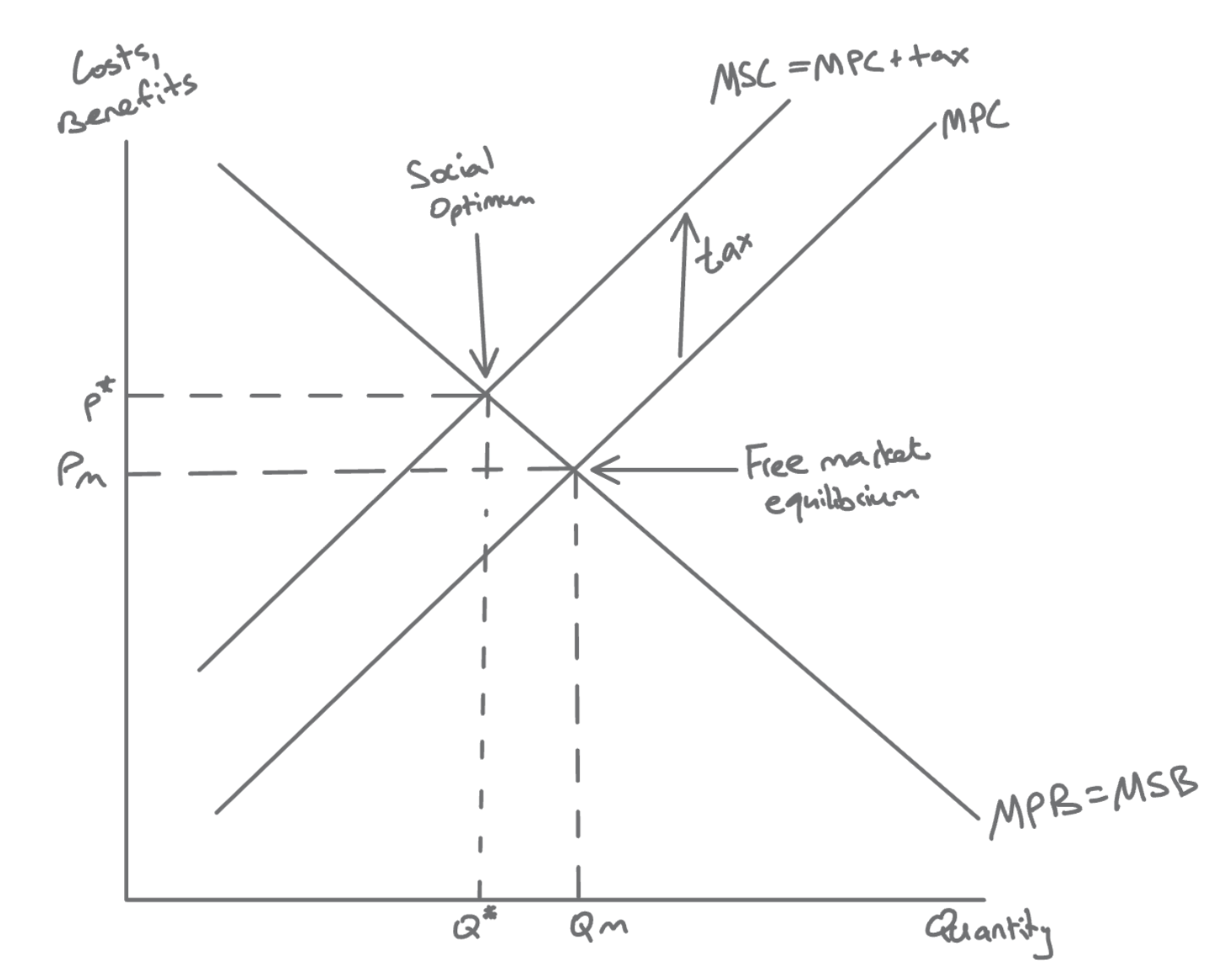
In the diagram, the market overproduces at Q1 where MPB = MPC, but a specific tax shifts MPC up towards MSC so output can fall to the socially efficient level at Q*. An ad valorem tax is different. It is charged as a percentage of the selling price, so the cash amount of tax rises as price rises. That is why the supply curve pivots rather than shifting up in a parallel way. VAT is the standard example. If a 20% tax is charged on a good priced at 100 pounds, the tax is 20 pounds, but on a good priced at 200 pounds it becomes 40 pounds. The higher the price, the larger the absolute tax.
Taxes have several strengths. They use the market mechanism, they can reduce harmful consumption, and they raise revenue at the same time. The problems are just as important. The government may not know the exact size of the externality, it may set the tax too high or too low, and there may be a conflict between correcting market failure and raising revenue. Indirect taxes can also be politically unpopular and regressive if they fall heavily on necessities bought by lower-income households.
The UK Soft Drinks Industry Levy is a useful application. It raised the cost of selling the highest-sugar drinks, encouraged firms to reformulate, and helped reduce the consumption of products linked to external costs in healthcare.
Definition: Subsidy
A payment by the government to producers or consumers to encourage production or consumption.
Subsidies are used where the market underprovides goods with positive externalities, such as education, training, or vaccinations. A subsidy lowers production costs or the effective price paid, so quantity rises. In a positive externality diagram, the free market produces where marginal private benefit equals marginal private cost, but the socially optimal output is higher where marginal social benefit equals marginal social cost. A subsidy can help close that gap.
The evaluation is similar to taxes in one sense: it is difficult to set the policy exactly right. Subsidies also have an opportunity cost because the money must come from taxation or from lower spending elsewhere. Once a subsidy exists, the recipients may lobby to keep it, and badly designed subsidies can leave inefficient firms in business or encourage overproduction.
Price Controls
Price controls are direct legal limits on price. They do not nudge the market gradually. They make certain prices illegal.
Definition: Maximum price
A legally imposed maximum price for a good or service.
A maximum price only has an effect if it is set below the free-market equilibrium price. At that lower price, quantity demanded rises but quantity supplied falls, so excess demand appears.
[DIAGRAM: asset_name: 1.4.1 - Government intervention in markets - diagram 2; asset_slug: 1.4.1 - 2; recommended_method: retained_png; description: Retained source diagram supporting 1.4.1 - Government intervention in markets; the packaged PNG preserves the original educational visual.]
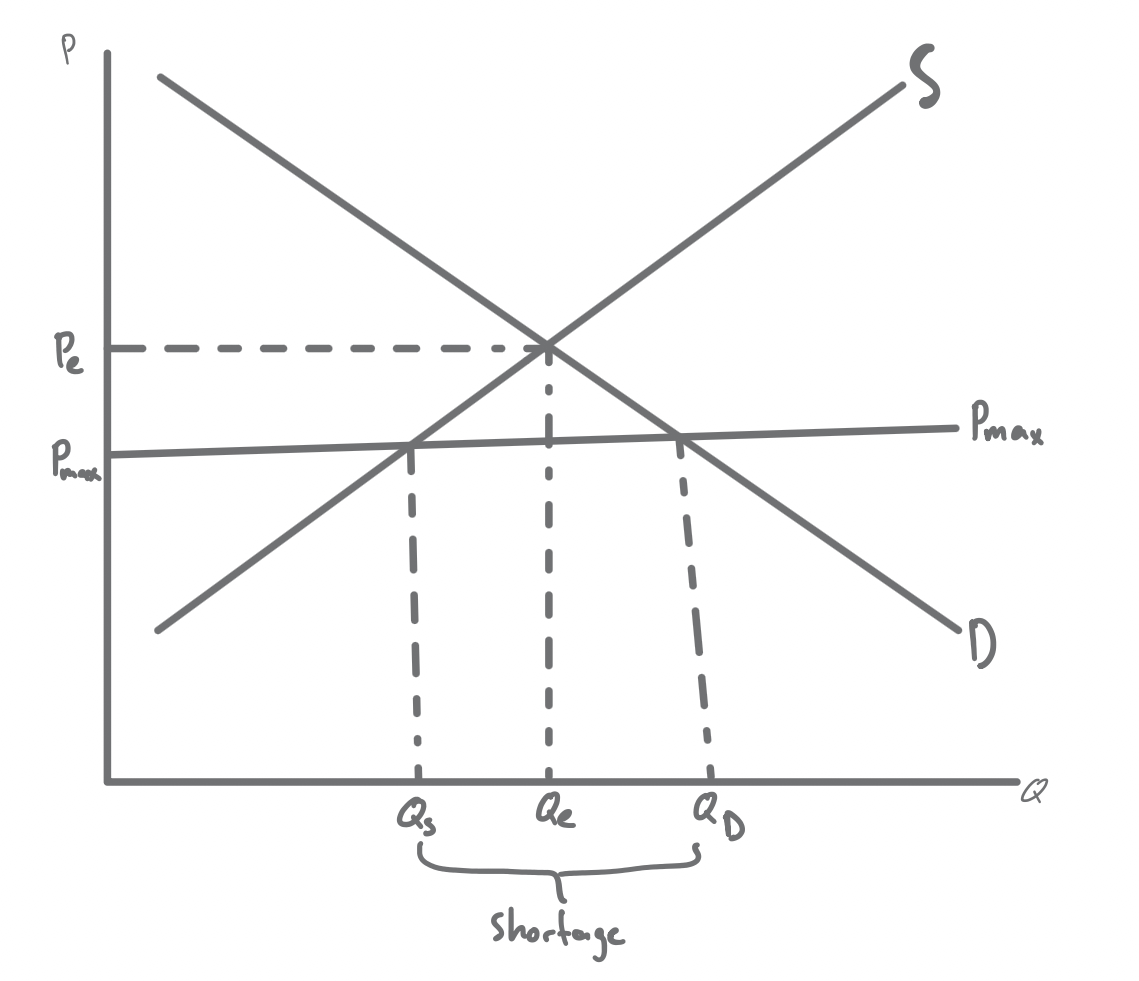
Because Pmax is below Pe, quantity supplied falls to Qs while quantity demanded rises to Qd, so the gap between Qs and Qd is the shortage. This is why maximum prices often create shortages, queues, waiting lists, or rationing. Some consumers benefit because they can buy at a lower price, but others lose because the product is no longer available. Over time, suppliers may cut quality, reduce maintenance, or leave the market, which can make the shortage worse. Rent controls are the classic example of this trade-off.
Definition: Minimum price
A legally imposed minimum price for a good or service.
A minimum price only binds if it is set above equilibrium. The higher legal price encourages supply but discourages demand, so excess supply emerges. Minimum prices may be used to support producer incomes, as with agricultural price floors, or to reduce consumption of demerit goods, as with minimum alcohol pricing.
[DIAGRAM: asset_name: 1.4.1 - Government intervention in markets - diagram 3; asset_slug: 1.4.1 - 3; recommended_method: retained_png; description: Retained source diagram supporting 1.4.1 - Government intervention in markets; the packaged PNG preserves the original educational visual.]
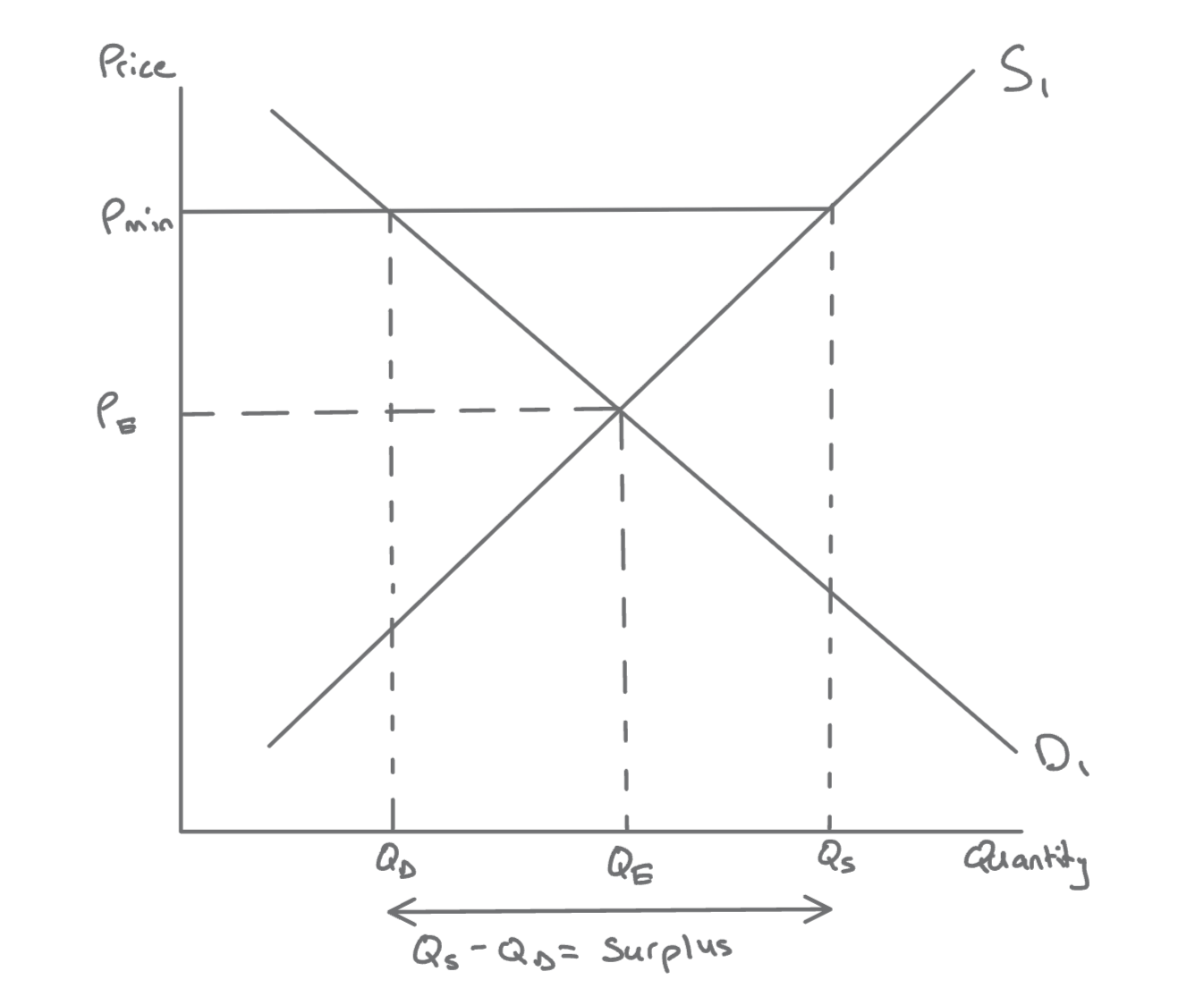
Because Pmin is above Pe, quantity supplied rises to Qs while quantity demanded falls to Qd, so the gap Qs - Qd is the surplus created by the price floor. If the policy is meant to support producers, that surplus may have to be bought, stored, or otherwise removed from the market.
The consequences depend on the aim. If the policy is used to support farmers, the government may have to buy and store the surplus, which is expensive. If it is used to reduce consumption of alcohol, consumers cannot switch to the very cheapest options, which can cut demand. But those who keep buying pay more, black markets may appear, and higher prices can still be regressive. Artificially high domestic prices can also create international competitiveness or trade-rule problems in some markets. Scotland's minimum unit pricing for alcohol is a clear real-world example of a minimum price designed to reduce harmful consumption.
Other Policy Tools
Not every market failure is best corrected through a tax, subsidy, or price control. Sometimes the government wants certainty about the total amount of pollution, direct provision of a good, better information for consumers, or legal rules that stop harmful behaviour altogether.
Definition: Trade pollution permits
Permits that give firms the right to pollute up to a certain level and can be bought and sold between firms.
Trade pollution permits, often described as cap-and-trade, are a market-based way to reduce pollution. The government sets a cap on total emissions and issues permits up to that limit. Firms that can cut emissions cheaply do so and may sell spare permits. Firms with high abatement costs buy permits instead. The total amount of pollution stays within the cap, but the reduction happens where it is cheapest.
That is why permits can be more cost-efficient than a uniform rule. If Firm A can cut emissions for 10 million pounds but Firm B would need 25 million pounds to achieve the same reduction, it makes sense for Firm A to do more of the abatement and then sell permits to Firm B. Society still gets the reduction, but at a lower total cost. The UK Emissions Trading Scheme uses this logic in parts of the energy and industrial sectors. One drawback is that permit prices can fluctuate. When economic activity falls, demand for permits can fall as well, weakening the incentive to reduce emissions.
Governments may also use state provision of goods where the free market would underprovide public goods. Public goods are non-excludable and non-rival, so people can benefit without paying directly. That creates the free rider problem, which is why goods such as national defence, street lighting, and flood defences are usually financed through taxation and provided by the state. This solves the underprovision problem, but it can still create productive inefficiency, allocative inefficiency, and an opportunity cost because resources used here cannot be used elsewhere.
Information provision is another lighter-touch intervention. Governments can require firms to disclose information, run public-health campaigns, or publish performance data. Nutritional labels, cigarette warnings, and APR rules on loans are all attempts to reduce information gaps. This can be relatively cheap and it preserves consumer choice, but it may not work well if people ignore the information or cannot interpret it properly.
Regulation uses legal rules instead. Governments may cap emissions, ban unsafe products, or impose financial rules on banks. Regulation is often easy to understand and can give certainty about the outcome because firms must obey the rule. The drawbacks are that one rule may not fit every firm, regulators may set the standard at the wrong level, enforcement is costly, and regulatory capture can weaken the policy if firms influence the regulator.
Judging Which Intervention Works Best
Different interventions suit different problems. Taxes and subsidies are useful when the government wants to change behaviour through the price mechanism. Maximum and minimum prices are more direct, but they often create shortages or surpluses. Trade pollution permits are attractive when the government wants certainty over total emissions but also wants firms to adjust flexibly. State provision is essential where the free rider problem is so strong that the market is unlikely to provide enough at all. Information provision and regulation are often used when behaviour can be improved without changing every market price.
The final judgement is always comparative. Economists ask whether the policy moves the market closer to the social optimum, whether it is affordable to run, whether it creates new distortions, and whether the government has enough information to calibrate it properly. A policy that looks good in theory can still disappoint in practice if it is badly targeted or politically difficult to sustain.
Exam tip
This is where the idea of government failure matters. Government failure happens when intervention intended to correct market failure creates new inefficiency or welfare loss instead. That can happen because policymakers misjudge the size of the externality, administration and enforcement are costly, firms influence the regulator, or a policy has side effects such as shortages, surpluses, or regressive effects. Strong evaluation asks whether the intervention reduces market failure by more than it creates government failure.
Before you move on, try to connect the whole toolkit into one clear story.
Quick Recap
- Market failure gives the main reason for intervention: the free-market equilibrium may not maximise social welfare.
- Specific and ad valorem taxes reduce harmful output in different ways, while subsidies are used where socially beneficial output is too low.
- Maximum prices can create shortages and minimum prices can create excess supply, even when the policy is introduced for a good reason.
- Trade pollution permits, state provision, information provision, and regulation are alternative tools, each with different strengths and limitations.