1.1.1 - Economics as a social science
Economics explores how households, firms, and governments make decisions, and how those decisions affect one another. Because the real world is messy, economists cannot analyse every influence at once. They use models and assumptions to simplify reality first, then test whether those simplifications still help explain what happens outside the classroom.
Why Economists Use Models
Economics is really about choices. Households decide what to buy and how much to save. Firms decide what to produce, what prices to charge, and how many workers to employ. Governments decide taxation, spending, and regulation. Each choice changes the incentives facing someone else, so the economy quickly becomes a web of cause and effect that is difficult to untangle.
If economists tried to analyse every influence at the same time, the subject would become unmanageable. That is why they use models.
Definition: Model
A simplified representation of reality used to provide insight into economic decisions and events.
A model is useful for the same reason a map is useful. A map of London does not show every tree, parked car, or broken paving stone. If it did, it would be almost as complicated as London itself and far less useful for navigation. Instead, it leaves out detail so the important patterns stand out. Economic models do the same thing: they strip away some complexity so economists can focus on the relationship that matters for the question they are trying to answer.
That is why a model should not be judged first by whether it copies reality perfectly. Its first job is to make a complicated problem understandable.
Building Models with Assumptions
Economists usually build models in stages rather than trying to explain the whole economy in one step. A common process is:
- identify the question or relationship they want to understand
- make assumptions that simplify the problem
- build a framework showing how the key variables are linked
- test the model against evidence and refine it if needed
Assumptions are statements taken as given for the purpose of analysis. An economist might assume consumers behave rationally, firms try to maximise profit, or buyers have perfect information. The point is not that these assumptions are perfectly realistic. The point is that they make the problem tractable, meaning manageable enough to analyse clearly.
Once a simple model works, economists can relax assumptions and add complexity gradually. For example, they might begin by assuming consumers have perfect information and later examine what changes when information is imperfect. This step-by-step approach helps economists see which influences matter most instead of mixing every complication together from the start.
Common mistake
An assumption is not a claim that the real world is exactly like the model. It is a simplifying starting point that helps economists isolate a relationship.
Ceteris Paribus and Cause and Effect
One of the most important assumptions in economics is ceteris paribus, which means "other things being equal". Economists use it when they want to study the effect of one variable while temporarily holding other relevant influences constant.
Definition: Ceteris paribus
Other things being equal; used when examining the relationship between variables while other relevant influences are held constant.
Take demand as an example. Economists expect a fall in price to increase quantity demanded. But demand is also affected by consumer incomes, tastes, advertising, and the prices of substitute and complementary goods. If all of those factors were changing at the same time, it would be difficult to tell what caused the final outcome. Ceteris paribus gives economists analytical clarity by letting them focus on one relationship at a time.
[DIAGRAM: asset_name: 1.1.1 - Economics as a social science - diagram 1; asset_slug: 1.1.1 - 1; recommended_method: retained_png; description: Retained source diagram supporting 1.1.1 - Economics as a social science; the packaged PNG preserves the original educational visual.]
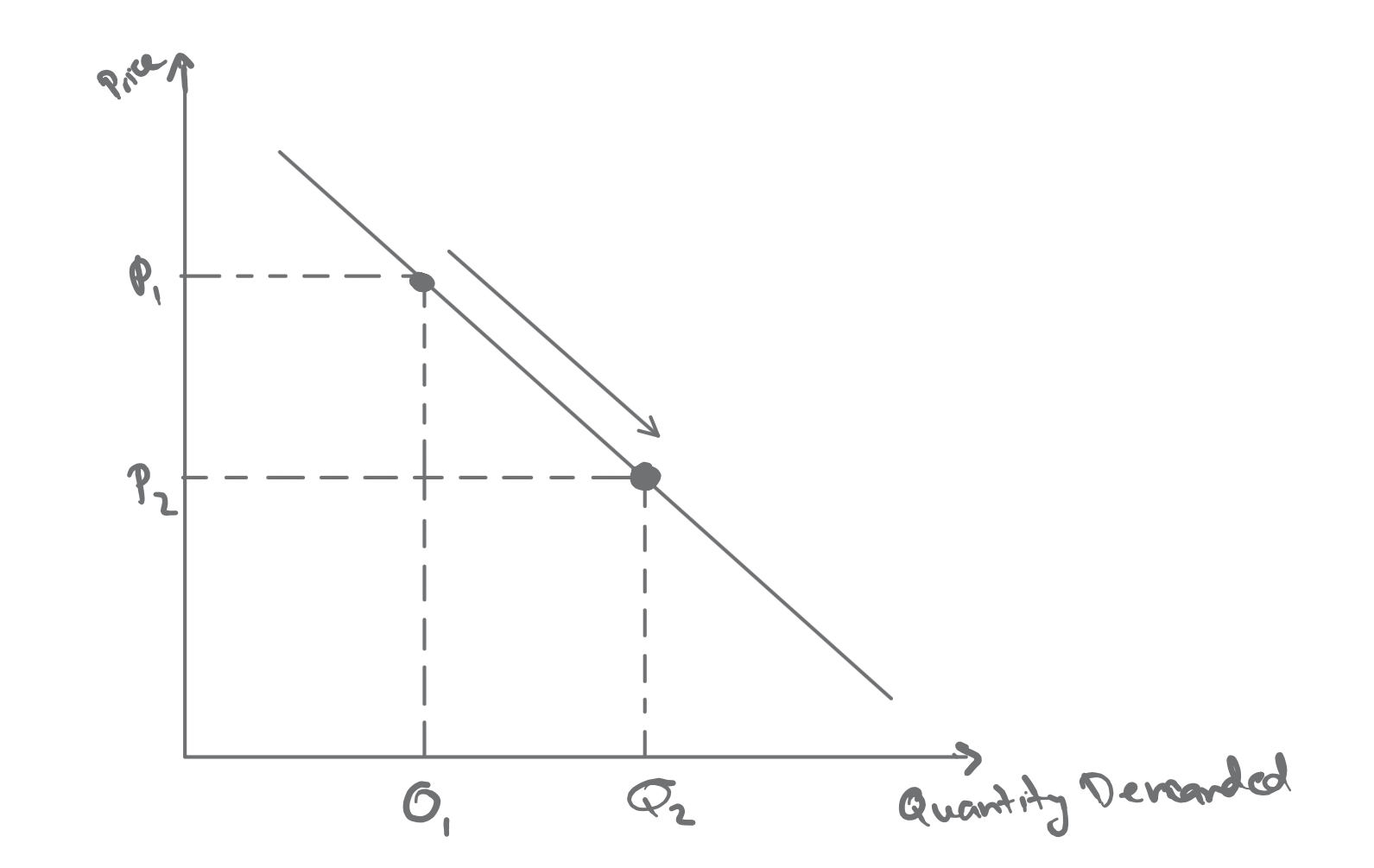
On curve D, a fall in price from P1 to P2 is matched by a movement from Q1 to Q2, so the diagram shows a movement along the same demand curve rather than a shift of the curve. That only makes sense because other influences on demand are being held constant. If income changed, tastes changed, or a substitute good became more expensive, the whole demand curve would shift instead.
Without ceteris paribus, economists would struggle to isolate cause and effect. If price falls at the same time as incomes rise and a rival firm raises its price, any increase in quantity demanded may reflect all three changes together. This is why ceteris paribus is so useful in theory, but also why it becomes a strong evaluation point in exams: in the real world, other things rarely stay equal for long.
When the Bank of England increased Bank Rate from 0.1% in December 2021 to 5.25% in August 2023, economists expected higher borrowing costs to reduce spending. In practice, energy bills, inflation expectations, and global supply conditions were also changing. That is exactly why economists often begin with ceteris paribus reasoning, then test whether the prediction survives in a messier real-world setting.
Why Economics Is a Social Science
Economics is a social science because it studies human behaviour using evidence, observation, and logical analysis. It is scientific in the sense that economists form hypotheses, use data, and test explanations. However, it differs from natural sciences such as chemistry or physics because economists are studying people, firms, and institutions rather than chemical reactions or physical objects.
Definition: Social science
A discipline that studies human behaviour and social relationships using observation, evidence, and logical analysis rather than controlled laboratory experiments.
In natural sciences, controlled experiments are often possible. A chemist can change one variable while keeping temperature, pressure, and concentration fixed. This makes it easier to isolate cause and effect and to repeat the experiment under almost identical conditions.
Economics usually cannot work that way for three main reasons. First, there are ethical constraints: governments cannot double income tax or deliberately increase unemployment just to see what happens. Second, there are practical limits: a business would take a serious risk if it raised prices purely as an experiment. Third, there is a control problem: even when a policy does change, many other variables are also changing at the same time.
| Natural sciences | Economics as a social science |
|---|---|
| Controlled experiments are often possible | Controlled experiments are usually limited or impossible |
| Variables can be isolated more precisely | Many variables change simultaneously |
| Results can often be replicated closely | Exact replication is difficult because each real-world situation is different |
| Hypotheses are tested in laboratories | Hypotheses are often tested through observation, data, and statistical analysis |
Economists therefore rely on observation of real events, comparisons across countries or time periods, and statistical methods to test ideas. In that sense, economics is closer in some ways to astronomy than to school-lab chemistry: economists cannot rearrange the economy at will, so they learn from careful observation of what actually happens.
For example, economists studying the UK's Soft Drinks Industry Levy after April 2018 could compare purchases before and after the policy, but they still had to separate the effect of the levy from product reformulation, advertising, and changing consumer preferences. That is useful evidence, but it is not the same as a perfectly controlled laboratory test.
Experimental economics is a growing field in which researchers use auctions, trading games, or other decision tasks in controlled settings. These experiments can reveal useful insights about individual behaviour, but they still cannot reproduce the full complexity of an entire economy.
How Economists Judge a Model
A common criticism is that economic models are unrealistic. On its own, that criticism is too weak. The better question is whether the model is useful.
A useful model should do at least one of three things. It should help economists predict likely behaviour, explain patterns in the data, or reveal a causal relationship that would otherwise be hard to see. If a model can do that, it may still have real value even when it simplifies reality sharply.
Good evaluation therefore focuses on the assumptions. What happens if the assumptions do not hold? Under what conditions would the model break down? Are the simplifications reasonable for the question being asked? A model based on rational behaviour, for example, may work well in some situations but be less convincing when people make impulsive purchases or when financial markets behave like a bubble.
Exam tip
Do not evaluate a model by saying only that it is unrealistic. A stronger judgement is that the simplification helps isolate a relationship, but the model becomes less reliable when important real-world influences are changing at the same time.
Thinking like an economist means holding both ideas together at once: simplification is necessary, but every simplification has limits. The strongest answers explain both why a model helps and when it may stop helping.
Quick Recap
- Economics uses models because the real world is too complex to analyse all at once.
- Assumptions simplify a problem first, and then economists can relax those assumptions to test how robust the model is.
- Ceteris paribus lets economists isolate one relationship by holding other influences constant.
- Economics is a social science because it studies human behaviour with evidence and logic, but usually without controlled laboratory experiments.
- Models should be judged by how useful their insights are, not by whether every assumption is perfectly realistic.