1.1.3 - The economic problem
Economics begins with a constraint. People have more wants than can ever be fully satisfied, but the resources used to produce goods and services are limited. That gap between unlimited wants and finite resources is why every economy has to make choices, accept trade-offs, and think about what is being given up.
Scarcity and Choice
At the heart of the economic problem is scarcity. This affects every economy, not just low-income countries. Even a rich country cannot provide every product, every service, and every public good that people might want. If scarcity did not exist, there would be no need to prioritise resources, and economics would barely be needed as a subject.
Definition: Scarcity
Scarcity is the situation where unlimited wants exceed finite resources.
To understand why scarcity matters, it helps to separate needs from wants. Needs are the basics required for survival, such as food, water, and shelter. Wants go beyond survival. They include things like a bigger house, a better phone, or more leisure. Needs may be met, but wants keep expanding, so the pressure on resources never disappears for long.
Scarce does not mean rare. A good can be common and still be scarce if there is not enough of it to satisfy every possible use at the same time. This is why most goods are economic goods: they are limited, so choices have to be made about producing and distributing them. By contrast, a free good is so abundant that using it does not usually require an allocation decision. Air is the classic example, although even clean air can become scarce when pollution reduces its quality.
Resource Types and Sustainability
The resources used in production do not all behave in the same way. Some can be replaced over time, while others are used up. That distinction matters because it changes how serious scarcity becomes and what responses might help.
Definition: Renewable resources
Renewable resources are resources that can be replenished over time if they are not used faster than they are replaced.
Forests, fish stocks, solar energy, and wind energy are common examples. But renewable does not mean unlimited. A fish stock can still collapse if catches are larger than the rate at which fish reproduce. A forest can still be depleted if trees are cut down faster than they are replanted. This is why economists and policymakers talk about sustainable development: using resources in a way that meets present needs without preventing future generations from meeting theirs. Fishing quotas and restrictions on deforestation exist because renewability depends on how a resource is managed.
Definition: Non-renewable resources
Non-renewable resources are resources that cannot be replenished within a meaningful human timescale once they have been used.
Oil, coal, and natural gas are the clearest examples. Every unit consumed today permanently reduces the remaining stock available to future users. As these resources become scarcer, rising prices can send an important signal. Higher prices encourage consumers and firms to conserve, recycle, and develop substitutes.
In the UK, North Sea oil is a clear non-renewable resource because extracting it reduces what remains underground. Offshore wind is renewable, but the turbines, skilled labour, sea sites, and grid capacity needed to use that energy are still scarce, so choices still have to be made.
Opportunity Cost and Marginal Analysis
Because scarcity forces choices, every decision involves a sacrifice. Economists call that sacrifice opportunity cost.
Definition: Opportunity cost
Opportunity cost is the value of the next-best alternative forgone when a choice is made.
The phrase next-best alternative is crucial. If a student spends the evening revising, the opportunity cost might be the film they chose not to watch or the paid shift they decided not to work. If a farmer uses land to grow wheat, the opportunity cost is the barley or other crop that could have been grown instead. If the UK government allocates extra money to the NHS, the opportunity cost is the next-best public service or project that cannot now be funded.
This is why opportunity cost is not just about the money spent. A project may cost £10 million in accounting terms, but the economic cost is the value of what that £10 million could have achieved elsewhere. Even raising taxes to fund extra spending carries an opportunity cost, because households then have less income available for their own consumption.
Economists often extend this thinking through marginal analysis. Instead of treating decisions as all-or-nothing, they ask whether doing one more unit is worthwhile. Would one more hour of revision produce a bigger gain than one more hour of leisure? Would one more worker add more output than it costs to employ them? Decisions are most sensible when the marginal benefit from doing more is equal to the marginal opportunity cost.
Economic Agents and the PPF
Opportunity cost affects all the main economic agents in the economy. Consumers have limited income but many wants, so buying one thing often means giving up another. A household that buys a new car may have to give up a family holiday. Producers face scarce labour, capital, land, and time, so choosing to make more of one product often means making less of another. A firm that invests in new machinery may give up the chance to hire more workers instead. Governments face the same basic problem on a larger scale: more spending on healthcare, education, or defence usually means less spending somewhere else unless taxes or borrowing increase.
Definition: Production possibility frontier (PPF)
The production possibility frontier (PPF) shows the maximum combinations of two goods or services an economy can produce when resources are fully and efficiently employed.
The PPF turns the economic problem into a visual model. A point on the frontier shows efficient use of resources. A point inside the frontier shows inefficiency or unemployment, because the economy is producing below its potential. A point outside the frontier is unattainable with current resources and technology.
[DIAGRAM: asset_name: 1.1.3 - The economic problem - diagram 1; asset_slug: 1.1.3 - 1; recommended_method: retained_png; description: Retained source diagram supporting 1.1.3 - The economic problem; the packaged PNG preserves the original educational visual.]
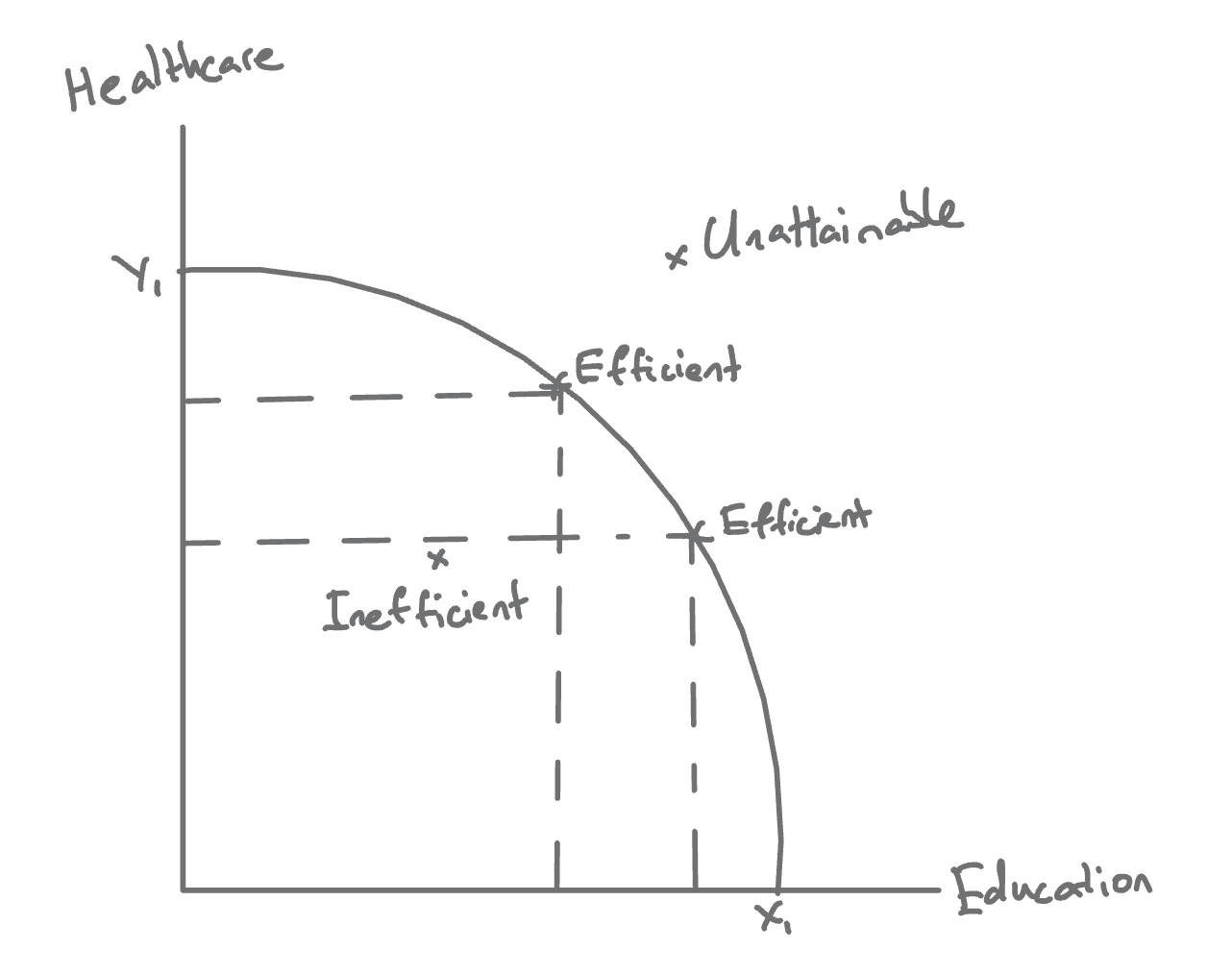
The point labelled efficient lies on the PPF, the point labelled inefficient lies inside it, and the point labelled unattainable lies beyond current productive capacity. Moving along the PPF from more education towards more healthcare makes the trade-off clear. If the economy produces more healthcare, it must produce less education, because the same scarce resources cannot be fully used twice. The amount of education lost is the opportunity cost of gaining more healthcare. In that sense, the slope of the PPF shows the opportunity cost of one good in terms of the other.
Quick Recap
- Scarcity means wants exceed finite resources, so every economy has to make choices.
- Economic goods are scarce and require allocation, while free goods are abundant enough not to.
- Renewable resources can be replaced if managed sustainably, but non-renewable resources are depleted when used.
- Opportunity cost is the value of the next-best alternative forgone, and the PPF shows that trade-off visually.