1.2.7 - Price mechanism
In a market economy, no central planner has to tell every firm what to produce or every consumer what to buy. Instead, prices change as demand and supply change. Those price changes help allocate scarce resources by rationing limited output, signalling what has changed in the market, and creating incentives for buyers and sellers to adjust their behaviour.
What the Price Mechanism Does
Definition: Price mechanism
The means by which the interaction of demand and supply allocates scarce resources by changes in price.
Because resources are scarce but wants are unlimited, an economy needs some way to decide who gets what, what firms should produce, and where resources should move next. In a market economy, the price mechanism performs that role.
Economists usually break the mechanism into three linked functions:
- rationing, because higher prices limit access to scarce goods
- signalling, because price changes tell buyers and sellers that market conditions have changed
- incentive, because those price changes encourage people to alter the quantities they demand and supply
In real markets, these functions happen together. A rise in price can ration a product, signal that demand has strengthened or supply has fallen, and encourage firms to expand output if they can.
Rationing Scarce Goods
The rationing function of price explains how scarce goods are allocated. If supply becomes more limited while demand remains strong, price tends to rise. That higher price reduces the number of consumers willing and able to buy, so the available output is rationed among those prepared to pay more.
[DIAGRAM: asset_name: 1.2.7 - Price mechanism - diagram 1; asset_slug: 1.2.7 - 1; recommended_method: retained_png; description: Retained source diagram supporting 1.2.7 - Price mechanism; the packaged PNG preserves the original educational visual.]
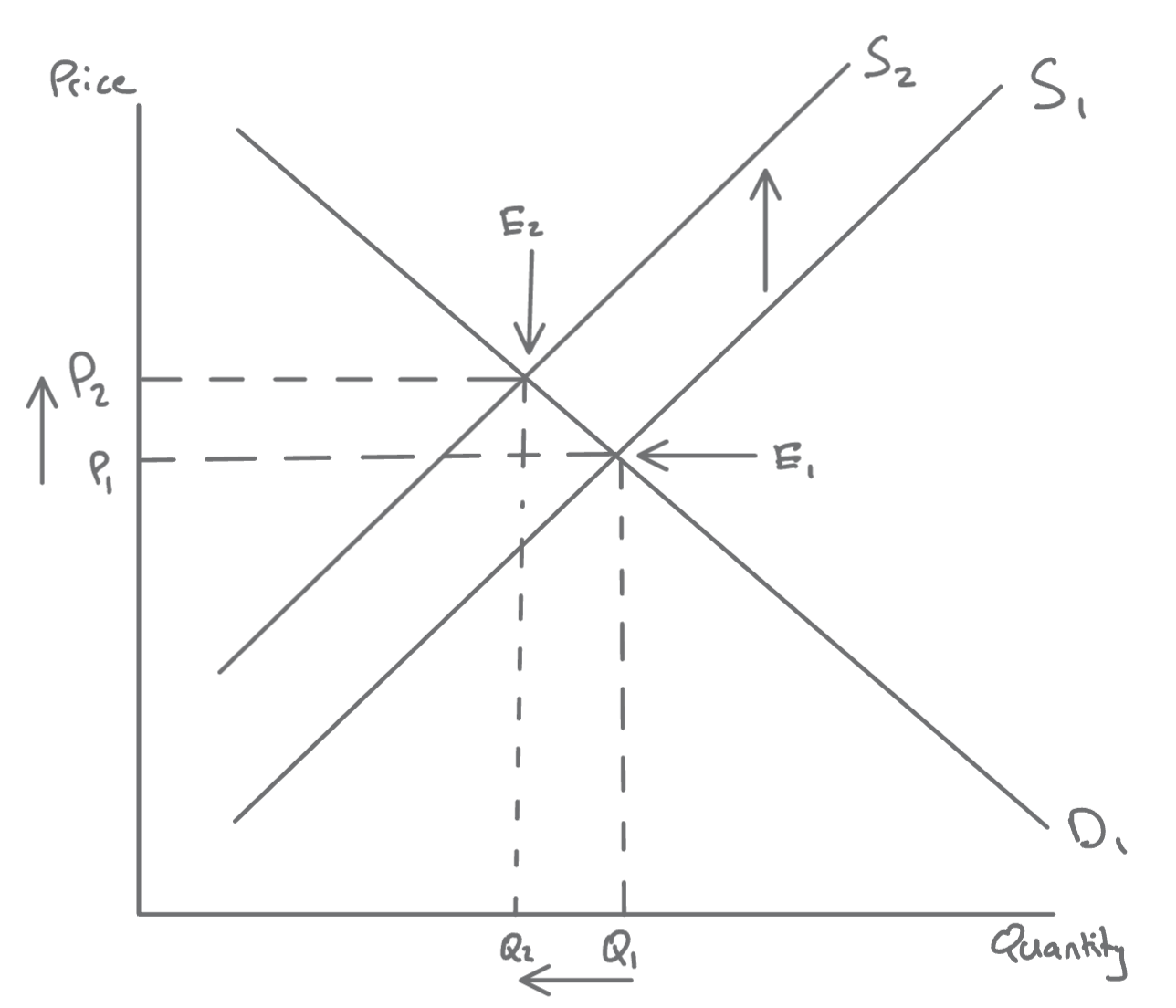
The diagram shows the logic clearly. A fall in supply shifts the supply curve left from S1 to S2 and moves the market from E1 at P1, Q1 to E2 at P2, Q2. At the old price, quantity demanded is now greater than quantity supplied, so there is excess demand. Price is then bid up until a new equilibrium is reached at a higher price and lower quantity.
Think about airline tickets. As a flight fills up, the remaining seats become scarcer and fares rise. Some passengers decide the journey is no longer worth the higher fare, so the limited seats are rationed to those willing and able to pay more.
That wording matters in exams. The market rations by ability to pay, not by need. So a higher price can clear the market, but it does not necessarily produce a fair outcome.
Signalling and Incentives
The signalling function means that price changes carry information. A rising price tells consumers and producers that something in the market has changed. Demand may have increased, supply may have fallen, or both.
The incentive function is slightly different. Once buyers and sellers receive the signal, the price change gives them a reason to respond. Higher prices usually encourage producers to supply more and encourage consumers to buy less or switch to alternatives. Lower prices tend to do the opposite.
This distinction is worth learning precisely. Signalling is the message sent by the price change. Incentive is the behaviour change caused by that message.
[DIAGRAM: asset_name: 1.2.7 - Price mechanism - diagram 2; asset_slug: 1.2.7 - 2; recommended_method: retained_png; description: Retained source diagram supporting 1.2.7 - Price mechanism; the packaged PNG preserves the original educational visual.]
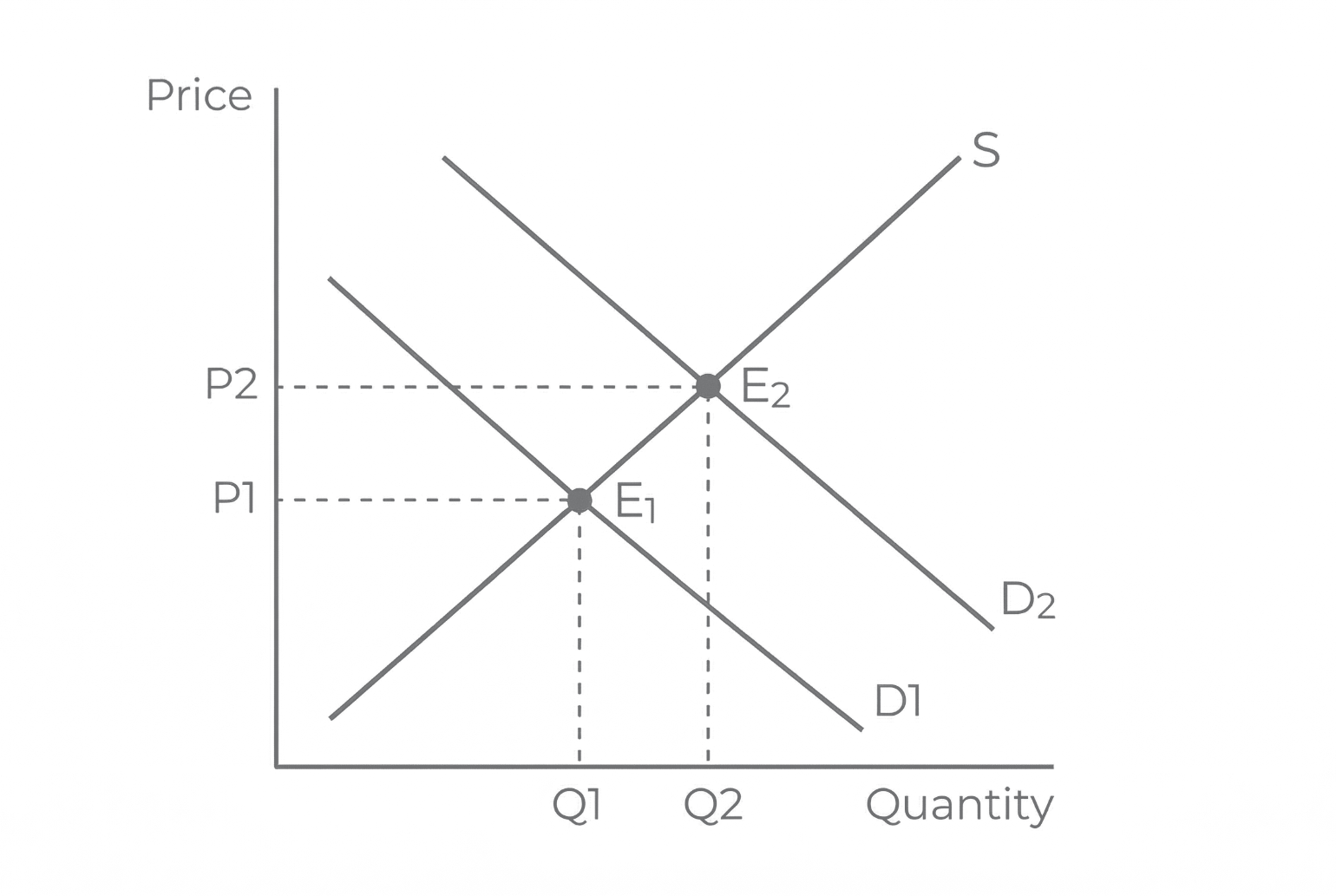
When demand rises from D1 to D2, the market moves from E1 at P1, Q1 to E2 at P2, Q2. The higher price signals to firms that the product has become more valuable in the market. It also gives them an incentive to expand supply along S by hiring more workers, extending opening hours, or investing in more capacity. That supply response is not automatic, though. In the short run, firms may be limited by spare capacity, labour shortages, or time needed for investment.
The global oil market is a good example of all three functions working together. If crude oil prices rise sharply, motorists receive a signal to economise on fuel, producers receive a stronger incentive to increase output where possible, and the higher price also rations oil away from lower-value uses.
Local, National and Global Markets
The price mechanism operates in all markets, but the forces affecting supply and demand depend on the market's geographic scale.
In local markets, price is shaped mainly by local conditions. A strong local strawberry harvest can push prices down at a farmers' market, while a late frost, a transport problem, or a busy local festival can push prices up. Information often travels quickly because buyers and sellers are close to one another.
In national markets, price reflects conditions across the whole country. The UK housing market is influenced by national factors such as Bank of England interest rates, mortgage availability, planning rules, taxation, and confidence in the wider economy. A cut in interest rates can raise housing demand across many regions at the same time.
In global markets, price responds to worldwide supply and demand, exchange rates, trade policies, and geopolitical events. Oil is the clearest example. A supply disruption in the Middle East can raise petrol prices in Birmingham because crude oil is traded internationally, not just within one country.
The UK car industry shows that price signals can also reallocate resources over time. In the 1970s and 1980s, poor quality and high production costs meant weak profits, signalling that the UK was becoming a poor location for mass car production. When firms such as Nissan and Toyota introduced more efficient methods from the mid-1980s, profitable production at plants such as Sunderland signalled that resources could still be used successfully in the UK, but only with much higher productivity.
Strengths and Limits
The price mechanism is powerful because it coordinates millions of decisions automatically. Buyers and sellers do not need a central authority to tell them what has changed. Prices adjust, and behaviour changes with them.
However, that does not mean the outcome is always socially best. If prices do not reflect the full social costs and benefits, then market failure can still occur even when the three functions are operating. For example, a market price may send a strong signal and create strong incentives, but still overproduce a good that creates external costs.
There are also equity concerns. The rationing function gives goods to those willing and able to pay, but income is unevenly distributed. That means essentials can be allocated away from low-income households even if their need is greatest.
Finally, the mechanism is not always fast. Supply responses can take time when firms need training, new machinery, or extra capacity. In global markets, domestic consumers can also be affected by shocks they did not cause, which can make prices volatile.
Exam tip
In evaluation, separate market clearing from good outcomes. The price mechanism may be effective at coordinating buyers and sellers, but it may still be unfair, slow to adjust, or socially inefficient if market failure is present.
Quick Recap
- The price mechanism allocates scarce resources through changes in demand, supply, and price.
- Rationing means higher prices restrict access to scarce goods.
- Signalling means price changes convey information about market conditions.
- Incentive means price changes encourage buyers and sellers to change their behaviour.
- The mechanism works in local, national, and global markets, but it does not always produce fair or socially efficient outcomes.