1.3.1 - Types of market failure
Markets often coordinate resources well through prices, profit, and consumer choice. However, a free market outcome is not automatically the best outcome for society. If prices leave out some wider costs or benefits, the market can produce the wrong quantity and social welfare is lost.
What Market Failure Means
Definition: Market failure
When the free market fails to allocate scarce resources efficiently, so the market outcome does not maximise social welfare.
The key idea is the socially optimum position. This is the output where society's welfare is maximised, not just the welfare of the individual buyer or seller. In simple terms, economists look for the point where marginal social cost equals marginal social benefit.
If the free market produces more than this level, society is giving up too many resources for too little benefit. If it produces less than this level, society is missing out on worthwhile gains. In this part of the specification, the main reasons for that mismatch are externalities, under-provision of public goods, and information gaps.
Externalities
Definition: Externalities
Costs or benefits from production or consumption that affect third parties not directly involved in the market transaction.
An externality is a spillover effect. The person making the choice focuses on their own private costs and benefits, but some of the consequences fall on other people. That is why the market price can send the wrong signal.
Private and social costs and benefits need to be kept separate:
- Private costs are paid by the producer or consumer making the decision.
- External costs fall on third parties.
- Private benefits are received by the buyer or seller directly involved.
- External benefits spill over to other people.
Formula: Social costs and benefits
If there is an external cost, marginal social cost is above marginal private cost. If there is an external benefit, marginal social benefit is above marginal private benefit.
Externalities can be classified in four main ways:
| Type | What is happening? | Likely market result | Example |
|---|---|---|---|
| Negative externality of production | Production imposes a cost on others | Overproduction | A factory polluting a river used by downstream communities |
| Negative externality of consumption | Consumption imposes a cost on others | Overconsumption | Smoking in public or car use causing congestion and air pollution |
| Positive externality of production | Production creates a benefit for others | Underproduction | Research and development spillovers or worker training that helps other firms later |
| Positive externality of consumption | Consumption creates a benefit for others | Underconsumption | Vaccination, education, and some healthcare |
The logic is easiest to see with a negative production externality. A firm may take into account wages, raw materials, and transport, but not the damage caused by waste, noise, or emissions. If a chemical plant dumps waste into a river, the firm's costs are lower than the true costs to society because nearby households, ecosystems, and water users bear part of the damage.
[DIAGRAM: asset_name: 1.3.1 - Types of market failure - diagram 1; asset_slug: 1.3.1 - 1; recommended_method: retained_png; description: Retained source diagram supporting 1.3.1 - Types of market failure; the packaged PNG preserves the original educational visual.]
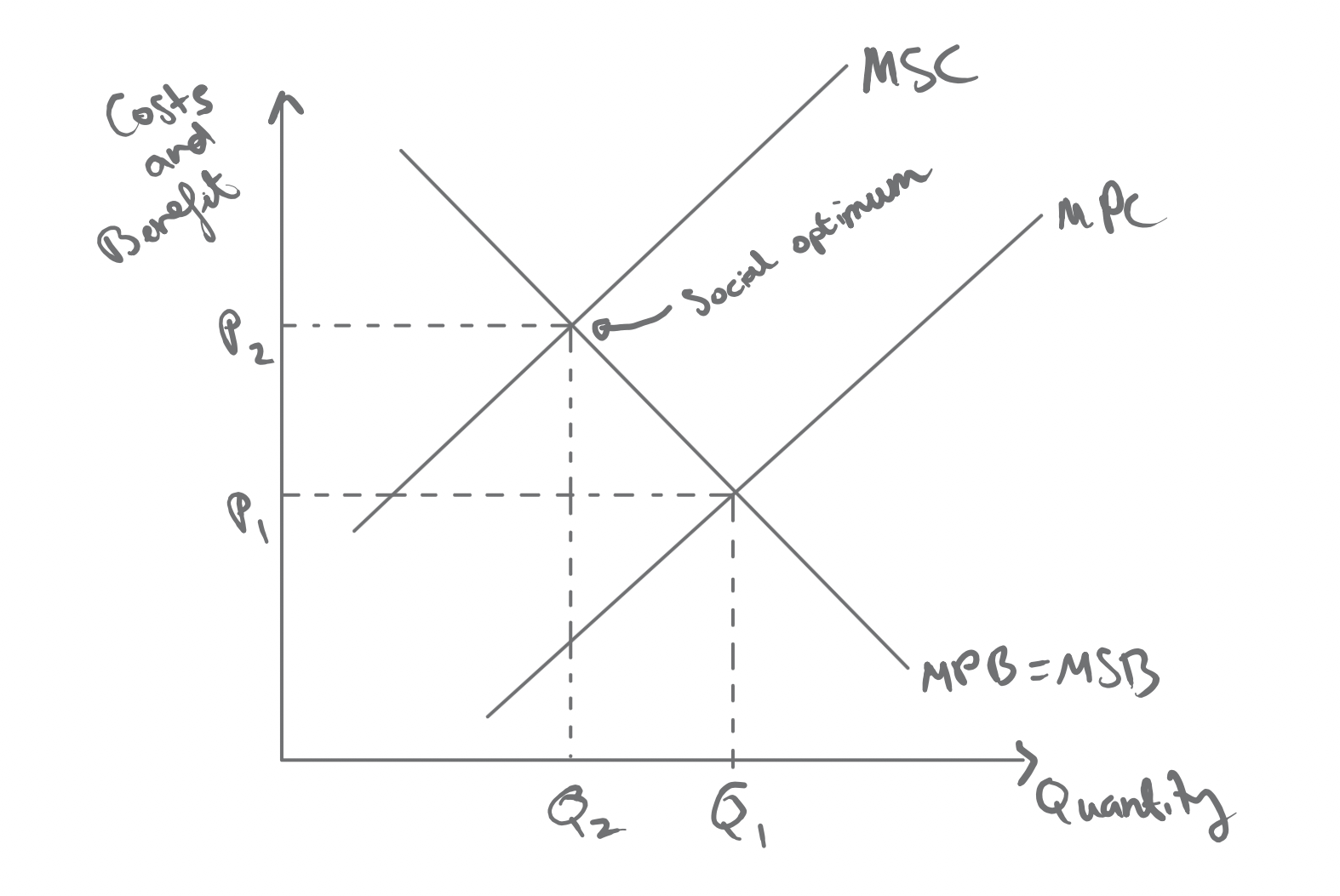
In that diagram, the free-market equilibrium is where MPC meets MPB at Q1 and P1, while the socially efficient point is where MSC meets MSB at Q* and P*. Because MSC is above MPC, the free market produces too much. The welfare loss triangle shows units between and where the social cost is greater than the social benefit.
Positive externalities work in the opposite direction. With vaccination, the individual gains protection, but other people also benefit because disease spreads less easily. With education, the student may earn higher wages, but society may also gain from higher productivity, better civic participation, and lower crime. In both cases, the market tends to produce too little because the buyer considers mainly private benefit, while social benefit is higher.
Positive externalities can also come from production. A beekeeper's bees may pollinate nearby crops, and a firm that trains apprentices may end up raising the skills available to other employers if those workers later move jobs. Because the producer cannot capture all of those wider gains, the activity may be underprovided.
Public Goods
Definition: Public goods
Goods that are non-excludable and non-rival, so the free market is likely to underprovide them.
Public goods have two defining features. First, they are non-excludable, which means it is impossible or very costly to stop people consuming them once they are provided. Second, they are non-rival, which means one person's consumption does not reduce the amount available for others.
These two features create the free rider problem. If people can enjoy the benefit whether or not they pay, many will wait for someone else to fund the good. That makes it hard for a private firm to collect revenue, so the market may provide too little or nothing at all.
Street lighting is the classic example. Once the lights are there, pedestrians cannot easily be excluded from their benefit, and one person using the light does not leave less for anyone else. The same logic applies to national defence, lighthouses, public firework displays, and flood defence systems. In the UK, the Thames Barrier protects London properties whether or not each household has contributed directly to its cost. Clean air, once achieved, also has strong public-good features.
It is also important not to force every good into a pure category. Some are quasi-public goods. A road without tolls can be hard to exclude people from using, but it is not fully non-rival because congestion means one extra user can reduce the benefit to others.
Information Gaps
Definition: Information gap
A lack of information needed by consumers or producers to make rational economic decisions.
The basic free market model assumes that economic agents have good information. Consumers are assumed to understand prices, quality, and consequences. Firms are assumed to know their costs and market conditions. In reality, this is often not true.
One form of information failure is imperfect information. Consumers may not understand the long-term health risks of smoking or poor diet, or they may underestimate the long-term benefits of education and training. When that happens, demand does not reflect the true costs and benefits, so some goods are overconsumed while others are underconsumed.
Exam tip
This is where merit and demerit goods fit in. A demerit good tends to be overconsumed because consumers underestimate its private or social costs. A merit good tends to be underconsumed because consumers underestimate its private or social benefits.
Another form is asymmetric information, where one side of the market knows more than the other. This is common in second-hand markets. In the UK used-car market, sellers usually know much more than buyers about a vehicle's accident history, engine problems, or maintenance record. Buyers cannot be fully sure of quality, so they become cautious and offer lower prices.
That can lead to adverse selection. If buyers are only willing to pay a price based on average quality, some sellers of high-quality used cars may leave the market. The result is fewer mutually beneficial trades and a less efficient allocation of resources.
Information gaps also matter in other markets. Pension schemes are complex, many households struggle to compare mortgages or insurance policies, and patients often rely on expert advice when making healthcare decisions. In each case, limited information can prevent consumers from making welfare-maximising choices.
Quick Recap
- Market failure happens when the free market does not allocate resources in the way that maximises social welfare.
- Externalities create a gap between private and social costs or benefits, causing overproduction or underproduction.
- Public goods are underprovided because non-excludability and non-rivalry encourage free riding.
- Information gaps mean buyers or sellers make decisions without enough knowledge, which can reduce welfare and distort markets.