1.3.2 - Externalities
Markets work efficiently only when prices reflect the full costs and benefits of what is being produced and consumed. Externalities matter because some effects spill over onto people outside the transaction, so the free market can settle at an output that is not best for society.
Prices Do Not Tell the Whole Story
An externality exists when the actions of a producer or consumer affect a third party who is not directly involved in the market exchange. Once that happens, the market price stops being a complete signal.
Definition: Externalities
Costs or benefits from production or consumption that fall on third parties not directly involved in the market transaction.
When a firm makes a production decision, it usually focuses on its own private costs such as wages, raw materials, rent, machinery, transport, and energy bills. A chemical manufacturer will include these on its accounts. But if its waste pollutes a river, the damage to local residents, anglers, tourism businesses, and water companies is not paid by the firm. Those are external costs.
Benefits work in the same way. A student buying education receives private benefits such as better job prospects, higher earnings, and personal fulfilment. But society may also gain from a more skilled labour force, lower crime, and better civic participation. Those wider gains are external benefits.
Costs and benefits summary
Private cost and private benefit are faced by the people directly involved in the market.
External cost and external benefit fall on third parties outside the transaction.
If external costs exist, social cost is greater than private cost. If external benefits exist, social benefit is greater than private benefit.
That difference matters because market decisions are usually based on private costs and private benefits, not the wider social ones. The result is a systematic tendency for some goods to be overproduced and others to be underconsumed.
The Four Types of Externality
Externalities can come from either production or consumption, and each can be either negative or positive. That gives four possibilities, and exam questions often test whether you can classify them accurately.
Negative externalities of production happen when the act of producing a good imposes costs on others. Factory emissions, industrial noise, and water pollution are the standard examples. In each case, the social cost of production is greater than the private cost faced by the firm.
Positive externalities of production happen when production creates wider benefits for others. A business that trains apprentices can leave other employers with a more skilled local workforce. A supermarket redevelopment of a derelict industrial site may also clean up pollution and improve nearby roads, benefiting the wider community as well as the firm itself.
Negative externalities of consumption happen when using a good harms third parties. Passive smoking is the clearest example because the smoker enjoys the cigarette while other people bear some of the health cost.
Positive externalities of consumption happen when consuming a good benefits others as well as the individual buyer. Vaccination is the classic case because it reduces the spread of disease across the wider population, not just the risk faced by the person receiving the injection.
The easiest way to avoid mixing these up is to ask two questions. First, does the spillover come from making the good or from using it? Second, is the spillover a cost or a benefit to others?
Negative Production Externalities
Negative externalities of production are a key diagram case because they show clearly why the free market can overproduce. Firms base decisions on their own costs, but society faces a higher true cost.
Definition: Negative externalities of production
External costs created by the production of a good or service and imposed on third parties.
[DIAGRAM: asset_name: 1.3.2 - Externalities - diagram 1; asset_slug: 1.3.2 - 1; recommended_method: retained_png; description: Retained source diagram supporting 1.3.2 - Externalities; the packaged PNG preserves the original educational visual.]
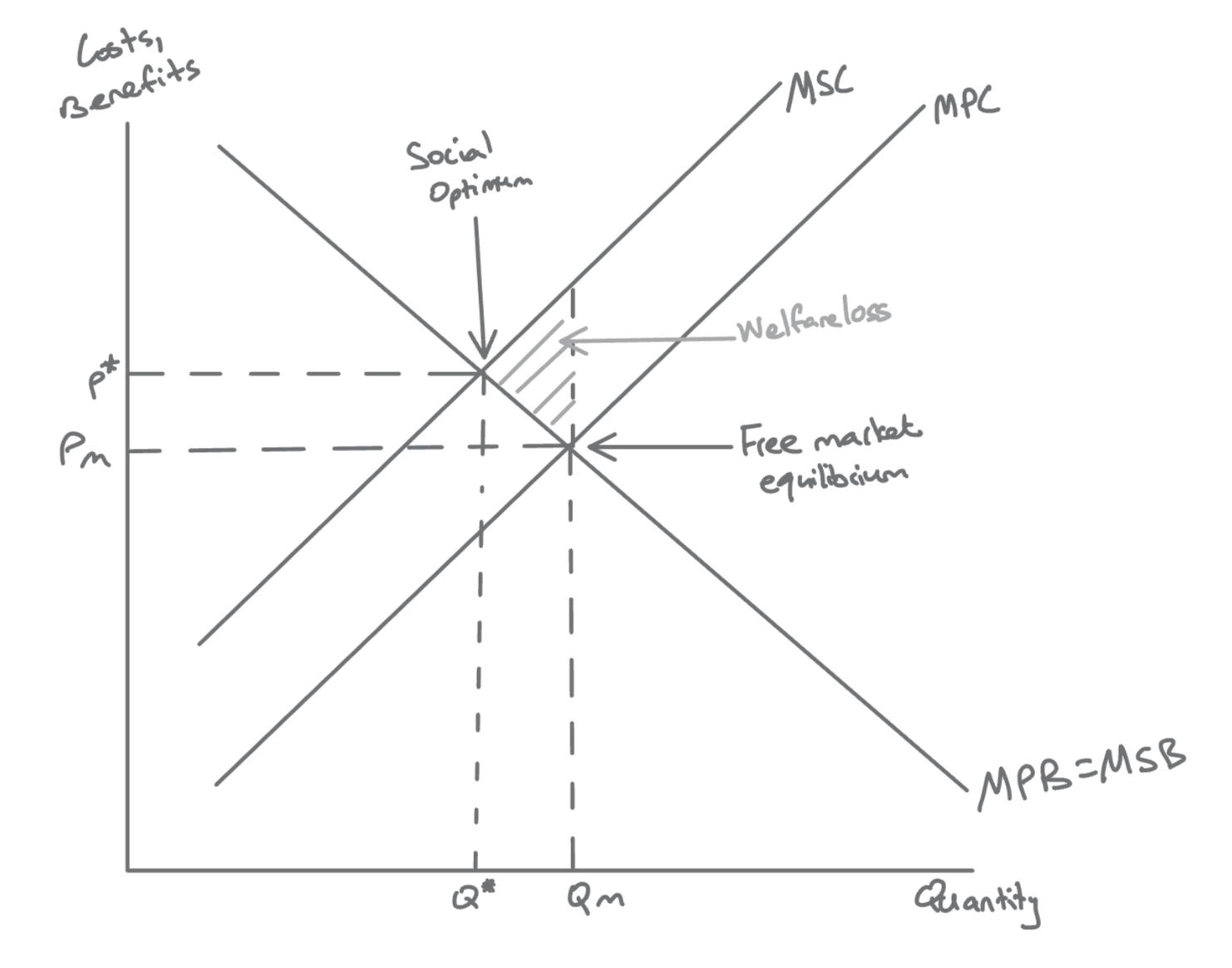
In this diagram, demand is both marginal private benefit and marginal social benefit because the externality comes from production rather than consumption. The supply curve seen by firms is MPC, but the true cost curve for society is MSC, which lies above it. The vertical distance between MSC and MPC shows the external cost per unit.
The free-market equilibrium is where MPC equals MPB, giving price and quantity . But that market outcome ignores the pollution or other spillover cost. The socially optimal position is where MSC equals MSB, at the lower quantity . This means the market overproduces from society's point of view.
The welfare loss triangle between and matters because every unit in that range costs society more than it benefits society. Those units are still produced in the free market because firms are responding to private costs only, not full social costs.
UK electricity generation gives a useful application. A power station's market costs include fuel, wages, and maintenance, but some of the environmental damage from emissions falls on people outside the transaction. If that external cost is not priced in, electricity generated from polluting sources can be overproduced relative to the social optimum.
Positive Consumption Externalities
Positive externalities of consumption are the other key diagram case. Here the market problem is not that producers ignore some cost, but that consumers do not capture the full benefit their consumption creates for society.
Definition: Positive externalities of consumption
External benefits created by the consumption of a good or service and received by third parties.
[DIAGRAM: asset_name: 1.3.2 - Externalities - diagram 2; asset_slug: 1.3.2 - 2; recommended_method: retained_png; description: Retained source diagram supporting 1.3.2 - Externalities; the packaged PNG preserves the original educational visual.]
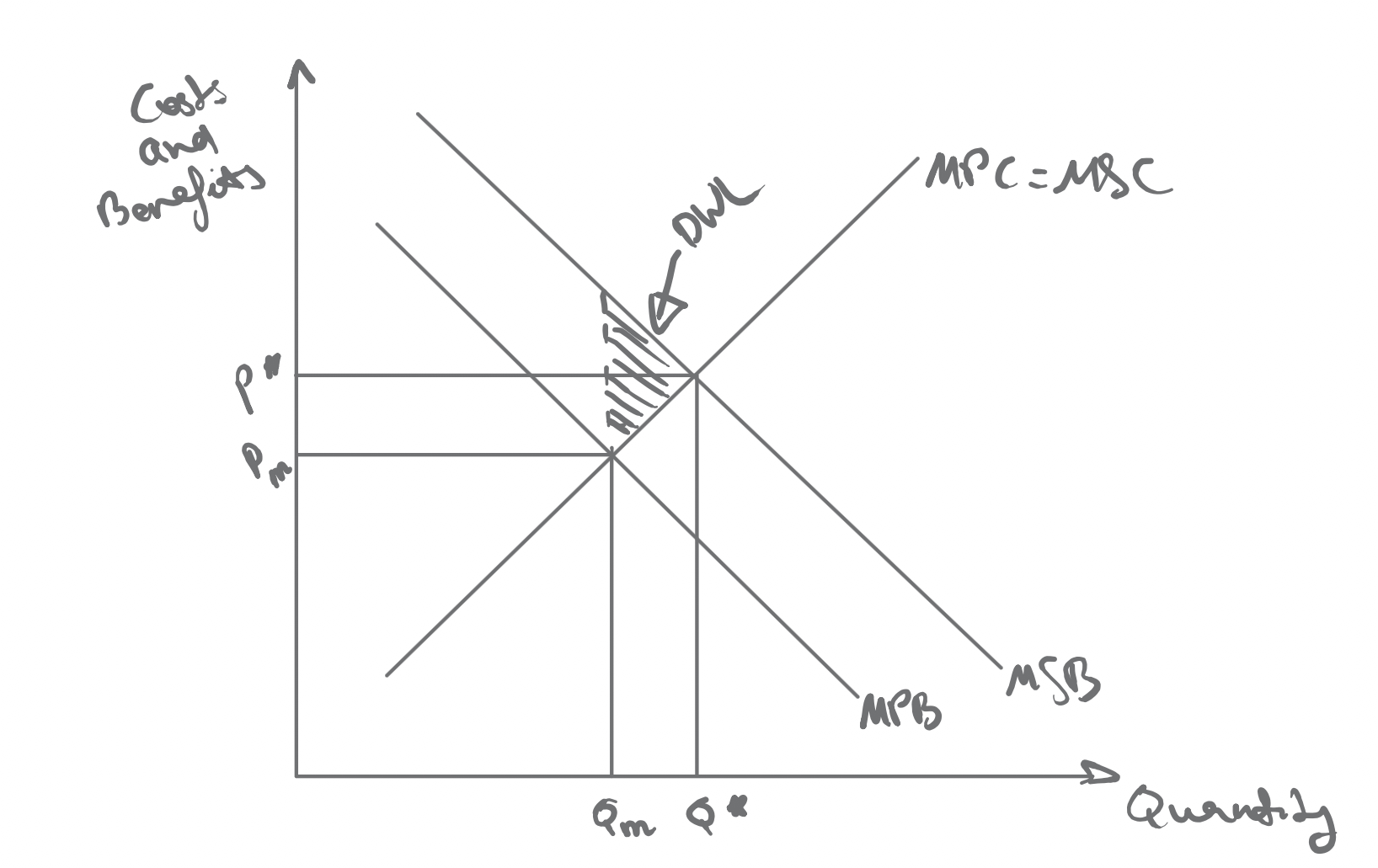
In this case, the supply curve is both MPC and MSC because the problem is not on the production side. The gap is on the benefit side instead. MSB lies above MPB, and the vertical distance between them shows the external benefit per unit.
The free-market equilibrium is where MPC equals MPB, at . That is too little consumption from society's point of view. The social optimum is where MSC equals MSB, at . So with positive consumption externalities, the market under-consumes the good.
The welfare area between and shows the benefit society misses out on when the market is left alone. Another way to say this is that the free market creates a welfare loss because units that would generate more benefit than cost are not consumed.
Vaccination is the standard example. A person receiving an NHS vaccination gains private protection, but other people also benefit because the chance of disease transmission falls. Education can be analysed in a similar way: the individual gains qualifications, but employers and society may also gain from higher productivity and lower crime.
Social Optimum and Government Response
The social optimum is the output level where society gets the best possible allocation of resources. It is the point where the cost of the last unit exactly matches the benefit of the last unit.
Definition: Social optimum position
The output level where marginal social cost equals marginal social benefit, so social welfare is maximised.
This differs from the free-market equilibrium, which is where marginal private cost equals marginal private benefit. When externalities exist, these two points diverge. The bigger the external cost or external benefit, the bigger the gap between the market outcome and the social optimum, and the larger the welfare loss.
Externalities also affect different groups in different ways. With negative externalities, producers may benefit because they do not pay the full social cost, and consumers may enjoy a lower market price than if all costs were included. Third parties then bear costs without compensation. With positive externalities, third parties receive benefits without paying, but the good is still underprovided because the decision-maker does not capture the full social gain.
Governments can intervene to move markets closer to the social optimum. An indirect tax can be used where there are negative externalities, ideally set equal to the external cost per unit. That shifts MPC towards MSC and internalises the externality. A subsidy can be used where there are positive externalities, lowering the private cost or raising the incentive to consume or produce more. Regulation can directly limit harmful activities, such as emissions standards or smoking bans in public places. Direct provision matters in markets like state education and public healthcare, where positive spillovers are large. Tradeable permits, such as carbon trading schemes, cap total pollution and allow firms to buy and sell the right to emit. Information provision can also help when part of the problem is ignorance, for example public health campaigns about smoking or vaccination.
Intervention is not automatically perfect. Governments may struggle to measure the exact size of an external cost or external benefit, and those estimates often involve value judgements. Taxes may be regressive, regulations can be costly to enforce, and poorly designed intervention can create government failure as well as reduce market failure.
Quick Recap
- Externalities are spillover costs or benefits that affect third parties outside the market transaction.
- Negative externalities of production cause overproduction because social cost is greater than private cost.
- Positive externalities of consumption cause under-consumption because social benefit is greater than private benefit.
- The free market settles where MPC = MPB, but the social optimum is where MSC = MSB.
- Taxes, subsidies, regulation, direct provision, tradeable permits, and information provision can all be used to reduce the misallocation of resources.