2.2.2a-c - Ionic bonding and giant ionic lattices
Ionic bonding explains how many metal and non-metal elements form compounds with high melting points, solid crystal structures and state-dependent electrical conductivity. In this lesson you will build the model from ion formation to dot-and-cross diagrams, then use the giant ionic lattice model to explain physical properties.
From atoms to oppositely charged ions
Ionic compounds usually form when a metal atom transfers one or more electrons to a non-metal atom. The metal atom loses electron(s), so it becomes a positive ion. The non-metal atom gains electron(s), so it becomes a negative ion.
For sodium chloride:
- a sodium atom loses one outer-shell electron to form Na+
- a chlorine atom gains one electron to form Cl-
- the formula is NaCl because the charges balance in a 1:1 ratio
The electron transfer helps you decide which ions are present, but it is not the definition of ionic bonding. The ionic bond is the attraction after the ions have formed.
Ionic bonding
Ionic bonding is the electrostatic attraction between positive and negative ions.
Electrostatic attraction means attraction between opposite charges. It is important to say "positive and negative ions", not just "atoms", because the attraction is between charged particles.
Worked reasoning: sodium chloride
Sodium is in Group 1, so one sodium atom forms Na+. Chlorine is in Group 7, so one chlorine atom forms Cl-. The charges are +1 and -1, so one of each ion gives an overall neutral compound: NaCl.
This model has two linked levels:
- electron transfer explains how the ions are made
- electrostatic attraction explains the ionic bonding between those ions
Constructing dot-and-cross diagrams
A dot-and-cross diagram shows the outer-shell electrons in the ions. Dots and crosses are not different types of electron; they are just a coding system showing which atom each electron originally came from.
For ionic dot-and-cross diagrams, use this routine:
- Work out the ions formed and their charges.
- Show only the outer-shell electrons of the ions unless the question asks for more.
- Put each ion in square brackets.
- Write the charge outside each bracket.
- Use dots for electrons from one atom and crosses for electrons from the other atom.
[DIAGRAM: asset_name: Lesson 2.2.2a-c: Ionic Bonding and Giant Ionic Lattices - diagram 01; asset_slug: 02_02_02a_ionic_bonding_and_giant_ionic_lattices__diagram_01; recommended_method: drawn_chem; description: A clean 16:9 dot-and-cross support diagram showing NaCl and MgO ions in brackets, correct charges, outer-shell electrons only, and a note that crosses show electrons originally from the metal atom.]
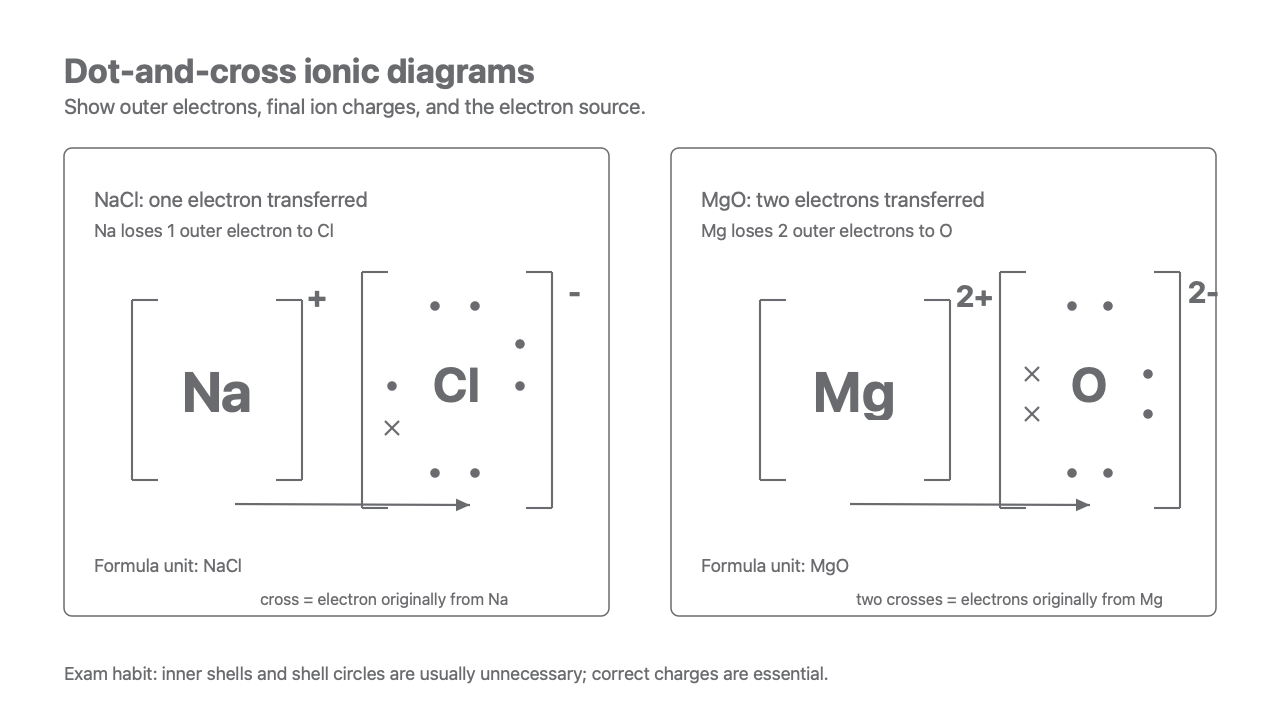
Worked example 1: sodium chloride
Sodium transfers one electron to chlorine.
- Na becomes [Na]+ with no outer electron shown in this simple outer-shell diagram.
- Cl becomes [Cl]- with eight outer-shell electrons.
- Seven of the chlorine outer electrons can be shown as dots.
- The extra electron from sodium can be shown as a cross.
The diagram must show the final ions and their charges. A common error is to draw an electron moving between atoms but leave the charges off the final ions; that does not fully show the ionic product.
Worked example 2: magnesium oxide
Magnesium is in Group 2, so it loses two electrons to form Mg2+. Oxygen is in Group 6, so it gains two electrons to form O2-. The oxide ion should have eight outer-shell electrons in total: six originally from oxygen and two from magnesium.
The charges are equal and opposite, so the formula unit is MgO.
For compounds with unequal numbers of ions, the same charge-balancing idea applies. In MgCl2, Mg2+ needs two Cl- ions to balance the charge. In K2O, two K+ ions are needed for one O2- ion.
The giant ionic lattice model
An ionic compound is not made from separate molecules. Sodium chloride, for example, does not contain little NaCl molecules. Instead, it has a giant ionic lattice: a repeating three-dimensional arrangement of positive and negative ions.
Giant ionic lattice
A giant ionic lattice is a regular repeating arrangement of many positive and negative ions, with each ion strongly attracted to oppositely charged ions in all directions.
The word giant means that the structure continues through a very large number of ions. The formula NaCl gives the simplest ratio of Na+ to Cl- ions, not a separate molecule.
[DIAGRAM: asset_name: Lesson 2.2.2a-c: Ionic Bonding and Giant Ionic Lattices - diagram 02; asset_slug: 02_02_02a_ionic_bonding_and_giant_ionic_lattices__diagram_02; recommended_method: drawn_chem; description: A clean 16:9 model of a small region of a sodium chloride giant ionic lattice, showing alternating Na+ and Cl- ions, strong attractions in all directions, and linked property explanations for high melting point, solubility and conductivity in solid, molten and aqueous states.]
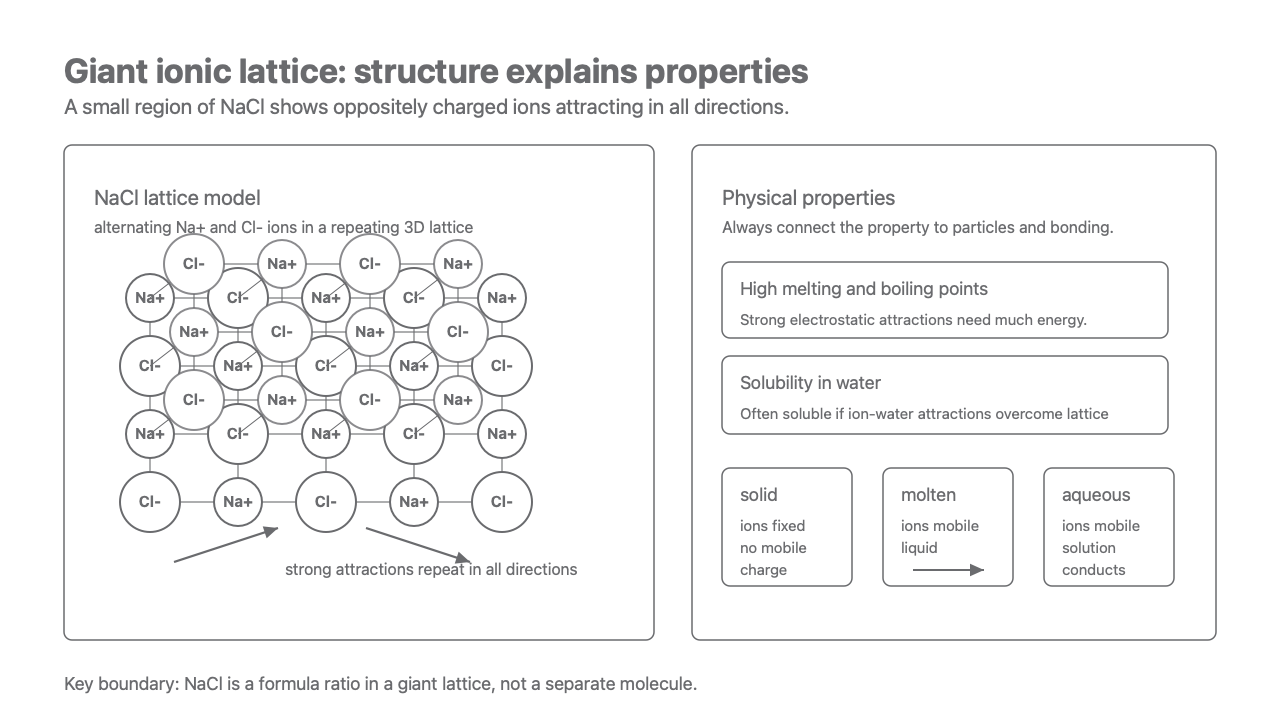
Worked reasoning: why NaCl is solid at room temperature
In solid sodium chloride, each Na+ ion is surrounded by oppositely charged Cl- ions and each Cl- ion is surrounded by oppositely charged Na+ ions. These attractions act in all directions through the lattice. A lot of energy is needed to overcome enough of these strong electrostatic attractions for the lattice to melt, so sodium chloride has a high melting point.
This explanation needs both parts: the structure is a giant lattice, and the bonding is strong electrostatic attraction between oppositely charged ions.
Explaining properties from structure
The useful exam habit is to explain every property by naming the particles, their arrangement and whether charged particles can move.
Melting and boiling points
Ionic compounds usually have high melting and boiling points. The ions are held in a giant lattice by strong electrostatic attractions between oppositely charged ions. A large amount of energy is needed to overcome these attractions, so high temperatures are needed to melt or boil the compound.
Do not write only "strong bonds". Say what the strong attraction is between: oppositely charged ions in a giant ionic lattice.
Electrical conductivity
An ionic compound contains charged particles, but conductivity also needs those charged particles to move.
| state | can it conduct? | particle explanation |
|---|---|---|
| solid ionic compound | no | ions are fixed in position in the lattice |
| molten ionic compound | yes | ions can move through the liquid |
| aqueous ionic solution | yes | dissolved ions can move through the solution |
Solid sodium chloride does not conduct because its ions are charged but fixed in place. Molten sodium chloride conducts because the ions are free to move and carry charge.
Solubility
Many ionic compounds dissolve in water. This happens when attractions formed between water molecules and ions are strong enough to overcome the attractions holding ions in the lattice. Not all ionic compounds are soluble, so avoid writing "all ionic compounds dissolve in water".
Ionic compounds are usually not soluble in non-polar organic solvents because those solvents do not form strong enough attractions with the ions.
Worked explanation: magnesium oxide melting point
Magnesium oxide is a giant ionic lattice containing Mg2+ and O2- ions. The oppositely charged ions have strong electrostatic attractions in all directions. A large amount of energy is needed to overcome these attractions, so magnesium oxide has a high melting point.
Using the model accurately
The bonding model is powerful because it connects the microscopic particles to macroscopic properties. That is a How Science Works idea: use a model about particles and forces to explain what can be observed or measured.
Here are the most common traps and the correction for each one.
| trap | better chemistry |
|---|---|
| "Ionic bonding is electron transfer." | Electron transfer forms ions; ionic bonding is electrostatic attraction between positive and negative ions. |
| "NaCl molecules have strong bonds." | Sodium chloride has a giant ionic lattice, not molecules. |
| "Solid ionic compounds cannot conduct because they have no charged particles." | They contain charged ions, but the ions are fixed and cannot carry charge through the solid. |
| "All ionic compounds dissolve in water." | Many do, but solubility depends on whether ion-water attractions can overcome lattice attractions. |
Worked response: identifying an ionic substance from data
A substance has a high melting point. It does not conduct as a solid, but it conducts when molten and when dissolved in water. The best model is a giant ionic lattice.
The high melting point suggests strong attractions in a giant structure. The lack of solid conductivity shows charged particles are not mobile in the solid. Conductivity when molten or aqueous shows mobile ions are present. Together, these observations support an ionic compound.
Now use the same model to improve an incomplete explanation.