1.2.2d-f - Volumetric glassware, reflux, filtration and indicators
This lesson is about using common wet-chemistry apparatus accurately and safely. You are not learning a long list of practical recipes; you are learning why each piece of apparatus is chosen, what accuracy it gives, and what details make an experimental method valid.
Choose Apparatus For The Job
Practical chemistry often fails before the reaction even starts: the wrong glassware gives the wrong volume, the wrong flask loses vapour, or the wrong filtration setup lets solid through. You need to recognise apparatus by purpose, not just by name.
Volumetric Glassware
Volumetric glassware is apparatus calibrated to measure one volume accurately. A volumetric pipette delivers a fixed volume, a burette delivers a measured variable volume, and a volumetric flask contains one accurate final volume.
Use the apparatus according to the measurement you need:
| Task | Best apparatus | Why |
|---|---|---|
| Transfer exactly 25.00 cm3 of solution | Volumetric pipette and pipette filler | Delivers one fixed, accurate volume |
| Add a variable volume until an endpoint | Burette | Lets you measure the volume delivered from initial and final readings |
| Make exactly 250.0 cm3 of solution | Volumetric flask | Calibrated to contain one final volume at the graduation mark |
| Hold the reacting mixture in a titration | Conical flask | Easy to swirl without splashing; its volume does not need to be measured accurately |
| Heat a reaction for a long time without losing volatile chemicals | Reflux apparatus | Vapour condenses and returns to the reaction flask |
| Separate an insoluble solid from a liquid | Filtration apparatus | Filter paper or a Buchner/Hirsch funnel traps the solid |
[DIAGRAM: asset_name: Lesson 1.2.2d-f: Volumetric glassware, reflux, filtration and indicators - diagram 01; asset_slug: 01_02_02b_volumetric_glassware_reflux_filtration_and_indicators__diagram_01; recommended_method: drawn_chem; description: NovaLearn-style line diagram comparing accurate volumetric glassware: burette clamped above a conical flask, volumetric pipette with filler delivering a fixed aliquot, and a volumetric flask filled to the calibration mark and inverted to mix.]
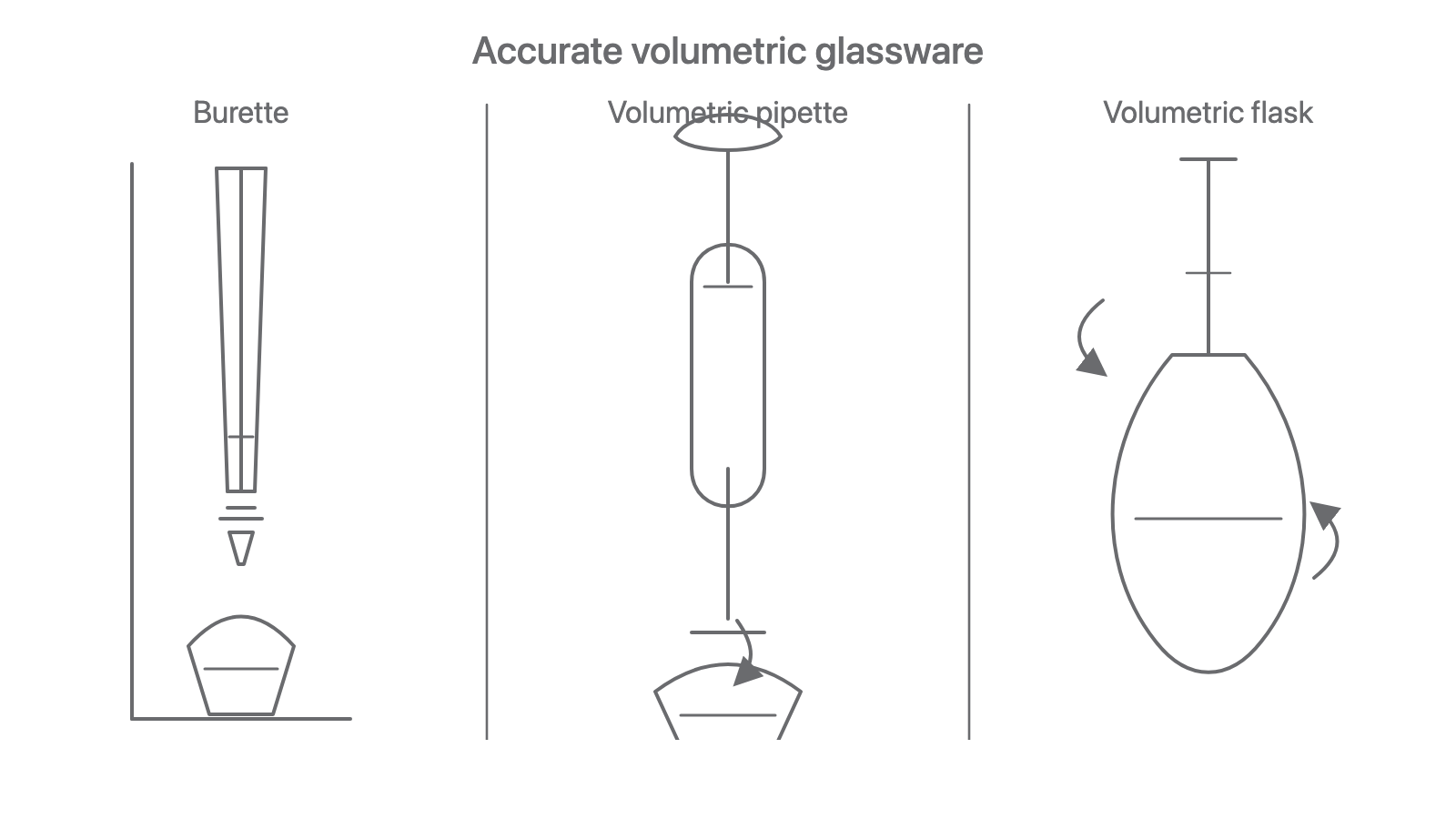
The most important practical distinction is between apparatus that measures and apparatus that merely holds. A conical flask can be rinsed with distilled water during a titration because the water does not change the amount of acid or alkali already in the flask. A pipette or burette must not be left with the wrong solution in it, because that would dilute or contaminate the measured reagent.
Worked reasoning: a student needs 25.00 cm3 of sodium carbonate solution in a conical flask before titrating it with hydrochloric acid. A measuring cylinder is quick, but it is not accurate enough for the fixed aliquot. The correct choice is a volumetric pipette with a pipette filler. The conical flask can then be placed under a burette containing hydrochloric acid.
Titration And Standard Solutions
A titration finds the volume of one solution needed to react exactly with a known volume of another solution. The solution in the burette is added until the indicator shows the endpoint. The volume delivered by the burette is the titre.
For reliable titration technique:
- Rinse the burette with the solution that will go in the burette, then fill it.
- Remove the funnel before titrating so drops do not fall in during the run.
- Remove any air bubble from the burette tip.
- Read the bottom of the meniscus at eye level.
- Record burette readings to two decimal places, usually ending in 0 or 5.
- Use a volumetric pipette and filler to transfer the fixed aliquot to the conical flask.
- Add only a few drops of indicator.
- Swirl the conical flask and rinse the flask walls with distilled water if needed.
- Near the endpoint, add solution dropwise until the first permanent colour change.
- Repeat until concordant titres are obtained.
The conical flask is not rinsed with the solution being pipetted into it, because extra drops would add extra moles of that reagent. It may be wet with distilled water because the amount of reagent already pipetted in stays the same.
Standard Solution
A standard solution has an accurately known concentration. It is usually prepared in a volumetric flask so the amount of solute and the final volume are both known accurately.
To prepare a standard solution from a solid:
- Weigh the required mass of solid accurately.
- Dissolve the solid in a beaker using less distilled water than the final required volume.
- Transfer the solution to the volumetric flask using a funnel or glass rod.
- Rinse the beaker, stirring rod and funnel into the volumetric flask so all dissolved solute is transferred.
- Add distilled water until the bottom of the meniscus is on the calibration mark.
- Stopper the flask and invert it several times to mix thoroughly.
Worked example: a student is asked to prepare 250.0 cm3 of 0.100 mol dm^-3 sodium carbonate solution from solid sodium carbonate, Na2CO3.
The amount needed is:
The molar mass of Na2CO3 is:
The mass required is:
The practical method must then match the calculation: weigh 2.65 g, dissolve it in a beaker, transfer all solution and washings into a 250.0 cm3 volumetric flask, make to the mark and invert to mix. The calculation alone is not enough if the transfer loses solute.
Reflux And Distillation Glassware
Heating under reflux and distillation both use a condenser, but they have different purposes.
Heating Under Reflux
Heating under reflux means heating a reaction mixture while vapour is condensed and returned to the reaction flask. It allows sustained heating without losing volatile reactants, products or solvent.
In a reflux setup, the condenser is vertical above a pear-shaped or round-bottom flask. The water enters at the bottom of the condenser and leaves at the top, so the condenser jacket stays full of cold water. The top is open to the air, so pressure cannot build up. The flask is held securely with a retort stand and clamp, and the heating source is chosen after considering flammability and other hazards.
Distillation is different. It is used to separate a liquid product or purify a liquid by boiling it, condensing the vapour and collecting the distillate. The condenser slopes down towards a receiving vessel. A thermometer, when used, has its bulb near the still-head outlet so it measures the temperature of vapour entering the condenser, not the liquid in the flask.
[DIAGRAM: asset_name: Lesson 1.2.2d-f: Volumetric glassware, reflux, filtration and indicators - diagram 02; asset_slug: 01_02_02b_volumetric_glassware_reflux_filtration_and_indicators__diagram_02; recommended_method: drawn_chem; description: NovaLearn-style line diagram showing heating under reflux beside simple distillation, with round-bottom flask, condenser, water-in at bottom, water-out at top, retort stand and clamps, thermometer at still-head for distillation, receiving vessel, and open-system safety note.]
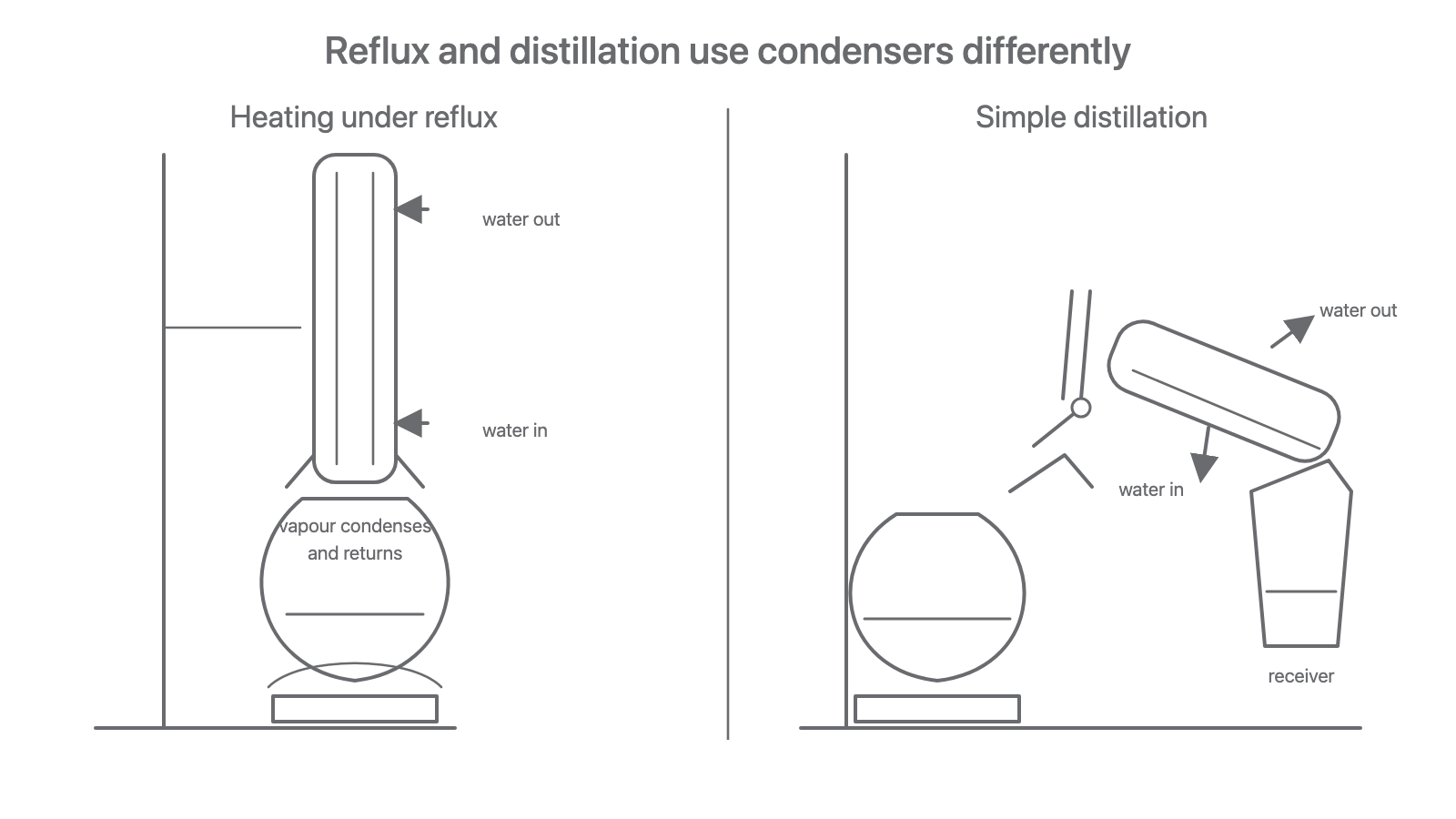
Worked reasoning: if a reaction is slow and contains a volatile organic reagent, reflux is the safer method to heat it for longer. Simple boiling in an open beaker would let vapour escape, changing the reacting amounts and increasing exposure to fumes. Distillation would remove volatile material from the reaction mixture, so it is only appropriate when the aim is separation or purification of a liquid.
Common error contrast: a condenser is not automatically a distillation setup. In reflux, the condensed liquid returns to the same flask. In distillation, condensed liquid is carried away and collected.
Filtration And Qualitative Tests
Filtration separates an insoluble solid from a liquid. The best filtration method depends on whether you want the filtrate, the solid residue, or a dry solid product.
In ordinary gravity filtration, a filter funnel holds filter paper. Fluted filter paper has folds that increase surface area and create channels for liquid to pass through more quickly. This is useful when the liquid filtrate is wanted, or when hot filtration needs to avoid crystallisation in the funnel.
Filtration under reduced pressure is used when the solid is the product and needs to be collected quickly. A Buchner or Hirsch funnel sits on a side-arm flask. The filter paper is moistened so it seals against the funnel plate, and the side arm is connected to suction. Reduced pressure below the paper pulls liquid through, leaving solid on the paper.
[DIAGRAM: asset_name: Lesson 1.2.2d-f: Volumetric glassware, reflux, filtration and indicators - diagram 03; asset_slug: 01_02_02b_volumetric_glassware_reflux_filtration_and_indicators__diagram_03; recommended_method: drawn_chem; description: NovaLearn-style line diagram comparing gravity filtration with fluted filter paper and filtration under reduced pressure using a Buchner funnel, side-arm flask, seal, vacuum tubing and labelled residue/filtrate.]
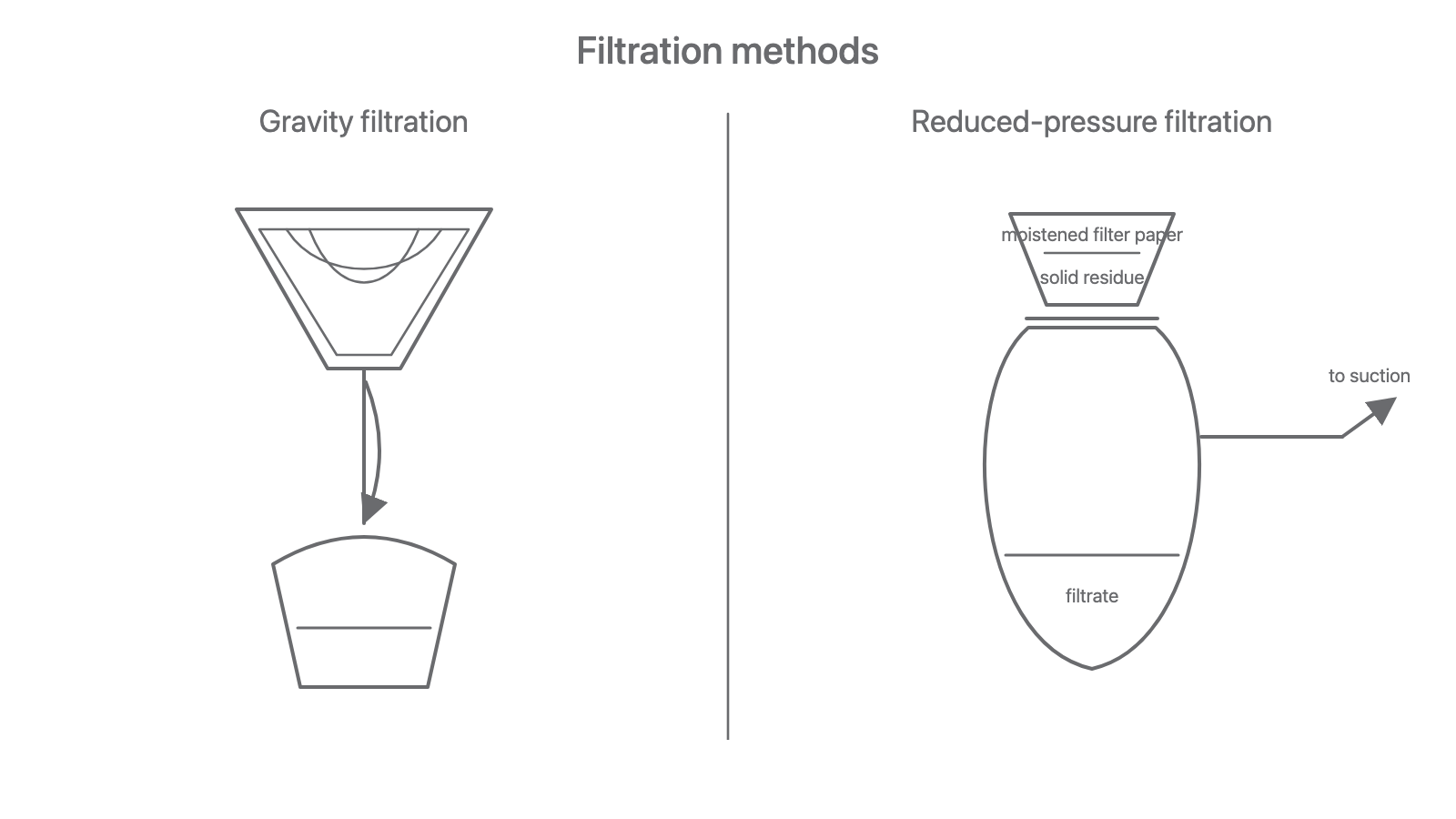
Risk management matters. Check glassware for cracks before reduced-pressure work, clamp the side-arm flask if needed, and release the vacuum safely before disconnecting. With hot filtration, handle hot glassware carefully and avoid sealing any heated system.
This specification row also includes use of apparatus for qualitative tests for ions and organic functional groups. The exact tests are taught in later chemistry lessons; here, the practical skill is to run small-scale tests cleanly and record observations precisely.
Good qualitative test technique includes:
- using small samples in clean test tubes
- adding reagents dropwise when the method requires it
- heating with a water bath or suitable heater when needed
- keeping controls or known samples separate from unknowns
- avoiding cross-contamination between dropping pipettes
- recording colour changes, precipitates, gases, dissolving and lack of change
Worked qualitative-test example: a student adds aqueous sodium hydroxide dropwise to a small sample and sees a pale blue precipitate. A useful record is "NaOH(aq) added dropwise: pale blue precipitate forms." A weak record is "it changed" because it omits the reagent, colour and physical observation. Keep this as practical technique here; the later ion-test lesson teaches which ions these observations identify.
Worked reasoning: if a solid organic product is collected after recrystallisation, reduced-pressure filtration is usually better than simple gravity filtration because it collects and partly dries the solid more quickly. If the aim is to remove insoluble impurities from a hot solution and keep the solution, gravity filtration with fluted paper is more appropriate.
Use Indicators At The Endpoint
An acid-base indicator changes colour over a pH range. In a titration, the endpoint is the observed colour change. The equivalence point is the chemical point where the acid and alkali have reacted in the exact stoichiometric ratio. Good indicator use makes the endpoint as close as possible to the equivalence point.
Only a few drops of indicator are used because indicators are weak acids or weak bases. Adding too much indicator can slightly change the reacting mixture and make the colour change harder to judge.
For this practical-techniques lesson, use these selection rules:
| Acid/alkali combination | Practical indicator message |
|---|---|
| Strong acid with strong alkali | The pH change near equivalence is very steep; several indicators can work if their colour-change range lies within the steep change |
| Weak acid with strong alkali | The equivalence region is above pH 7; phenolphthalein or a similar higher-range indicator is often suitable |
| Strong acid with weak alkali | The equivalence region is below pH 7; methyl orange or a similar lower-range indicator is often suitable |
| Weak acid with weak alkali | The pH change is too gradual for a sharp visual endpoint; an indicator is not suitable |
The words strong and weak describe the extent of ionisation in water, not the concentration. A dilute strong acid is still strong because its acid particles fully ionise; a concentrated weak acid is still weak because only a small proportion of acid particles ionise.
Worked example: an acid is titrated with a strong alkali. The sharp colour-change region from the experimental pH data is about pH 8 to pH 10. Phenolphthalein changes colour in roughly this region, so it is a suitable indicator. Methyl orange changes colour at a much lower pH, so it would change before the equivalence region and give a poorer endpoint.