1.2.2a-c - Core measurement, heating and pH techniques
This lesson is about choosing apparatus because it fits the measurement, not because it is familiar. You will learn how to record mass, time, volumes and temperature, how to heat mixtures using water baths, electric heaters and sand baths, and how to measure pH with charts, meters and probes.
Choose the Measurement
A practical method should say exactly what is being measured and how. The specification expects you to choose appropriate apparatus for mass, time, liquid volume, gas volume and temperature. The word appropriate matters: the instrument must give a reading accurate enough for the conclusion you need.
[DIAGRAM: asset_name: Lesson 1.2.2a-c: Core measurement, heating and pH techniques - diagram 01; asset_slug: 01_02_02a_core_measurement_heating_and_ph_techniques__diagram_01; recommended_method: drawn_chem; description: NovaLearn-style measurement-selection map showing apparatus for mass, time, liquid volume, gas volume and temperature, with units and recording habits.]
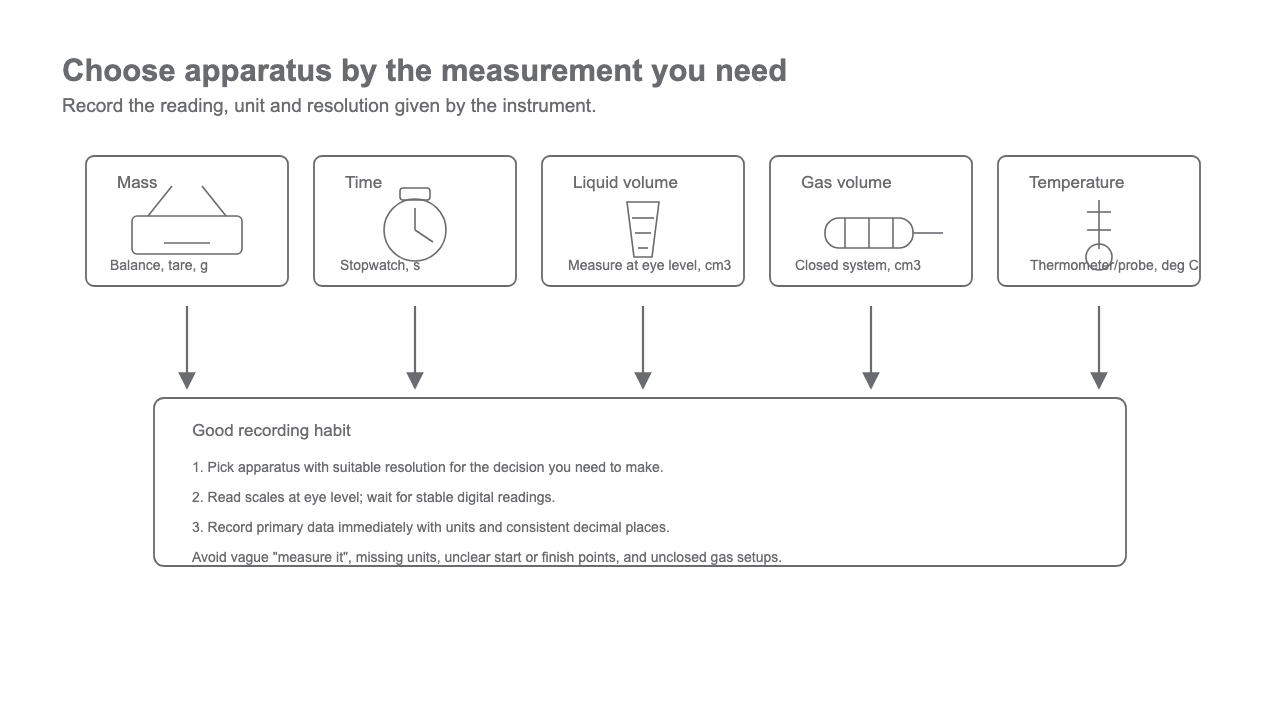
Common choices are:
| Measurement | Suitable apparatus | Typical unit |
|---|---|---|
| Mass | Balance | g |
| Time | Stopwatch, stop clock or data logger | s |
| Liquid volume | Measuring cylinder, pipette, burette or volumetric flask depending on accuracy needed | cm3 |
| Gas volume | Gas syringe or inverted burette/measuring cylinder over water | cm3 |
| Temperature | Thermometer or temperature probe | deg C or K |
Worked reasoning: a student wants to compare how fast two reactions produce carbon dioxide. A beaker is not a gas-volume instrument. A better method is to connect the reaction vessel to a gas syringe, record gas volume at regular times, and keep the setup closed so gas cannot escape before measurement.
Record Readings Clearly
Good measurements are not just taken; they are recorded in a way that another chemist can understand. A number without a unit is incomplete, and a table without headings is hard to use.
For every primary measurement, record:
- the quantity, such as mass, time, volume or temperature
- the unit, such as g, s, cm3 or deg C
- all relevant digits shown by the apparatus
- repeated readings in the same format
- any observation needed to interpret the number
Read scale instruments at eye level where possible to reduce parallax error. Wait for digital readings to stabilise before recording them. For gas collection, check that the plunger moves freely in a gas syringe or that the inverted measuring cylinder starts full of water if collecting over water.
Worked example: recording liquid volume
A measuring cylinder scale is marked every 1 cm3. The bottom of the meniscus is halfway between 26 and 27 cm3. A sensible reading is 26.5 cm3. Writing just 26 loses information, while writing 26.473 cm3 claims precision the apparatus cannot provide.
Heating Methods
The required heating methods in this folder are water bath, electric heater and sand bath. The choice depends on the temperature needed, the substance being heated and the risk.
[DIAGRAM: asset_name: Lesson 1.2.2a-c: Core measurement, heating and pH techniques - diagram 02; asset_slug: 01_02_02a_core_measurement_heating_and_ph_techniques__diagram_02; recommended_method: drawn_chem; description: NovaLearn-style comparison of water bath, electric heater and sand bath, with purpose and risk-control notes.]
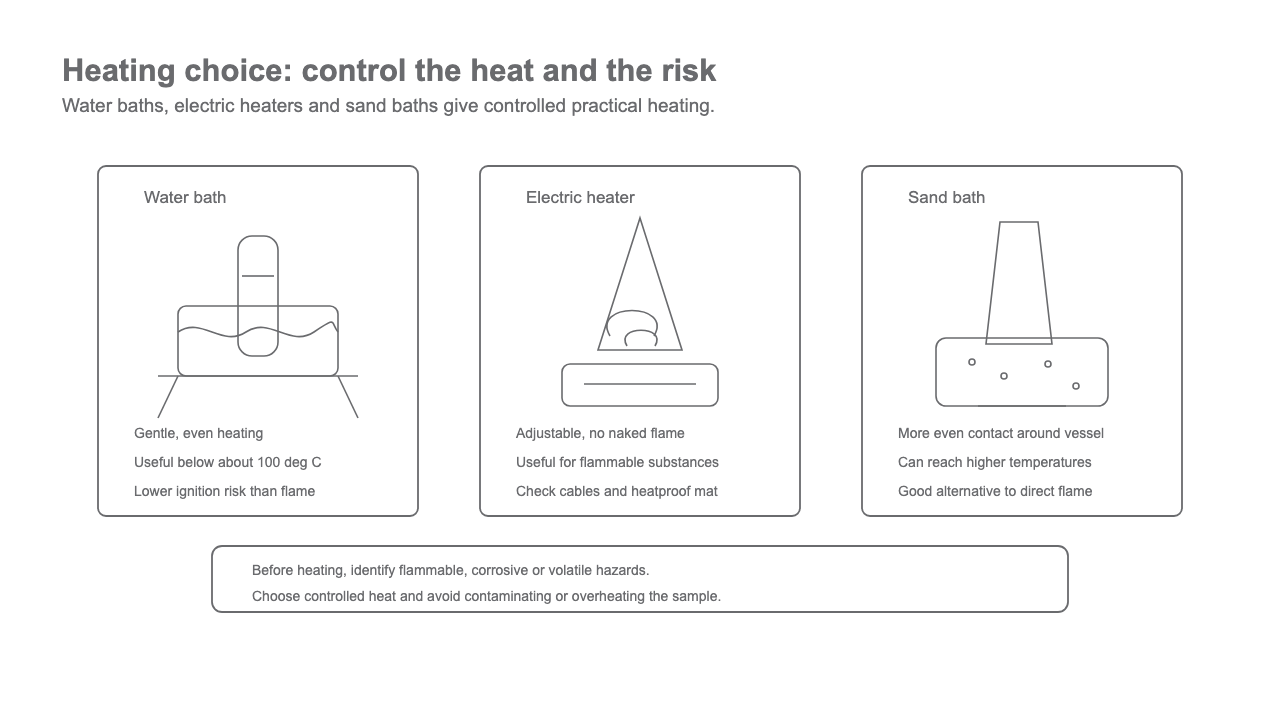
A water bath gives gentle, even heating and limits the temperature to around the boiling point of water. It is useful when direct flame would be too harsh or when a flammable liquid must be kept away from a naked flame. An electric heater or heating mantle gives controlled heating without a Bunsen flame. A sand bath supports a vessel and spreads heat more evenly around it, often when a higher or steadier temperature is needed.
The practical answer should link the risk to the method. For example, "use a water bath" is stronger if you add "because the liquid is flammable and should not be heated with a naked flame."
Worked reasoning: a student heats ethanol. Ethanol is flammable, so a Bunsen burner is a poor choice. A water bath or suitable electric heater controls the heating and avoids a naked flame.
Measuring pH
pH can be measured approximately or numerically. The best method depends on the precision needed and whether pH is being followed over time.
[DIAGRAM: asset_name: Lesson 1.2.2a-c: Core measurement, heating and pH techniques - diagram 03; asset_slug: 01_02_02a_core_measurement_heating_and_ph_techniques__diagram_03; recommended_method: drawn_chem; description: NovaLearn-style pH measurement workflow comparing pH chart/paper, pH meter/probe and data logger, with calibration and stable-reading notes.]
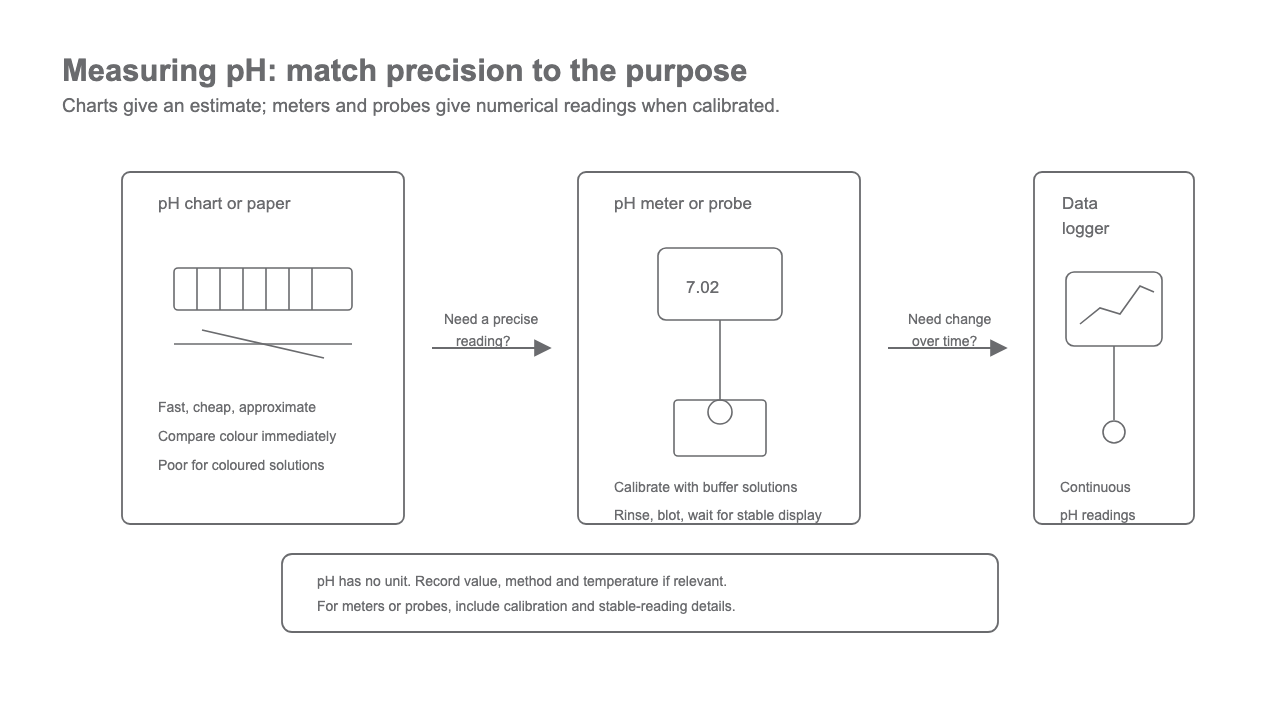
pH paper or a pH chart gives an approximate value by colour comparison. It is fast and simple, but it is not very precise and can be difficult to use with coloured solutions.
A pH meter or pH probe gives a numerical reading. For a reliable reading, the probe should be calibrated using buffer solutions if required by the method, rinsed with distilled water between solutions, and allowed to settle before the value is recorded. A pH probe connected to a data logger can record pH continuously, which is useful when pH changes during a reaction or titration-style investigation.
Worked example: choosing a pH method
A student only needs to know whether a solution is strongly acidic, neutral or alkaline. Universal indicator paper is suitable. Another student needs to compare two buffer solutions whose pH values differ by 0.20. A calibrated pH meter is more suitable because a colour chart is too approximate for that comparison.
Integrated Method Choice
In exam-style practical questions, apparatus choice is often hidden inside a method. Read the aim first, then match the measurement to the instrument.
Worked example: designing a simple measurement sequence
Aim: measure how temperature affects the rate of a reaction that produces gas.
A suitable method would:
- Use a balance if a solid reactant mass must be kept constant.
- Use a measuring cylinder or pipette to measure the liquid reactant volume, depending on the accuracy needed.
- Use a water bath to bring reactants to the chosen temperature.
- Use a thermometer or temperature probe to check temperature.
- Connect the reaction vessel to a gas syringe.
- Start the stopwatch when the reactants are mixed.
- Record gas volume at fixed time intervals.
The method works because each measured quantity has an appropriate instrument and unit. It also controls risk by choosing a heating method deliberately rather than heating blindly.
Explain It Back
Use this as a self-explanation check after the section above. It is for diagnosing what you can already explain, not for learning new material from scratch.
That final check should feel like choosing tools from an aim, not reciting a list. Now test that thinking in your own words.