2.1.2 - Compounds, formulae and equations
Chemical formulae and equations are the shorthand language used through the rest of chemistry. In this lesson you will learn how ionic charges determine formulae, how to balance equations without changing formulae, and how to write ionic equations that show only the particles that actually react.
Ionic Charge and Neutral Formulae
An ionic compound is made from positive ions and negative ions. The formula of an ionic compound gives the simplest whole-number ratio of ions that makes the overall charge zero.
Ionic formula
The formula of an ionic compound shows the simplest ratio of positive and negative ions needed to give no overall charge.
This is a charge-balance problem. A formula such as means one ion for every two ions. The total charge is:
So the compound is neutral.
[DIAGRAM: asset_name: Lesson 2.1.2: Compounds, Formulae and Equations - diagram 01; asset_slug: 02_01_02_compounds_formulae_and_equations__diagram_01; recommended_method: drawn_chem; description: A clean 16:9 NovaLearn-style charge-balance diagram showing Mg2+ with two NO3- ions forming Mg(NO3)2, and Al3+ with three Cl- ions forming AlCl3. Include charge sums showing +2 + 2(-1) = 0 and +3 + 3(-1) = 0.]
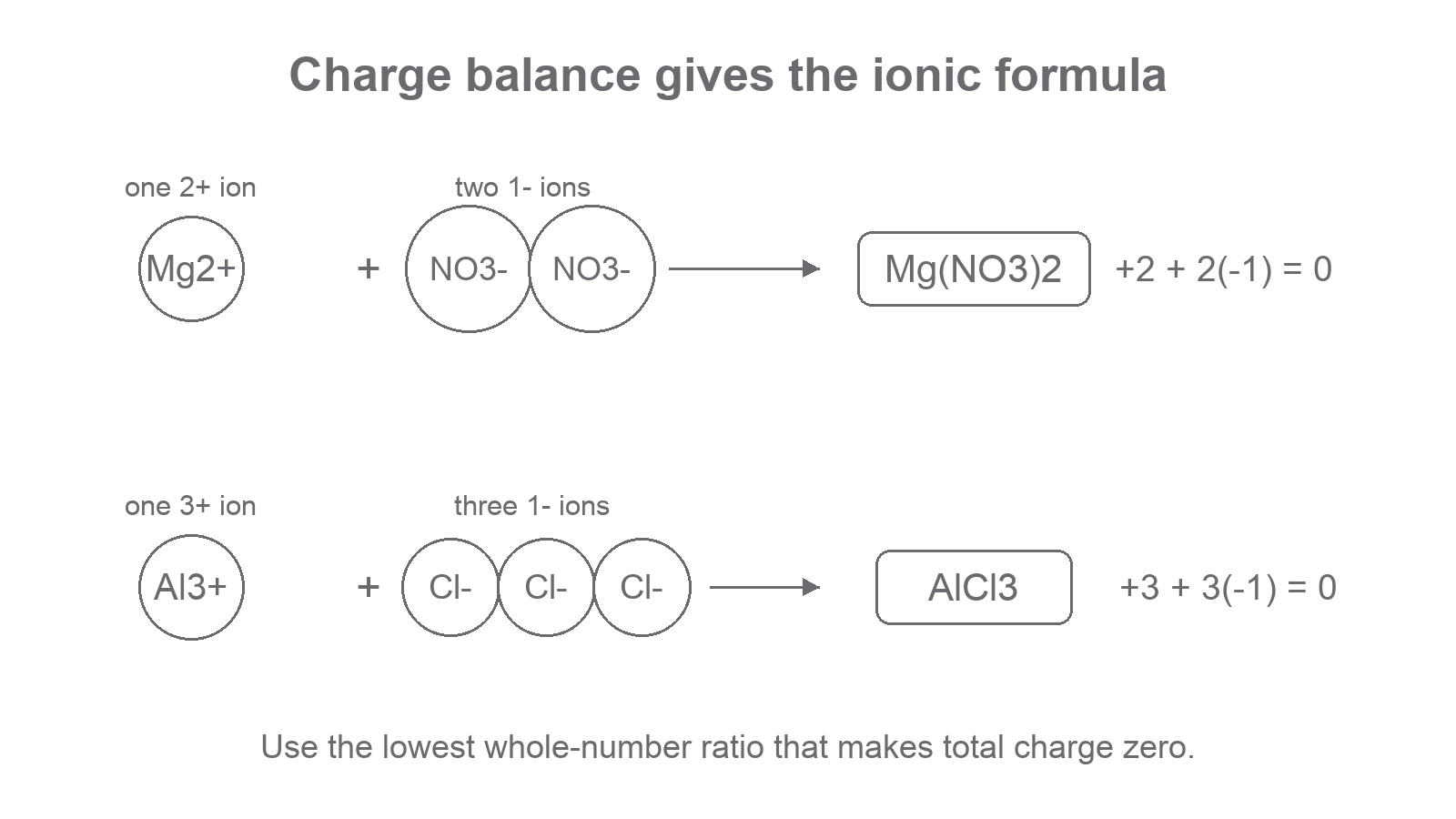
For simple ions, you can often predict the charge from the element's position in the Periodic Table:
| Position in Periodic Table | Typical simple ion charge | Example |
|---|---|---|
| Group 1 metal | , | |
| Group 2 metal | , | |
| Group 3 metal, especially aluminium | ||
| Group 5 non-metal in simple ionic compounds | ||
| Group 6 non-metal | , | |
| Group 7 non-metal | , |
The logic is that metal atoms usually form positive ions, while non-metal atoms in simple ionic compounds usually form negative ions. You do not need to predict every possible ion in chemistry from the Periodic Table. If a question uses an ion outside this predictable pattern, and it is not one of the required recall ions in the next part, the charge will be given.
Worked example: formula from predicted charges
Deduce the formula of aluminium oxide.
Aluminium forms . Oxygen forms .
To make the charges balance, use the lowest common total charge of 6:
- two ions give
- three ions give
The neutral formula is:
Do not write . That would combine and , giving an overall charge, so it would not be a neutral compound.
Required Ions and Brackets
Some ions contain more than one atom. These are still single ions, so the whole group carries one overall charge. You must recall the following names, formulae and charges.
| Ion name | Formula |
|---|---|
| nitrate | |
| carbonate | |
| sulfate | |
| hydroxide | |
| ammonium | |
| zinc ion | |
| silver ion |
When a question says nitrate, assume . When it says sulfate, assume . Do not change these into nitrite, sulfite or any other ion unless the question explicitly gives a different formula.
The bracket rule is simple:
- if only one polyatomic ion is needed, do not use brackets: ,
- if more than one of the whole ion is needed, put the ion in brackets before the subscript: ,
Worked example 1: magnesium nitrate
Magnesium forms . Nitrate is .
One magnesium ion has charge , so two nitrate ions are needed:
The formula is . The brackets show that there are two complete nitrate ions, not just two oxygen atoms.
Worked example 2: ammonium sulfate
Ammonium is . Sulfate is .
Two ammonium ions are needed for one sulfate ion:
The formula is:
A common error is to write . That has one ion and one ion, so the charges do not balance.
Balanced Equations and State Symbols
A chemical equation represents a reaction using formulae. A balanced equation has the same number of atoms of each element on both sides. For ordinary full equations, the total charge on both sides must also match.
Balance equations by changing coefficients in front of formulae. Never balance by changing the formula subscripts inside a correct compound.
For example, magnesium reacts with hydrochloric acid to form magnesium chloride and hydrogen.
Step 1: write the correct formulae.
Step 2: balance atoms by adding coefficients.
Step 3: add state symbols.
State symbols tell you the physical form of each species:
| State symbol | Meaning |
|---|---|
| solid | |
| liquid | |
| gas | |
| aqueous, dissolved in water |
Use normal-size lower-case letters in brackets: , , . Do not hide state symbols as tiny subscripts, and do not guess a gas just because bubbles are mentioned unless the reaction information supports it.
Worked example: acid and carbonate reaction
Construct a balanced equation, including state symbols, for solid calcium carbonate reacting with aqueous nitric acid to form aqueous calcium nitrate, carbon dioxide and water.
First write formulae:
- calcium carbonate:
- nitric acid:
- calcium nitrate:
- carbon dioxide:
- water:
Now balance. Calcium and carbonate are already balanced. Calcium nitrate contains two nitrate groups, so two nitric acid molecules are needed.
Check atoms:
| Element | Left | Right |
|---|---|---|
| Ca | 1 | 1 |
| C | 1 | 1 |
| H | 2 | 2 |
| N | 2 | 2 |
| O | 9 | 9 |
The equation is balanced. The coefficient 2 in front of changes the number of nitric acid particles; it does not change the nitrate ion formula.
Ionic Equations
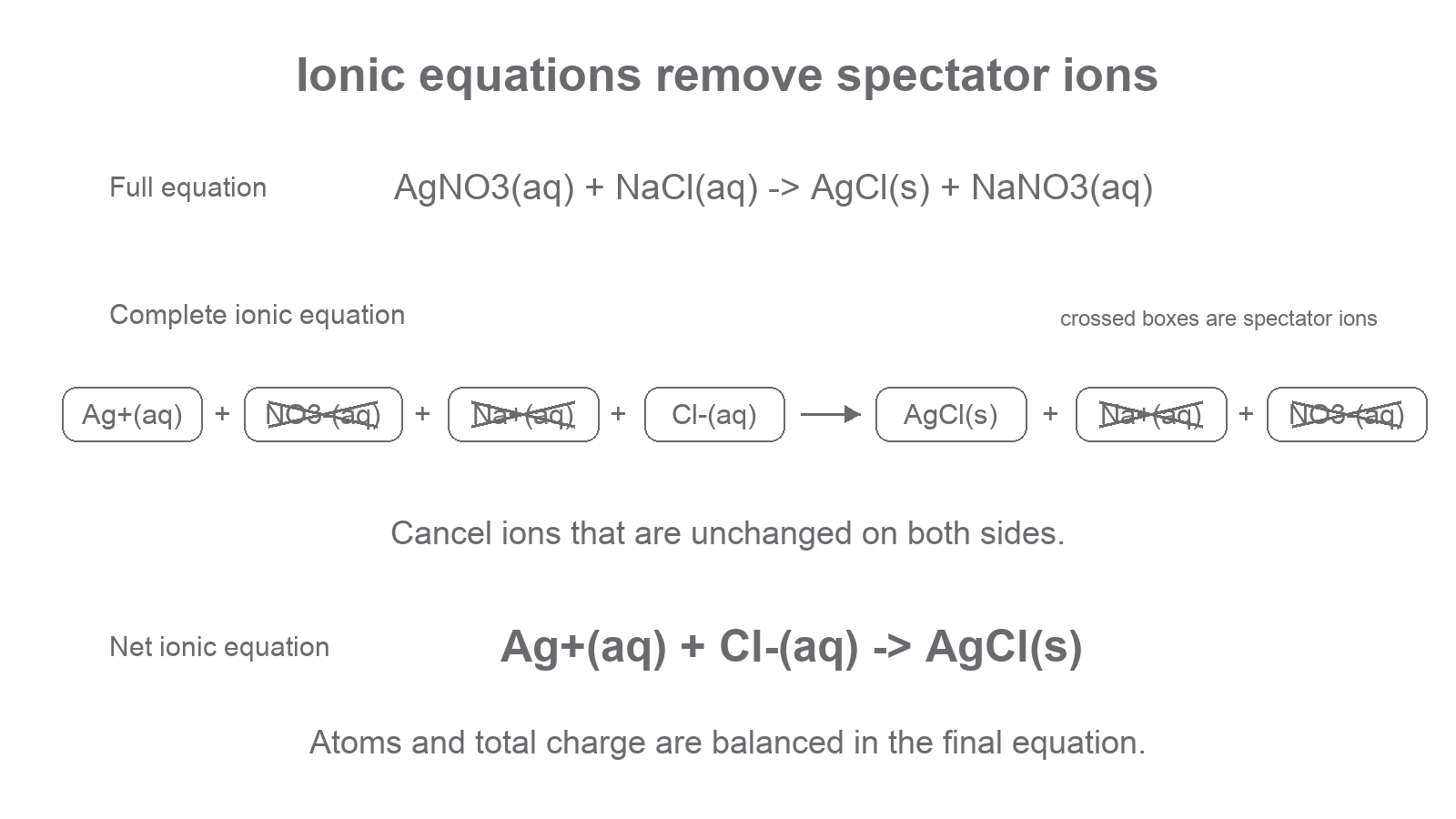
An ionic equation shows the species that actually change during a reaction. Ions that appear unchanged on both sides are spectator ions. They are present in solution, but they are not part of the net chemical change.
Spectator ion
A spectator ion is an ion that is present in the reaction mixture but remains unchanged and appears on both sides of the complete ionic equation.
To write an ionic equation:
- Start with a balanced full equation, including state symbols.
- Split aqueous ionic compounds into their ions.
- Do not split solids, liquids, gases or covalent molecules.
- Cancel spectator ions that are identical on both sides.
- Check that atoms and charge are balanced in the final ionic equation.
[DIAGRAM: asset_name: Lesson 2.1.2: Compounds, Formulae and Equations - diagram 02; asset_slug: 02_01_02_compounds_formulae_and_equations__diagram_02; recommended_method: drawn_chem; description: A clean 16:9 NovaLearn-style worked spectator-ion cancellation for AgNO3(aq) + NaCl(aq) -> AgCl(s) + NaNO3(aq), showing complete ionic equation, Na+ and NO3- cancelled as spectators, and final net ionic equation Ag+(aq) + Cl-(aq) -> AgCl(s).]
Worked example: silver chloride precipitate
Construct the ionic equation for the reaction between aqueous silver nitrate and aqueous sodium chloride. A white precipitate of silver chloride forms.
The full balanced equation is:
Split the aqueous ionic compounds into ions:
and appear unchanged on both sides, so they are spectator ions. Cancel them.
The ionic equation is:
Now check charge. The left side has . The right side is a neutral solid. Charge is balanced.
Worked example: neutralisation
Hydrochloric acid reacts with sodium hydroxide:
For this ionic equation, the aqueous acid provides and the aqueous alkali provides . Sodium and chloride ions are spectators.
This ionic equation is balanced for atoms and charge: , and water is neutral.
Unfamiliar Reactions
You are not expected to memorise every reaction in advance. You can construct equations for unfamiliar reactions when the question gives enough information about the reactants, products, charges or states.
Use this route:
- Identify each named substance and write its correct formula.
- Use ionic charges to build neutral ionic formulae.
- Add state symbols from the information given.
- Balance atoms using coefficients.
- For an ionic equation, split aqueous ionic compounds and cancel spectators.
- Check the final answer for balanced atoms and balanced charge.
Worked example: unfamiliar precipitation reaction
A question says: aqueous magnesium nitrate reacts with aqueous potassium hydroxide to form solid magnesium hydroxide and aqueous potassium nitrate. Construct a balanced equation with state symbols.
First write formulae:
- magnesium nitrate:
- potassium hydroxide:
- magnesium hydroxide:
- potassium nitrate:
Then balance:
The ionic equation is found by splitting aqueous ionic compounds:
Cancel and :
This final ionic equation has total charge zero on both sides: .
Explain It Back
Use this as a self-explanation check after the section above. It is for diagnosing what you can already explain, not for learning new material from scratch.
Before you move on, pause on the central distinction in this lesson: formula subscripts belong to the identity of a substance, while equation coefficients belong to the amount of that substance taking part.