2.1.1c-e - Relative mass and mass spectrometry
Atoms are far too small to weigh one by one in grams, so chemists compare their masses on a relative scale. In this lesson you will learn the carbon-12 mass scale, how isotope data from mass spectrometry is used to calculate relative atomic mass, and when to use the terms relative molecular mass and relative formula mass.
The carbon-12 relative mass scale
Relative masses compare particle masses with a fixed standard. For atomic masses, the standard is one twelfth of the mass of one atom of carbon-12, written as ^12C. Carbon-12 is assigned a relative mass of exactly 12, so one twelfth of a ^12C atom is the reference unit.
Relative isotopic mass
The relative isotopic mass is the mass of an atom of a specific isotope compared with one twelfth of the mass of an atom of carbon-12.
This is about one isotope only. For example, ^35Cl and ^37Cl have different relative isotopic masses because their atoms contain different numbers of neutrons.
Relative atomic mass
The relative atomic mass, A_r, is the weighted mean mass of an atom of an element compared with one twelfth of the mass of an atom of carbon-12.
The word weighted matters. Most elements have more than one isotope, and the isotopes do not usually occur in equal amounts. A_r therefore depends on both the relative isotopic masses and the relative abundances of the isotopes.
Relative isotopic mass is for one isotope. Relative atomic mass is a weighted mean for a sample of the element.
Worked example: why A_r is a weighted mean
Imagine a sample of chlorine atoms made from 75 atoms of ^35Cl and 25 atoms of ^37Cl. The total relative mass of these 100 atoms is:
The mean mass of one atom in the sample is:
So the relative atomic mass of this sample of chlorine is 35.5. No chlorine atom has mass 35.5; the value is the weighted mean of many atoms.
Reading isotope data from a mass spectrum
Mass spectrometry can be used to determine the relative isotopic masses and relative abundances of isotopes. For this lesson, you do not need to know how the mass spectrometer works. You only need to interpret the data it provides.
The simplified isotope mass spectra in this lesson use singly charged positive ions only. That means the charge is 1+, so the mass-to-charge ratio, m/z, has the same numerical value as the relative isotopic mass.
[DIAGRAM: asset_name: Lesson 2.1.1c-e: Relative Mass and Mass Spectrometry - diagram 01; asset_slug: 02_01_01b_relative_mass_and_mass_spectrometry__diagram_01; recommended_method: drawn_chem; description: A clean 16:9 mass spectrum for chlorine with m/z on the x-axis, relative abundance on the y-axis, bars at 35 and 37 labelled 35Cl+ and 37Cl+, and a note that for singly charged ions m/z equals relative isotopic mass.]
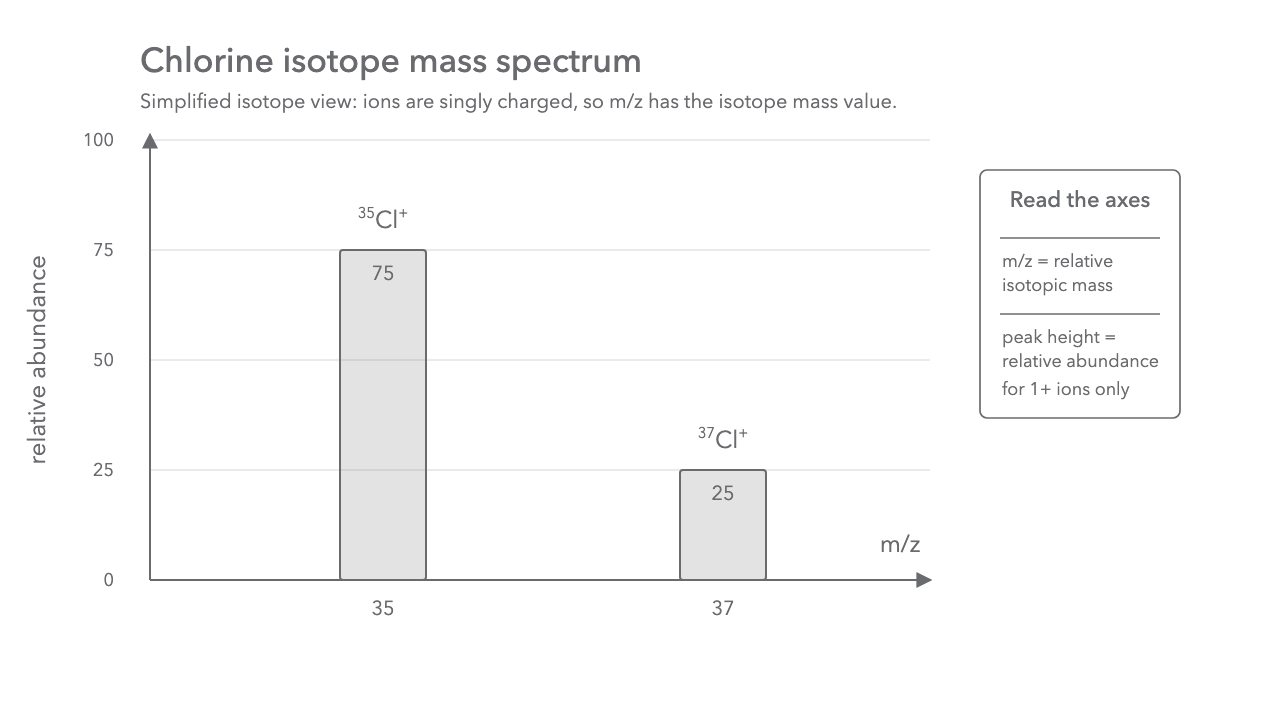
To read a simple isotope spectrum:
- Use the x-axis positions to identify the relative isotopic masses.
- Use the peak heights or given percentages to identify the relative abundances.
- Combine mass and abundance using a weighted mean.
For the chlorine example, the peak at m/z 35 represents ^35Cl+ ions and the peak at m/z 37 represents ^37Cl+ ions. The taller m/z 35 peak shows that ^35Cl is more abundant in the sample.
Here, treat isotope peaks as singly charged ions: m/z gives the isotope mass, and peak height gives relative abundance.
Worked example: reading spectrum information
A spectrum of an element has two peaks:
- m/z 10, relative abundance 20
- m/z 11, relative abundance 80
Because the ions are singly charged, the isotopic masses are 10 and 11. The relative abundances are in the ratio 20:80, so the isotope at m/z 11 is four times as abundant as the isotope at m/z 10.
Calculating relative atomic mass
The calculation is a weighted mean. Multiply each isotope mass by its abundance, add those values, then divide by the total abundance.
Relative atomic mass from isotope data
If the abundances are percentages, the total abundance is 100:
Worked example 1: percentages
Bromine has two isotopes in this sample:
| isotope | relative isotopic mass | percentage abundance |
|---|---|---|
| ^79Br | 79 | 50.7 |
| ^81Br | 81 | 49.3 |
Substitute into the percentage form:
To three significant figures, this is:
This answer is close to 80 because the two isotopes are almost equally abundant and lie either side of 80.
Worked example 2: relative peak heights
A mass spectrum of boron has these simplified relative abundances:
| m/z | relative abundance |
|---|---|
| 10 | 23 |
| 11 | 100 |
Do not divide by 100 here, because the abundances are not percentages. Divide by their total:
To three significant figures:
Calculation habits
Show your substitution clearly, keep one or two extra figures during working, then round the final answer to the requested precision. Relative atomic mass has no unit because it is a ratio on the carbon-12 scale.
Using Mr and relative formula mass
Relative mass language depends on the type of substance.
For simple molecules, use the term relative molecular mass, M_r. Calculate it by adding the relative atomic masses of all the atoms in one molecule.
Worked example: relative molecular mass of carbon dioxide
Carbon dioxide is a simple molecular substance with formula CO2.
Using A_r values C = 12.0 and O = 16.0:
For compounds with giant structures, use the term relative formula mass. This includes ionic compounds such as MgBr2 and giant covalent structures. Calculate it in the same arithmetic way: add the relative atomic masses in the formula.
Worked example: relative formula mass of magnesium bromide
Magnesium bromide, MgBr2, is ionic, so use relative formula mass rather than relative molecular mass.
Using A_r values Mg = 24.3 and Br = 79.9:
The calculation is the same kind of addition, but the term changes: M_r for simple molecules, relative formula mass for giant structures.
Avoiding Common Traps
Several small wording errors can change the chemistry.
First, do not call A_r a simple average. A simple average of 35 and 37 is 36, but chlorine's A_r is about 35.5 because ^35Cl is more abundant than ^37Cl.
Second, do not write that relative atomic mass is compared with carbon-12 as a whole atom. The comparison is with one twelfth of the mass of a carbon-12 atom.
Third, do not add units to A_r, M_r or relative formula mass. These are relative values. Later, molar mass uses units such as g mol^-1, but that is a different quantity.
Fourth, stay inside the mass-spectrometry boundary. For isotope spectra in this lesson, you only need to use the peaks to find isotope masses and relative abundances. You do not need to describe ionisation, acceleration, deflection or detection as an examinable method, and you do not need to handle ions with charges other than 1+.