2.1.3a - The mole and chemical amount
Chemists need a way to count particles that are far too small to count one by one. The amount of substance, measured in moles, is the counting quantity that connects particles, mass and gas volume. In this lesson you will learn the exact language and one-step conversions that later mole calculations depend on.
Amount of substance and specified entities
Amount of substance is a chemical quantity. It tells you how many specified elementary entities are present, where the entities might be atoms, molecules, ions, electrons or formula units.
The symbol for amount of substance is usually n. The unit is the mole, with symbol mol.
Amount of substance
Amount of substance is the quantity that counts specified chemical entities. It is measured in mol.
The word specified is important. A statement such as "amount of oxygen" can be ambiguous, because oxygen might mean O atoms or O2 molecules. Use the formula or named entity:
n(O2)means amount of oxygen molecules.n(O)means amount of oxygen atoms.n(NaCl)means amount of sodium chloride formula units.n(H+)means amount of hydrogen ions.
For ionic compounds, chemists often use the formula unit as the counted entity. One mole of NaCl means one mole of NaCl formula units, not one mole of separate NaCl molecules.
Always attach amount of substance to a formula or named entity: n(CO2), n(Mg2+), n(NaCl). The formula tells you what is being counted.
Worked example: choosing the counted entity
A question refers to 0.200 mol of O2.
This means:
- the amount is
0.200 mol; - the specified entity is O2 molecules;
- it is not the same as
0.200 mol of O atoms.
Each O2 molecule contains two O atoms, but that atom-count relationship belongs to formula interpretation. The amount statement itself is about the entity named in the formula.
The mole and the Avogadro constant
The mole is the SI unit for amount of substance. One mole contains the Avogadro constant number of specified entities.
Mole
The mole, symbol mol, is the unit for amount of substance. One mole contains the Avogadro constant number of specified elementary entities.
Avogadro constant
The Avogadro constant, N_A, is the number of specified particles per mole. Use N_A = 6.02 x 10^23 mol^-1.
The value of the Avogadro constant is provided on the data sheet. You should know how to use it and how to keep the unit attached to the quantity. Some older resources define the mole using carbon-12; that wording and the modern Avogadro-constant definition are both acceptable routes to the same practical idea here.
Particles and amount
where N is the number of particles, n is amount in mol, and N_A is the Avogadro constant.
Rearranging gives:
Worked example: amount to number of particles
Calculate the number of CO2 molecules in 0.250 mol of CO2.
The specified entity is CO2 molecules, so:
To three significant figures:
The answer is a number of molecules, so it has no mol unit.
Worked example: particles to amount
A sample contains 3.01 x 10^22 chlorine molecules, Cl2. Calculate the amount of Cl2.
This is also 0.0500 mol.
Molar mass connects mass and amount
Molar mass is the mass per mole of a substance. Its unit is g mol^-1.
Molar mass
Molar mass, M, is the mass per mole of a substance, with units g mol^-1.
For a substance with formula mass or relative molecular mass of 44.0, the molar mass is 44.0 g mol^-1. The number is the same, but the meaning is different: relative mass has no unit, while molar mass is a mass per mole.
For example:
| substance | formula mass or M_r | molar mass |
|---|---|---|
| CO2 | 44.0 | 44.0 g mol^-1 |
| NaCl | 58.5 | 58.5 g mol^-1 |
| MgO | 40.3 | 40.3 g mol^-1 |
Mass and amount
where n is amount in mol, m is mass in g, and M is molar mass in g mol^-1.
Rearranging gives:
Worked example: mass to amount
Calculate the amount of sodium chloride formula units in 5.85 g of NaCl. Use M(NaCl) = 58.5 g mol^-1.
The entity is NaCl formula units because the formula is NaCl.
Worked example: amount to mass
Calculate the mass of 0.125 mol of CO2. Use M(CO2) = 44.0 g mol^-1.
Molar gas volume at RTP
Molar gas volume is the gas volume per mole. Its unit is dm^3 mol^-1.
Molar gas volume
Molar gas volume, V_m, is the volume per mole of a gas, with units dm^3 mol^-1.
At room temperature and pressure, RTP, the data sheet value is:
That means 1.00 mol of any gas at RTP occupies 24.0 dm^3. This is a conversion factor for gases at RTP. Do not use it for solids, liquids, solutions, or gases under conditions where the ideal gas equation is being used.
Gas volume and amount at RTP
At RTP, use V_m = 24.0 dm^3 mol^-1.
Rearranging gives:
When using 24.0 dm^3 mol^-1, the volume must be in dm^3. If a question gives cm^3, convert first:
Worked example: amount to gas volume
Calculate the volume of 0.150 mol of CO2 at RTP.
Worked example: gas volume to amount
Calculate the amount of oxygen molecules, O2, in 480 cm^3 of O2 at RTP.
First convert the volume:
Then use molar gas volume:
Choosing the correct conversion route
Amount of substance is the central quantity. The information in the question tells you which conversion route to use.
[DIAGRAM: asset_name: Lesson 2.1.3a: The Mole and Chemical Amount - diagram 01; asset_slug: 02_01_03a_the_mole_and_chemical_amount__diagram_01; recommended_method: drawn_chem; description: A clean 16:9 conversion map with amount of substance n in mol at the centre, linked to particles N by Avogadro constant NA, mass m by molar mass M in g mol^-1, and gas volume V at RTP by molar gas volume Vm = 24.0 dm^3 mol^-1; includes formula-specific entity reminders.]
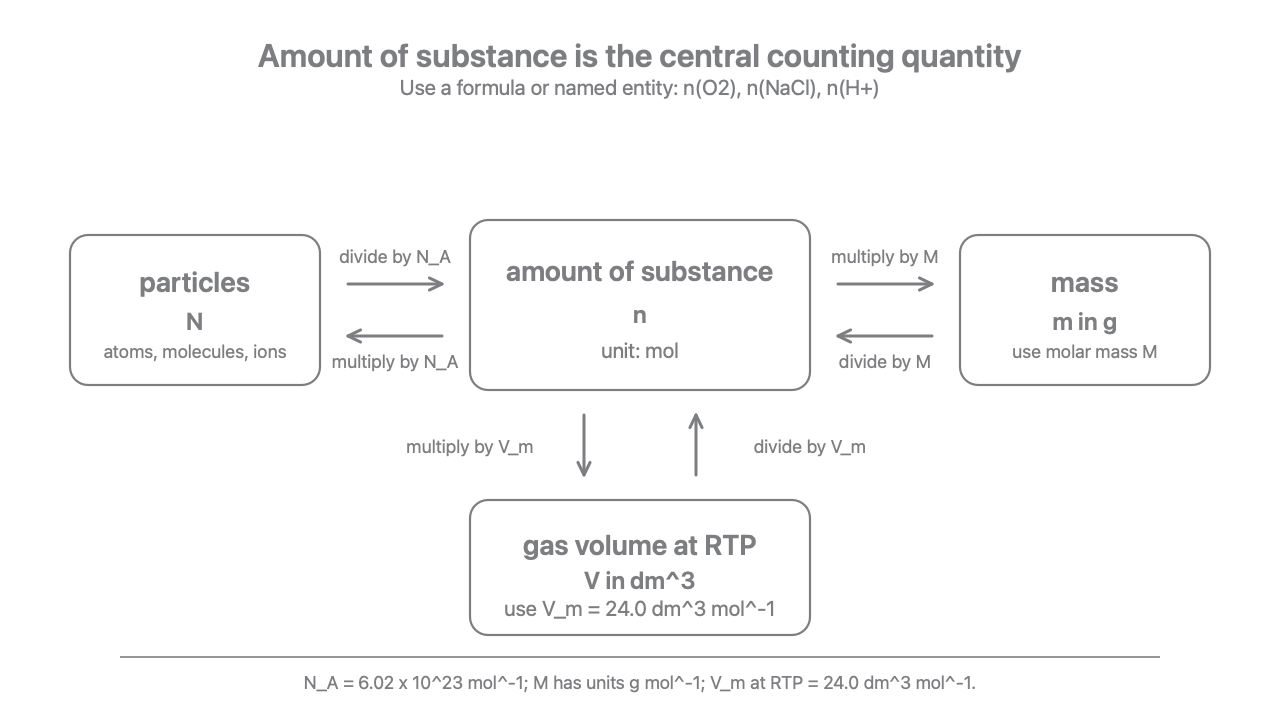
Use this decision sequence:
- Identify the specified entity:
CO2 molecules,NaCl formula units,Mg2+ ions, or another formula-named entity. - Identify the measured quantity: number of particles, mass, or gas volume at RTP.
- Convert to amount in mol using the matching conversion factor.
- Keep units visible in the working and round only at the end.
| given information | route to amount |
|---|---|
number of particles, N | n = N / N_A |
mass in g, m | n = m / M |
gas volume at RTP in dm^3, V | n = V / V_m |
Worked example: selecting the route
A student is given 1.20 dm^3 of ammonia gas, NH3, at RTP and asked for n(NH3).
The measured quantity is a gas volume at RTP, so use molar gas volume:
Do not use molar mass here, because the question gives a volume, not a mass. Do not use the ideal gas equation here, because the RTP molar gas volume route is the given model.
Common traps
- Do not write "number of moles" when you mean amount of substance. Use
amount in mol. - Do not leave the entity unspecified. Write
n(O2)rather than justn(oxygen)when the formula matters. - Do not put
molon a particle count. A particle count such as1.51 x 10^23 moleculesis not an amount in mol. - Do not use
24.0 dm^3 mol^-1unless the substance is a gas at RTP. - Do not treat molar mass and relative mass as the same quantity. They can have the same numerical value, but molar mass has units
g mol^-1.
The core skill in this lesson is choosing the correct bridge to n. Later calculations will use balanced equations and formula ratios, but those steps rely on this first idea: a chemical amount must name the entity and use the correct unit.