2.1.3h-j - Percentage yield, atom economy and measurement
A balanced equation can predict the maximum amount of product a reaction could make, but real experiments rarely give that perfect amount. This lesson teaches two different percentage calculations: percentage yield, which compares the actual product made with the theoretical maximum, and atom economy, which judges how efficiently the equation turns atoms into the desired product. You will also connect these calculations to practical measurements of mass, solution volume and gas volume.
Percentage yield compares actual and theoretical yield
The theoretical yield is the maximum amount of product predicted by the balanced equation, assuming the reaction goes to completion and no product is lost. The actual yield is the amount of product actually obtained in the experiment.
Percentage yield
Percentage yield compares the actual yield with the theoretical yield for a reaction. Actual yield and theoretical yield must be in the same unit before the percentage is calculated.
Percentage yield
The yields may be masses, amounts in mol, or volumes of a gas, provided the two quantities being compared use the same unit. In a preparation experiment, the actual yield is often lower than the theoretical yield because:
- the reaction may not go to completion
- side reactions may form other products
- product may be lost during transfer, filtration, washing, drying or purification
- some product may remain dissolved in a solution
A percentage yield above 100% usually means the product was not pure or not fully dry, or a measurement has been made incorrectly. It does not mean the reaction created extra atoms.
Worked example: calculating percentage yield from a mass
Calcium carbonate decomposes on heating:
A student heats 5.00 g of calcium carbonate and obtains 2.52 g of calcium oxide. Calculate the percentage yield of calcium oxide.
Use:
First calculate the amount of calcium carbonate:
The equation ratio is 1 mol CaCO3 : 1 mol CaO, so:
The theoretical mass of calcium oxide is:
Now compare the actual mass with the theoretical mass:
The answer to three significant figures is:
Percentage yield is an experimental comparison: actual amount obtained divided by the theoretical amount predicted by stoichiometry.
Rearranging yield for related quantities
Percentage yield questions do not always ask directly for the percentage. They may give the percentage yield and ask for the actual yield, theoretical yield or a related mass of reactant.
Start from:
To find actual yield:
To find theoretical yield:
If a question asks for the mass of reactant needed to make a particular actual mass of product, first convert the actual product target into a theoretical product amount. Then use the balanced equation backwards.
Worked example: finding the reactant mass needed for a target product
Magnesium reacts with hydrochloric acid to form magnesium chloride:
A preparation has a percentage yield of 75.0%. Calculate the mass of magnesium needed to obtain an actual yield of 2.40 g of magnesium chloride.
Use:
First find the theoretical mass of magnesium chloride needed:
Now convert this theoretical mass of magnesium chloride to amount:
The equation ratio Mg : MgCl2 is 1 : 1, so:
Convert amount of magnesium to mass:
The mass of magnesium needed is:
This calculation uses the theoretical product amount because the balanced equation predicts maximum amounts, not experimental losses.
Atom economy uses the balanced equation
Atom economy is different from percentage yield. It is not about how successful one experiment was. It is about the reaction equation itself.
Atom economy
Atom economy is the percentage of the total mass of products that is present in the desired product.
Atom economy
The word sum matters. If the balanced equation contains a coefficient, multiply the relative formula mass by that coefficient.
For a balanced equation, the total relative formula mass of all reactants equals the total relative formula mass of all products. Atom economy is usually calculated from the products because it asks what fraction of the product mass is useful.
Worked example: atom economy of a decomposition
Calcium carbonate decomposes as follows:
If calcium oxide is the desired product, calculate the atom economy.
Use:
The sum of the relative formula masses of all products is:
So:
The atom economy for making calcium oxide in this reaction is:
The carbon dioxide is not counted as desired product in this calculation, so its atoms reduce the atom economy.
Yield and atom economy answer different questions
Percentage yield and atom economy are both percentages, but they diagnose different problems.
[DIAGRAM: asset_name: Lesson 2.1.3h-j: Percentage Yield, Atom Economy and Measurement - diagram 01; asset_slug: 02_01_03e_percentage_yield_atom_economy_and_measurement__diagram_01; recommended_method: drawn_chem; description: A clean 16:9 two-lane flow diagram comparing percentage yield and atom economy. The percentage-yield lane should show actual yield from experiment, theoretical yield from stoichiometry, percentage yield formula, and causes of low yield. The atom-economy lane should show balanced equation, desired product, atom economy formula using product masses, and fewer waste by-products. Use NovaLearn grey linework and labels only.]
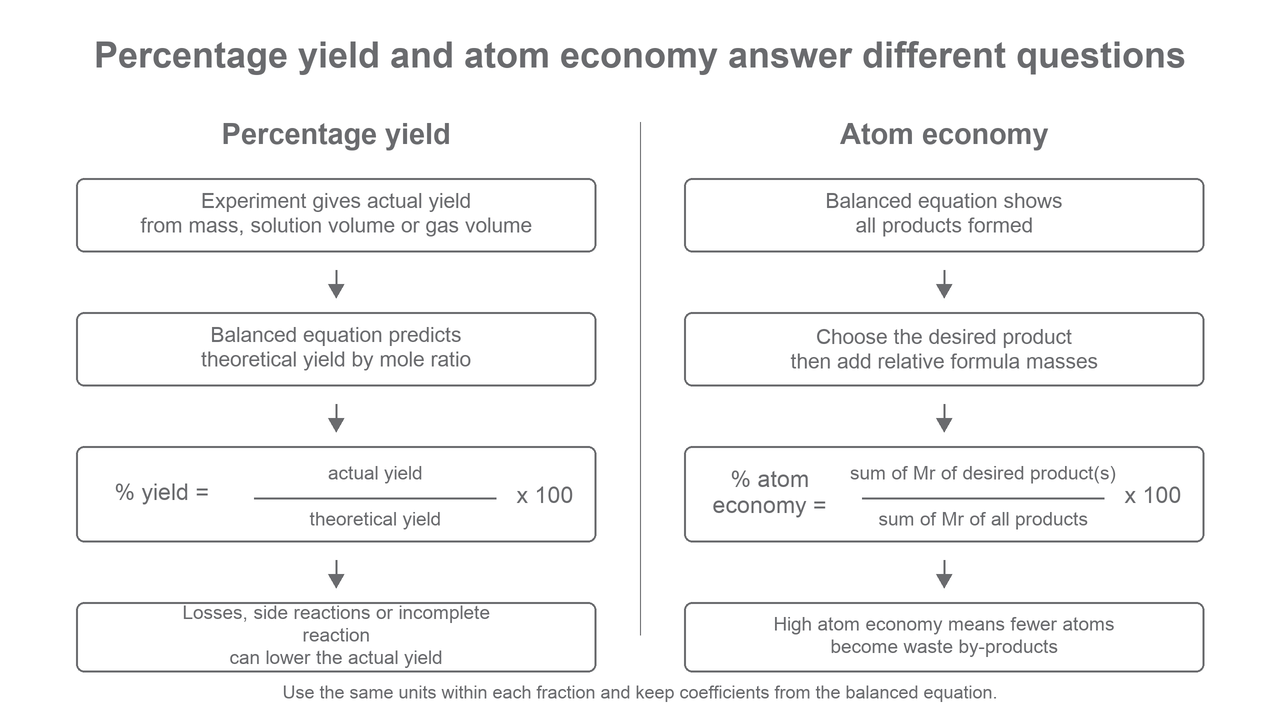
Use this contrast:
| question | percentage yield | atom economy |
|---|---|---|
| What does it measure? | How much product the experiment actually gave compared with the theoretical maximum | How much of the product mass is the desired product |
| What data does it use? | Experimental actual yield and theoretical yield | Balanced equation and relative formula masses |
| Can it change between attempts? | Yes, because practical losses and reaction conditions can change | No, not for the same balanced equation and same desired product |
| Main problem it detects | Low actual production in the laboratory or process | Waste by-products built into the reaction route |
A reaction can have a high percentage yield but poor atom economy. That means the experiment makes most of the theoretical desired product, but the balanced equation still sends many atoms into unwanted by-products.
A reaction can also have high atom economy but a low percentage yield. That means the equation is efficient in principle, but the real experiment loses product or does not go to completion.
High atom economy is beneficial for sustainability because more atoms from the reactants become useful product. This can reduce waste, reduce the cost and environmental impact of waste disposal, and make better use of raw materials. It is especially important when processes are scaled up in the chemical industry.
Atom economy is not the only sustainability factor. A high-atom-economy process may still use hazardous solvents, high temperatures, high pressures or difficult separations. For this lesson, the key assessed point is that developing reactions with high atom economy reduces waste by-products and improves the efficient use of resources.
Explain It Back
Use this as a self-explanation check after the section above. It is for diagnosing what you can already explain, not for learning new material from scratch.
Before using the measurements in the next part, pause on the distinction: one percentage is about practical success, and the other is about how the equation allocates atoms.
Measurement techniques for yield data
Percentage yield calculations depend on measurements. If the mass, solution volume or gas volume is measured poorly, the calculated yield will be unreliable.
For measuring mass, use an appropriate balance and record all readings to the balance precision. If a solid is transferred from a container, weighing by difference is often more reliable:
- weigh the container plus solid before transfer
- transfer the solid
- weigh the container plus remaining solid
- subtract to find the mass actually transferred
For an isolated solid product, the measured mass should normally be taken after the product has been filtered, washed if appropriate, and dried. Wet product can give an apparent yield that is too high.
For measuring volumes of solutions:
- a volumetric pipette measures one fixed accurate volume
- a burette measures a variable delivered volume accurately
- a volumetric flask is used to make up an accurate known volume of solution
- a measuring cylinder is less precise and is used when an approximate volume is acceptable
Read the bottom of the meniscus at eye level for colourless aqueous solutions. Convert cm^3 to dm^3 before using concentration calculations.
For measuring gas volumes, use apparatus such as a gas syringe or an inverted measuring cylinder over water. The apparatus should be sealed before the gas is produced. Gas escaping before collection, leaks in the apparatus, gas dissolving in water, or temperature and pressure changes can all affect the measured gas volume.
Worked example: using gas volume as an actual yield
A reaction is predicted to produce 120 cm^3 of carbon dioxide at room temperature and pressure. In the experiment, only 96.0 cm^3 is collected.
Because both quantities are gas volumes under the same conditions, they can be compared directly:
If some carbon dioxide escaped before the gas syringe was attached, the measured actual volume would be too low. The calculated percentage yield would therefore be too low.