RP03 - Water Potential of Plant Tissue
This practical uses a dilution series to find the concentration of solute that is isotonic with plant tissue. By measuring how the mass of potato chips changes in known sucrose solutions, you can identify the point at which there is no net movement of water and use that to infer the water potential of the tissue.
Part 1: Aim and Background
The practical is based on osmosis. Water moves across the partially permeable cell-surface membrane of potato cells according to the water potential difference between the cells and the surrounding solution.
Water Potential
A measure of the tendency of water to move from one place to another. Pure water has a water potential of 0 kPa, and adding solute makes the value more negative.
Osmosis
The net movement of water from a region of higher water potential to a region of lower water potential through a partially permeable membrane.
If a potato chip gains mass, water has entered the cells. If it loses mass, water has left the cells. The key point is the concentration at which there is no overall mass change. At that point, the solution and the potato tissue have the same water potential.
Part 2: Dilution Series and Method
The AQA handbook method uses a 1.0 mol dm^-3 sucrose solution and distilled water to prepare six 20 cm^3 solutions.
Dilution Series
A set of solutions with known concentrations made by mixing different volumes of a stock solution with a solvent.
| Sucrose concentration / mol dm^-3 | Volume of 1.0 mol dm^-3 sucrose / cm^3 | Volume of water / cm^3 |
|---|---|---|
| 0.0 | 0 | 20 |
| 0.2 | 4 | 16 |
| 0.4 | 8 | 12 |
| 0.6 | 12 | 8 |
| 0.8 | 16 | 4 |
| 1.0 | 20 | 0 |
A careful method is what makes the graph meaningful.
- Label six boiling tubes with the concentrations shown above.
- Use a graduated pipette or syringe to add the correct volumes of sucrose solution and water to each tube.
- Stand the tubes in a water bath at 30 degrees C and check the temperature with a thermometer.
- Cut six potato chips from the same tuber using a potato chip cutter or cork borer. Trim them to the same length.
- Blot each chip dry without squeezing, then record its initial mass.
- Put one chip into each tube and leave for 20 minutes.
- Remove the chips, blot them dry in the same way, and record the final masses.
- Calculate the percentage change in mass and plot a graph of sucrose concentration against percentage change in mass. This can be done by hand or using spreadsheet software.
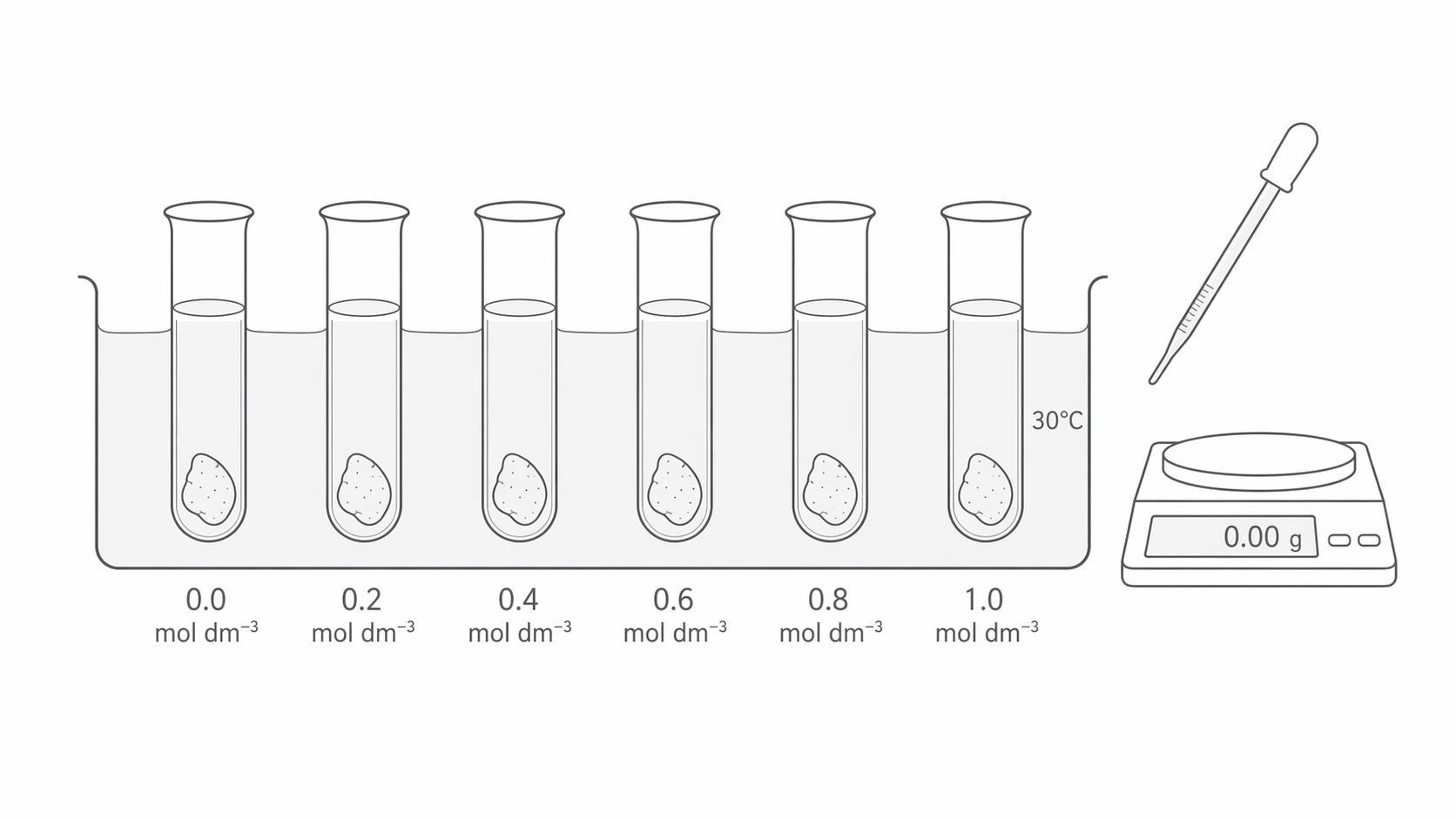
The diagram below shows the whole setup at a glance. As you read it, notice the fixed concentration steps across the six labelled tubes and the way everything else is held constant: one potato chip per tube, the same 30 degrees C water bath, and the same measuring equipment used to prepare and weigh the samples.
[DIAGRAM: asset_name: RP 03 - Production of a dilution series of a solute to produce a calibration curve with which to identify the water potential of plant tissue - Diagram 1; asset_slug: RP 03 - Production of a dilution series of a solute to produce a calibration curve with which to identify the water potential of plant tissue - Diagram 1; recommended_method: retained_png; description: Six labelled boiling tubes in a 30 degrees C water bath, each containing a different sucrose concentration and one potato chip, with a balance and pipette shown alongside.]
Part 3: Variables and Controls
| Type of variable | What it is in this practical |
|---|---|
| Independent variable | Concentration of sucrose solution |
| Dependent variable | Percentage change in mass of the potato chip |
Important control variables are just as important as the independent variable.
| Control variable | How to control it | Why it matters |
|---|---|---|
| Size of potato chips | Use the same cutter and trim to the same length | Different sizes have different surface area to volume ratios |
| Source of tissue | Cut all chips from the same potato tuber | Different potatoes can start with different water potentials |
| Volume of solution | Use the same volume in each tube | Different volumes could affect the extent of water movement |
| Temperature | Use the same water bath for all tubes | Temperature changes the rate of osmosis |
| Time in solution | Leave all chips for the same time | Longer immersion allows more change in mass |
| Blotting method | Dry all chips in the same way before weighing | Surface liquid would change the mass reading |
Percentage change in mass is used instead of raw change in mass because potato chips rarely start with exactly the same mass.
Part 4: Processing and Interpreting Results
In dilute sucrose solutions, potato chips usually gain mass because water enters the cells. In concentrated sucrose solutions, they usually lose mass because water leaves the cells.
Percentage Change in Mass
When you plot the results:
- put sucrose concentration on the x-axis
- put percentage change in mass on the y-axis
- draw a line of best fit
- identify the x-intercept, where percentage change in mass is 0
The x-intercept gives the concentration of solution with the same water potential as the potato tissue. If your teacher or exam data provide a conversion from sucrose concentration to water potential, you can then identify the tissue water potential in kPa.
Part 5: Errors, Anomalies and Safety
| Possible problem | Effect on results | Improvement |
|---|---|---|
| Chips not all the same size | Different rates and amounts of osmosis | Use one cutter and trim carefully |
| Chips not blotted consistently before weighing | Surface liquid makes some masses too high | Standardise the blotting method |
| Inaccurate solution volumes | Wrong sucrose concentrations | Use a graduated pipette or syringe carefully |
| Temperature varies | Rate of osmosis changes between tubes | Keep all tubes in the same water bath |
| Chips left for different times | Some chips change mass more than others | Start and finish all chips consistently |
A more reliable data set comes from repeats. Repeating each concentration and calculating a mean helps you spot anomalies and reduces the effect of one poor measurement.
Safety points:
- Take care with scalpels or cork borers when cutting the potato.
- Use the water bath carefully to avoid burns.
- Handle glassware and balances carefully to avoid breakages and inaccurate readings.
The practical works only if the concentrations are known accurately and every other condition is controlled tightly enough for the x-intercept to mean something.