3.1.2 - Carbohydrates
This lesson follows carbohydrates from monosaccharide structure through glycosidic bonds to storage and structural polysaccharides. It then links those molecular differences to starch, glycogen and cellulose functions before using biochemical tests to distinguish reducing sugars, non-reducing sugars and starch.
Part 1: Monosaccharides
Carbohydrates are built from sugar units called saccharides. The smallest carbohydrate units are monosaccharides, and these act as the monomers from which larger carbohydrates are made.
Monosaccharide
A monosaccharide is a single sugar unit and the monomer from which larger carbohydrates are made.
The common monosaccharides you need are glucose, galactose and fructose. They are small, soluble molecules and most have the general formula (CH2O)n.
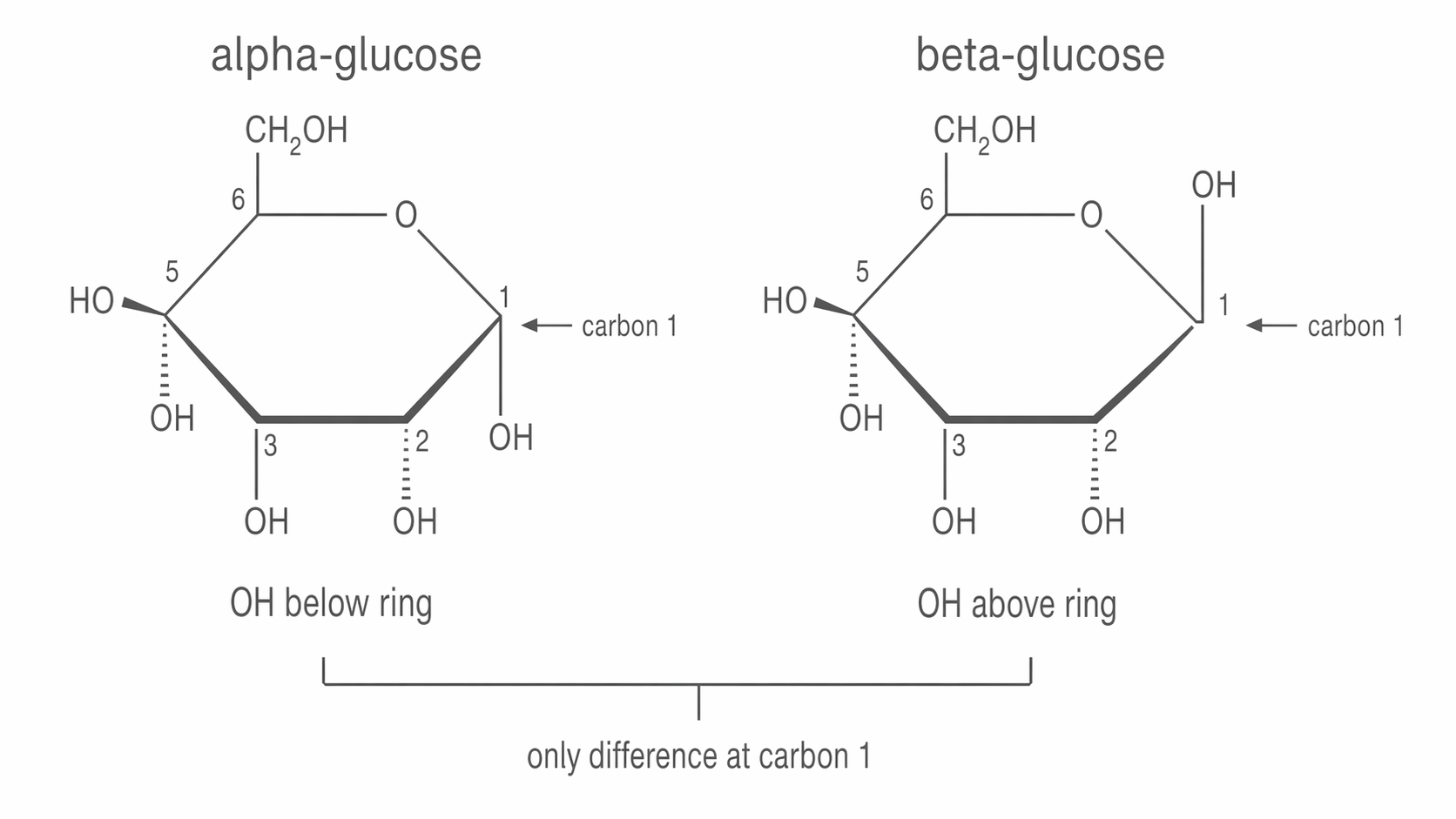
Glucose is especially important because it is a major respiratory substrate. It has two isomers, alpha-glucose and beta-glucose. These have the same molecular formula, C6H12O6, but a different arrangement of atoms. In the ring form, the key difference is the position of the OH group on carbon 1:
- in alpha-glucose, the OH group is below the ring
- in beta-glucose, the OH group is above the ring
That small structural difference leads to major differences in the polysaccharides that form later.
In the diagram below, compare the two rings carbon by carbon and notice that every labelled group matches except the OH on carbon 1. That single change, from below the ring in alpha-glucose to above the ring in beta-glucose, is what leads to different polysaccharides later.
[DIAGRAM: asset_name: 1.2 - Carbohydrates - Diagram 1; asset_slug: 1.2 - Carbohydrates - Diagram 1; recommended_method: retained_png; description: alpha-glucose and beta-glucose ring structures with the OH group on carbon 1 labelled.]
Part 2: Disaccharides and glycosidic bonds
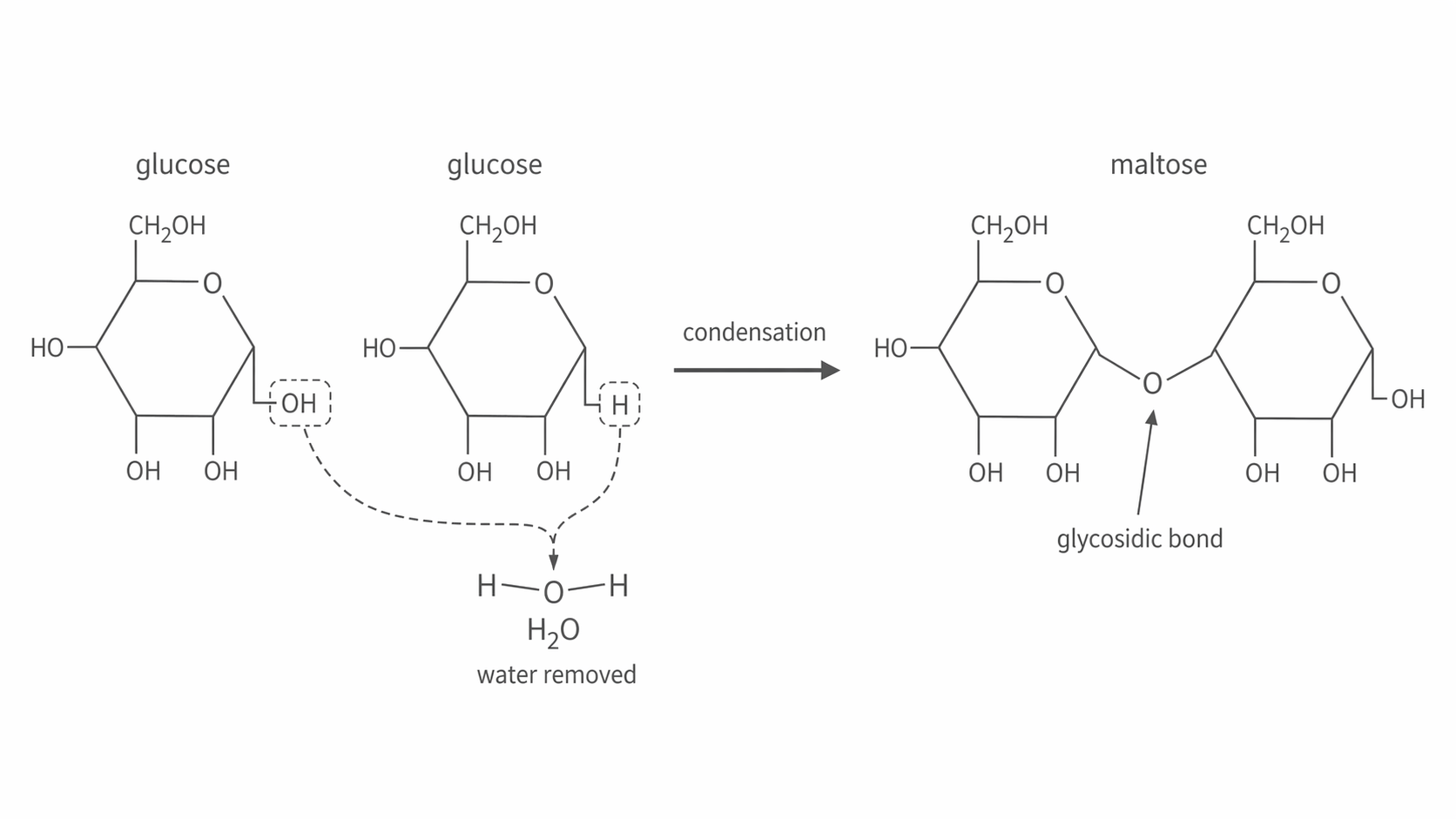
When two monosaccharides join together, a condensation reaction occurs. A molecule of water is removed and a glycosidic bond forms between the two sugar molecules.
Glycosidic bond
A glycosidic bond is the covalent bond formed between two monosaccharides in a condensation reaction.
A disaccharide is made from two monosaccharides. You need to know these examples:
| Disaccharide | Monosaccharides joined |
|---|---|
| Maltose | glucose + glucose |
| Sucrose | glucose + fructose |
| Lactose | glucose + galactose |
Hydrolysis is the reverse process. Water is used to break the glycosidic bond and release the original monosaccharides.
In the diagram below, trace the -OH from one glucose and the -H from the other joining to make water, then locate the new glycosidic bond in the maltose product.
[DIAGRAM: asset_name: 1.2 - Carbohydrates - Diagram 2; asset_slug: 1.2 - Carbohydrates - Diagram 2; recommended_method: retained_png; description: formation of maltose from two glucose molecules, showing removal of water and formation of a glycosidic bond.]
Part 3: Storage polysaccharides
Polysaccharides are formed when many glucose molecules are joined by condensation reactions. Starch and glycogen are both made from alpha-glucose and both act as storage carbohydrates.
Starch is the storage polysaccharide in plants. It contains two components:
- amylose, which is unbranched and forms a coiled chain with 1,4 glycosidic bonds
- amylopectin, which is branched, with 1,4 glycosidic bonds in the chains and 1,6 glycosidic bonds at branch points
Glycogen is the storage polysaccharide in animals. It is similar to amylopectin but is more highly branched.
These structural features explain why starch and glycogen are effective stores:
- they are insoluble, so they do not affect water potential
- they are large, so they do not diffuse out of cells
- they are compact, so a lot can be stored in a small space
- branching provides many ends for enzymes, allowing rapid hydrolysis to release glucose
In plant cells, starch is a good long-term store. In animal cells, glycogen is especially useful because its extra branching means glucose can be released very quickly when respiration demand increases.
Part 4: Cellulose
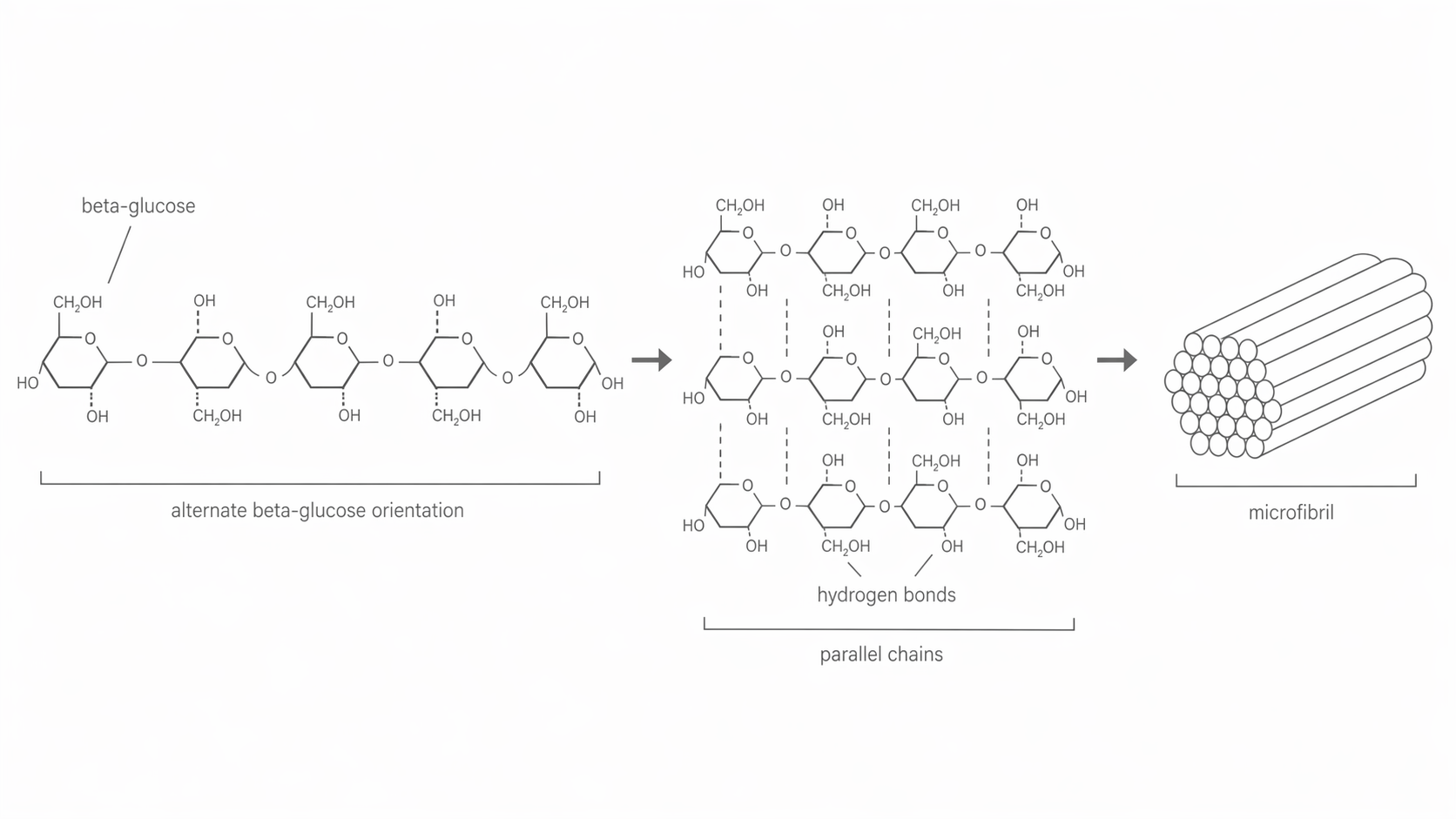
Cellulose is also a polysaccharide, but it is made from beta-glucose rather than alpha-glucose. This changes the way the chains form.
Each beta-glucose molecule is rotated 180 degrees relative to the next one. As a result, cellulose forms long, straight, unbranched chains rather than coiled ones. Parallel cellulose chains lie next to each other, and hydrogen bonds form between them. Many chains group together into microfibrils, and microfibrils group into fibres.
This structure makes cellulose suitable for its role in plant cell walls:
- straight chains pack closely together
- many hydrogen bonds provide high tensile strength
- microfibrils and fibres add extra rigidity
- the wall resists bursting when water enters the cell by osmosis
- turgid cells help support non-woody parts of the plant
In the diagram below, notice the alternating flipped orientation of successive beta-glucose units, then follow how parallel straight chains are linked by hydrogen bonds and bundled into a microfibril.
[DIAGRAM: asset_name: 1.2 - Carbohydrates - Diagram 3; asset_slug: 1.2 - Carbohydrates - Diagram 3; recommended_method: retained_png; description: cellulose chains with alternate beta-glucose orientation, hydrogen bonds between chains, and grouping into microfibrils.]
Part 5: Biochemical tests for carbohydrates
The required tests are Benedict's test for reducing sugars, the modified Benedict's test for non-reducing sugars, and the iodine in potassium iodide test for starch.
A reducing sugar, such as glucose, can reduce copper(II) ions in Benedict's reagent when heated. A positive result changes from blue through green, yellow and orange to a brick-red precipitate, depending on concentration.
To test for a non-reducing sugar:
- first carry out Benedict's test
- if the result stays blue, heat a fresh sample with dilute hydrochloric acid to hydrolyse the sugar
- neutralise the acid with sodium hydrogencarbonate
- add Benedict's reagent and heat again
- an orange or brick-red precipitate now shows that a non-reducing sugar was present originally
To test for starch, add iodine in potassium iodide solution at room temperature. A positive result is blue-black.