3.1.8 - Inorganic Ions
Inorganic ions occur in solution in the cytoplasm and body fluids of organisms, sometimes in high concentrations and sometimes in very low concentrations. Their roles depend on their charge and the way they interact with other molecules. For AQA, the key examples are hydrogen ions in pH, iron ions in haemoglobin, sodium ions in co-transport of glucose and amino acids, and phosphate ions in DNA and ATP.
Part 1: Hydrogen ions and pH
pH
A measure of hydrogen ion concentration in a solution.
The concentration of hydrogen ions, H+, determines pH. A high H+ concentration means a low pH, while a low H+ concentration means a high pH. Because the pH scale is logarithmic, a change of one pH unit represents a tenfold change in H+ concentration.
Hydrogen ions matter in biology because changes in pH affect proteins. They alter the charges on some amino acid side chains, which can disrupt ionic bonds and hydrogen bonds. As a result, the tertiary structure of an enzyme can change and the shape of its active site may no longer be complementary to its substrate.
Cells and body fluids therefore need careful control of H+ concentration. Even relatively small changes in pH can reduce enzyme activity.
Part 2: Iron ions in haemoglobin
Iron ions are components of haemoglobin, the protein that transports oxygen in red blood cells. Each haemoglobin molecule has four polypeptide chains, and each chain contains a haem group with an iron ion at its centre.
That iron ion allows oxygen to bind reversibly. In the lungs, oxygen loads onto haemoglobin. In respiring tissues, oxygen is released. Without iron ions, haemoglobin could not carry oxygen effectively.
This is why iron deficiency can reduce oxygen transport and lead to tiredness: less haemoglobin can be made, so less oxygen reaches tissues for aerobic respiration.
Part 3: Sodium ions in co-transport of glucose and amino acids
Co-transport
The linked movement of one substance down its concentration gradient with another substance against its concentration gradient through the same membrane protein.
Sodium ions are important in the absorption of glucose and amino acids across epithelial cell membranes, especially in the ileum. First, sodium ions are actively transported out of the epithelial cell by a carrier protein using ATP. This keeps the sodium ion concentration lower inside the cell than outside.
Sodium ions then move back into the cell down their concentration gradient through sodium-dependent co-transport proteins in the membrane facing the gut lumen. Glucose is absorbed with sodium by one type of co-transporter, and amino acids are absorbed with sodium by other co-transport proteins, even when glucose or the amino acids are moving against their own concentration gradients.
The diagram below is most useful if you read the two membranes separately. First notice the blood-facing membrane, where ATP is used to pump sodium ions out so the sodium ion concentration stays low inside the epithelial cell. Then look at the gut-facing membrane, where sodium ions move back in down their gradient through the co-transporter and bring glucose in with them. Finally, follow the separate route by which glucose leaves the cell into the blood. The key idea is that the sodium gradient provides the energy for glucose absorption.
[DIAGRAM: asset_name: 1.8 - Inorganic ions - Diagram 1; asset_slug: 1.8 - Inorganic ions - Diagram 1; recommended_method: retained_png; description: An epithelial cell from the ileum showing sodium ions actively transported out of the cell on one side, and sodium ions returning through a co-transporter with glucose on the side facing the gut lumen.]
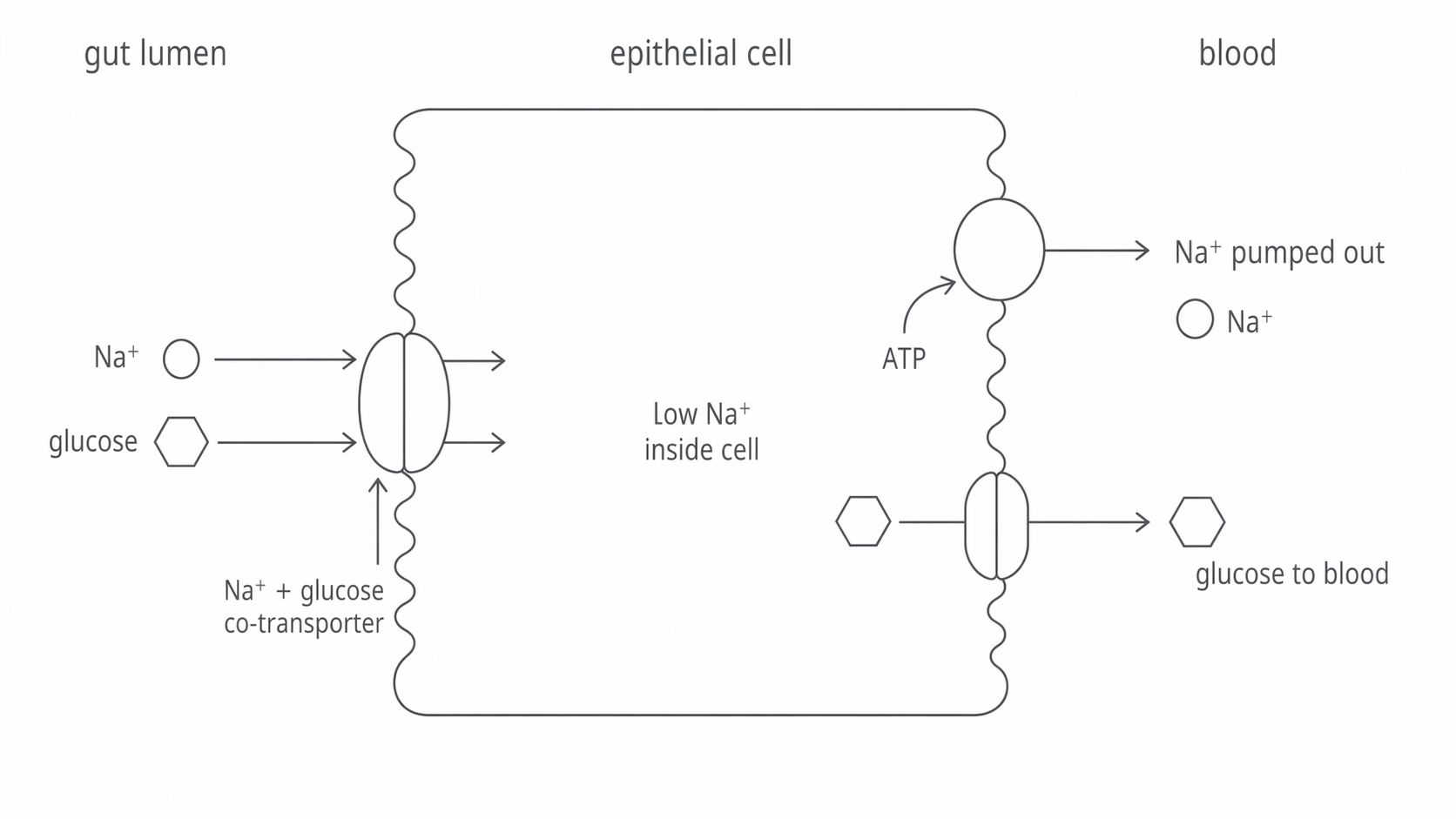
The absorbed molecules then leave the epithelial cell across the opposite membrane and enter the blood. The process depends on the sodium ion gradient, so it depends indirectly on ATP.
Part 4: Phosphate ions in DNA and ATP
Phosphate ions are components of DNA and ATP.
In DNA, each nucleotide contains a phosphate group. Phosphate groups help link nucleotides together by forming phosphodiester bonds, creating the sugar-phosphate backbone of each DNA strand. Phosphate therefore has a structural role in DNA.
In ATP, phosphate is central to energy transfer. ATP contains three phosphate groups. When ATP is hydrolysed to ADP and inorganic phosphate, energy is released and can be used in cellular processes. The phosphate that is released can also be transferred to other molecules, making them more reactive.
So in this specification point, phosphate ions matter in two different ways: they help build DNA, and they are essential to the energy-carrying role of ATP.
Part 5: Linking the ions to their roles
| Ion | Main role in the specification |
|---|---|
| H+ | Determines pH and so affects enzyme activity |
| Iron ion | Component of haemoglobin involved in oxygen transport |
| Na+ | Enables co-transport of glucose and amino acids |
| Phosphate ion | Component of DNA and ATP |
The pattern is simple: inorganic ions are useful because their properties suit specific biological jobs. Some affect conditions in a solution, some help transport substances, and some form part of larger molecules.