3.1.3 - Lipids
This lesson examines how glycerol, fatty acids and phosphate-containing groups give triglycerides and phospholipids different properties. It connects saturation and molecular shape to packing, energy storage and membrane formation, then applies lipid solubility in the emulsion test.
Part 1: Triglycerides
Lipids are insoluble in water and soluble in organic solvents such as ethanol. In this topic, the two groups you need are triglycerides and phospholipids. Triglycerides are made from glycerol and fatty acids, while phospholipids are similar molecules that also include a phosphate-containing group.
Triglyceride
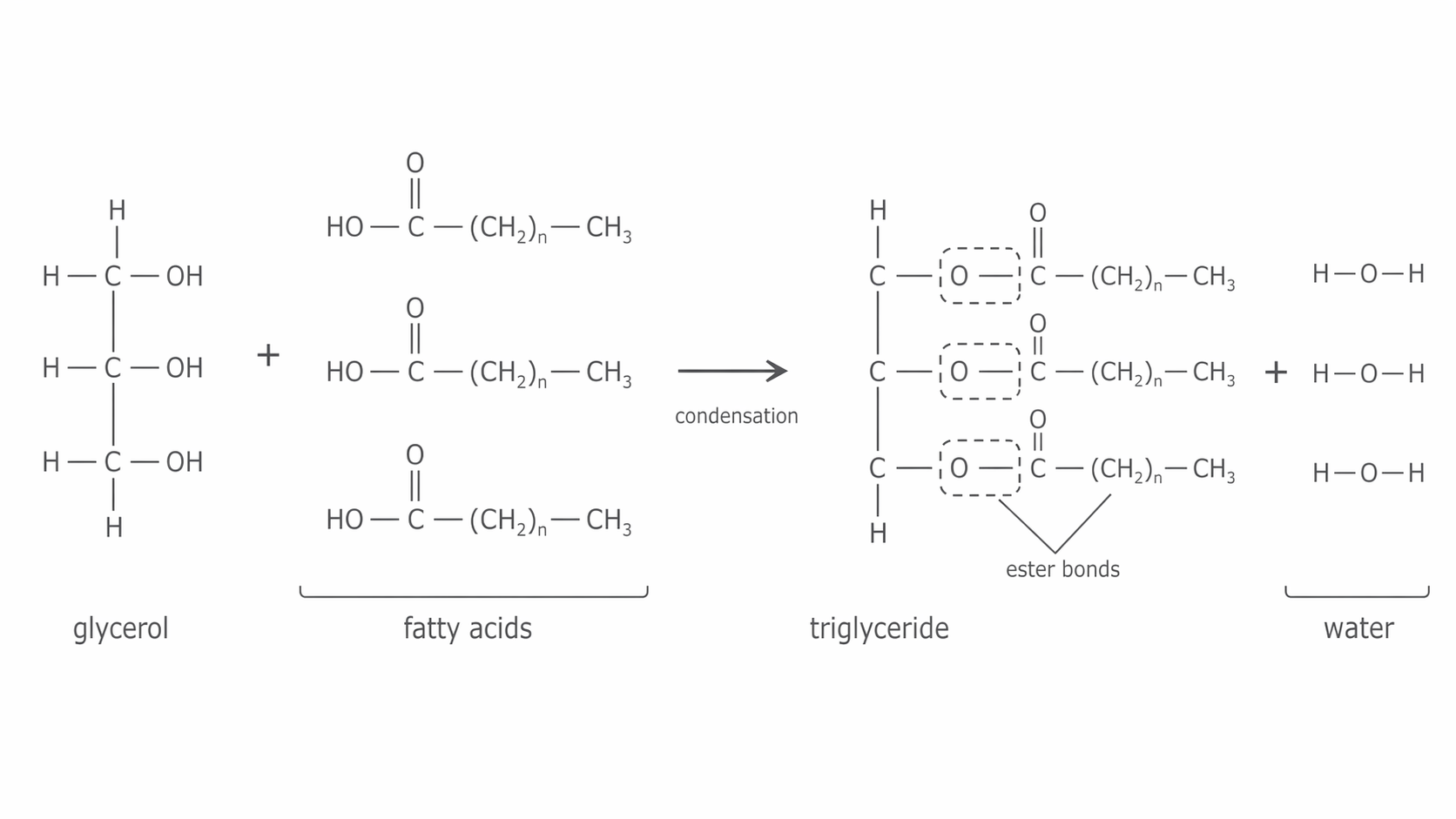
A triglyceride is a lipid made from one molecule of glycerol and three molecules of fatty acid.
Each fatty acid joins to glycerol in a condensation reaction. Every time this happens, an ester bond forms and a molecule of water is released. Because one glycerol molecule has three hydroxyl groups, three condensation reactions occur, producing three ester bonds in total.
Hydrolysis is the reverse process. Water is used to break the ester bonds, releasing glycerol and fatty acids again.
The diagram below summarises that whole condensation process. As you read it, track how each fatty acid joins to glycerol, then check that every new ester bond lines up with one water molecule being released.
[DIAGRAM: asset_name: 1.3 - Lipids - Diagram 1; asset_slug: 1.3 - Lipids - Diagram 1; recommended_method: retained_png; description: glycerol plus three fatty acids forming a triglyceride, with three ester bonds and three water molecules labelled.]
Part 2: Saturated and unsaturated fatty acids
Fatty acids differ in the hydrocarbon chain, often called the R group. The key distinction is whether the chain contains carbon-carbon double bonds.
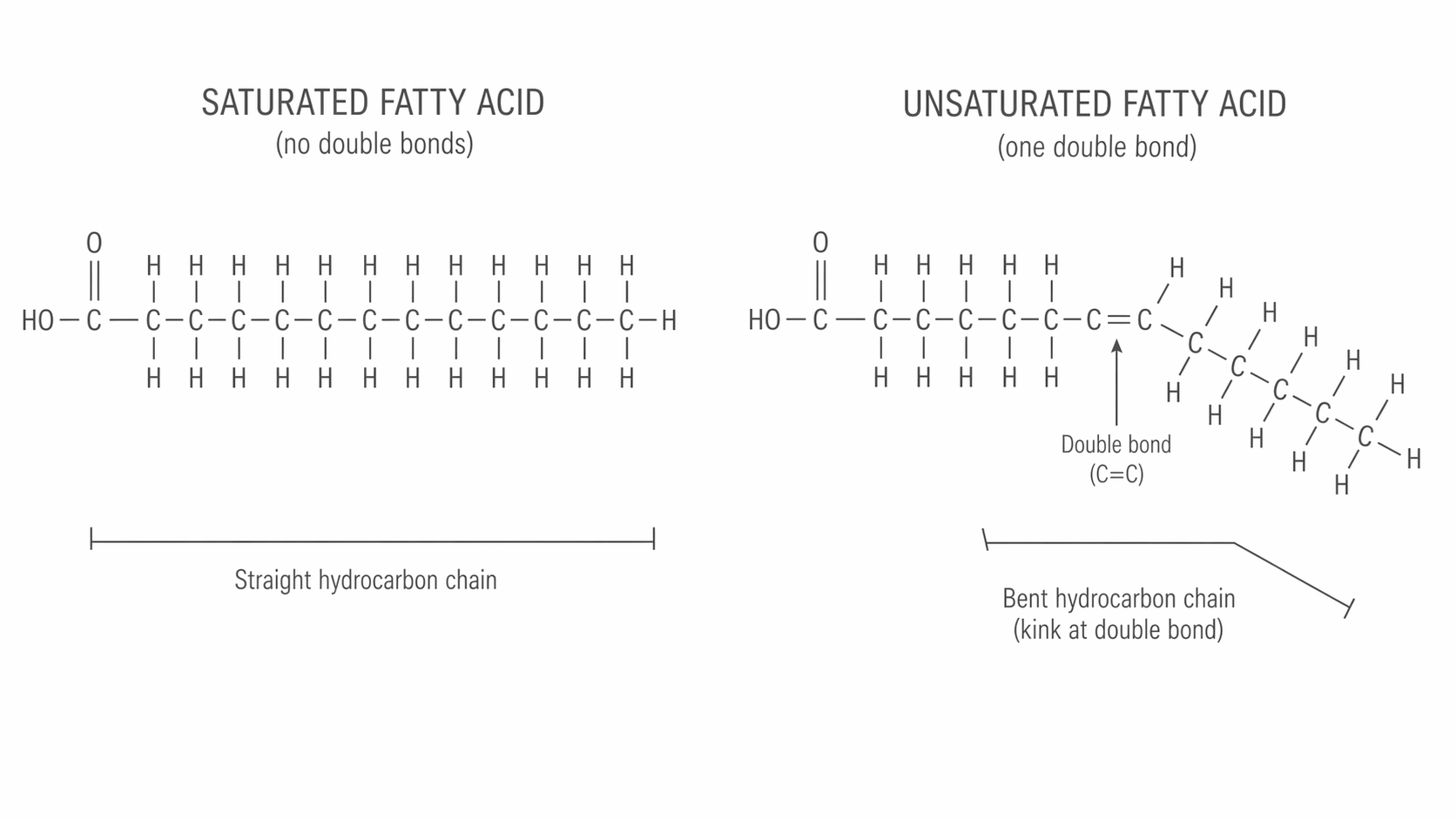
- a saturated fatty acid has no carbon-carbon double bonds
- an unsaturated fatty acid has one or more carbon-carbon double bonds
Double bonds change the shape of the chain. Saturated fatty acids are straight enough to pack closely together, so lipids containing many saturated fatty acids are often solid at room temperature. Unsaturated fatty acids have bends where the double bonds occur, so they cannot pack closely and are often liquid at room temperature.
When you are asked to recognise these from a diagram, look first for a C=C bond. If one is present, the fatty acid is unsaturated.
The diagram below makes this easy to spot. Compare the two chains directly: notice that the saturated fatty acid stays straight because it has no C=C bond, while the unsaturated fatty acid contains a C=C bond that creates a bend.
[DIAGRAM: asset_name: 1.3 - Lipids - Diagram 2; asset_slug: 1.3 - Lipids - Diagram 2; recommended_method: retained_png; description: saturated fatty acid with no C=C bond beside unsaturated fatty acid with a C=C bond and bend in the chain.]
Part 3: Triglyceride properties and structure
The structure of triglycerides makes them effective storage molecules.
They contain many energy-rich carbon-hydrogen bonds and relatively little oxygen, so oxidation releases a large amount of energy. They also store a lot of energy relative to their mass, which is useful for animals that have to carry their reserves. Because triglycerides are non-polar and insoluble, storing them does not affect water potential. Their oxidation also releases water, which can be useful to some animals.
These points explain why triglycerides are good long-term energy stores.
Part 4: Phospholipids and bilayers
Phospholipid
A phospholipid is a lipid in which one of the fatty acids of a triglyceride is replaced by a phosphate-containing group.
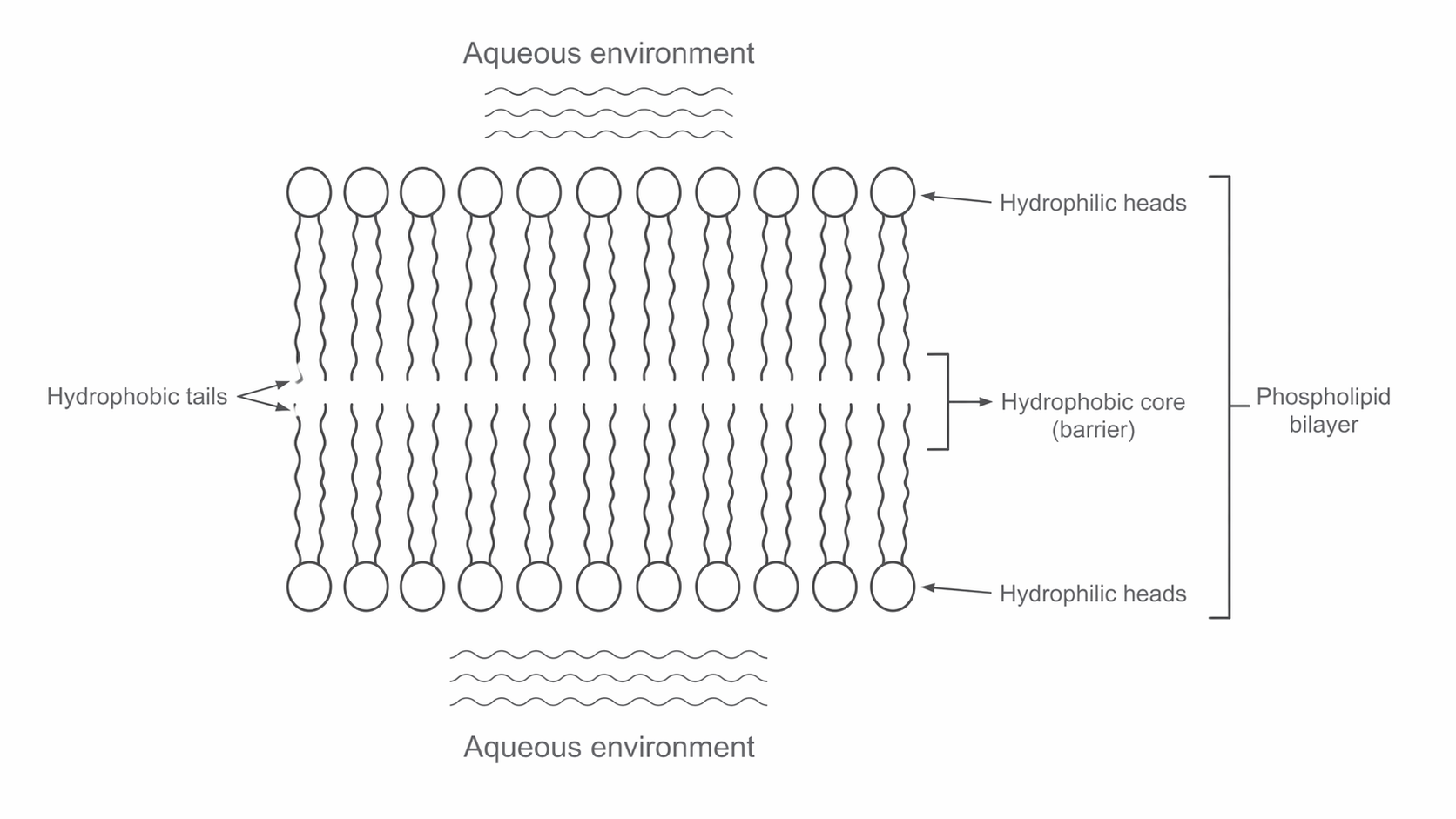
This gives the molecule two different regions. The phosphate-containing head is hydrophilic, so it interacts with water. The two fatty acid tails are hydrophobic, so they avoid water. A molecule with both regions is described as amphipathic.
In water, phospholipids arrange themselves into a bilayer. The hydrophilic heads face the aqueous environments on either side, and the hydrophobic tails face inward, away from water. This creates a hydrophobic barrier in the middle of the membrane.
Their structure explains their properties:
- they form bilayers in cell-surface membranes and organelle membranes
- the hydrophobic centre slows the movement of water-soluble substances and ions
- the hydrophilic heads help the membrane interact with watery cytoplasm and tissue fluid
- phospholipids can combine with carbohydrates to form glycolipids involved in cell recognition
The diagram below shows that bilayer arrangement clearly. Notice that the hydrophilic heads face the water on both sides, while the hydrophobic tails point inward to create the non-polar barrier through the middle of the membrane.
[DIAGRAM: asset_name: 1.3 - Lipids - Diagram 3; asset_slug: 1.3 - Lipids - Diagram 3; recommended_method: retained_png; description: phospholipid bilayer with hydrophilic heads facing outward and hydrophobic tails facing inward.]
Part 5: The emulsion test for lipids
The emulsion test is used to show whether lipid is present in a sample.
Method:
- use a dry, grease-free test tube
- add 2 cm3 of the sample and 5 cm3 of ethanol, then shake thoroughly
- add 5 cm3 of water and shake gently
If lipid is present, a cloudy white emulsion forms. If no lipid is present, the mixture stays clear. The cloudiness is caused by tiny lipid droplets becoming dispersed in the water.
A control should be set up using water instead of the sample. This should remain clear.