3.1.7 - Water
Water is a major component of cells. Its importance in biology comes from two linked features: water is dipolar, and neighbouring water molecules form hydrogen bonds. Those features explain why water can act as a metabolite, an important solvent, a thermal buffer, an efficient coolant when it evaporates, and a cohesive liquid in plants and at water-air surfaces.
Part 1: Why water has unusual properties
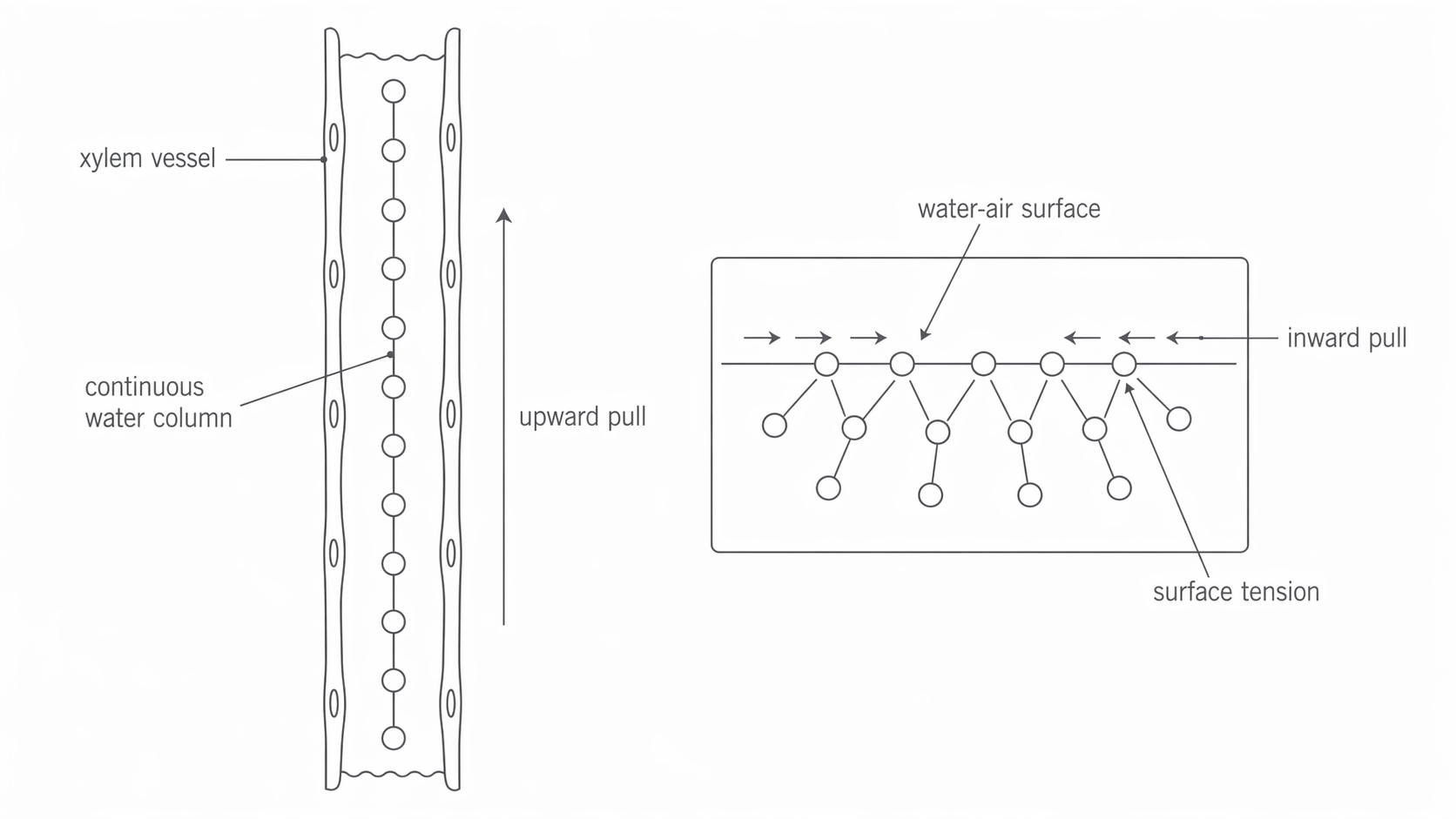
A water molecule contains one oxygen atom covalently bonded to two hydrogen atoms. Oxygen attracts the shared electrons more strongly than hydrogen, so the oxygen end of the molecule has a slight negative charge and the hydrogen ends have slight positive charges. Water is therefore dipolar.
The slight positive charge on a hydrogen atom in one water molecule is attracted to the slight negative charge on the oxygen atom in another water molecule. This weak attraction is a hydrogen bond.
Hydrogen bond
A weak attraction between the slight positive charge on a hydrogen atom of one water molecule and the slight negative charge on the oxygen atom of another water molecule.
Although each hydrogen bond is weak, huge numbers of them form and reform continuously in liquid water. Together they give water its important biological properties.
The diagram below shows this directly. Notice that the oxygen end of each molecule is slightly negative, the hydrogen ends are slightly positive, and the dotted lines mark hydrogen bonds between neighbouring molecules rather than the covalent bonds within one molecule.
[DIAGRAM: asset_name: 1.7 - Water - Diagram 1; asset_slug: 1.7 - Water - Diagram 1; recommended_method: retained_png; description: Several water molecules with delta plus charges on the hydrogens, delta minus charges on the oxygens, and dotted lines showing hydrogen bonds between neighbouring molecules.]
Part 2: Water as a metabolite
Water takes part directly in metabolic reactions, so it is a metabolite. In hydrolysis reactions, water is added to break a covalent bond. This splits larger molecules into smaller ones, such as disaccharides into monosaccharides or proteins into amino acids.
In condensation reactions, a covalent bond forms between smaller molecules and a molecule of water is released. Condensation reactions build polysaccharides, polypeptides and polynucleotides, and they also form the ester bonds in triglycerides.
Water is therefore involved in both the breakdown and the synthesis of biological molecules.
Part 3: Water as a solvent
Water is an important biological solvent because its partial charges allow it to surround ions and many polar molecules. This means substances such as sodium ions, chloride ions, glucose, amino acids and urea can dissolve in it.
This matters because many metabolic reactions happen in aqueous solution inside cells. When enzymes and substrates are dissolved, they can move, collide and react. Water also allows dissolved substances to be transported in blood, tissue fluid and plant sap.
Some gases, including carbon dioxide and oxygen, also dissolve in water. This supports gas exchange and transport, although gases are much less soluble than ions and many polar solutes.
Part 4: High specific heat capacity
Specific heat capacity
The amount of energy needed to raise the temperature of 1 kg of a substance by 1 degree C.
Water has a relatively high specific heat capacity. A lot of energy is needed before its temperature changes because some of the energy goes into disrupting hydrogen bonds between molecules.
This buffers temperature changes. Aquatic habitats stay more stable than they would if water heated and cooled rapidly, and organisms are protected from sudden internal temperature changes because so much of their mass is water.
Part 5: Large latent heat of vaporisation
Latent heat of vaporisation
The energy needed to change liquid water into water vapour without a change in temperature.
Water has a relatively large latent heat of vaporisation because hydrogen bonds must be broken before molecules can escape from the liquid. As water evaporates, the molecules with the most kinetic energy leave the surface and take heat energy with them.
This makes evaporation a very effective cooling mechanism. When sweat evaporates from the skin, or water evaporates from leaf surfaces, heat is removed. Because a large amount of energy is lost per gram of water evaporated, cooling happens with relatively little water loss.
Part 6: Cohesion and surface tension
Hydrogen bonds make water molecules stick to one another. This attraction between molecules of the same substance is called cohesion.
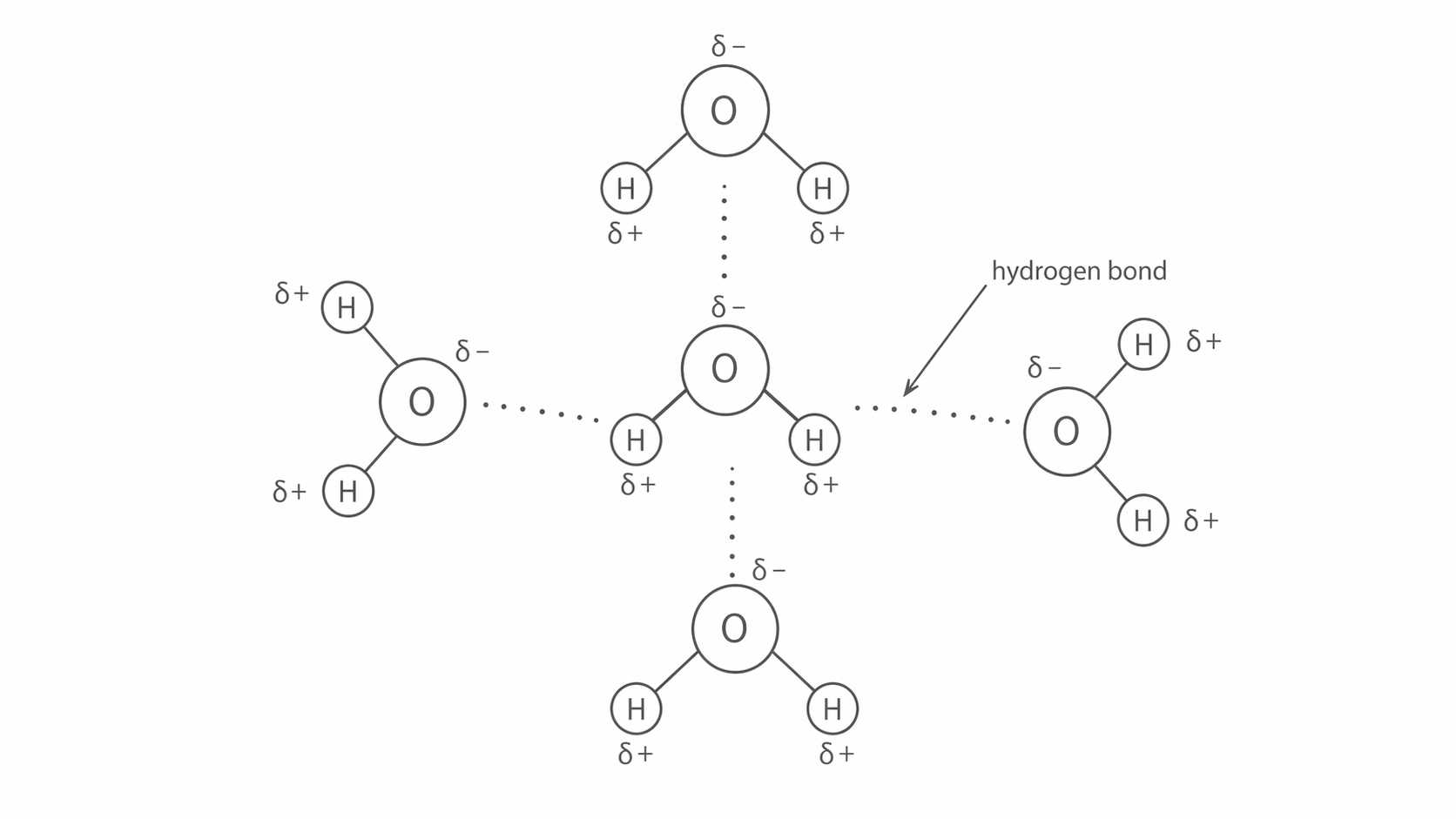
In plants, cohesion helps maintain an unbroken column of water in the xylem. As water leaves the leaves during transpiration, more water is pulled up behind it. Because the molecules cohere, the water column can stay continuous inside the narrow transport vessels.
Cohesion also helps produce surface tension where water meets air. Molecules at the surface are pulled inwards by the water molecules below and beside them, so the surface behaves like a stretched skin. This is why small organisms such as pond skaters can rest on the water surface.
The diagram below links these two ideas. In the main panel, notice how cohesion keeps the xylem water column continuous as it is pulled upwards. In the inset, notice that water molecules at the surface are pulled inwards because they have no water molecules above them, creating surface tension.
[DIAGRAM: asset_name: 1.7 - Water - Diagram 2; asset_slug: 1.7 - Water - Diagram 2; recommended_method: retained_png; description: A xylem vessel with arrows showing upward movement of a continuous water column, plus a small inset showing water molecules at a water-air surface being pulled inwards to create surface tension.]