3.1.1 - Monomers and Polymers
This lesson introduces the small biological building blocks called monomers and the larger molecules made by joining them. It connects condensation and hydrolysis through the bonds they form or break and the opposite roles of water in each reaction.
Part 1: Shared biochemical building blocks
Living organisms look very different, but they are built from the same small set of biological molecules. A bacterium, an oak tree and a human all use the same kinds of small molecules to build larger ones. This is why the biochemical basis of life is similar across living things.
Monomer and polymer
A monomer is a small molecule that can be joined to other molecules. A polymer is a large molecule made from many monomers joined together.
The key monomers you need in AQA Biology are:
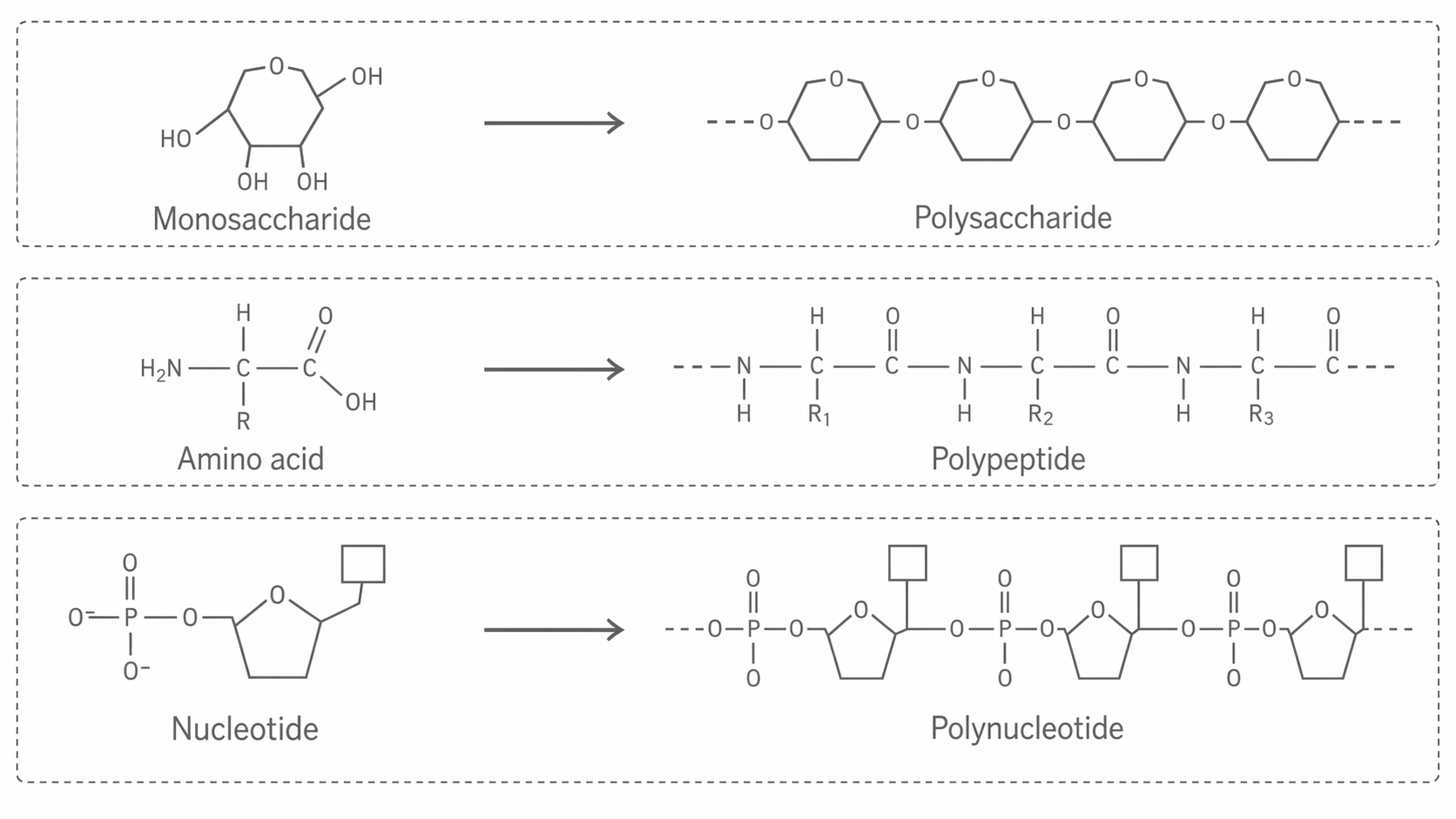
- monosaccharides, which form polysaccharides
- amino acids, which form polypeptides
- nucleotides, which form polynucleotides such as DNA and RNA
| Monomer | Polymer formed |
|---|---|
| Monosaccharide | Polysaccharide |
| Amino acid | Polypeptide |
| Nucleotide | Polynucleotide |
A good way to think about this is that cells reuse a small set of building blocks in different combinations. The variety of life is huge, but the core chemistry is shared.
The diagram below helps you compare that same monomer-to-polymer pattern across carbohydrates, proteins, and nucleic acids at a glance. Notice the repeated naming pattern: a small monomer is the building block, while the corresponding polymer is the larger molecule made by joining many of those monomers together.
[DIAGRAM: asset_name: 1.1 - Monomers and polymers - Diagram 1; asset_slug: 1.1 - Monomers and polymers - Diagram 1; recommended_method: retained_png; description: monosaccharide to polysaccharide, amino acid to polypeptide, and nucleotide to polynucleotide.]
Part 2: Condensation reactions
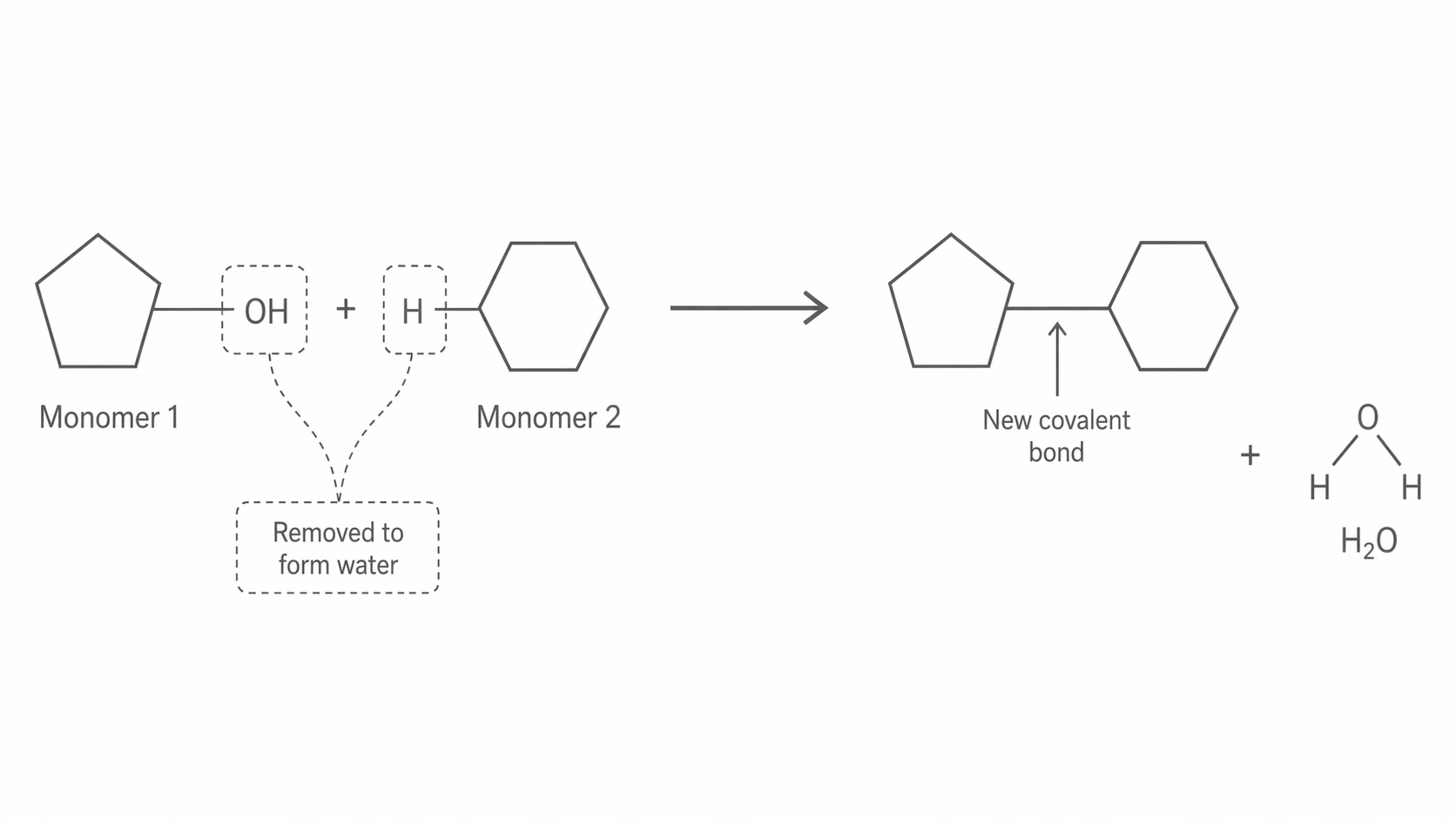
Monomers are joined together by condensation reactions. In a condensation reaction, a chemical bond forms between two molecules and a molecule of water is released.
Condensation reaction
A condensation reaction joins two molecules by forming a chemical bond and eliminating a molecule of water.
The type of bond formed depends on the monomers involved:
- two monosaccharides form a glycosidic bond
- two amino acids form a peptide bond
- two nucleotides form a phosphodiester bond
One condensation reaction makes one new bond. Repeated condensation reactions are what build a large polymer.
In the diagram below, focus on what is removed and what stays behind. The -H from one monomer and the -OH from the other combine to form water, and the remaining parts of the molecules stay joined by the new covalent bond.
[DIAGRAM: asset_name: 1.1 - Monomers and polymers - Diagram 2; asset_slug: 1.1 - Monomers and polymers - Diagram 2; recommended_method: retained_png; description: two monomers joining, with -H from one and -OH from the other forming H2O, leaving a new covalent bond.]
Part 3: Hydrolysis reactions
Hydrolysis is the reverse of condensation. Instead of removing water to form a bond, water is used to break a bond.
Hydrolysis reaction
A hydrolysis reaction breaks a chemical bond using a molecule of water.
During hydrolysis, water splits into H and OH. These attach to the two parts of the molecule as the bond breaks. This is how biological polymers can be broken down into smaller molecules.
Examples include:
- starch being broken down into smaller sugars and eventually glucose
- polypeptides being broken down into amino acids
- polynucleotides being broken down into nucleotides
Hydrolysis is especially important in digestion because large molecules are often too big to be absorbed, whereas their monomers can cross membranes and be used by cells.
Part 4: Opposite reactions in biology
Condensation and hydrolysis are opposite reactions, but it helps to be precise about what each one does.
- one condensation reaction forms one new bond and releases water
- many condensation reactions are needed to build a polymer
- one hydrolysis reaction breaks one bond using water
- repeated hydrolysis can break a polymer into many monomers
In exam answers, it is usually not enough to say that a molecule is "built" or "broken down". Strong answers name the bond involved and state whether water is released or used.