5.2.2 - AI, machine learning and robotics
AI can recommend who gets an interview, while a robot can turn a software decision into movement in the physical world. This lesson makes four questions precise: who must answer for the system, how harm is prevented, how unfair patterns arise, and who may be legally responsible when something goes wrong. You will learn to turn those questions into linked explanations rather than vague lists.
Systems and issues
The terms artificial intelligence, machine learning and robotics overlap, but they are not interchangeable.
Artificial intelligence
Artificial intelligence (AI) is the use of computer systems to perform tasks commonly associated with human intelligence, such as recognising patterns, making predictions or selecting actions.
Machine learning
Machine learning (ML) is an approach to AI in which a system learns patterns from training data so that it can make predictions or decisions on new data, rather than having every decision rule written explicitly by a programmer.
Robot
A robot is a programmable physical machine that carries out actions in the world. It may follow fixed instructions, be controlled by a person, or use AI and machine learning to choose or adapt its actions.
This gives three important relationships:
- machine learning is one approach used to build AI systems, but not every AI system has to use machine learning;
- some robots use AI or machine learning, but a fixed-sequence factory arm is still a robot;
- AI and machine learning can be software-only, such as a system that scores applications, so they do not have to control a robot.
Consider these three systems.
| System | AI? | ML? | Robot? | Reason |
|---|---|---|---|---|
| A packing arm repeats a programmed movement | No | No | Yes | It acts physically, but it neither makes an intelligent selection nor learns from data. |
| A model trained on past fault reports predicts which machine needs servicing | Yes | Yes | No | It learns patterns and makes a prediction, but has no physical mechanism. |
| A warehouse vehicle uses a trained vision model to choose a route around obstacles | Yes | Yes | Yes | A learned model informs the actions of a physical machine. |
These systems raise both ethical and legal questions.
Ethical issue
An ethical issue is a question about what is right, fair or acceptable for the people and groups affected by a technology.
Legal issue
A legal issue concerns duties, rights and responsibility under the law, including what happens when a system causes harm or breaks a legal requirement.
Something can be criticised as unfair or irresponsible even when a court has not found it unlawful. Equally, calling a system "AI" does not remove the legal duties of the people and organisations that design, supply and use it.
Do not write as though "AI", "machine learning" and "robot" name the same thing. First identify what the system does, then connect the relevant issue to a stakeholder and an effect.
Accountability across the system
When an AI system or robot affects someone, "the computer decided" is not an adequate answer. A system has been designed, supplied, deployed, operated and monitored by people or organisations.
Accountability
Accountability means that named people and organisations are answerable for a system and its effects. They must be able to explain relevant decisions, manage risks, keep evidence, respond to problems and correct harmful outcomes.
Accountability exists before, during and after use. Useful measures include:
- assigning a responsible owner with enough authority and technical understanding to act;
- documenting the system's purpose, data sources, known limits, tests and changes;
- defining what the system may decide and what still needs human approval;
- training operators and giving them a genuine way to intervene or stop a robot;
- monitoring results after deployment rather than assuming that one successful test is permanent proof;
- keeping logs so an output or physical action can be investigated;
- giving affected people a way to report an error, challenge an outcome and request correction.
Accountability can be shared across a supply chain, but it must not become so vague that every participant points elsewhere.
| Stage | Example actor | Accountable action |
|---|---|---|
| Design and training | developer or supplier | Record design choices, data limitations and test evidence. |
| Decision to deploy | purchasing organisation or manager | Decide whether the system is suitable and set limits on its use. |
| Everyday operation | trained operator or decision maker | Follow procedures, review warnings and intervene when required. |
| Monitoring and response | organisation with supplier support | Review outcomes, investigate incidents and make corrections. |
[DIAGRAM: asset_name: Accountability across an AI or robotics system; asset_slug: 5_2_2_ai_machine_learning_and_robotics__diagram_01; recommended_method: image_gen; description: Original monochrome 16:9 responsibility-chain diagram on a white background. Four large left-to-right stages labelled exactly "DESIGN & DATA", "DEPLOYMENT", "AI DECISION / ROBOT ACTION" and "EFFECT ON PEOPLE OR PROPERTY", connected by single right-pointing arrows. Beneath the stages, align the short accountability labels "document & test", "name an owner", "monitor & intervene" and "report, challenge & correct". A thin bracket spanning all four stages is labelled "ACCOUNTABILITY THROUGHOUT". A separate lower callout beside the final effect reads "LEGAL LIABILITY: decided from the law, evidence and facts", making clear that liability is investigated after a harmful effect rather than automatically assigned to the machine. No people, decorative icons, colour, gradients or photorealism.]
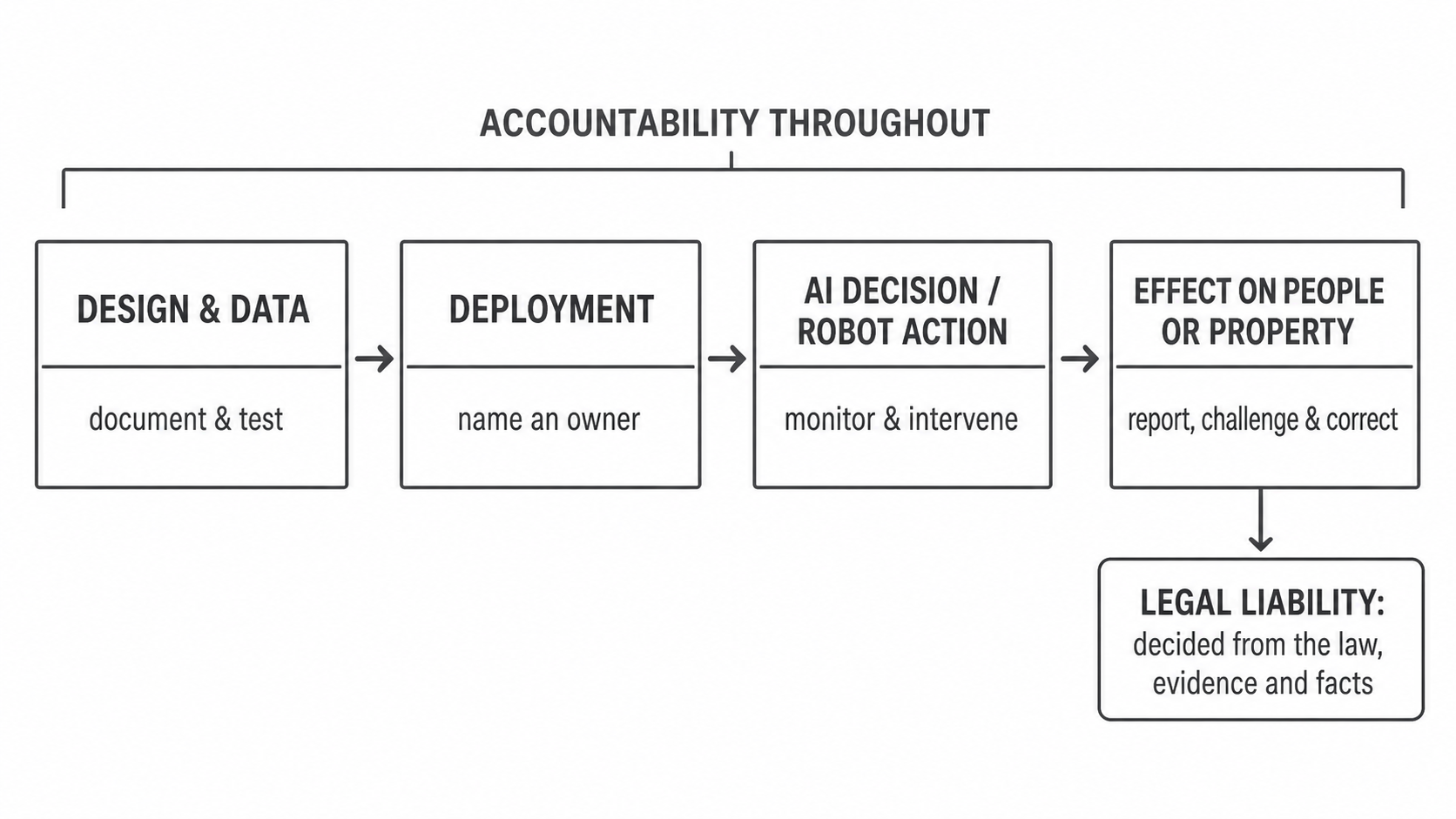
Worked example: council repair requests
A council uses AI to recommend which housing repairs should be inspected first. A staff member makes the final scheduling decision.
- The council names a service manager as the responsible owner. Buying the model from a supplier does not make the council's own use unaccountable.
- The council records each request, the model's recommendation and the staff member's final decision. This creates evidence for an investigation.
- Staff can override the recommendation when urgent evidence has been missed.
- A tenant can report an incorrect priority and ask for a human review.
- The council monitors whether the system repeatedly misses a type of repair or disadvantages a group, then changes or withdraws the system if necessary.
The human reviewer is useful only if they have enough information, time and authority to disagree. A person who simply accepts every recommendation does not provide meaningful oversight.
Safety and control
Safety
Safety means designing, testing and operating a system so that it performs as intended, including in unexpected conditions, without creating an unacceptable risk of harm.
The harm is not always physical. A moving robot can injure a person or damage property, while an incorrect AI recommendation can cause financial loss, loss of opportunity or an unsafe decision. The likely severity of harm and the chance of it happening both matter when deciding what controls are proportionate.
Safety has to be managed across the system's life cycle:
- before deployment: identify hazards, set safe requirements and test expected, boundary and unexpected conditions;
- during operation: use guards, speed limits, reliable sensors, warnings, emergency stops and meaningful human supervision where appropriate;
- when something is uncertain: use a fail-safe response, such as stopping rather than continuing movement when a safety sensor gives no trustworthy reading;
- after deployment: maintain equipment, inspect logs, report near misses, monitor performance after updates and correct newly discovered risks.
Fail-safe
A fail-safe system moves to a safer state when a fault or uncertain condition is detected. For a mobile robot, this might mean stopping when an obstacle sensor fails rather than assuming the route is clear.
Worked example: a warehouse robot
A mobile robot carries stock through a shared warehouse aisle. Its requirement is: move only when the route is confirmed clear.
| Test condition | Unsafe response | Safer response | Why it matters |
|---|---|---|---|
| Route is clear | Robot moves | Robot moves | The intended task can continue. |
| Person blocks the route | Robot continues | Robot stops | Stopping reduces collision risk. |
| Sensor is covered and gives no reading | Robot continues because no obstacle was reported | Robot stops and raises a warning | "No reading" is not evidence that the route is clear. |
Continue this lesson.
You’re previewing NovaLearn without an account. Create a free account to read the rest.
Create free account