5.1.1 - Environmental impacts of digital technology
A digital device may look clean and quiet on a desk, but its environmental story begins before it is switched on and continues after it is replaced. In 5.1.1, you will connect energy use, manufacture, replacement cycles and disposal into precise cause-and-consequence chains. You will also judge how repair, reuse, recycling and environmental monitoring can reduce impact without pretending that any choice is impact-free.
The whole-life view
Consider a tablet. Metals and other materials must be extracted, its components must be made, electricity is used while it operates, and eventually someone decides whether to keep, repair, replace, reuse or discard it. Looking only at the charging stage misses most of that story.
Device life cycle
The stages a digital device passes through from raw-material extraction and manufacture, through use and replacement, to reuse, recycling or disposal at the end of its useful life.
An environmental impact is a change to the natural environment caused by an activity. Relevant impacts include greenhouse-gas emissions, air or water pollution, habitat damage, depletion of finite resources and the creation of waste.
[DIAGRAM: asset_name: Digital device life cycle and intervention points; asset_slug: 5_1_1_environmental_impacts_of_digital_technology__diagram_01; recommended_method: image_gen; description: A monochrome left-to-right causal life cycle showing four stages labelled Manufacture, Use, Replacement decision and End of life. Manufacture has the short label materials, water, energy; Use has electricity source matters; Replacement decision branches to repair and reuse or replace, with replace feeding a new-manufacture loop; End of life branches to specialist recycling or general waste, with recycling returning recovered materials towards manufacture. Arrows make clear that short replacement cycles increase both new manufacture and e-waste, while repair, reuse and recycling reduce different impacts.]
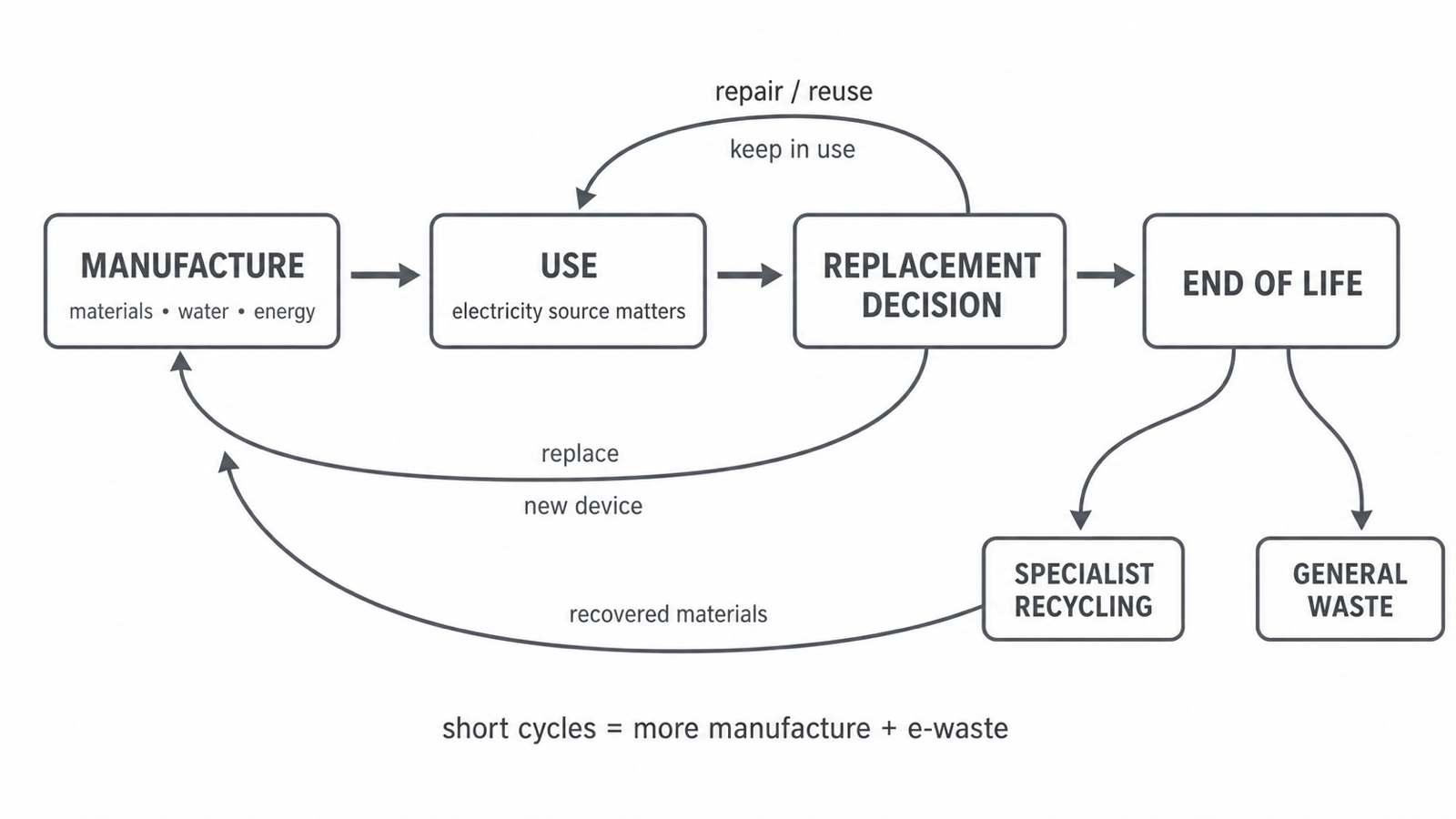
The stages interact. Replacing a working device quickly does not create only a disposal problem: it also brings forward the impacts of manufacturing another device. Repair and reuse delay both events. Recycling acts later, recovering some materials and keeping some harmful waste away from landfill, but it cannot remove the energy and resources already used.
Worked example: following one device
A community centre buys a set of tablets, charges them for three years, replaces them while most still work, and puts the old tablets in general waste.
- Manufacture: extracting materials and producing components can damage habitats, use water and consume energy.
- Use: charging the tablets creates electricity demand; the impact depends partly on how that electricity is generated.
- Replacement: replacing usable tablets makes another round of manufacture happen sooner.
- Disposal: general waste can send recoverable materials and hazardous components to landfill.
The key correction is simple: a device does not become an environmental issue only when it turns into rubbish. Every life-cycle stage can contribute.
Energy use
Digital devices need energy to power processors, displays, storage and network connections. Online services also rely on networking equipment, servers and cooling systems elsewhere. One small device may use little electricity at a moment, but long operating times and large numbers of devices increase total demand.
The strongest Paper 1 explanation makes the generation step visible:
more device use -> more electricity demand -> more fossil fuel burned, if fossil generation supplies that demand -> more carbon dioxide -> greater contribution to climate change
The phrase if fossil generation supplies that demand matters. Electricity does not release carbon dioxide at the socket. Burning coal, oil or gas to generate it does. Electricity from lower-carbon sources can reduce use-stage greenhouse-gas emissions, although generation equipment still has its own environmental impacts.
Ways to reduce the use-stage impact include:
- switching off devices and displays when they are not needed;
- using sleep or power-saving modes;
- choosing energy-efficient equipment that meets the same need;
- reducing unnecessary processing, storage or data transfer;
- using electricity from lower-carbon sources where available.
These actions reduce the use-stage impact. They do not undo the materials and energy already used to manufacture the device.
Worked example: developing the link
A design studio leaves 24 desktop computers and monitors switched on every night even though nobody uses them.
- Activity: the equipment operates for unnecessary hours.
- Immediate effect: the studio demands more electricity.
- Environmental consequence: if the extra electricity comes from fossil-fuel generation, more carbon dioxide is released, contributing to climate change.
"It wastes electricity" is a relevant point, but it is not yet a developed environmental explanation. The generation source and environmental consequence complete the chain.
Manufacture
Manufacture begins before a factory assembles the finished device. Phones, laptops, games consoles and sensors contain materials such as metals, glass and plastics. Obtaining and processing those materials, then producing chips, batteries, circuit boards and displays, can all affect the environment.
Raw-material extraction can:
- remove vegetation and disturb land, destroying or fragmenting habitats;
- create polluted runoff or waste that contaminates soil and water;
- deplete finite mineral resources;
- use machinery and processing that consume energy and may release greenhouse gases.
Component production can:
- consume large quantities of electricity;
- require water for cleaning and cooling processes;
- produce contaminated wastewater or chemical waste if it is not treated correctly;
- generate greenhouse-gas emissions when its energy comes from fossil fuels.
Water needs a precise explanation. Taking a large volume from rivers or reservoirs can leave less for people, agriculture and wildlife. Releasing contaminated wastewater can pollute habitats and harm organisms. Water use does not directly cause global warming; that link is valid only if energy used to pump, clean or heat the water is supplied by fossil fuels.
Worked example: water in component production
A component plant takes water from a local reservoir and uses it to clean silicon wafers.
- If too much water is taken during a dry period, less remains for local habitats, so aquatic organisms may be harmed.
- If contaminated water is released without suitable treatment, the reservoir may be polluted, reducing water quality and harming organisms.
- If pumping and treating the water uses fossil-fuel electricity, that energy use can release additional carbon dioxide.
Continue this lesson.
You’re previewing NovaLearn without an account. Create a free account to read the rest.
Create free account