4.1.3 - Internet structure, IP addresses and routers
Sending one request across the Internet can involve several independently run networks and a chain of router decisions. In this lesson, you will learn how backbones and connection points fit together, how IP addresses identify destinations, and how each router chooses the next step.
A network of networks
Imagine a student using a school computer to request a file from a server operated by a museum. The computer and server are not joined by one enormous school-to-museum cable. Each belongs to a network, and those networks can reach one another through other connected networks.
Internet
The Internet is a global system of interconnected computer networks.
This is why the Internet is often called a network of networks. Home, school, company, university and service-provider networks can all be part of it. The separate networks may be owned and managed by different organisations, but connections between them allow data to travel from one network to another.
There is no single central computer that stores or controls the whole Internet. Its structure is distributed: many networks, connection locations, links and routers work together. A route can pass through several independently operated networks before reaching its destination.
The Internet is also not the same thing as the World Wide Web. The Internet is the underlying network infrastructure. The web is one service that can use that infrastructure; web protocols and services are outside this lesson.
Think of the Internet as many connected networks, not one giant network with a single centre.
Backbone and connection points
An Internet service provider (ISP) connects a customer's network to its wider network and onwards to other networks.
A simplified journey from the school network to the museum network might look like this:
source network -> ISP point of presence -> backbone -> exchange point -> destination network
The labels describe different jobs, not interchangeable pieces of equipment.
Internet backbone
The Internet backbone is the collection of high-capacity core networks and long-distance links that carry data between major networks and regions.
The backbone is not one cable and it is not owned by one organisation. Several large network providers operate high-capacity core networks, and those networks interconnect. A particular route may use part of one backbone network and then part of another.
Point of presence (PoP or POP)
A point of presence is a physical location where an Internet service provider or other network provides access to its network and connects traffic onward.
For example, a provider's PoP may contain routers and links that join customer or regional access networks to the provider's wider network. Here, POP means point of presence, not the email protocol POP3.
Network access point (NAP)
A network access point is a physical location where separate provider or backbone networks connect so that they can exchange Internet traffic.
NAP is the term named in Pearson's course guidance. In current networking, Internet exchange point (IXP) is a common name for this kind of inter-network exchange location. A NAP or IXP does not control the Internet; it provides a place for separate networks to interconnect.
[DIAGRAM: asset_name: Internet structure from source network to destination; asset_slug: 4_1_3_internet_structure_ip_addresses_and_routers__diagram_01; recommended_method: image_gen; description: A monochrome 16:9 conceptual network diagram showing a source device in a school network connected to an access router, an ISP point of presence (PoP), a group of interconnected backbone routers with at least two possible paths, a network access point labelled "NAP / modern IXP" where two provider networks interconnect, a destination provider router and a destination server; one example route is clearly numbered hop by hop, with no central Internet node and no implication that every route must pass through the same exchange point.]
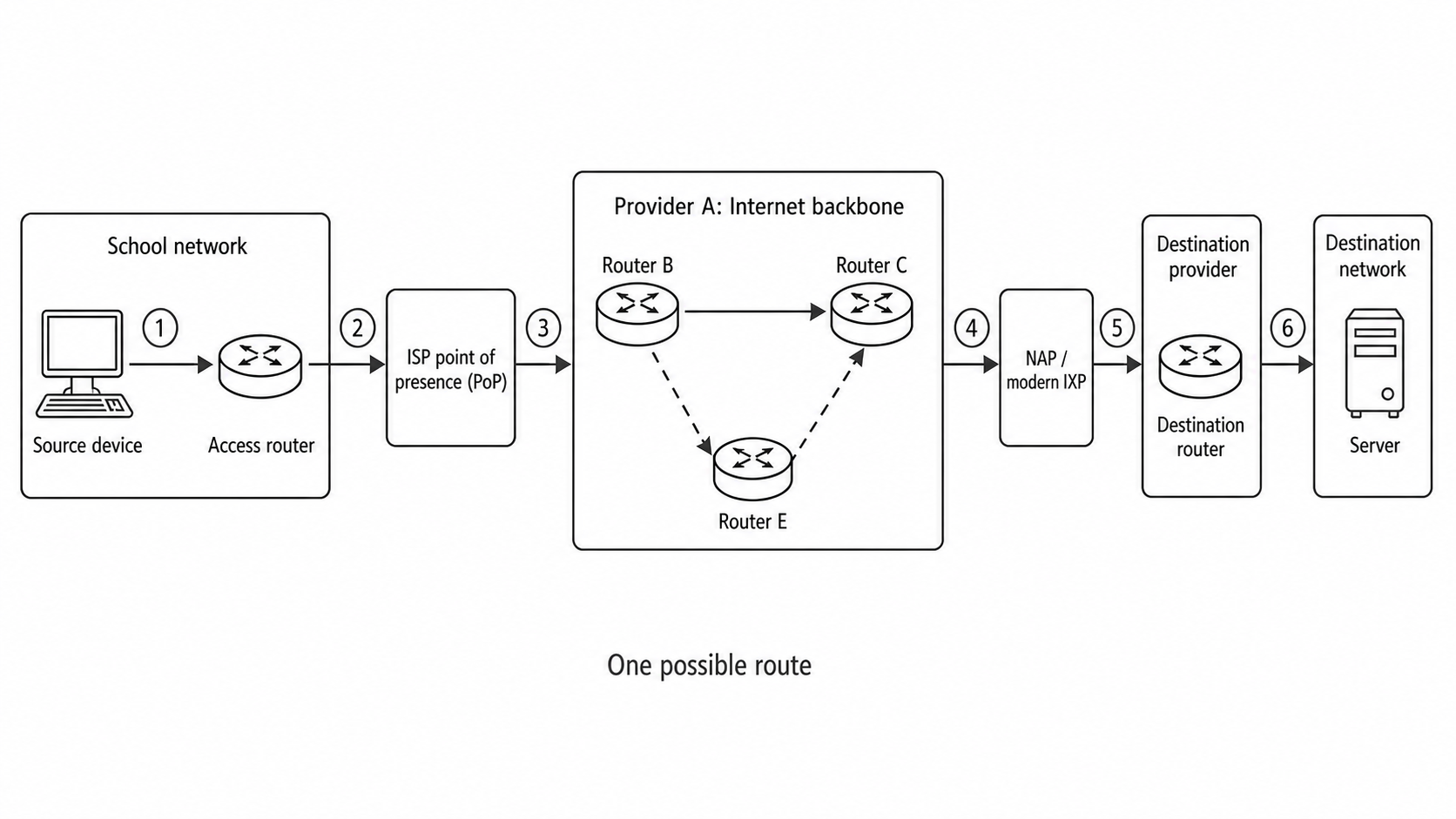
The diagram is one possible route, not a compulsory route for all Internet traffic. Networks can also connect directly or through other exchange locations. The key structural idea is that access locations join users to provider networks, backbones carry traffic across the core, and exchange locations join separate provider networks.
IP addresses identify endpoints
A router needs something more precise than "send this towards the museum". An IP packet carries a destination IP address, which routers can use when deciding where to forward it. It also carries a source IP address so that the communication has an address for its origin.
IP address
An IP address is a logical numerical address assigned to a network interface for IP communication. It identifies a source or destination so that data can be routed between networks.
At GCSE level, it is common to say that an IP address identifies a device on a network. More precisely, a device can have an address for each network connection. The important relationship is:
destination IP address -> routing decision -> progress towards the intended destination
An IP address is logical, so it is not a permanent serial number built into a device. An address may change when a device changes network or when its network assigns a different address. It must identify the intended destination unambiguously for the current communication, but a device is not guaranteed to keep one IP address forever.
Two versions of IP are widely encountered:
Continue this lesson.
You’re previewing NovaLearn without an account. Create a free account to read the rest.
Create free account