3.1.3 - Embedded systems
A washing machine can sense water temperature, time a cycle and control a motor without being a laptop in disguise. In this lesson, you will learn what makes its controller an embedded system, how information moves from sensors to outputs, and how to explain why embedded systems suit particular jobs.
Embedded or general-purpose?
An automatic door contains a computer system, but people do not normally use that computer to write an essay or edit a video. Its computing is part of the door and serves the door's operation.
Embedded system
A computer system built into a larger device or system to perform a specific task or control a specific function.
There are two defining tests:
- Where is it used? It is an integral part of a larger device or system.
- What is its purpose? It is designed around a particular task or a closely related set of control functions.
"Specific" does not have to mean one tiny action. A washing-machine controller may manage the door lock, water level, heater, drum motor and timing. These related actions all serve the specific overall purpose of controlling the washing machine.
| Feature | Embedded system | General-purpose computer |
|---|---|---|
| Relationship to other equipment | Built into and used as part of a larger device or system | The computer itself is the main device |
| Purpose | Performs a specific task or controls a specific function | Performs many unrelated tasks |
| Software | Runs stored software chosen for the device's purpose | Lets a user install and run a wide range of applications |
| Typical example | Controller inside an automatic door | Laptop used for browsing, coding and media editing |
Small size, being hidden and having an internet connection are not defining features. A visible control panel can belong to an embedded system, and an embedded system can work without a network. A modern smartphone is normally treated as general-purpose because it runs many unrelated user-selected applications, although it can contain dedicated embedded controllers within it.
To justify that a system is embedded, link both defining ideas: it is part of a larger device and it has a specific purpose in that device.
Components and control
An embedded system combines hardware with stored software. The software contains the instructions for the device's task; it is often called firmware when it is stored in and closely tied to the device.
Many embedded systems use a microcontroller.
Microcontroller
An integrated circuit containing a processor, memory and input/output peripherals on a single chip.
| Component | Function in an embedded system |
|---|---|
| Processor | Executes the stored instructions, processes input data and makes control decisions. |
| Memory | Stores the instructions and the data needed while the system operates. |
| Input/output peripherals | Allow the microcontroller to receive input and send output. |
| Stored software | Provides the sequence of instructions that defines the system's behaviour. |
Control systems often interact with the physical world through sensors and actuators:
- A sensor is an input device that detects or measures a physical condition, such as temperature, light, pressure or distance, and supplies input data.
- An actuator is an output device that turns a control signal into a physical action, such as moving a motor, opening a valve or switching on a heater.
[DIAGRAM: asset_name: Embedded control system data flow; asset_slug: 3_1_3_embedded_systems__diagram_01; recommended_method: image_gen; description: A monochrome left-to-right control diagram in which temperature is detected by a sensor, input data enters a microcontroller containing processor, memory and input/output peripherals, and a control signal goes to an actuator that turns a fan.]
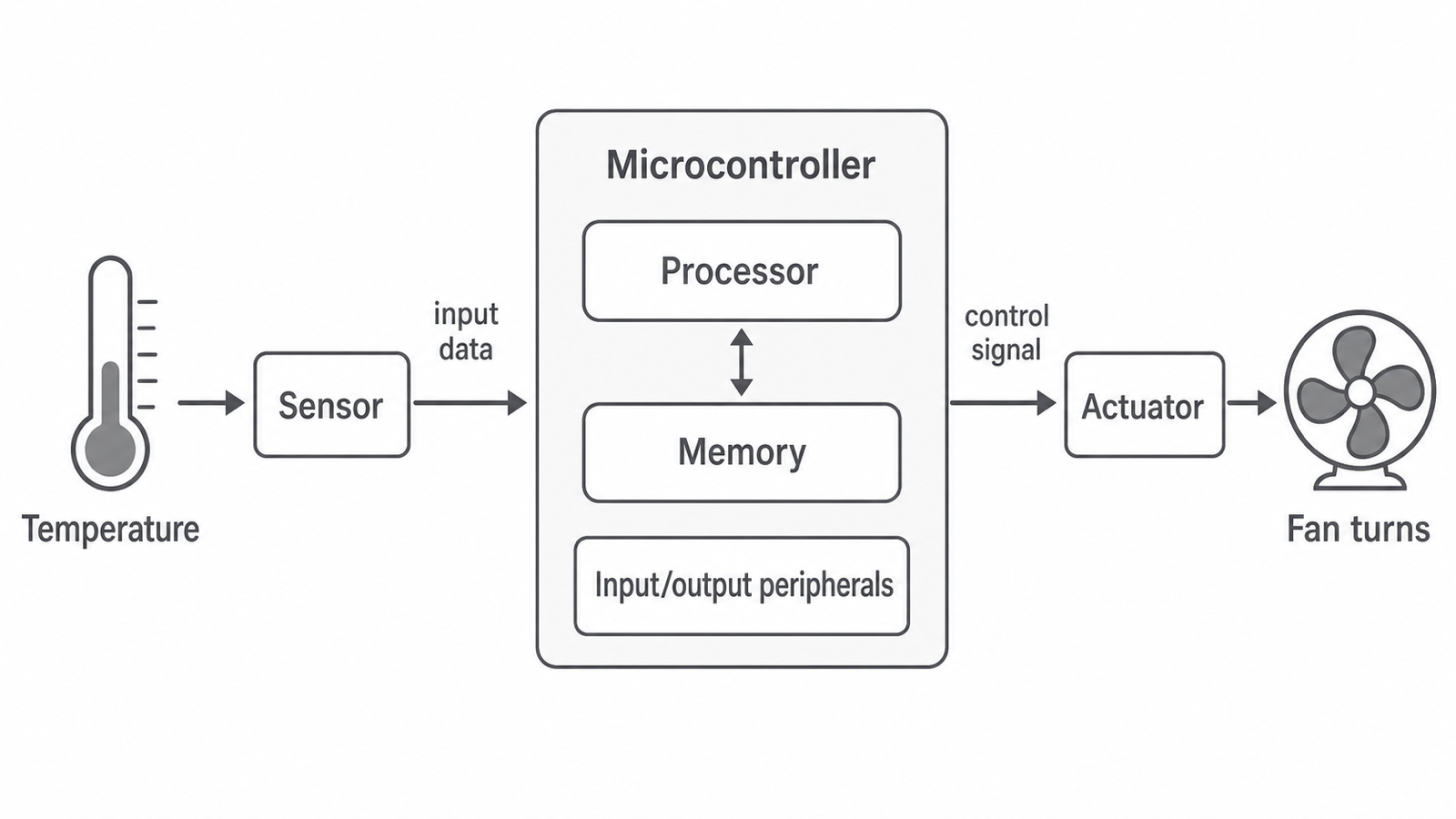
The diagram shows containment as well as flow: the processor, memory and input/output peripherals are inside the microcontroller. The sensor supplies data to it; the actuator receives a control signal from it. A sensor alone is not an embedded system because it does not include all the processing and stored instructions.
Sensors and actuators are common, but they are not compulsory in every embedded system. A button can provide input, while a display or buzzer can provide output without measuring or moving anything.
Continue this lesson.
You’re previewing NovaLearn without an account. Create a free account to read the rest.
Create free account