3.1.3 - Empiricist responses to innatism
Scope: This lesson covers Locke's empiricist attack on innatism, Locke's tabula rasa account, Hume's impressions and ideas, simple and complex concepts, and issues for empiricist responses. It stays within AQA 7172 3.1.3 by evaluating empiricism as a response to innatism without teaching Descartes' intuition and deduction thesis in detail.
The Empiricist Challenge
The innatist asks us to explain something puzzling: some knowledge seems to go beyond what any particular experience can show. Mathematical and logical truths look necessary. Some concepts seem too general or abstract to be copied straight from one sensory encounter. So the innatist proposes that at least some knowledge or concepts are in the mind before experience.
The empiricist response is not just to say that experience is important. Innatists can accept that too. The sharper empiricist claim is that experience can supply the materials from which our concepts and knowledge are built, so innate ideas or principles are unnecessary.
| Term | Meaning in this debate | Why it matters |
|---|---|---|
| Innatism | The view that at least some knowledge or concepts are innate | This is the target Locke and Hume are responding to. |
| Empiricism | The view that experience is the source of the contents of the mind | This is the alternative explanation. |
| Tabula rasa | The mind as a blank slate with no innate ideas written into it | This captures Locke's positive alternative to innatism. |
| Simple concept or idea | A basic mental content not made by combining other concepts | Empiricists need to explain where these first materials come from. |
| Complex concept or idea | A mental content formed by combining, comparing, abstracting, or otherwise working on simpler contents | This is how empiricists explain rich thought without innate content. |
The basic empiricist challenge can be reconstructed like this:
Claim at issue: We need innate ideas or principles to explain human knowledge.

1. P1: If experience can explain the origin of our concepts and knowledge, then innate ideas or principles are not needed as an explanation.
2. P2: Experience can supply the simple materials of thought, and the mind can form complex concepts from them.
3. P3: We should not posit innate content when a simpler experience-based explanation is available.
4. Therefore, C: Innatism is unnecessary.

Hidden assumption: Explanatory economy matters; do not multiply built-in mental contents without need.
Inference type: Abductive argument to the better explanation, supported by conceptual analysis.
Main pressure point: Whether experience really can explain necessary truths and abstract concepts.
So the lesson's central question is:
Can empiricism explain what innatism was introduced to explain?
Locke Against Innate Principles
Locke's first move is negative. He attacks the idea that some principles are already in the mind. His target is especially the claim that there are innate speculative principles, such as very general logical truths.
One innatist argument appeals to universal assent:
If everyone agrees to a principle, that agreement is best explained by the principle being innate.
Locke gives two replies. First, even if everyone did agree, universal agreement would not prove innateness if there were another way to explain the agreement. Second, Locke denies that there is universal agreement. Children and people who have not yet formed the relevant abstract concepts do not consciously assent to highly general logical principles. The point is not an insult about their rational status; it is that the alleged innate content is not actually present to all minds.
Locke's anti-innatism can be reconstructed like this:
Claim at issue: There are innate speculative principles in the mind.

1. P1: If a principle is innate, it should be present to the mind in some way before teaching or reasoning from experience.
2. P2: Allegedly innate principles are not consciously understood or assented to by all people.
3. P3: Saying that people know them only when they come to use reason does not show innateness, because reason can be involved in discovering what was not already known.
4. Therefore, C: The appeal to innate speculative principles fails.

Hidden assumption: Innate content should be recognisable independently of later learning or discovery.
Inference type: Conceptual objection plus empirical counterexample.
Main pressure point: Whether innateness must involve conscious assent.
That main pressure point matters. An innatist might reply that innate knowledge need not be consciously entertained from birth. It might be dispositional: the mind is structured so that, once developed, it naturally recognises certain truths.
Locke's strongest answer is that this weakens the innatist claim. If innate only means that the mind has the capacity to come to know something, then nearly everything we learn could count as innate. Locke accepts that the mind has natural powers, such as perceiving, comparing, remembering, and abstracting. What he denies is that the mind begins with built-in ideas or principles as its content.
Locke's Tabula Rasa
Locke's positive response is the tabula rasa account. The mind begins without innate ideas, but it is not inert. It has capacities that can receive and work on experience.
For Locke, experience has two main sources:
| Source | What it gives | Example |
|---|---|---|
| Sensation | Ideas from external objects affecting the senses | Colour, sound, heat, solidity, motion |
| Reflection | Ideas from the mind's awareness of its own operations | Thinking, doubting, willing, remembering, comparing |
The tabula rasa claim is easiest to misunderstand if it is treated as saying that the mind does nothing. Locke's view is subtler:
No innate content: the mind is not born already containing ideas or principles.
Active faculties: the mind can receive, retain, compare, combine, separate, and abstract.
Experience first supplies the materials; mental operations then build more complex thought.
This explains the difference between simple and complex concepts. A simple idea is a basic item the mind receives, such as a colour, sound, taste, pain, or act of thinking. A complex idea is formed when the mind works with simpler materials. For example, the idea of an apple combines colour, shape, taste, smell, solidity, and other sensory ideas. The idea of justice is more abstract, but Locke can still treat it as constructed by the mind from experienced actions, rules, harms, benefits, rights, and social relations.
Locke's positive argument can be reconstructed like this:
Claim at issue: Experience can explain the contents of the mind without innatism.

1. P1: All the simple materials of thought can be traced to sensation or reflection.
2. P2: Complex concepts can be formed by mental operations on simpler materials.
3. P3: If simple materials and complex construction are explained by experience and mental operations, innate ideas are unnecessary.
4. Therefore, C: The mind can be understood as a tabula rasa rather than as containing innate ideas.

Hidden assumption: Every meaningful idea must be either simple and experience-derived, or complex and built from experience-derived simples.
Inference type: Abductive and genetic explanation of concept acquisition.
Main pressure point: Whether every simple or abstract idea can really be traced to experience.
Book IV Chapter 11 adds an important empiricist boundary: knowledge of other finite things depends on actual sensation. Locke allows that we know our own existence differently and that he has arguments about God elsewhere, but for ordinary external things the route is sensory. This matters for EPI12 because Locke is offering experience as the starting point for worldly knowledge, not innate rational insight.
Hume: Impressions And Ideas
Hume sharpens empiricism by analysing the mind into perceptions. A perception, for Hume, is any content of consciousness. He divides perceptions into impressions and ideas.
| Humean term | Meaning | Example |
|---|---|---|
| Impression | A lively perception in sensation, feeling, passion, or immediate awareness | Seeing a bright colour, feeling pain, feeling anger |
| Idea | A fainter perception in thinking, remembering, or imagining | Remembering that colour, imagining pain, thinking of anger |
| Simple perception | A perception that cannot be divided into smaller perceptions | A particular shade of colour considered on its own |
| Complex perception | A perception composed from simpler perceptions | A golden mountain, a city, a complex emotion |
AQA uses the language of simple and complex concepts; Locke and Hume usually speak of ideas. The connection is straightforward: concepts are the contents with which we think, and empiricists explain them by tracing them back to experience.
Hume's copy principle says that simple ideas are copied from corresponding simple impressions. The imagination can then form complex ideas by combining, rearranging, enlarging, or diminishing the materials first supplied by experience. This is why Hume can explain a fictional golden mountain without saying anyone has seen one: gold and mountain are experience-derived ideas, recombined by imagination.
The route matters because it shows how Hume's copy principle strengthens Locke's wider empiricist response to innatism. The diagram keeps the sequence visible while the precise argument is reconstructed below.
[DIAGRAM: asset_name: 3.1.3 - Empiricist responses to innatism - diagram 1; asset_slug: epi12_empiricist_responses_to_innatism__diagram_01; recommended_method: retained_png; description: Empiricist route from experience to simple and complex ideas, with necessary-truth pressure]
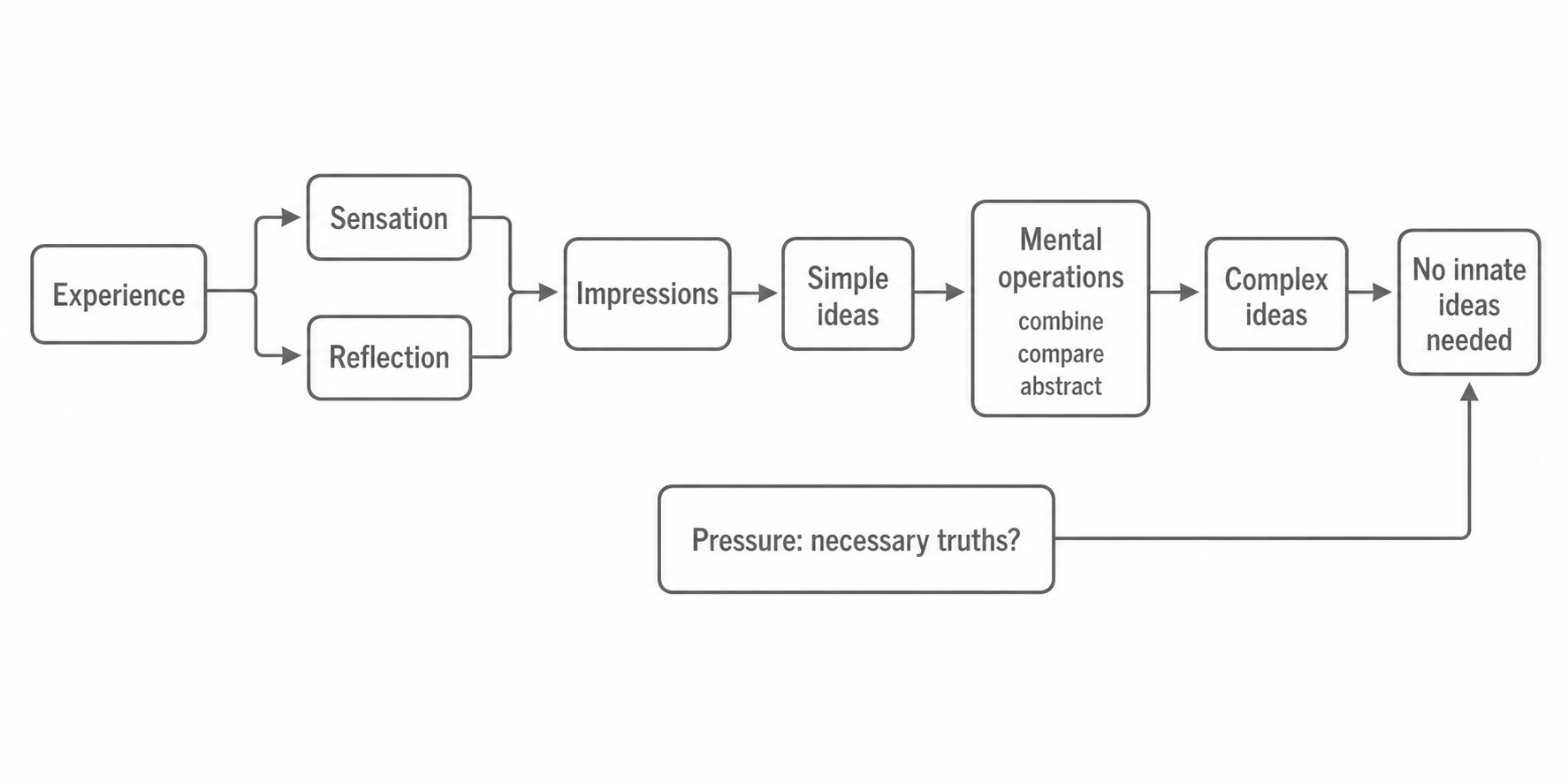
Read the diagram from left to right. Locke's sensation and reflection supply experiential materials; Hume sharpens this as impressions copied into simple ideas; mental operations then build complex ideas. The lower pressure arrow marks the main evaluative question: even if this route explains the origin of many concepts, can it explain necessary truths without appealing to innate content?
Hume's argument can be reconstructed like this:
Claim at issue: The mind contains ideas not derived from experience.

1. P1: When we inspect our mental contents, impressions are more forceful and lively than ideas.
2. P2: Simple ideas resemble earlier simple impressions, but with less force and liveliness.
3. P3: Complex ideas can be explained by operations on simpler ideas copied from impressions.
4. Therefore, C: Ideas do not need to be innate; they can be explained as copies or constructions from impressions.

Hidden assumption: Tracing an idea to an impression is a good test of whether the idea has genuine content.
Inference type: Introspective and inductive argument about the origin of ideas.
Main pressure point: Whether the copy principle holds for every simple idea and every meaningful concept.
Hume's method also gives empiricism a critical tool. If a philosopher uses a term but cannot identify the impression from which the supposed idea is derived, Hume treats that as evidence that the term may be empty, confused, or being used without a clear idea.
Hume On Necessary Truths
The hardest issue for empiricism is necessary truth. Experience seems to tell us what happens, not what must happen. No amount of seeing particular triangles seems to show, by itself, that a geometrical truth could not have been otherwise.
Hume's Section 4 part 1 gives an empiricist way to handle this. He divides objects of human reason into two kinds:
| Kind of truth | How it is known | Status | Example type |
|---|---|---|---|
| Relations of ideas | By considering relations between ideas | Necessary and certain | Mathematics and geometry |
| Matters of fact | By experience, memory, testimony, and causal inference | Contingent and not demonstratively certain | Claims about what exists or will happen |
This is important because Hume does not simply say all knowledge is sensory observation. He allows that once we have ideas, reason can discover relations between them. The empiricist claim is about the origin of ideas and the limits of factual knowledge, not that students must count objects every time they do arithmetic.
Hume's move can be reconstructed like this:
Claim at issue: Necessary truths require innate knowledge.

1. P1: Necessary truths, such as mathematical truths, concern relations among ideas.
2. P2: Relations among ideas can be discovered by thought once the relevant ideas are possessed.
3. P3: Possessing those ideas can still be explained through impressions and mental construction.
4. Therefore, C: Necessary truths do not by themselves prove innate knowledge.

Hidden assumption: A truth can be a priori in its justification without the ideas involved being innate in origin.
Inference type: Conceptual distinction used as a reply to an explanatory challenge.
Main pressure point: Whether experience can really explain possession of the ideas used in necessary truths.
This reply is powerful but limited. It helps empiricism resist the claim that necessary truths must be innate. However, it does not fully explain why relations of ideas have necessity, or whether concepts such as equality, number, identity, and contradiction can be built from experience alone.
Keep the scope boundary clear: this Humean distinction will later matter for empiricist responses to Descartes, but this lesson uses it only to evaluate empiricism as a response to innatism.
Issues For Empiricism
Empiricism is attractive because it offers a simpler explanation than innatism. It also fits obvious facts about learning: people acquire many ideas through seeing, hearing, touching, remembering, practising, and being taught. But the main question is whether it explains enough.
| Issue | Target | Why it matters | Strongest empiricist reply | Residual problem |
|---|---|---|---|---|
| Necessary truths seem to outrun experience. | Locke's and Hume's explanatory power. | Experience gives examples, but necessity seems universal and exceptionless. | Hume can distinguish origin from justification: ideas may come from experience, while relations of ideas are known by thought. | The critic can ask whether experience-derived ideas are enough to explain necessity itself. |
| The mind seems to need built-in capacities. | A crude reading of tabula rasa. | If the mind has no structure, it is unclear how it compares, abstracts, or recognises patterns. | Locke can accept innate faculties while denying innate ideas or principles. | An innatist may argue that some faculties are so content-guiding that the difference from innate concepts becomes thin. |
| Some simple ideas may not be copied from impressions. | Hume's copy principle. | Hume's own missing shade of blue case suggests a person might form an idea of a shade not previously experienced. | Hume treats this as an unusual exception that does not undermine the general rule. | If one exception is possible, the copy principle may be less strict than Hume needs. |
| Abstract concepts are difficult to trace. | The claim that complex concepts are built from simple experience-derived materials. | Concepts such as substance, infinity, equality, causation, or justice do not look like simple sensory copies. | Locke and Hume can say the mind constructs complex ideas by abstraction, comparison, and recombination. | The critic can press whether construction from experience explains the exact content of these abstract concepts. |
| Universal assent is not decisive either way. | Locke's argument against innatism. | Lack of conscious assent may show only that innate knowledge is undeveloped or dispositional. | Locke can reply that dispositional innateness risks becoming too broad: ordinary learnability would count as innate. | The debate turns on what kind of dispositional structure counts as genuine innate content. |
The strongest innatist objection in this lesson is the necessary truths objection:
Claim at issue: Empiricism cannot explain necessary truths.

1. P1: Experience only tells us what has happened or is happening.
2. P2: Necessary truths tell us what must be the case and could not be otherwise.
3. P3: What must be the case cannot be fully justified by what merely has happened.
4. Therefore, C: Empiricism cannot fully explain our knowledge of necessary truths.

Hidden assumption: If the origin of our concepts is experiential, then the justification of necessary truths must also be experiential.
Inference type: Conceptual objection to empiricism's explanatory power.
Main pressure point: The hidden assumption, because Hume can separate the origin of ideas from relations between ideas.
The best empiricist reply is to insist on that separation. Experience supplies the ideas; reason then sees relations among them. The remaining problem is whether this gives the empiricist a genuine explanation of necessity or simply renames it as a relation of ideas.
Exam Synthesis
For AQA, a strong answer should show that Locke and Hume are not merely anti-rationalist slogans. They offer a structured alternative to innatism.
Use this route for explanation:
1. Define innatism and empiricism.
2. Explain Locke's attack on innate principles, especially his challenge to universal assent.
3. Explain Locke's tabula rasa account: sensation and reflection supply simple ideas; the mind forms complex concepts.
4. Explain Hume's distinction between impressions and ideas, including simple and complex perceptions.
5. Use Hume's relations of ideas and matters of fact to show how empiricism can respond to necessary truths.
6. Evaluate whether the response succeeds, focusing on necessary truths, abstract concepts, and the copy principle.
For a 25-mark evaluation, build a chain rather than a list:
| Essay move | What it should do |
|---|---|
| Thesis | State whether empiricism explains knowledge and concepts better than innatism. |
| AO1 base | Reconstruct Locke's anti-innatism and tabula rasa, then Hume's impressions and ideas. |
| AO2 pressure | Target the hardest issue: whether experience can explain necessary truths or abstract concepts. |
| Reply | Use Hume's relation-of-ideas distinction, or Locke's distinction between innate faculties and innate contents. |
| Judgement | Decide whether that reply explains the phenomenon or merely avoids the innatist conclusion. |
A precise judgement might be:
Locke weakens innatism by showing that alleged innate principles are not obviously present in all minds,
and Hume gives empiricism a clear account of impressions, ideas, and relations of ideas. However,
empiricism is strongest as an account of the origin of many concepts, and weaker when asked to explain
the necessity of truths such as logic and mathematics.
Avoid absorbing the next AQA subtopic. You may mention that Hume's distinction later becomes relevant to Descartes, but this lesson's evaluation is about empiricist responses to innatism: Locke, Hume, tabula rasa, impressions and ideas, simple and complex concepts, and the issues these responses face.