3.1.1 - Knowledge types and the nature of definition
Scope: This lesson covers the distinction between acquaintance knowledge, ability knowledge and propositional knowledge, and the nature of definition as individually necessary and jointly sufficient conditions. It stays within AQA 7172 section 3.1.1 by using Linda Zagzebski's 'What is Knowledge?' only to frame the definitional project and by leaving justified true belief, Gettier cases and post-Gettier theories for later lessons.
The Problem Of Knowing
The word "know" looks simple until we test it.
Someone might say:
| Claim | What seems to be meant |
|---|---|
| I know Paris. | I am familiar with the city. |
| I know how to swim. | I have a skill or ability. |
| I know that Paris is in France. | I accept a proposition that is true. |
These are not obviously the same kind of achievement. Knowing a city is not the same as knowing how to perform a skill. Knowing how to swim is not the same as knowing that a sentence is true. So the first philosophical problem is not yet "What conditions make knowledge justified?" It is more basic: which kind of knowledge are we trying to define?
In this lesson, a definition is not just a helpful dictionary phrase. A philosophical definition aims to give the conditions under which a concept correctly applies. If it is a definition of propositional knowledge, it should tell us what must be true for a subject, S, to know that a proposition, p, is true.
The opening problem can be reconstructed like this:
1. P1: If one word is used for importantly different things, a single undifferentiated definition may misclassify cases.
2. P2: "Knowledge" is used for acquaintance, ability and propositional claims.
3. P3: The AQA epistemology debate about analysing knowledge asks what it takes for S to know that p.
4. Therefore, C: We must distinguish types of knowledge before analysing propositional knowledge.

Hidden assumption: A good analysis needs a clear target concept, not a loose family of ordinary uses.
Inference type: Conceptual reasoning from distinctions in meaning and use.
Main pressure point: Whether the three uses are merely different expressions or genuinely different kinds of knowledge.
The practical exam point is simple: if an answer confuses the type of knowledge being analysed, the rest of the answer will drift. This lesson builds the grip needed before later work on justified true belief and Gettier.
Three Types Of Knowledge
AQA specifies three types of knowledge: acquaintance knowledge, ability knowledge and propositional knowledge.
| Type | Basic form | Definition | Example | Common confusion |
|---|---|---|---|---|
| Acquaintance knowledge | S knows X | Knowledge by familiarity or direct experience of a person, place, object or experience. | I know my neighbour; I know London; I know what coffee tastes like. | Treating familiarity as if it must be a list of true propositions. |
| Ability knowledge | S knows how to X | Knowledge as a skill, competence or practical capacity. | I know how to ride a bicycle; I know how to solve a quadratic equation. | Treating skill as if it is only memorised instructions. |
| Propositional knowledge | S knows that p | Knowledge that a proposition is true. A proposition is something that can be true or false. | I know that water boils at 100 degrees Celsius at standard pressure. | Treating every use of "know" as propositional. |
The grammar helps. Acquaintance knowledge often takes a direct object: I know Emma, Rome or the taste of mango. Ability knowledge often uses "how": I know how to drive. Propositional knowledge often uses "that": I know that the exam is three hours long.
The grammar is not a perfect mechanical test, but it is a useful first filter. "I know where the library is" looks like a "where" claim, but it can be unpacked propositionally: I know that the library is on this street. By contrast, "I know how to swim" is normally not just a claim that I know a list of propositions about swimming. It says I can do something.
These distinctions matter because the standards for success differ. A person might know many facts about swimming without knowing how to swim. A person might know a famous singer by acquaintance after meeting them, while knowing very few propositions about their career. A person might know that a mathematical claim is true without having any direct acquaintance with a physical object.
For AQA 3.1.1, the central target is propositional knowledge because it is the kind of knowledge that can be analysed using truth-related conditions. That does not make acquaintance or ability knowledge unimportant. It means they are not the main target of the definition project in this part of epistemology.
Why Propositional Knowledge Is The Target
Propositional knowledge is knowledge that a proposition is true. A proposition is the content of a claim that can be true or false. The sentence "snow is white" expresses a proposition. So does "snow is green", even though that proposition is false. This matters because a theory of propositional knowledge can ask: what must be true of S, and of p, for S to know that p?
Acquaintance and ability knowledge do not fit that pattern as neatly.
If S knows Paris by acquaintance, the object of knowledge is a city. If S knows how to bake bread, the object is a practical ability. But if S knows that Paris is in France, the object is a proposition: Paris is in France. Propositions can be true or false, believed or disbelieved, supported or unsupported. That makes them suitable for analysis in terms of conditions.
Here is the core argument for focusing on propositional knowledge:
1. P1: A philosophical analysis needs a clearly specified analysandum, the thing being analysed.
2. P2: Acquaintance knowledge, ability knowledge and propositional knowledge have different objects and success conditions.
3. P3: Propositional knowledge has the form "S knows that p", where p can be true or false.
4. P4: Conditions such as truth, belief and justification can be meaningfully applied to propositions.
5. Therefore, C: The analysis of knowledge in this AQA topic should focus on propositional knowledge.

Hidden assumption: The best starting point for a general analysis is the kind of knowledge most clearly assessable through truth-related conditions.
Inference type: Conceptual and methodological reasoning.
Main pressure point: Whether ability or acquaintance knowledge can be reduced to propositional knowledge. This lesson does not need to settle that larger debate.
This is why the later AQA wording uses the form "S knows that p". S stands for the subject, the person or knower. p stands for the proposition known. The point of the notation is not to make the topic look mathematical. It keeps the analysis precise.
The key move is this:
| Expression | What is being analysed? |
|---|---|
| S knows X | A relation of familiarity or acquaintance. |
| S knows how to X | A practical competence or ability. |
| S knows that p | A subject's relation to a true proposition. |
The route map below shows how that target is selected. It is not a replacement for the definitions above; it is a visual reminder of the lesson's controlling path from different uses of "know" to the definitional tests that follow.
[DIAGRAM: asset_name: 3.1.1 - Knowledge types and the nature of definition - diagram 1; asset_slug: epi01_knowledge_types_and_the_nature_of_definition__diagram_01; recommended_method: retained_png; description: Route map from knowledge types to the propositional knowledge definition project]
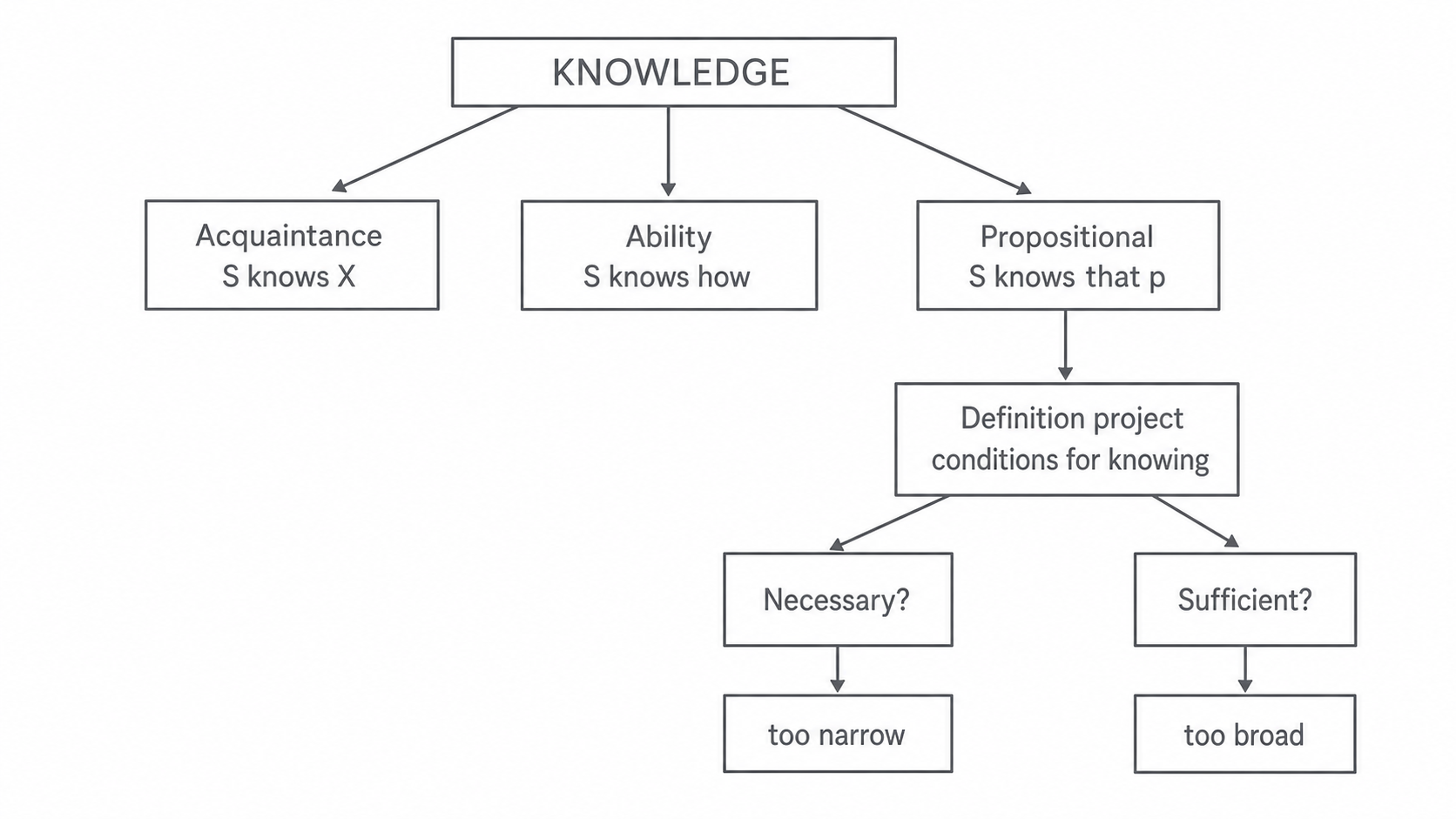
Read the diagram as a filter. The first split separates acquaintance, ability and propositional knowledge. Only the propositional branch continues into the definition project, because only "S knows that p" gives us a proposition that can be tested through necessary and sufficient conditions. The lower boxes preview the two failure modes explained next: too narrow when a proposed condition is not really necessary, and too broad when the proposed conditions are not sufficient.
Only the propositional route is the immediate target for the definition of knowledge in this part of the course.
Definitions As Conditions
A philosophical definition tries to say what makes something the kind of thing it is. In analytic philosophy, this is often done by giving necessary and sufficient conditions.
A necessary condition is something that must be present for the concept to apply. Without it, the thing is not an instance of the concept.
A sufficient condition is something that is enough for the concept to apply. If it is present, the thing is an instance of the concept.
When a definition gives several conditions, each condition may be individually necessary, while the whole set is jointly sufficient.
Suppose someone proposes:
S knows that p if and only if conditions A, B and C are met.
The definition claims two things:
| Claim | Meaning |
|---|---|
| A, B and C are individually necessary. | If S knows that p, then A is met, B is met and C is met. Remove any one of them and knowledge is absent. |
| A, B and C are jointly sufficient. | If A, B and C are all met together, that is enough for S to know that p. |
"If and only if" matters because it works in both directions:
1. If S knows that p, then the listed conditions are met.
2. If the listed conditions are met, then S knows that p.
The first direction tests necessity. The second direction tests sufficiency. A definition can fail in either direction.
A simple non-epistemology example helps. Being a shape is necessary for being a triangle, because triangles are shapes. But being a shape is not sufficient for being a triangle, because squares are shapes too. Being a closed plane figure with three straight sides is much closer to being both necessary and sufficient for being a triangle.
Now apply the same pattern to knowledge. If a proposed definition of knowledge allows false beliefs to count as knowledge, it is too broad. If it excludes clear cases of knowledge, it is too narrow. The aim is to find conditions that include all genuine cases and exclude all non-cases.
This is the definitional method that prepares the ground for the next lesson on the tripartite view. The next lesson asks which conditions belong in the analysis. This lesson teaches what kind of claim such an analysis is trying to make.
How Definitions Go Wrong
Definitions are tested by cases. A case is not a decorative example; it is evidence about whether the proposed conditions classify correctly.
There are three common failures in this lesson's scope.
| Failure | Target | How it weakens the definition | Example | Strongest repair | Residual issue |
|---|---|---|---|---|---|
| Confusing kinds of knowledge | The analysandum | The definition answers the wrong question. | Defining knowledge as a skill would not explain "S knows that p". | Separate acquaintance, ability and propositional knowledge before defining. | Some real cases mix kinds, such as knowing how to do something by knowing many propositions. |
| Over-broad definition | Sufficiency | The conditions let in things that are not knowledge. | "Knowledge is believing something strongly" includes confident false beliefs. | Add or sharpen a condition that blocks the counterexample. | Added conditions may create new problems or become unclear. |
| Over-narrow definition | Necessity | The conditions exclude things that do seem to be knowledge. | "Knowledge is what a person learns from a teacher" excludes knowledge gained by perception, memory or reasoning. | Remove the unnecessary restriction or explain why the excluded case is not really knowledge. | The repair must not become so loose that it turns over-broad. |
Notice the targeted structure. An over-broad definition mainly attacks sufficiency: meeting the definition is not enough. An over-narrow definition mainly attacks necessity: the proposed condition is not really required.
That gives students a clean evaluative vocabulary:
Objection: This definition is over-broad.
Target: The claim that the proposed conditions are jointly sufficient.
Force: A counterexample meets the definition but is not knowledge.
Reply: Add a condition, clarify a condition or restrict the analysandum.
Residual issue: The repair must be tested against new cases.
And:
Objection: This definition is over-narrow.
Target: The claim that a proposed condition is necessary.
Force: A counterexample lacks that condition but still seems to be knowledge.
Reply: Remove the condition, weaken it or argue that the case is not genuine knowledge.
Residual issue: The reply must avoid letting in non-knowledge.
This is the basic rhythm of definition in epistemology. A philosopher proposes conditions. A critic offers a case. The defender repairs, clarifies or accepts that the analysis fails.
Zagzebski And Cognitive Contact
AQA names Linda Zagzebski in connection with the nature of definition and the analysis of propositional knowledge. The exact set text boundary is Zagzebski, Linda (1999), 'What is Knowledge?' in John Greco and Ernest Sosa (eds.), The Blackwell Guide to Epistemology, pages 92-116.
For this lesson, Zagzebski's importance is not that students must quote her. It is that her framing helps show why knowledge is not just any mental state. Knowledge is valuable because it connects a knower with reality. Acquaintance knowledge can be thought of as a more direct relation to what is known, while propositional knowledge is knowledge of a true proposition about the world.
That framing puts pressure on weak definitions. If someone defines knowledge as "feeling certain", the definition is over-broad because certainty can be detached from reality. A person can feel certain and be wrong. If someone defines knowledge as "directly experiencing something", the definition is over-narrow for propositional knowledge because many propositions are known through testimony, memory or reasoning rather than immediate acquaintance.
A cautious reconstruction of the definitional project, using Zagzebski's opening concern with knowledge as contact with reality, is:
1. P1: Knowledge is a valuable cognitive success, not merely a psychological feeling.
2. P2: A cognitive success must connect the subject with reality in the right way.
3. P3: Propositional knowledge connects a subject with reality through a true proposition.
4. P4: A definition of propositional knowledge should state the conditions under which that connection obtains.
5. Therefore, C: The analysis of propositional knowledge should seek conditions that are individually necessary and jointly sufficient for S knowing that p.

Hidden assumption: The relevant connection with reality can be captured by a set of analysable conditions.
Inference type: Conceptual reconstruction of the definition project.
Main pressure point: The analysis might capture the extension of knowledge without fully explaining its value.
This also explains why AQA places this lesson before the tripartite view. Before asking whether truth, belief and justification are the right conditions, students need to understand what a condition is, what it means for conditions to be necessary or sufficient, and why the target is propositional knowledge.
The lesson boundary matters. Zagzebski is also important later when post-Gettier analyses are considered, especially virtue epistemology. That belongs in a later lesson. Here, use her to sharpen the question: what would a successful definition of propositional knowledge have to do?
Exam Synthesis
For AQA, this lesson supports short explanation and 12-mark AO1-style answers. The exam skill is not to list terms, but to show how the distinctions control the analysis.
A strong answer can follow this route:
| Stage | What to do |
|---|---|
| 1. State the problem | "Knowledge" has different uses, so the target of analysis must be specified. |
| 2. Distinguish the types | Acquaintance is familiarity, ability is know-how, propositional knowledge is knowing that p. |
| 3. Explain the focus | Propositional knowledge is the target because propositions can be true or false and can be analysed through conditions. |
| 4. Define conditions | A necessary condition must be present; a sufficient condition is enough; a successful analysis gives individually necessary and jointly sufficient conditions. |
| 5. Show testing | Over-broad definitions fail on sufficiency; over-narrow definitions fail on necessity. |
| 6. Use Zagzebski carefully | Her set text helps frame knowledge as a valuable relation or cognitive contact with reality; do not invent quotations or drift into later post-Gettier material. |
A concise synthesis might say:
The analysis of knowledge begins by identifying the kind of knowledge being analysed. Acquaintance knowledge is familiarity with a person, place, object or experience; ability knowledge is knowing how to do something; propositional knowledge is knowing that a proposition is true. AQA focuses on propositional knowledge because it has the form "S knows that p", where p can be assessed as true or false. A definition then aims to state conditions that are individually necessary and jointly sufficient. If a definition includes non-knowledge, it is over-broad and fails as sufficient. If it excludes genuine knowledge, it is over-narrow and treats something as necessary when it is not. Zagzebski's discussion helps frame why this project matters: knowledge is not merely a feeling of certainty, but a valuable cognitive relation to reality.
Avoid three common mistakes.
| Mistake | Why it loses precision | Better move |
|---|---|---|
| Defining all knowledge as "facts". | It ignores acquaintance and ability knowledge. | Say that facts belong most naturally to propositional knowledge. |
| Saying "necessary means important". | Importance is not the same as logical requirement. | Say a necessary condition must be present for the concept to apply. |
| Starting Gettier evaluation here. | Gettier belongs to a later lesson on whether the tripartite conditions are sufficient. | Signpost that sufficiency will become a major issue later. |
The central judgement for this lesson is modest but important: the search for a definition of knowledge is only clear once the target is propositional knowledge and the standard of success is necessary and sufficient conditions.