3.1.1 - Post-Gettier analyses of knowledge
Scope: This lesson covers the four AQA 7172 3.1.1 post-Gettier responses to the tripartite definition of propositional knowledge: infallibilism, no false lemmas, reliabilism, and virtue epistemology. It stays within AQA 7172 3.1.1 by asking how each repair tries to remove epistemic luck, whether it makes knowledge too demanding or too easy, and how the four approaches compare in exam evaluation.
The Repair Problem
Gettier cases create a sharp problem for the tripartite view of knowledge. The tripartite view says that propositional knowledge is justified true belief: subject S knows that proposition p if and only if S is justified in believing p, p is true, and S believes p. Gettier-style cases appear to satisfy all three conditions while still falling short of knowledge because the truth of the belief depends on luck.
The issue is not that the believer is careless or irrational. The believer has a reason that seems good enough from their point of view. The problem is that the reason and the truth come apart: the belief is true, but not true in the right way.
Key terms:
| Term | Meaning in this lesson | Why it matters |
|---|---|---|
| Fallible justification | Support that makes a belief reasonable but still leaves open the possibility of error | Gettier cases exploit fallible justification |
| Epistemic luck | Luck in the way a belief turns out true, despite the believer's route to it being defective or unsafe | The repair strategies try to block this luck |
| Lemma | An intermediate claim used in reasoning towards a conclusion | The no false lemmas response focuses on false intermediate claims |
| Reliable process | A belief-forming method that tends to produce true beliefs in the relevant conditions | Reliabilism replaces justification with reliability |
| Epistemic virtue | An intellectual ability or excellence that makes true belief creditable to the knower | Virtue epistemology replaces justification with virtue |
The basic post-Gettier problem can be reconstructed like this:
1. P1: If the tripartite view is a correct definition of knowledge, then every justified true belief is knowledge.
2. P2: In Gettier-style cases, a subject has a justified true belief, but the truth of the belief depends on luck.
3. P3: A belief whose truth depends on that kind of luck is not knowledge.
4. Therefore, C: The tripartite view does not give sufficient conditions for knowledge.

Hidden assumption: knowledge excludes the relevant kind of epistemic luck.
Inference type: deductive, if P1-P3 are accepted.
Main pressure point: what exactly counts as the kind of luck that knowledge must exclude.
The four AQA responses can be seen as four repair strategies. Before the lesson separates them, the diagram gives the whole repair pattern: Gettier luck at the top, four possible repairs in the middle, and the same evaluation test at the bottom.
[DIAGRAM: asset_name: 3.1.1 - Post-Gettier analyses of knowledge - diagram 1; asset_slug: epi04_post_gettier_analyses_of_knowledge__diagram_01; recommended_method: retained_png; description: Post-Gettier repair routes]
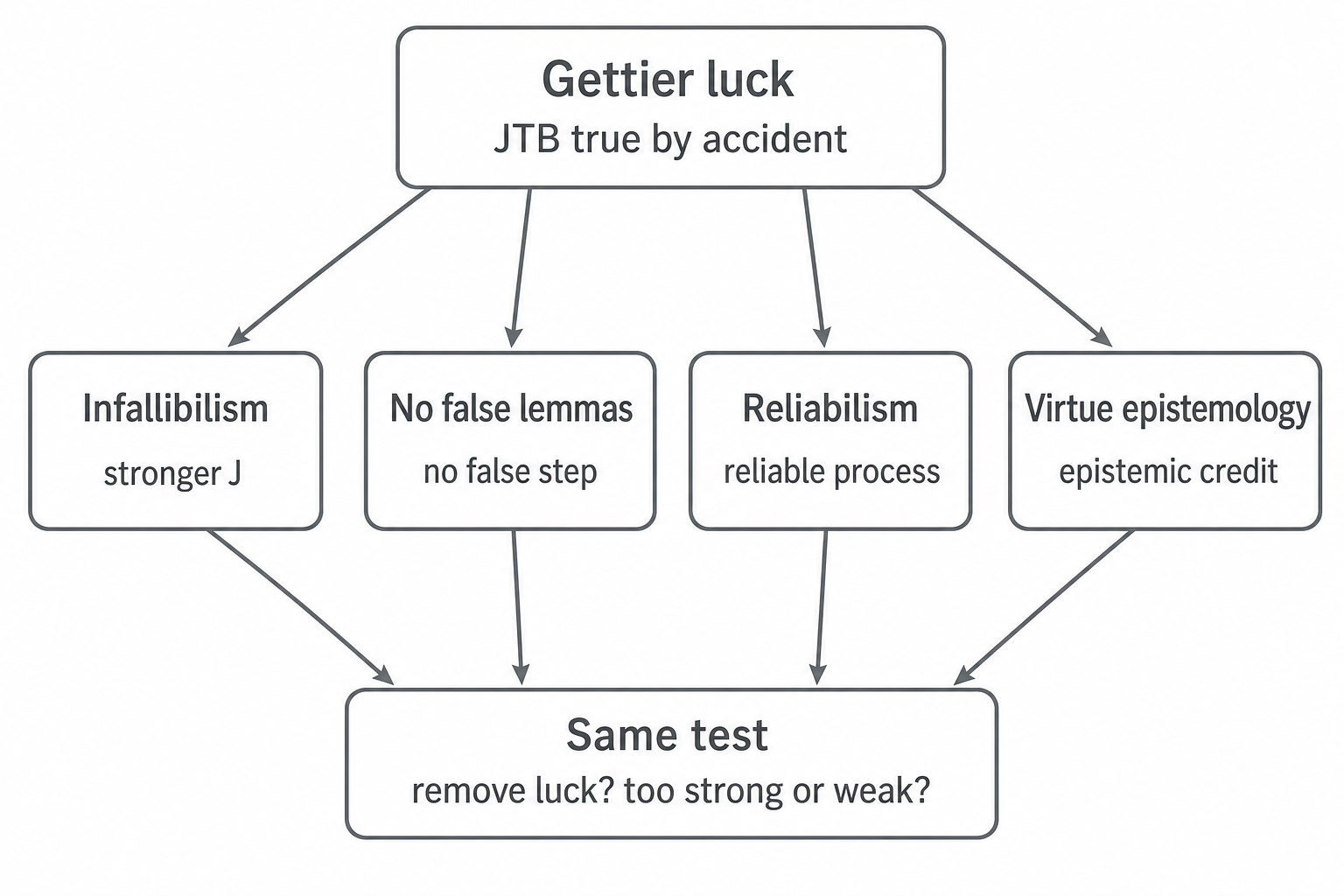
Read the diagram from top to bottom. Each route tries to make true belief less accidental, but each must still answer whether it removes luck without making knowledge too strong or too weak. The table below pins down the exact formula and repair move for each route:
| Response | Formula | Repair move |
|---|---|---|
| Infallibilism | stronger J + T + B | Make justification so strong that error is impossible |
| No false lemmas | J + T + B + N | Add a condition excluding false steps in the reasoning |
| Reliabilism | R + T + B | Replace justification with reliable belief formation |
| Virtue epistemology | V + T + B | Replace justification with belief through epistemic virtue |
Each response must answer the same question: has it removed luck without destroying too much ordinary knowledge?
Infallibilism: Strengthen Justification
Infallibilism repairs the tripartite view by strengthening the justification condition. On this view, S knows that p only if S's justification guarantees p, or at least rules out the possibility that p is false. Fallible support is not enough for knowledge.
This makes the Gettier response simple. Gettier subjects have evidence that makes their beliefs reasonable, but their evidence could still have led them into error. Infallibilism says that this was never strong enough for knowledge in the first place.
1. P1: Gettier cases arise because the subject's justification is fallible.
2. P2: If knowledge requires infallible justification, fallibly justified true beliefs do not count as knowledge.
3. P3: The beliefs in Gettier-style cases are only fallibly justified.
4. Therefore, C: Gettier-style beliefs are not knowledge, and JTB should be repaired by strengthening J.

Hidden assumption: knowledge requires certainty, not merely strong evidence.
Inference type: conceptual and deductive.
Main pressure point: whether certainty is a plausible condition for ordinary knowledge.
Why it is initially plausible: if knowledge is meant to be more than a lucky success, then a condition that removes the possibility of error looks attractive. It blocks Gettier cases at the root because it refuses to treat merely fallible justification as knowledge-making.
The main objection is that infallibilism is too strong.
| Move | Analysis |
|---|---|
| Objection | Most ordinary empirical beliefs are based on perception, memory, or testimony, all of which can be mistaken. |
| Target | The implication of infallibilism: that knowledge requires certainty. |
| Force | If the objection works, infallibilism avoids Gettier cases only by implying scepticism about much everyday knowledge. |
| Reply | The infallibilist can say that ordinary language is loose, and strict philosophical knowledge really does require a higher standard. |
| Residual issue | This reply protects the theory from luck, but it may make the definition too remote from the knowledge we normally claim to have. |
Exam judgement: infallibilism is the cleanest anti-luck response but often looks like an overreaction. It removes Gettier luck by making knowledge extremely hard to obtain.
No False Lemmas: Remove False Steps
The no false lemmas response keeps justified true belief but adds a fourth condition: S's belief that p must not depend on any false lemma. A lemma is a step or intermediate claim used in reasoning. The idea is that Gettier cases go wrong because the subject reaches a true conclusion through a false step.
In Gettier's job-and-coins style case, the subject's reasoning includes a false belief about who will get the job. The final belief happens to be true, but it is reached through a false route. The no false lemmas response says this is why it is not knowledge.
1. P1: In central Gettier cases, the subject's true belief depends on a false intermediate claim.
2. P2: A true belief based essentially on a false intermediate claim is not knowledge.
3. P3: The Gettier subject's belief is based essentially on such a false claim.
4. Therefore, C: The subject lacks knowledge; knowledge requires J + T + B + no false lemmas.

Hidden assumption: the relevant Gettier luck enters through falsity in the subject's reasoning.
Inference type: conceptual and deductive.
Main pressure point: whether every Gettier-style case depends on a false lemma.
Why it is initially plausible: it explains what is defective in the original Gettier cases without abandoning ordinary fallible knowledge. It seems reasonable to say that knowledge should not be built on false reasoning.
The main objection is that no false lemmas can be too weak.
| Move | Analysis |
|---|---|
| Objection | Some Gettier-style cases seem not to involve inference from a false lemma. A person may look at the only real barn in an area full of fake barns and believe there is a barn, without basing the belief on a false intermediate step. |
| Target | The sufficiency of the no false lemmas condition. |
| Force | If the subject still lacks knowledge, then J + T + B + N is not enough. Epistemic luck can survive even when no false lemma is used. |
| Reply | A defender can widen the condition to exclude false evidence, misleading background assumptions, or significant falsehoods in the route to belief. |
| Residual issue | The wider version risks becoming too strong, because ordinary reasoning often includes some false or irrelevant background assumptions. |
Exam judgement: no false lemmas is a neat repair for the original pattern of Gettier reasoning, but it looks less successful against cases where the luck comes from the environment rather than from a false step in an inference.
Reliabilism: Reliable Formation
Reliabilism replaces the justification condition with a reliability condition. On the AQA formula, knowledge is reliably formed true belief: R + T + B. A reliable cognitive process is a way of forming beliefs that tends to produce true beliefs in the relevant circumstances, such as normal perception, memory, or good reasoning.
This is an externalist move. Externalism says that whether a belief counts as knowledge can depend on factors outside the subject's reflective awareness. A child, animal, or ordinary adult might know through a reliable process even if they cannot explain their justification in philosophical terms.
1. P1: Lucky guesses fail to be knowledge because they are not formed by truth-conducive processes.
2. P2: A true belief formed by a reliable cognitive process is connected to truth in the right way.
3. P3: Many ordinary beliefs are true because they are formed by reliable processes such as perception or memory in normal conditions.
4. Therefore, C: Knowledge is better analysed as reliable true belief than as justified true belief.

Hidden assumption: reliability supplies the right anti-luck connection between belief and truth.
Inference type: conceptual proposal supported by abductive fit with ordinary cases.
Main pressure point: how to specify the relevant process and relevant conditions.
Why it is initially plausible: reliabilism avoids making knowledge depend entirely on what the subject can internally justify. It can explain why ordinary perception and memory often produce knowledge, while random guessing does not.
The first major objection is the generality problem.
| Move | Analysis |
|---|---|
| Objection | Any belief can be described as produced by many process types. Seeing a real barn might be produced by vision, by vision while driving, by vision in fake-barn country, or by vision at a particular second. Some descriptions are reliable; others are not. |
| Target | The concept of a reliable process. |
| Force | If reliabilism cannot say which process type matters, it cannot give clear conditions for knowledge. |
| Reply | The reliabilist can specify process types by normal explanatory relevance: the process must be the one that actually explains the belief's formation in its environment. |
| Residual issue | The more detail added, the more the theory looks less like the simple R + T + B analysis and more like a family of further conditions. |
The second major objection is environmental luck. A person may use normal eyesight and happen to see the one real barn in an area full of fake barns. Their visual process is generally reliable, and their belief is true, but it seems they could easily have been wrong.
The reliabilist reply is to make reliability local to the relevant environment. In fake-barn country, the process of forming barn beliefs by roadside appearances is not reliable. The residual problem is that local reliability must be defined carefully enough to avoid ad hoc adjustments.
Exam judgement: reliabilism is stronger than no false lemmas because it targets the source of belief rather than just false steps in reasoning. Its weakness is that reliability is harder to define than it first appears.
Virtue Epistemology: Epistemic Credit
Virtue epistemology replaces the justification condition with an account of epistemic virtue. In the AQA formula, knowledge is V + T + B. An epistemic virtue is an intellectual excellence that helps a person reach truth, such as careful observation, intellectual honesty, open-mindedness, intellectual courage, good memory, or reliable perceptual competence.
Linda Zagzebski is an important named figure for this part of the topic. The AQA set-text boundary is her 1999 chapter What is Knowledge? in John Greco and Ernest Sosa's The Blackwell Guide to Epistemology, pages 92-116. A Zagzebski-style virtue account treats knowledge as true belief arising through intellectual virtue. The central thought is that knowledge is not just a true belief that happened to come out right; it is a true belief for which the knower deserves epistemic credit.
1. P1: In Gettier cases, the subject's belief is true, but the truth is not creditable to the subject's intellectual virtue.
2. P2: Knowledge requires true belief because of epistemic virtue, not merely true belief alongside virtue.
3. P3: Gettier subjects do not believe the truth because of epistemic virtue; their success depends on luck.
4. Therefore, C: Gettier subjects lack knowledge, and knowledge should be analysed as V + T + B.

Hidden assumption: knowledge is a kind of intellectual achievement.
Inference type: conceptual proposal supported by explanatory fit with the value of knowledge.
Main pressure point: how much credit must belong to the believer for knowledge to occur.
Why it is initially plausible: virtue epistemology explains why knowledge seems more valuable than a lucky true belief. If two people believe the truth, but only one gets there through intellectual ability or good intellectual character, the second seems to have achieved something epistemically better.
The main objection is that virtue epistemology can be too strong.
| Move | Analysis |
|---|---|
| Objection | Much knowledge comes from testimony, teaching, or simple perception, where the subject's own intellectual virtue may seem minimal. A traveller can know a direction by trusting a competent local speaker. |
| Target | The concept of epistemic credit. |
| Force | If knowledge requires strong individual credit, the theory may exclude ordinary testimonial knowledge. |
| Reply | A defender can say that credit need not mean praise or heroic intellectual effort. It may be enough that the subject exercises appropriate trust, attention, understanding, or participation in a reliable social practice. |
| Residual issue | If credit is made too thin, virtue epistemology may struggle to exclude Gettier cases; if it is made too thick, it excludes too much ordinary knowledge. |
A second objection is that virtue may be present while luck remains. A person with excellent eyesight may form a true belief in a misleading environment. The defender must show that the truth of the belief is because of the virtue rather than merely accompanied by virtue.
Exam judgement: virtue epistemology gives the richest explanation of why Gettier cases fail, because it targets the relation between the agent, the belief, and the truth. Its hardest task is making epistemic credit precise enough to handle ordinary knowledge and lucky success.
Zagzebski and the Pattern of Repair
Zagzebski matters here because she helps students see a pattern behind the repairs. The issue is not only whether one proposed condition works, but whether a condition can be satisfied while the belief is still false and then made true by luck. If that can happen, the theory may be vulnerable to a new Gettier-style case.
This is a diagnostic tool for the four specified responses, not an invitation to broaden the lesson beyond AQA 3.1.1.
1. P1: Suppose a repair condition F can be satisfied even when S's belief that p is false.
2. P2: If F can be satisfied while p is false, we can often imagine a case where F remains satisfied but p becomes true by luck.
3. P3: A belief that becomes true by luck in this way still does not seem to be knowledge.
4. Therefore, C: Any repair condition that leaves room for this pattern may fail to give sufficient conditions for knowledge.

Hidden assumption: the repair condition is independent enough from truth that luck can reconnect it to truth accidentally.
Inference type: conceptual counterexample schema.
Main pressure point: whether the proposed repair really blocks the relevant luck rather than merely renaming it.
This pattern explains the comparative pressure:
| Response | How it handles Zagzebski-style pressure |
|---|---|
| Infallibilism | Tries to stop the pattern at P1 by making justification truth-guaranteeing. This is powerful but very demanding. |
| No false lemmas | Blocks original cases where false steps are essential, but can leave room for environmental or non-inferential luck. |
| Reliabilism | Makes truth more likely by requiring a reliable process, but must explain how reliable is reliable enough in the actual environment. |
| Virtue epistemology | Requires truth because of epistemic virtue, but must explain how much virtue-based credit is enough and how much luck is too much. |
The lesson to draw is not that every response automatically fails. It is that a good post-Gettier analysis needs more than a condition that often accompanies true belief. It needs a condition that explains why the truth of the belief is non-accidental in the right way.
Comparative Exam Synthesis
For an AQA answer, do not list the four responses as separate facts. Compare them by asking the same evaluative question each time: does this analysis remove epistemic luck without becoming too strong or too weak?
| Response | Main strength | Main weakness | Best concise judgement |
|---|---|---|---|
| Infallibilism | Completely blocks Gettier cases by excluding fallible justification | Too strong: risks scepticism about ordinary empirical knowledge | Decisive against luck, but costly |
| No false lemmas | Explains what goes wrong in original inference-based Gettier cases | Too weak: luck can remain without false intermediate reasoning | Useful repair, not a full solution |
| Reliabilism | Preserves ordinary knowledge and shifts focus to truth-conducive processes | Process reliability and environmental luck are hard to specify | Promising, but needs careful detail |
| Virtue epistemology | Explains knowledge as creditable true belief and targets luck directly | Credit may be too demanding or too vague | Often the richest repair, but not problem-free |
A strong 25-mark judgement might run like this:
Thesis: No post-Gettier response is clearly complete, but virtue epistemology and reliabilism are stronger than no false lemmas because they target the source of true belief rather than only the presence of false reasoning. Infallibilism removes luck most decisively, but it does so by setting the standard for knowledge too high.

Route:
1. Explain the Gettier problem as a problem of lucky justified true belief.
2. Analyse infallibilism and object that it is too strong.
3. Analyse no false lemmas and object that it is too weak against environmental luck.
4. Compare reliabilism and virtue epistemology as deeper replacements for justification.
5. Judge whether reliable formation or epistemic credit gives the better account of non-accidental truth.
Useful evaluation sentences:
- This objection targets the sufficiency of the analysis because the subject still has the proposed conditions but lacks knowledge.
- The reply succeeds only if the added condition removes the relevant luck without excluding ordinary knowledge.
- Infallibilism solves Gettier by raising the standard, whereas reliabilism and virtue epistemology try to explain the right connection between belief and truth.
- No false lemmas handles the original Gettier structure better than it handles fake-barn-style environmental luck.
- Virtue epistemology is attractive because it explains why knowledge is more valuable than lucky true belief, but the account depends on making epistemic credit precise.
The most controlled conclusion is comparative rather than absolute: infallibilism is too strong, no false lemmas is too weak, reliabilism is practical but faces the generality problem, and virtue epistemology gives the best account of achievement if it can define epistemic credit without excluding ordinary testimony and perception.