3.1.2 - Berkeley idealism and its problems
Berkeley asks you to reconsider what an ordinary object is when every feature you encounter appears in perception. You will trace how his idealism tries to preserve a stable, shared world without matter, then test it against illusion, hallucination, solipsism and the role of God. Indirect realism appears only as a contrast, and the set-text focus remains Berkeley's 1713 Three Dialogues Between Hylas and Philonous.
The Problem
You open your eyes and there is a table. It looks solid, has a shape, seems brown, and resists your hand when you press it. The natural thought is that the table is there anyway, whether anyone sees it or not.
Berkeley's challenge begins by asking what, exactly, you are immediately aware of. You do not step outside perception and compare your idea of the table with a table as it is when no mind is aware of it. You encounter colours, shapes, textures, resistance, warmth, coldness, sounds, and smells as they appear in experience. The philosophical pressure is this:
If every sensible feature of the table is known only as an object of perception, what justifies adding a mind-independent material thing behind those perceived features?
Key terms:
| Term | Meaning in this lesson | Why it matters |
|---|---|---|
| Immediate object of perception | What the mind is directly aware of in perception | AQA says Berkeley's idealism is a theory about immediate objects of perception. |
| Mind-dependent object | An object whose existence or nature depends on being perceived by a mind | Berkeley says ordinary objects, such as tables and chairs, are mind-dependent. |
| Mind-independent object | An object that exists and has its relevant properties independently of any mind perceiving it | This is what Berkeley rejects for ordinary sensible objects. |
| Idea | For Berkeley, a passive object of awareness: a colour, sound, taste, shape, pain, warmth, or a collection of such sensible contents | Ordinary objects are analysed as organised collections of ideas. |
| Spirit or mind | An active perceiver that has, orders, wills, or understands ideas | Berkeley rejects matter, but not minds. |
Berkeley's idealism does not say there are no tables or chairs. It says tables and chairs are not material substances existing outside all minds. They are real ordinary objects, but their reality consists in being perceived or otherwise dependent on minds.
Core reconstruction:
1. P1: The immediate objects of perception are ideas: colours, sounds, shapes, textures, pains, tastes, and so on.
2. P2: Ordinary sensible objects are collections of such perceived qualities.
3. P3: If something is a collection of mind-dependent ideas, then it is not a mind-independent material object.
4. Therefore, C: Ordinary sensible objects are mind-dependent rather than mind-independent.

Hidden assumption: There is no need to add an unknowable material substance behind the perceived qualities.
Inference type: Conceptual and metaphysical; it aims to be deductive if the analysis of ordinary objects is granted.
Main pressure point: P2 and the hidden assumption. A critic can ask whether ordinary objects are more than the qualities we perceive.
Why the view initially has force:
- It keeps close to experience: all the sensible features we can name are features as perceived.
- It avoids a hidden material substratum whose nature we cannot directly inspect.
- It promises to protect ordinary objects from scepticism: Berkeley thinks the table is real because it is perceived, not because it resembles an unknowable thing behind perception.
The lesson's central evaluative question is therefore not "Did Berkeley deny common sense?" It is sharper:
Can Berkeley preserve a real, stable, shared world after making ordinary objects mind-dependent?
The Positive Model
Berkeley needs more than an attack on matter. He needs a positive account of what the world is like if matter is removed.
His basic ontology has two kinds of thing:
| Kind of thing | Role | Example |
|---|---|---|
| Ideas | Passive objects of awareness | Redness, roundness, heat, pain, the taste of apple, visual shape |
| Minds or spirits | Active perceivers and willers | You, other finite minds, and God |
Ordinary objects are not extra items hidden underneath their sensible qualities. An apple is a stable collection of ideas: colour, taste, smell, shape, texture, and resistance, grouped together in experience and treated under one name.
This is why Berkeley can say he is defending, rather than destroying, ordinary reality. On his view:
| Worry | Berkeley's answer |
|---|---|
| If the apple is only ideas, is it unreal? | No. The apple is real because the relevant ideas are genuinely perceived and organised as one object. |
| Is the apple just whatever I imagine? | No. Sensory ideas are not normally under my control in the way imagined ideas are. |
| Does the apple vanish when I stop looking? | Not if its continued order depends on another mind, ultimately God. |
| Is science impossible? | Berkeley can reinterpret science as the study of regular patterns among ideas, not as discovery of hidden material substance. |
The positive model can be reconstructed like this:
1. P1: We directly perceive ideas, not mind-independent material substances.
2. P2: Some ideas occur in stable, vivid, involuntary, lawlike patterns.
3. P3: Collections of these stable ideas are what we ordinarily call real things.
4. P4: These patterns require an active cause beyond passive ideas.
5. Therefore, C: A real physical world can be understood as an ordered system of mind-dependent ideas caused and sustained by mind.

Hidden assumption: Stability, involuntariness, and order are enough to distinguish real things from mere imagination.
Inference type: Abductive within Berkeley's system: it offers the best explanation once matter is rejected.
Main pressure point: Whether order among ideas can replace mind-independent objects without losing objectivity.
This model also explains why Berkeley's idealism is not the same as saying "everything is in my head" in a casual sense. It is not a private fantasy theory. Berkeley wants a public, ordered world, but he relocates that world from material substance to ideas sustained by minds.
There is still a cost. The more work Berkeley gives to mind, especially God's mind, the more his theory must explain what it means for sensible things to exist in a mind. That issue becomes crucial when we reach pain and hallucination.
Primary And Secondary Qualities
Berkeley's first major argument for idealism attacks the primary/secondary quality distinction.
The distinction, associated with Locke in the AQA perception topic, says roughly:
| Quality type | Claimed status | Examples |
|---|---|---|
| Primary qualities | Supposed to be in objects themselves, mind-independently | Shape, size, motion, number, solidity, extension |
| Secondary qualities | Supposed to depend on perceivers, or on powers in objects to produce ideas in perceivers | Colour, taste, smell, sound, heat, cold |
This distinction supports a materialist or indirect realist picture. Even if colour and taste are mind-dependent, perhaps shape, size, and motion belong to the object itself. Berkeley tries to collapse that distinction.
Route 1: inseparability
Berkeley argues that we cannot perceive or conceive a primary quality in isolation from secondary qualities. Try to imagine a shape with no colour, no visible boundary, no tactile feel, and no sensory presentation at all. The supposed primary quality is never given as a bare, mind-independent item. It is always experienced through sensible qualities.
Reconstruction:
1. P1: Secondary qualities, such as colour, taste, sound, heat, and cold, are mind-dependent.
2. P2: Primary qualities, such as shape, size, and motion, cannot be perceived or conceived except together with sensible qualities.
3. P3: If primary qualities cannot be separated from mind-dependent sensible qualities, we lack grounds for treating primary qualities as mind-independent.
4. Therefore, C: The primary/secondary quality distinction fails as a defence of mind-independent material objects.

Hidden assumption: What cannot be separated in perception or conception should not be treated as separately existing in mind-independent reality.
Inference type: Conceptual argument from inseparability.
Main pressure point: P3. A critic may say conceptual inseparability does not prove metaphysical inseparability.
Route 2: perceptual variation
Berkeley also presses a parity argument. The same water can feel warm to one hand and cold to another. That kind of variation is often used to show that heat and cold are mind-dependent. But shape, size, and motion also vary with perspective, distance, scale, lighting, bodily condition, and instruments. A coin looks circular from one angle and elliptical from another; a tower looks small from far away and larger close up.
If variation shows that secondary qualities are mind-dependent, Berkeley asks why similar variation does not show the same about primary qualities.
1. P1: Perceptual variation gives reason to treat secondary qualities as mind-dependent.
2. P2: Primary qualities also vary in perception.
3. P3: Similar cases should be treated similarly unless there is a relevant difference.
4. Therefore, C: Perceptual variation gives reason to treat primary qualities as mind-dependent too.

Hidden assumption: The defender of primary qualities has not supplied a relevant difference between the two cases.
Inference type: Analogical argument.
Main pressure point: Whether measurable primary qualities can be distinguished from variable appearances in a way secondary qualities cannot.
Objection and reply
| Move | Analysis |
|---|---|
| Objection | Berkeley mistakes how science uses primary qualities. Even if perceived shape varies, the object's real measurable structure may still be mind-independent. |
| Target | P3 in the inseparability argument and P3 in the variation argument. |
| Force | It suggests Berkeley has shown only that our perceptions vary, not that no mind-independent structure exists. |
| Berkeleyan reply | Any supposed structure must either be perceived as an idea, described abstractly, or inferred from ideas. None gives direct access to a material object as it is outside all perception. |
| Residual issue | The success of mathematical science may still make the critic suspect that Berkeley has removed too much by reducing physical reality to perceived ideas and regularities among them. |
The attack is strongest when aimed at a crude version of the primary/secondary distinction: the idea that we simply perceive real shape as it is in objects while colour is merely in us. It is weaker if the defender says primary qualities are theoretical structural properties inferred by science rather than qualities directly resembling our ideas.
The Master Argument
The Master argument is Berkeley's most compact challenge to mind-independent objects. It asks you to try to conceive of a sensible object existing wholly unconceived and unperceived.
The trap is immediate. If you conceive the object, then it is being conceived by a mind. Berkeley thinks the idea of a sensible object existing outside all minds is therefore not a genuine positive conception. It is just words pretending to describe something possible.
Reconstruction:
1. P1: To show that a mind-independent sensible object is possible, we must be able to conceive of such an object existing unconceived or unperceived.
2. P2: Whenever we conceive of a sensible object, that object is an object of thought for a mind.
3. P3: So we cannot conceive of a sensible object as existing with no relation to any mind.
4. Therefore, C: The idea of a mind-independent sensible object is incoherent or empty.

Hidden assumption: Conceivability is a reliable test of possibility for sensible objects.
Inference type: Conceptual reductio; Berkeley tries to show that the opponent's idea defeats itself.
Main pressure point: The move from "I cannot think of an object without thinking of it" to "the object cannot exist without being thought of."
Why it looks attractive:
- It exposes how hard it is to give positive content to "matter existing outside all minds."
- It fits Berkeley's empiricism: meaningful ideas should be traceable to possible experience.
- It pressures the materialist to explain what is being asserted beyond "there is something I cannot perceive, imagine, or describe except by using perceived qualities."
The standard objection is that Berkeley confuses the act of conceiving with the object conceived.
| Move | Analysis |
|---|---|
| Objection | I can conceive of a tree existing when no human perceives it, even though my act of conceiving is occurring now. |
| Target | The inference from P2 to P3. |
| Force | It separates the mental act from the content of the thought. The content can represent a tree as unperceived even if the content is currently being thought. |
| Berkeleyan reply | The critic has not produced a positive idea of a mind-independent sensible object; they have only attached the words "unperceived" or "mind-independent" to an idea currently before the mind. |
| Residual issue | The reply may demand too much. We often understand possibilities without forming a sensory image of them. A critic can say Berkeley has shown a limit of imagination, not a limit of reality. |
For evaluation, do not write merely that the Master argument is "confusing". Say exactly what the alleged confusion is:
The objection targets the inference. Berkeley may be right that any imagined object is imagined, but it does not follow that the object imagined must be imagined as perceived. A thought can represent a situation in which no one is perceiving the object.
The Master argument is therefore useful in essays even if you reject it. It forces the opponent to explain what sense they attach to mind-independent sensible reality.
Illusion And Hallucination
Arguments from illusion and hallucination are usually used against direct realism, but AQA also lists them as issues for Berkeley's idealism. The problem changes shape.
For Berkeley, ordinary objects are mind-dependent ideas. But illusions and hallucinations are also mind-dependent ideas. If both real perception and hallucination consist in ideas, what makes one a real object and the other a mere appearance?
Definitions:
| Case | Lean example | Philosophical pressure |
|---|---|---|
| Illusion | A straight stick looks bent in water | There is a perceived idea that does not fit how we later judge the object. |
| Hallucination | Someone seems to see an object that no one else can find | There may be an experience with no ordinary public object. |
Objection reconstruction:
1. P1: Berkeley says ordinary real objects are mind-dependent ideas or collections of ideas.
2. P2: Illusions and hallucinations are also mind-dependent ideas or collections of ideas.
3. P3: If real objects and hallucinations have the same basic status as ideas, Berkeley cannot clearly distinguish the real from the unreal.
4. Therefore, C: Idealism struggles to explain illusion and hallucination.

Hidden assumption: A successful real/unreal distinction must be grounded in something beyond ideas, such as mind-independent material objects.
Inference type: Explanatory objection; it targets Berkeley's ability to preserve ordinary distinctions.
Main pressure point: P3. Berkeley can accept that all immediate objects are ideas while denying that all ideas have the same role or status.
Berkeley's response is to distinguish real ideas of sense from ideas of imagination, dream, hallucination, or misjudgement.
| Feature | Real ideas of sense | Imagined, dream, or hallucinatory ideas |
|---|---|---|
| Voluntary control | Normally not chosen by us | Often more dependent on our mind, though not always voluntarily controlled |
| Order | Fit stable laws and patterns | Less coherent or less integrated with the rest of experience |
| Vividness | Typically forceful and clear | Often less stable, though vivid hallucinations complicate this |
| Public connection | Coordinate with other experiences and other perceivers | Fail to fit shared, continuing patterns |
| Practical success | Support prediction and action | Break down under further checking |
On this reply, the bent-stick case is not a disaster for idealism. The visual idea is real as a visual idea. The error occurs when we judge that the stick will also feel bent, behave as bent, or fit the wider pattern of bent objects. A hallucinated object is an idea, but it does not belong to the coherent public order of ideas that constitutes a real ordinary object.
Targeted evaluation:
| Move | Analysis |
|---|---|
| Objection | Idealism cannot distinguish real objects from hallucinations because both are ideas. |
| Target | Explanatory power of Berkeley's theory. |
| Reply | Berkeley distinguishes ideas by coherence, lawlike order, involuntariness, and integration with other experiences. |
| Residual issue | Hallucinations can be vivid and involuntary, while illusions can be lawlike. Berkeley's criteria may be a matter of degree, not a sharp boundary. |
| Further residual issue | If God causes the ordered sensory ideas, Berkeley must explain why a benevolent God allows misleading appearances, unless error belongs only to our judgement rather than to the ideas themselves. |
This is a strong exam point because it lets you avoid a shallow criticism. Berkeley does not need to deny that illusions and hallucinations occur. He needs to explain them without appealing to mind-independent material objects. The evaluation turns on whether his coherence-and-order response is enough.
Solipsism
Solipsism is the view that only one's own mind is certain, or more strongly that only one's own mind exists. AQA lists solipsism as a problem for Berkeley because idealism seems to pull the world inside experience.
The worry is not simply "Berkeley says everything is imaginary." That is too crude. The better objection is:
If all I immediately perceive are my ideas, and there is no mind-independent material world, what entitles me to believe in anything beyond my own mind and its experiences?
Objection reconstruction:
1. P1: I am directly aware only of my own ideas.
2. P2: Berkeley rejects mind-independent material objects as causes or supports of those ideas.
3. P3: If I have no direct access to anything beyond my own ideas, I lack secure grounds for believing in other minds or an external world.
4. Therefore, C: Berkeley's idealism leads to solipsism.

Hidden assumption: Only direct awareness can justify belief in something beyond my own mind.
Inference type: Sceptical epistemic challenge. It does not prove solipsism deductively; it claims Berkeley cannot avoid it.
Main pressure point: P3. Berkeley can argue that direct perception is not the only form of justification.
Berkeley's reply has two main stages.
First, many of my sensory ideas are not caused by my will. I can choose to imagine a purple table, but I cannot choose at will what I will see when I open my eyes in a classroom. Sensory experience has a force and order that exceeds my finite mind.
Second, Berkeley argues that passive ideas cannot cause themselves. If matter has been rejected and I do not cause these ideas, their source must be another active spirit. The orderly and immense character of the sensory world points, for Berkeley, to God. Other finite minds are also inferred from patterns in experience, such as speech, action, and bodily behaviour.
So Berkeley's anti-solipsist structure is:
1. P1: Some of my ideas are involuntary, orderly, and not produced by me.
2. P2: Passive ideas cannot cause themselves.
3. P3: Matter cannot be the cause, because mind-independent material substance is incoherent or unknowable.
4. P4: Only minds or spirits are active causes.
5. Therefore, C1: Some mind other than mine causes my sensory ideas.
6. P5: The scale and order of sensory experience require a powerful, wise, and constant cause.
7. Therefore, C2: God exists as the cause and sustainer of the shared sensory order.

Hidden assumption: The best explanation of involuntary ordered experience is another mind rather than unknown non-mental reality.
Inference type: Abductive, with deductive elements once Berkeley's ontology is accepted.
Main pressure point: P4 and P5. The critic may reject Berkeley's restriction of causation to spirits.
Targeted evaluation:
| Move | Analysis |
|---|---|
| Solipsism objection | Idealism traps the subject inside their own ideas. |
| Target | The implication of Berkeley's theory and its epistemic resources. |
| Berkeleyan reply | Involuntary, ordered sensory ideas are not produced by my finite will, so they point beyond my mind to God and to a shared order. |
| Strength of reply | It explains why idealism need not be private fantasy. It gives Berkeley a route to objectivity without matter. |
| Residual issue | If the route depends heavily on God, then any weakness in Berkeley's argument for God threatens the whole anti-solipsist response. Other finite minds may remain known only indirectly. |
The best exam judgement is careful: Berkeley's idealism does not straightforwardly equal solipsism, because Berkeley explicitly posits God and other spirits. But it faces solipsistic pressure because the immediate data are still my ideas, and the move beyond them requires controversial metaphysical commitments.
God And Pain
God has three jobs in Berkeley's idealism:
| Role | What God explains |
|---|---|
| Cause | Why involuntary sensory ideas occur when finite minds do not choose them |
| Continuity | Why ordinary objects do not depend on being perceived by this or that human at a given moment |
| Order | Why experience follows stable patterns that allow prediction, action, and science |
Berkeley's God argument can be reconstructed like this:
1. P1: Ideas are passive and cannot cause other ideas.
2. P2: Many sensory ideas are involuntary; I do not cause them by my will.
3. P3: Mind-independent matter cannot cause them, because Berkeley has rejected material substance.
4. P4: Only active minds or spirits can be genuine causes.
5. Therefore, C1: My involuntary sensory ideas are caused by another spirit.
6. P5: The sensory world is vast, orderly, coherent, and stable.
7. Therefore, C2: The cause is an infinite divine mind: God.

Hidden assumption: The cause of ordered sensory experience must have the features of a divine mind rather than being some lesser or unknown cause.
Inference type: Abductive within Berkeley's system; it is strongest as an inference to the best explanation, not as a neutral proof that all critics must accept.
Main pressure point: P3 and P4. Anyone unconvinced by Berkeley's rejection of matter or by his claim that only spirits cause will resist the conclusion.
God solves one problem but creates another. AQA names the issue directly: if our ideas exist within God's mind, how can Berkeley say God cannot feel pain or have sensations?
The problem can be reconstructed:
1. P1: Berkeley says sensible objects are ideas and that real ideas ultimately depend on God's mind.
2. P2: Pain, heat, colour, and other sensations are ideas.
3. P3: If an idea exists in a mind, that mind has or undergoes that idea.
4. P4: God is perfect and cannot feel pain, suffer, or undergo finite sensations.
5. Therefore, C: Berkeley's claim that ideas exist in God's mind seems inconsistent with his claim that God cannot feel pain or have sensations.

Hidden assumption: Existing in God's mind works in the same way as existing in a finite human mind.
Inference type: Reductio objection against Berkeley's concept of divine perception.
Main pressure point: P3. Berkeley must clarify what "in God's mind" means.
Berkeley's strongest reply is to distinguish different senses of "in a mind".
For finite human minds, an idea may be a passive sensation: I feel pain, see red, or hear a sound. For God, Berkeley can say ideas are not suffered in that passive way. God knows, wills, orders, and sustains the sensory world. The painful idea exists for the finite creature who feels it; God comprehends and causes the order of ideas without undergoing pain as a limitation or injury.
That reply matters because Berkeley does not mean that ideas are in the mind as books are in a room. Existing in a mind means being perceived, understood, or sustained by mind, not being spatially contained inside a mental box.
Targeted evaluation:
| Move | Analysis |
|---|---|
| Pain objection | If painful ideas exist in God, God feels pain; but a perfect God cannot suffer. |
| Target | Berkeley's account of divine mind and the phrase "ideas in God's mind." |
| Reply | God can know, will, and sustain ideas without passively undergoing finite sensations. Pain exists as a finite creature's idea, not as divine suffering. |
| Strength of reply | It blocks the crude inference from "God sustains the idea" to "God suffers the pain." |
| Residual issue | Berkeley now seems to use "idea in a mind" differently for humans and God. If divine perception is too unlike human perception, it becomes unclear how God's mind preserves the existence of ordinary sensible objects. |
This is one of the deepest pressure points in the whole topic. Berkeley needs God to avoid solipsism and preserve object permanence, but the more unlike us God's perception becomes, the less clear it is that ordinary objects exist in God's mind in the same sense required by idealism.
Exam Synthesis
For AQA, this lesson can appear in short explanation answers and in evaluation essays. The strongest answers do not list "pros and cons". They build chains: argument, targeted objection, reply, residual judgement.
Before using the AO1 and AO2 tables, keep the whole route visible. Berkeley's idealism moves from immediate perception to ideas, removes matter, then tries to rebuild a stable public world through mind-dependent objects and God.
[DIAGRAM: asset_name: 3.1.2 - Berkeley idealism and its problems - diagram 1; asset_slug: epi10_berkeley_idealism_and_its_problems__diagram_01; recommended_method: retained_png; description: Berkeley idealism problem route map]
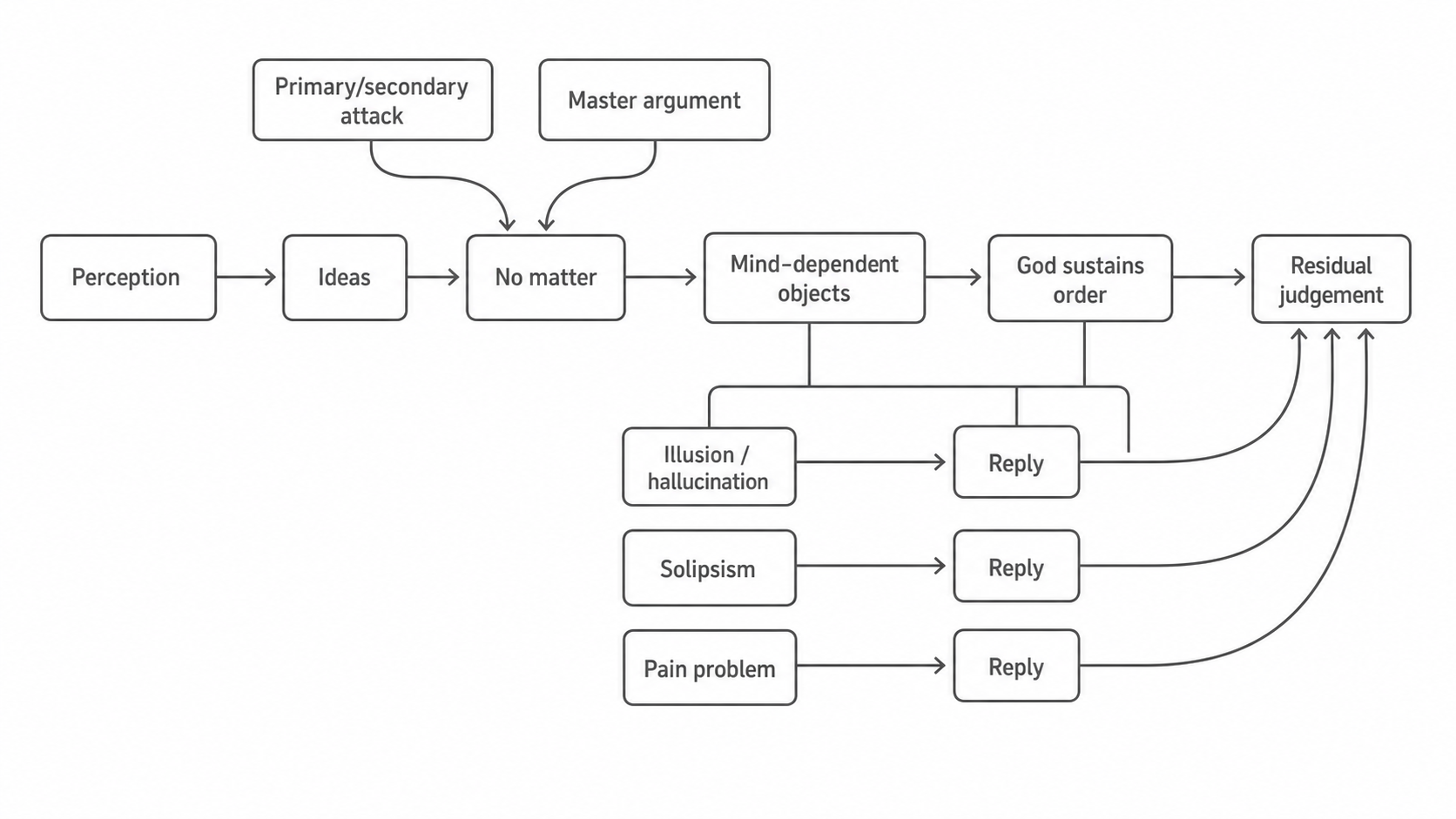
Use the route map as a tracker for evaluation, not as a replacement for the precise argument reconstructions above. The key pattern is that the same move that helps Berkeley answer one problem can create another: God helps with order, continuity, and solipsism, but then raises the pain problem and the question of what divine perception really means.
Core AO1 you must be able to explain:
| Topic | Minimum precise explanation |
|---|---|
| Berkeley's idealism | Ordinary objects are mind-dependent collections of ideas, not mind-independent material substances. |
| Primary/secondary attack | Berkeley argues that primary qualities cannot be separated from secondary qualities and are also subject to perceptual variation. |
| Master argument | Berkeley challenges the coherence of conceiving a sensible object as existing unconceived or unperceived. |
| Illusion/hallucination | The issue is whether idealism can distinguish real ordered ideas from misleading or hallucinatory ideas. |
| Solipsism | The issue is whether Berkeley can justify anything beyond one's own mind and ideas. |
| God | God explains cause, continuity, and order, but creates the pain/sensation problem. |
High-value AO2 chains:
| Chain | How to write it |
|---|---|
| Primary/secondary | Berkeley's attack is powerful against a simple Lockean split between objective shape and subjective colour, because shape varies too and cannot be perceived bare. However, a scientific realist can reply that primary qualities are not meant to be raw appearances but measurable structures inferred from experience. Berkeley then needs to show that such structures are incoherent, not merely unperceived. |
| Master argument | The argument pressures the materialist to explain mind-independent sensible objects. Its weakness is the act/content objection: conceiving an unperceived tree is not the same as perceiving the tree. Berkeley can reply that the critic has no positive idea of mind-independent sensible reality, but that may show a limit of imagination rather than impossibility. |
| Illusion/hallucination | Berkeley can distinguish real from unreal ideas through coherence, order, involuntariness, and public integration. The residual problem is that hallucinations can be vivid and involuntary, so his distinction may be less sharp than common sense requires. |
| Solipsism | Berkeley avoids simple solipsism by positing God as the cause of ordered sensory ideas. But this makes his anti-solipsism depend on a controversial argument for divine mind, and other finite minds remain indirectly known. |
| God and pain | Berkeley can say God sustains ideas without suffering them. The residual problem is whether this changes the meaning of "ideas in a mind" and weakens the account of object permanence. |
A balanced 25-mark judgement could run like this:
Berkeley is strongest as a critic of material substance and of the primary/secondary quality distinction. He exposes the difficulty of explaining how mind-dependent ideas could reveal a mind-independent substratum. However, his positive idealism relies heavily on the Master argument and on God's role. The Master argument is vulnerable to the act/content objection, and the divine-mind reply faces the pain problem. Therefore Berkeley gives a serious challenge to indirect realist matter, but his own idealism remains under-explained unless the role of God can be made coherent.
Common errors to avoid:
- Do not say Berkeley denies the existence of ordinary objects. He denies mind-independent material substance.
- Do not treat illusion and hallucination as if they were only objections to direct realism. In this lesson, they test idealism's real/unreal distinction.
- Do not criticise the Master argument vaguely. Name the act/content objection.
- Do not say solipsism is exactly Berkeley's view. It is a problem Berkeley tries to avoid.
- Do not use God as a magic fix. Explain what God is supposed to do, then evaluate the pain/sensation problem.
The exam-ready synthesis is:
Berkeley's idealism is attractive because it keeps to what is immediately perceived and removes unknowable matter. Its weakness is that once ordinary objects become mind-dependent ideas, Berkeley must reconstruct objectivity, error, other minds, and continuity through order and God. The final judgement depends on whether those reconstructions are clearer than the material substance they replace.