3.1.2 - Indirect realism and scepticism about the external world
Scope: This lesson covers the scepticism objection to indirect realism and the specified responses from Locke, Locke/Trotter Cockburn on coherence, and Russell on the external world as the best hypothesis. It stays within AQA 7172 section 3.1.2 by focusing on whether indirect realism can justify belief in mind-independent objects; Berkeley's separate attack on representation and Berkeley's idealism are left for later lessons.
The Sceptical Pressure
Imagine that everything immediately available to you is a stream of experiences: colours, sounds, textures, pains, tastes, smells, and bodily sensations. You naturally take these experiences to reveal tables, chairs, trees, screens, and other people. Indirect realism agrees that ordinary experience points beyond the mind, but it adds an important filter: what you immediately perceive is not the mind-independent object itself, but mind-dependent sense-data caused by and representing that object.
That filter creates the problem. If the immediate object is always sense-data, then all the evidence you can inspect is on the mind-dependent side of experience. The external object is inferred, not directly encountered. The sceptic asks: what justifies the step from these sense-data to a world of mind-independent objects?
Key terms:
| Term | Meaning in this lesson | Why it matters |
|---|---|---|
| Indirect realism | The view that we immediately perceive mind-dependent sense-data, which are caused by and represent mind-independent objects. | It creates a gap between experience and external objects. |
| Sense-data | The immediate objects of awareness in perception, such as a seen colour, heard sound, or felt hardness. | They are what the indirect realist says we directly access. |
| Mind-independent object | An object whose existence does not depend on being perceived by this mind. | This is what the sceptic says indirect realism cannot secure. |
| External world scepticism | Doubt about whether there are mind-independent objects corresponding to our experiences. | It is the objection AQA attaches to indirect realism here. |
| Abduction | Inference to the best explanation. | Russell's response depends on this form of reasoning. |
This is a local sceptical problem about perception. It is not yet the full Cartesian scepticism lesson about dreams, deception, and global doubt. The question is narrower: once indirect realism says we only immediately perceive sense-data, can it still justify belief in the mind-independent external world?
The Sceptical Argument
The sceptical objection is strongest when it is treated as a challenge to justification, not as the claim that external objects definitely do not exist. The sceptic need only say that indirect realism has not earned the move from inner appearances to outer objects.
1. P1: According to indirect realism, the immediate objects of perception are mind-dependent sense-data.
2. P2: Sense-data can occur even when there is no corresponding mind-independent object, as in dreams, hallucinations, or misleading appearances.
3. P3: If all direct evidence consists of sense-data, then the subject cannot directly compare sense-data with mind-independent objects.
4. P4: Without such comparison, the subject cannot know that sense-data are caused by and represent mind-independent objects.
5. Therefore, C: Indirect realism leads to scepticism about the existence of mind-independent objects.

Hidden assumption: knowledge of the external world requires more than having coherent or involuntary experiences; it requires a non-circular route from experience to external cause.
Inference type: a deductive-style sceptical challenge, moving from the indirect realist's access claim to a limitation on justification.
Main pressure point: P4. The defender can reply that knowledge does not require direct comparison or absolute proof.
The argument can be made too strong. It would be unfair to say indirect realism obviously entails that there is no external world. Indirect realists can believe that external objects exist. The issue is whether their theory gives enough reason for that belief once all immediate awareness is confined to sense-data.
The sceptic's target is therefore the bridge principle in indirect realism: sense-data are said to be caused by and to represent mind-independent objects. If the bridge is not justified, indirect realism risks becoming a veil between the perceiver and the world.
Locke: Involuntary Experience
Locke's first response begins from a familiar difference between imagination and sensation. If you merely imagine sunlight, you can usually stop, redirect, or vary the idea. If you open your eyes in bright daylight, the visual experience happens to you. It is not under the same voluntary control.
For Locke, this passivity is evidence that sensory ideas are produced by something outside the mind. The mind can call up memories and images, but many sensations force themselves on us. That is why he treats sensation as giving knowledge of other existing things, although not the same kind of certainty as intuitive knowledge of one's own existence or demonstrative knowledge.
1. P1: Ideas produced by memory or imagination are often under voluntary control.
2. P2: Many sensory ideas are not under voluntary control; they occur whether or not we choose them.
3. P3: The best explanation of involuntary sensory ideas is that something external acts on our senses.
4. Therefore, C: We have reason to believe that external objects exist as causes of our sensory ideas.

Hidden assumption: if an experience is not produced by the perceiver's voluntary mental activity, it is likely to have an external cause.
Inference type: inductive or abductive. It is stronger than a mere guess, but it is not a deductive proof.
Main pressure point: P3. Involuntary experience may show that the experience is not chosen, but does it show that its cause is a mind-independent object?
This reply has real force because it explains a difference students can test immediately. You can imagine the feel of cold water, but the sensation of actually putting your hand into cold water has a force and resistance that imagination lacks. Experience presses back.
The objection is that involuntariness alone may not prove an external world. Dreams and hallucinations can also happen without choice. A frightening dream is not voluntary just because it lacks a corresponding object. So Locke's argument is strongest when it is not isolated: involuntary experience gives one strand of support, but it needs help from the coherence of experience.
Locke and Trotter Cockburn: Coherence
The coherence response strengthens the case by looking at patterns across experience. The point is not just that sensations happen without choice. It is that different kinds of experience fit together in stable, action-guiding ways.
Locke develops this through examples where the senses confirm one another. If you see a fire and then feel heat or pain when you approach it, sight and touch are not random isolated episodes. If you write letters on paper, you can predict that certain movements of the hand will produce certain visible marks, and that those marks will remain available to sight afterwards. Experience behaves as if there are stable objects and regular causal relations.
Trotter Cockburn, in the letter attributed to her by AQA, pushes the point through relations between different senses. The same object can produce very different ideas in different senses: the seen appearance of distance or shape need not resemble the felt appearance. But through experience we learn reliable connections between these different sensory routes. The lack of resemblance between sight and touch does not destroy the external-object inference, because the coherence of the senses can be explained by a common external cause.
1. P1: Our sensory experiences across sight, touch, hearing, movement, memory, and action form regular and predictable patterns.
2. P2: These patterns include cross-sensory coherence: what is given through one sense often lets us anticipate what another sense will present.
3. P3: The best explanation of this cross-sensory coherence is that enduring external objects cause different sense-data in different ways.
4. Therefore, C: We have good reason to believe in mind-independent objects as common causes of coherent experience.

Hidden assumption: stable, cross-sensory coordination is better explained by external objects than by purely internal mental production.
Inference type: abductive, supported by repeated inductive experience.
Main pressure point: P3. A sceptic can accept coherence while denying that external objects are the only possible explanation.
This response also helps with a mistake about representation. Indirect realism does not need every sense-datum to resemble the object in a simple picture-like way. Touch, sight, and sound can present very different kinds of sense-data while still being systematically connected to one external cause. That is why coherence matters: it is not resemblance alone that is doing the justificatory work.
Still, coherence has a limit. A dream can be coherent for a while. A fictional world can be internally consistent. A perfectly coordinated non-external cause could, in principle, produce orderly experiences. So the coherence response weakens scepticism by showing that experience is not chaotic, but it does not deductively rule out every sceptical alternative.
Russell: Best Hypothesis
Russell's response is the cleanest way to state the lesson's overall defence. He accepts that we cannot strictly prove the external world from sense-data alone. The hypothesis that all experience is dreamlike or internally generated is not a logical contradiction. But Russell argues that the external world is still the best hypothesis because it explains our experiences more simply and systematically than the sceptical alternative.
The evidence to be explained includes persistence, predictability, and order. A table seems to remain available when you look away and return. A hidden object can explain why the relevant sense-data reappear when the obstruction is removed. A cat seems to move, eat, and behave continuously even when you are not observing every moment. Other people appear as stable centres of speech and action. The hypothesis of a public external world gives one unified explanation for all this.
1. P1: We have sense-data arranged in stable, predictable, and practically useful patterns.
2. P2: One hypothesis is that mind-independent objects exist and cause those sense-data.
3. P3: A rival sceptical hypothesis is that the patterns occur without mind-independent objects.
4. P4: The external-world hypothesis explains persistence, order, and predictability more simply and systematically than the sceptical rival.
5. P5: When one hypothesis best explains the available evidence, it is rational to accept it, even without deductive proof.
6. Therefore, C: It is rational to believe that the external world exists.

Hidden assumption: explanatory virtues such as simplicity, coherence, and systematisation are legitimate guides to rational belief.
Inference type: abductive.
Main pressure point: P5. The sceptic may deny that best explanation is enough for knowledge.
Russell's move changes the standard of success. If the sceptic demands certainty that excludes every possible doubt, Russell does not meet that demand. If the question is whether belief in the external world is more reasonable than sceptical suspension, Russell has a powerful answer. We should not reject a simple, coherent, successful explanation merely because a less simple sceptical scenario is logically possible.
Objections and Replies
The debate now turns on what kind of justification is needed. Each response targets the sceptical gap in a different way, and each leaves a different residual worry.
The route map below gives the shape of the whole debate before the details are weighed. It shows how the sense-data gap creates sceptical pressure, how the three specified responses try to answer it, and why the final issue is rational belief rather than deductive certainty.
[DIAGRAM: asset_name: 3.1.2 - Indirect realism and scepticism about the external world - diagram 1; asset_slug: epi08_indirect_realism_and_scepticism_about_the_external_world__diagram_01; recommended_method: retained_png; description: Scepticism response route map]
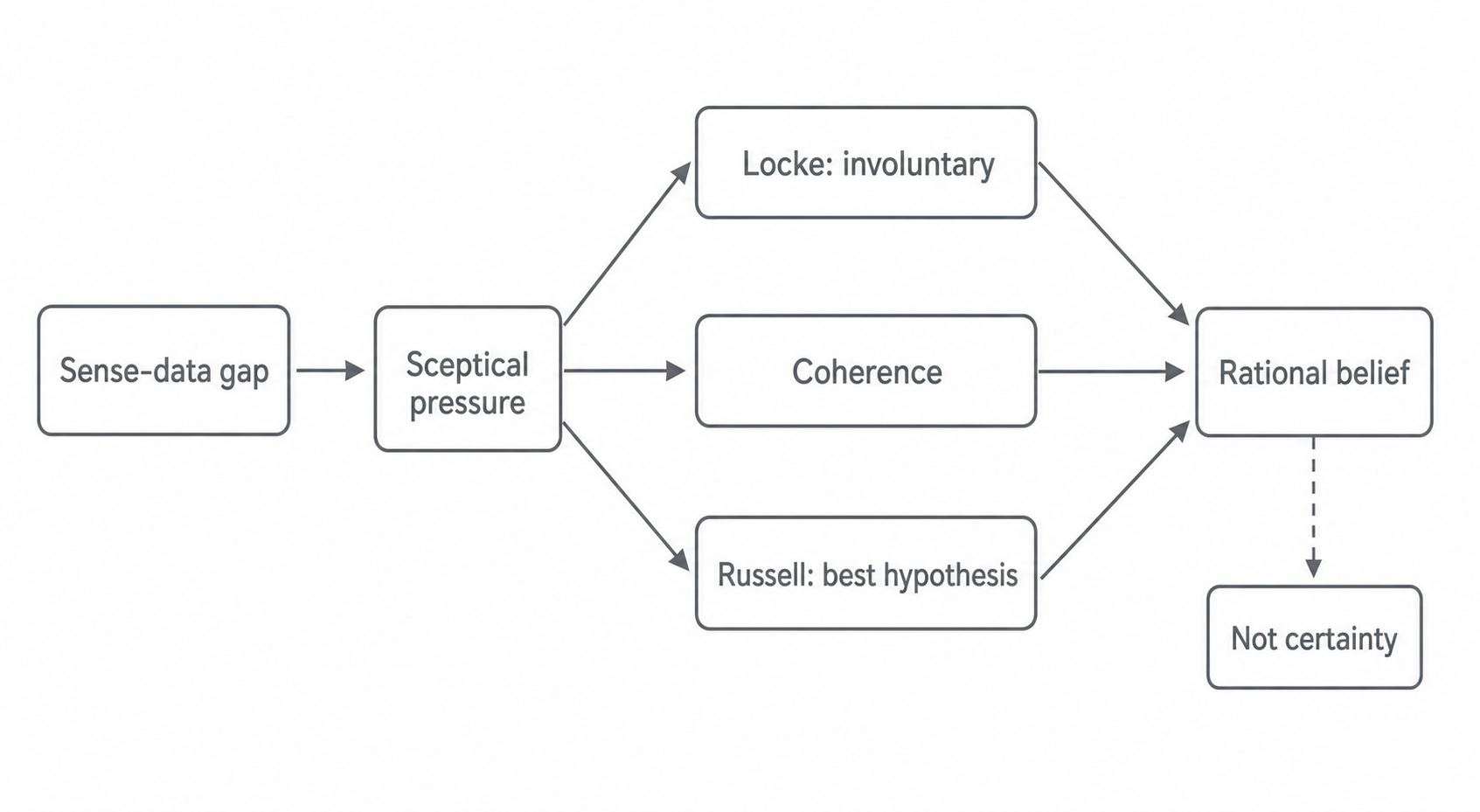
Read the map from left to right. Locke's involuntary experience response, the coherence response, and Russell's best-hypothesis response all push against the same sceptical gap, but they do not all do the same work. The detailed table now separates each route's target, force, reply, and remaining problem.
| Move | Target | Force | Strongest reply | Residual issue |
|---|---|---|---|---|
| Scepticism objection: indirect realism traps us behind sense-data. | The inference from sense-data to mind-independent objects. | If all direct evidence is mental, external objects may be unknowable. | The defender can argue that knowledge of the external world does not require direct comparison; it can be supported by the character of experience. | This reply depends on rejecting certainty as the required standard. |
| Locke's involuntary experience response. | The claim that sense-data could be merely chosen or imagined. | It explains why sensation differs from voluntary imagination. | Many experiences force themselves on us, which suggests a cause beyond voluntary mental activity. | Involuntary dreams or hallucinations show that passivity alone is not enough. |
| Coherence response from Locke and Trotter Cockburn. | The worry that sense-data are isolated inner items. | Cross-sensory regularity makes external causes a strong explanation. | Sight, touch, action, and memory fit together in stable ways that allow prediction and correction. | A sceptical scenario could also be coherent, so the argument is not demonstrative. |
| Russell's best hypothesis response. | The demand for a reason to prefer external-world belief over scepticism. | It admits strict proof is unavailable but defends rational belief. | The external-world hypothesis is simpler and more explanatory than the view that experiences occur without external objects. | The sceptic can deny that abduction gives knowledge rather than only reasonable belief. |
The strongest evaluation is not that one side obviously wins. A better judgement is conditional:
If knowledge requires absolute certainty:
    The sceptical objection remains serious, because none of the responses rules out every possible non-external cause of experience.

If knowledge can be based on strong explanatory justification:
    Russell's best-hypothesis response, supported by Locke's involuntariness and coherence points, gives indirect realism a defensible answer.
This matters for AQA because the question is often phrased as whether indirect realism leads to scepticism. The best answer distinguishes entailment from pressure. Indirect realism does not automatically prove scepticism, but it creates a genuine sceptical vulnerability because its evidence begins with mind-dependent sense-data.
Exam Synthesis
For a short answer, keep the target precise. External world scepticism here is doubt about whether mind-independent objects exist, generated by indirect realism's claim that we immediately perceive only mind-dependent sense-data.
For a 5-mark explanation, the safest route is:
Indirect realism says that sense-data are the immediate objects of perception.
Because sense-data are mind-dependent, the perceiver never directly accesses mind-independent objects.
This creates a gap between what is immediately known and what is inferred.
The sceptic argues that dreams, hallucinations, or internally generated experiences could produce sense-data without corresponding objects.
So indirect realism seems to threaten knowledge of the external world.
For a 12-mark answer, reconstruct one argument clearly rather than listing names. If the question asks for responses, explain the three specified routes:
| Response | Core idea | Reasoning type |
|---|---|---|
| Locke: involuntary experience | Actual sensation is not controlled like memory or imagination, so it points to external causes. | Inductive/abductive |
| Locke and Trotter Cockburn: coherence | Different senses and actions fit together in stable patterns, suggesting common external causes. | Abductive |
| Russell: best hypothesis | The external world explains sense-data more simply and systematically than sceptical alternatives. | Abductive |
For a 25-mark essay, a strong line of judgement could be:
Indirect realism creates a serious sceptical problem because it places sense-data between the subject and mind-independent objects. Locke's involuntary experience response and the coherence response reduce the force of the sceptic's challenge, especially when Trotter Cockburn's cross-sensory point shows that unlike sense-data can still be linked to one common cause. However, these responses do not give deductive certainty, because dreams or hallucinations may also be involuntary and coherent. Russell gives the best defence by reframing the issue abductively: the external world is not strictly proved, but it is the simplest and most explanatory hypothesis. Therefore, indirect realism leads to scepticism only if knowledge requires certainty; if rational abductive support can justify knowledge, it need not lead to scepticism.
The examiner-facing skill is to evaluate the standard of justification. Do not merely say that Locke, Trotter Cockburn, and Russell all prove the external world. They do not prove it in a deductive way. Their better role is to show that the external-world belief is involuntary, coherent, explanatorily powerful, and more rational than sceptical suspension.