3.1.1 - Gettier and lucky true belief
Scope: This lesson covers Edmund Gettier's original challenge to the tripartite view of propositional knowledge. It stays within AQA 7172 3.1.1 by explaining lucky true beliefs, why Gettier-style cases satisfy justified true belief, and why they seem not to be knowledge, without developing the later post-Gettier repairs in detail.
The Pressure On JTB
Suppose you believe something true, and you have good reasons for believing it. That looks very close to knowledge. The tripartite view says it is not merely close: it says propositional knowledge is justified true belief, often shortened to JTB.
In this lesson, the important claim is not that truth, belief, and justification are irrelevant. The pressure is on sufficiency.
| Term | Meaning in this debate | Why it matters |
|---|---|---|
| Propositional knowledge | Knowing that some proposition is true | Gettier is about "knows that p", not skill or acquaintance knowledge. |
| Justification | The subject has good epistemic support for believing p | The support may be strong even if it is not impossible to be wrong. |
| Sufficiency | If the conditions are met, knowledge is guaranteed | Gettier argues that JTB is not sufficient for knowledge. |
| Lucky true belief | A belief that is true because of luck, even though the subject has justification | This is the counterexample pressure on JTB. |
So the question becomes sharper:
If S believes that p, p is true, and S is justified in believing p,
must S know that p?
Gettier's answer is no. He tries to show this by constructing cases where a person satisfies all three JTB conditions but still seems not to know.
Gettier's General Move
Gettier's article, "Is Justified True Belief Knowledge?", is extremely short, but the structure is powerful. He relies on two ideas.
First, a person can be justified in believing a proposition that is actually false. Good evidence can mislead. If justification had to make false belief impossible, Gettier's cases would not get started, but ordinary justification seems fallible.
Second, justification can pass through competent deduction. If S is justified in believing p, and S recognises that p entails q, then S can become justified in believing q by deducing q from p.
The challenge can be reconstructed like this:
Claim at issue: JTB is sufficient for propositional knowledge.

1. P1: If JTB is sufficient for knowledge, then every justified true belief is knowledge.
2. P2: In Gettier's cases, Smith has a justified true belief.
3. P3: In Gettier's cases, Smith does not have knowledge.
4. Therefore, C: JTB is not sufficient for knowledge.

Hidden assumption: The cases are genuine possible cases, not confused descriptions.
Inference type: Deductive counterexample to a universal sufficiency claim.
Main pressure point: Whether we accept both P2 and P3 at the same time.
This is a counterexample strategy. To refute "all justified true beliefs are knowledge", Gettier only needs one possible case of justified true belief without knowledge. AQA requires the original two counterexamples, so both matter: each makes the same pressure visible in a slightly different form.
Case I: Job And Coins
Gettier's first case concerns Smith and Jones, who have applied for the same job. Smith has strong evidence for this proposition:
d: Jones will get the job, and Jones has ten coins in his pocket.
Smith's evidence is that the company president has assured him Jones will be selected, and Smith has counted ten coins in Jones's pocket. From d, Smith deduces:
e: The person who will get the job has ten coins in his pocket.
But unknown to Smith, Smith himself will get the job. Also unknown to Smith, Smith himself has ten coins in his pocket. So e is true, but it is true because of facts about Smith, not because of the facts about Jones that Smith relied on.
Here is the case as a JTB test:
| JTB condition | Is it satisfied? | Why |
|---|---|---|
| Belief | Yes | Smith accepts e. |
| Truth | Yes | The person who will get the job, Smith, has ten coins in his pocket. |
| Justification | Yes | Smith has strong evidence for d and competently deduces e from d. |
The problem is that Smith's route to the truth goes through a false lemma. A lemma is a supporting step in an argument. Here, the relevant false lemma is that Jones will get the job. Smith's belief e is true, but the truth of e is disconnected from the evidence that led Smith to it.
The result is a lucky true belief:
Bad luck: Smith's evidence about Jones is misleading.
Good luck: Smith's final proposition is true anyway.
Epistemic result: Smith has justified true belief, but not knowledge.
Why does knowledge seem absent? Because Smith does not know the truth-maker of e. He does not know that Smith will get the job, and he does not know that Smith has ten coins. His belief lands on truth, but by a route that misses why it is true.
Case II: Ford And Brown
Gettier's second case uses disjunction. A disjunction is an either/or claim. In standard logic, "p or q" is true if at least one side is true.
Smith has strong evidence for:
f: Jones owns a Ford.
His evidence is based on Jones's past Ford ownership and Jones recently offering him a ride while driving a Ford. Smith has another friend, Brown, but Smith has no idea where Brown is. Smith then forms three disjunctions, including:
h: Either Jones owns a Ford, or Brown is in Barcelona.
Smith is justified in believing h because f entails h. If Jones owns a Ford, then "Jones owns a Ford or Brown is in Barcelona" must be true. But unknown to Smith, Jones does not own a Ford; he is driving a rented car. Also unknown to Smith, Brown happens to be in Barcelona.
Again, the JTB conditions are met:
| JTB condition | Is it satisfied? | Why |
|---|---|---|
| Belief | Yes | Smith accepts h. |
| Truth | Yes | Brown is in Barcelona. |
| Justification | Yes | Smith has strong evidence for f and recognises that f entails h. |
Yet Smith does not seem to know h. He has no evidence about Brown's location, and the part of h that makes it true is exactly the part Smith is ignorant about. His justification points toward Jones owning a Ford; the truth of h comes from Brown being in Barcelona.
The false lemma is that Jones owns a Ford. The luck is that a different part of the disjunction happens to make Smith's belief true.
What Luck Does
The word "luck" can be too vague unless it is tied to the structure of the case. Gettier luck is not merely that Smith is fortunate to have evidence. It is a mismatch between the subject's justification and the fact that makes the belief true.
The diagram below abstracts the pattern shared by both original cases. It separates Smith's evidential route from the hidden truth-maker route, so the luck is visible as a gap rather than just a word.
[DIAGRAM: asset_name: 3.1.1 - Gettier and lucky true belief - diagram 1; asset_slug: epi03_gettier_and_lucky_true_belief__diagram_01; recommended_method: retained_png; description: Diagram showing the Gettier route from evidence through a false lemma to final belief, with a hidden truth-maker creating the truth by luck]
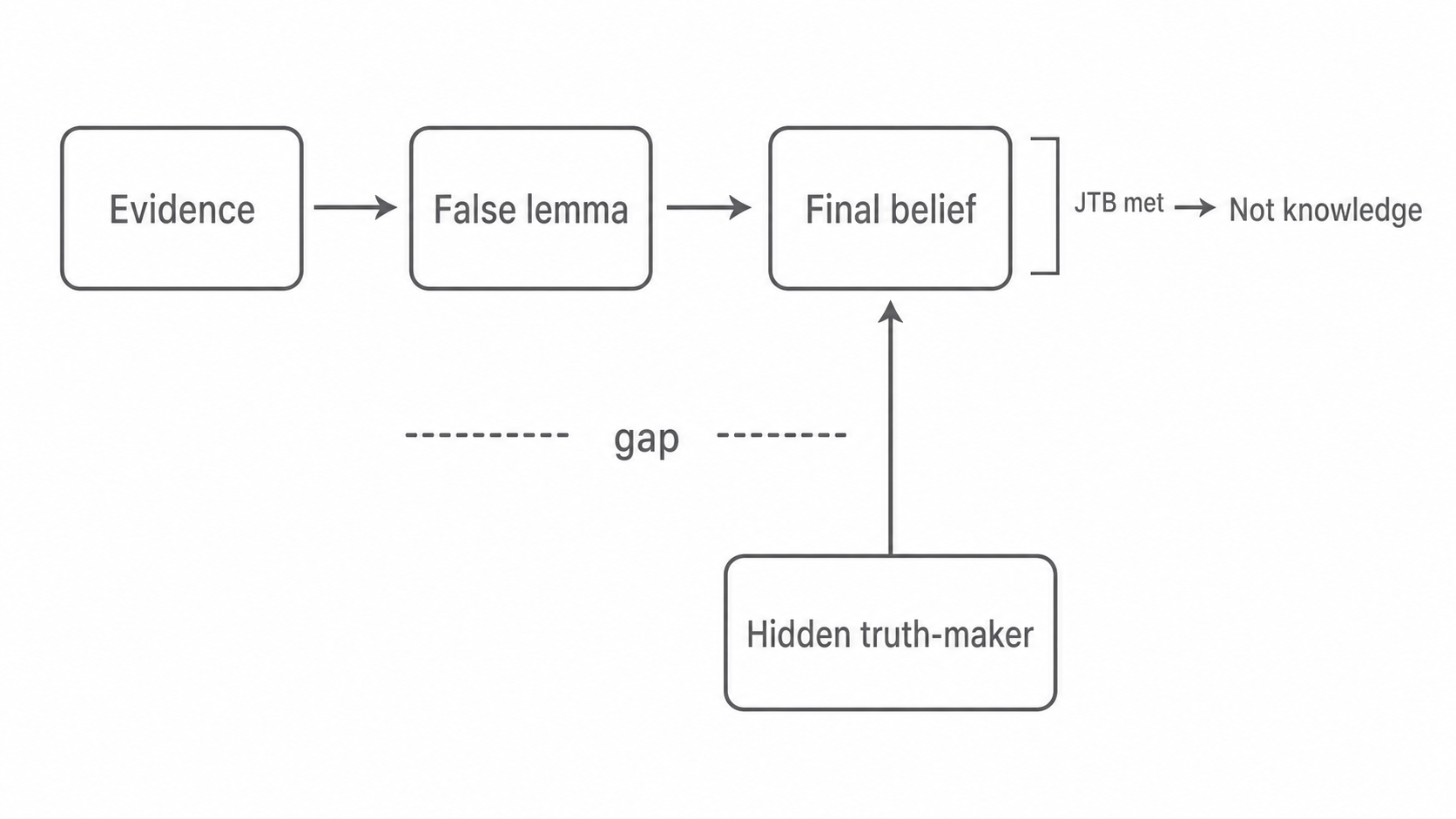
Read the diagram left to right. Smith's evidence can justify the final belief through deduction, so JTB is met. But the fact that makes the final belief true sits on a different route, hidden from Smith. That is why the belief can be true and justified while still failing to be knowledge.
In both original cases:
| Feature | Case I | Case II |
|---|---|---|
| Smith's evidence supports | Jones will get the job and has ten coins | Jones owns a Ford |
| Smith infers | The person who gets the job has ten coins | Either Jones owns a Ford or Brown is in Barcelona |
| What makes the belief true | Smith gets the job and has ten coins | Brown is in Barcelona |
| Why this is lucky | The truth-maker is hidden from Smith | The true disjunct is hidden from Smith |
The important epistemic gap is this:
Smith's evidence does not connect him to the fact that makes his final belief true.
This is why Gettier cases are not just cases of guessing. Smith is not guessing; he has reasons. But they are not cases of knowledge either, because the truth of the final belief depends on a coincidence outside the route supplied by his reasons.
So Gettier's pressure on JTB can be put as a dilemma:
Either JTB allows lucky true beliefs to count as knowledge,
or JTB needs some extra condition or revision.
The next lesson can examine detailed repairs. For this lesson, the core point is that truth plus belief plus fallible justification leaves room for epistemic luck.
Targeted Issues And Replies
Gettier's cases create targeted issues. They are not just "weird examples"; they put pressure on specific parts of the JTB analysis.
| Issue | Target | Why it matters | Possible reply | Residual problem |
|---|---|---|---|---|
| Smith is justified but wrong about a key step. | The justification condition. | If justification can rest on a false lemma, JTB may allow knowledge by accident. | Strengthen justification or add a no-false-lemmas condition. | This belongs to post-Gettier repair, and it must handle cases without obvious false lemmas. |
| Smith's final belief is true only by coincidence. | JTB's explanatory power. | JTB explains truth, belief, and support, but not whether the support is connected to the truth-maker. | Add an anti-luck requirement. | The repair must explain what kind of luck is harmless and what kind destroys knowledge. |
| Perhaps Smith does know after all. | The intuition that Gettier cases lack knowledge. | If lucky knowledge is possible, JTB may survive the cases. | A defender could say Smith has knowledge because JTB is met. | This makes knowledge too cheap for many epistemologists and clashes with the idea that knowledge is more than accidentally hitting the truth. |
| Perhaps Smith is not really justified. | P2 of Gettier's reconstruction. | If Smith lacks justification, the cases are not JTB cases. | A critic can say the evidence was not good enough. | Gettier stipulates strong evidence, and ordinary justification seems fallible rather than infallible. |
The strongest simple diagnosis is that Gettier exposes a gap between having good reasons and knowing because of those reasons. JTB captures the first idea better than the second.
Be careful, though: this lesson should not turn into the full post-Gettier debate. AQA separates the Gettier challenge from later analyses such as infallibilism, no false lemmas, reliabilism, and virtue epistemology. Here, those are useful only as signs of what Gettier forces philosophers to repair.
Exam Synthesis
For AQA, the central task is to make the counterexample structure explicit. A strong answer does not merely retell a story about Smith. It shows how the story is a philosophical test case for sufficiency.
Use this sequence:
1. Define JTB: S knows that p iff S is justified in believing p, p is true, and S believes p.
2. Explain sufficiency: if JTB is sufficient, any justified true belief must be knowledge.
3. Reconstruct one original Gettier case.
4. Show belief, truth, and justification separately.
5. Explain why knowledge seems absent: the belief is true by luck, often through a false lemma.
6. Draw the conclusion: Gettier challenges JTB as a sufficient condition for knowledge.
For a short explanation, focus on one case and the three JTB conditions. For an evaluative essay, build a chain:
| Essay move | What it should do |
|---|---|
| AO1 base | Accurately reconstruct the Gettier case and define sufficiency, lucky true belief, and false lemma. |
| AO2 pressure | Argue that the truth of Smith's belief is disconnected from his justification. |
| Reply | Consider whether Smith really is justified, or whether lucky true belief could still be knowledge. |
| Judgement | Decide whether that reply saves JTB or shows that JTB needs repair. |
A precise final judgement might be:
Gettier does not show that justification, truth, and belief are irrelevant to knowledge.
It shows that their combination is not enough, because a belief can satisfy all three
conditions while reaching truth through epistemic luck.
That is the lesson's exam core: Gettier is an objection to JTB's sufficiency, not a rejection of every role for belief, truth, or justification.