3.1.2 - Problems for direct realism
Scope: This lesson covers the AQA 7172 3.1.2 problems for direct realism: illusion, perceptual variation, hallucination, and time lag, together with direct realist responses and residual evaluation. It stays within AQA 7172 3.1.2 by using indirect realism only as a brief contrast when explaining why these problems matter.
The Shared Pressure
Direct realism is attractive because it fits the ordinary thought that, when you look at a table, the table itself is what you see. The theory says that the immediate objects of perception are mind-independent objects and their properties.
The problem is that perception does not always behave like a simple window onto things as they are. A straight stick can look bent in water. The same surface can look different colours under different lighting. Someone can have an experience as of an object when no such object is there. Light from distant objects reaches us after a delay. Each case asks the same sharp question:
If perception is direct awareness of mind-independent objects and their properties, how can perceptual experience mislead, vary, occur without an object, or present the past?
Before the individual arguments, it helps to hold the shared pressure in one view. The map below does not replace the precise reconstructions; it shows what each problem makes awkward for direct realism's claim that the object itself is immediately perceived.
[DIAGRAM: asset_name: 3.1.2 - Problems for direct realism - diagram 1; asset_slug: epi06_problems_for_direct_realism__diagram_01; recommended_method: retained_png; description: Four pressures on direct realism]
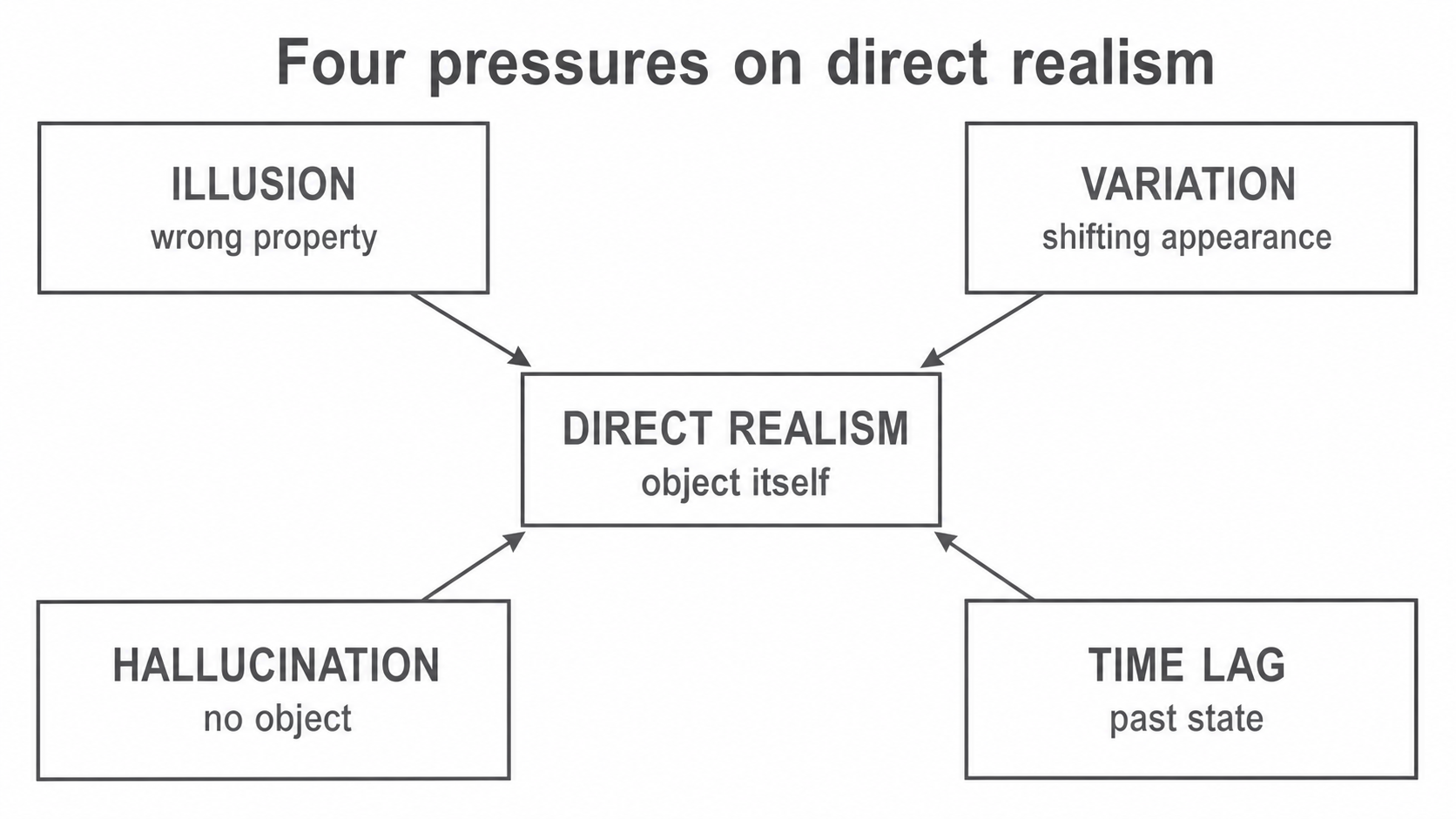
Use the map as an orientation device: illusion and perceptual variation press apparent properties, hallucination presses whether an object is present, and time lag presses whether directness requires simultaneity. The sections that follow then reconstruct each pressure precisely.
Key vocabulary:
| Term | Use in this lesson |
|---|---|
| Immediate object | What a subject is directly aware of in perception, not something inferred from another perceived item. |
| Mind-independent object | An object whose existence does not depend on being perceived, such as a tree, cup, or star. |
| Veridical perception | A successful perception where an object is perceived and appears as it is, at least in the relevant respect. |
| Illusion | A case where an object is there, but it appears other than it is. |
| Hallucination | A perception-like experience where there is no corresponding ordinary object being perceived. |
| Perceptual intermediary | Something the subject would directly perceive instead of the ordinary object, such as sense-data on an indirect realist account. |
| Causal intermediary | A process or item involved in producing perception, such as light, retinal stimulation, or neural processing. A causal intermediary need not be something perceived. |
The target of the four problems is precise. They do not simply ask whether the external world exists. They ask whether direct realism can keep its claim about the immediate object of perception. If the immediate object is always a private mental item, direct realism loses. If the immediate object can still be the mind-independent object even when perception is fallible, perspectival, delayed, or absent in hallucination, direct realism survives in a more careful form.
The shared challenge can be reconstructed like this:
1. P1: In some perception-like cases, what appears to the subject does not match a mind-independent object as it is.
2. P2: If direct realism is true, the immediate objects of perception are mind-independent objects and their properties.
3. P3: If the immediate object were a mind-independent object and its properties, the mismatch in P1 should not occur.
4. Therefore, C: Direct realism is false, or at least needs serious qualification.

Hidden assumption: Direct realism must treat perceptual appearance as a direct presentation of things exactly as they are.
Inference type: Deductive if P3 is accepted; otherwise a conceptual pressure argument.
Main pressure point: P3, because a direct realist can deny that direct perception must be infallible or unqualified.
Argument From Illusion
An illusion is not a case where there is no object. There is an object, but it appears to have a property it does not really have. A straight stick partly submerged in water can look bent. A white wall under coloured light can look tinted. The case matters because direct realism seems to say that we are immediately aware of the ordinary object and its properties. But in an illusion, the apparent property is not a property the ordinary object actually has.
The argument from illusion presses direct realism through the apparent property:
1. P1: In an illusion, an object appears to have a property F.
2. P2: The mind-independent object does not really have property F.
3. P3: If direct realism is true, the immediate object of perception is the mind-independent object and its properties.
4. P4: If the immediate object is the mind-independent object and its properties, then what is immediately presented as F must be something that really is F.
5. Therefore, C: In illusion, the immediate object is not the mind-independent object and its properties, so direct realism is false.

Hidden assumption: If something appears F, there must be an object of awareness that really is F.
Inference type: Deductive, once the hidden assumption and P4 are granted.
Main pressure point: P4 and the hidden assumption, because they turn an appearance into an extra object or property.
The direct realist response is to reject the move from appears F to there is a perceived thing that is F. The straight stick can be the very object seen, while looking bent because of the viewing conditions. The appearance is relational: the stick has the property of looking bent to this perceiver, in this medium, from this angle. That is not the same as having the intrinsic property of being bent.
This reply keeps the immediate object as the mind-independent stick. The illusion is explained by how the stick is perceived, not by replacing the stick with a mental intermediary.
Target analysis:
| Objection | Target | Direct realist reply | Residual issue |
|---|---|---|---|
| Illusion shows we are aware of properties ordinary objects lack. | The idea that the immediate object is the ordinary object and its properties. | We perceive the ordinary object, but some apparent properties are relational or condition-dependent rather than intrinsic. | The reply weakens a very naive version of direct realism: direct perception does not mean everything appears exactly as it is. |
The evaluation is therefore mixed. Illusion is a strong objection to the careless claim that direct realism means reality is always just as it appears. It is weaker against a careful direct realism that distinguishes the object perceived from the conditions under which it appears.
Argument From Perceptual Variation
Perceptual variation occurs when the same object appears differently to different perceivers, or to the same perceiver under different conditions. A coin can look circular from above and elliptical from the side. A surface can look lighter in bright light and darker in shadow. A building can look small from far away and large when nearby.
This is not exactly the same as illusion. In illusion, the focus is on a misleading appearance. In perceptual variation, the focus is on a range of appearances generated by angle, distance, lighting, sensory apparatus, or context. The problem is that the object seems to have one stable set of mind-independent properties, while experience varies.
The argument from perceptual variation can be reconstructed like this:
1. P1: The same mind-independent object can appear to have different and incompatible properties in different perceptual conditions.
2. P2: A single object cannot have incompatible intrinsic properties in the same respect at the same time.
3. P3: If direct realism is true, we immediately perceive mind-independent objects and their properties.
4. P4: If we immediately perceive mind-independent objects and their properties, then perceptual variation should reveal the same stable properties.
5. Therefore, C: Perceptual variation suggests that what we immediately perceive is not simply the mind-independent object and its stable properties.

Hidden assumption: Direct realism must identify apparent properties with intrinsic properties of the object.
Inference type: Conceptual argument using a reductio-style pressure on direct realism.
Main pressure point: P4, because a direct realist can deny that direct perception must present only intrinsic properties.
The direct realist reply is again to use relational properties and perspective. The coin is not both circular and elliptical in its intrinsic shape. Rather, the circular coin looks elliptical from this angle. The surface is not simply many incompatible colours; it appears differently under different lighting. Direct realism can say that perception is of a mind-independent object from a position, through a medium, and under conditions.
This matters because perspective is not automatically a barrier. When you see a building from far away, the small-looking appearance can still be direct perception of the building from a distance. You do not need to perceive a mental image first and then infer the building. The variation is part of how embodied perceivers encounter public objects.
Target analysis:
| Objection | Target | Direct realist reply | Residual issue |
|---|---|---|---|
| Different perceivers get different appearances of the same object. | The assumption that direct perception gives one fixed appearance of an object's intrinsic properties. | Perceivers directly perceive the same object under different relational conditions. | The more properties are treated as relational, the less simple direct realism becomes. It must explain which properties are directly perceived as object properties. |
Perceptual variation is especially useful in evaluation because it shows direct realism can be repaired rather than simply abandoned. A student should avoid saying, "appearances vary, therefore direct realism is obviously false." The real issue is whether the repair still deserves to be called direct realism. If the mind-independent object remains the thing perceived, and the variation is explained by relations between object, perceiver, and conditions, the theory has not yet collapsed into indirect realism.
Argument From Hallucination
Hallucination is more threatening than illusion or perceptual variation because there may be no relevant mind-independent object at all. If someone has an experience as of a person standing in the room, but no person is there, direct realism cannot say that the person is directly perceived. There is no person to be perceived.
The argument becomes stronger when it adds the thought that hallucination and veridical perception can be subjectively indistinguishable. From the inside, the subject may not be able to tell which kind of case they are in. The critic then argues that if the experience feels the same in both cases, its immediate object or underlying kind must be the same in both cases. Since the hallucinatory case cannot have a mind-independent object as its immediate object, neither can the veridical case.
That is the spreading move: a problem from hallucination spreads to ordinary perception.
1. P1: In hallucination, a subject can have an experience subjectively indistinguishable from veridical perception.
2. P2: In hallucination, there is no relevant mind-independent object being perceived.
3. P3: If two experiences are subjectively indistinguishable, they have the same kind of immediate object or the same fundamental perceptual structure.
4. P4: The immediate object in hallucination cannot be a mind-independent object.
5. Therefore, C: The immediate object in veridical perception is also not a mind-independent object, so direct realism is false.

Hidden assumption: Subjective indistinguishability requires a common kind of immediate object or mental state.
Inference type: Deductive if the common-kind assumption in P3 is accepted.
Main pressure point: P3, because the direct realist can deny that same feel entails same metaphysical structure.
The direct realist has two main responses.
First, hallucinations are not perceptions. A genuine perception requires the right kind of causal relation to a mind-independent object. A hallucination may be internally caused, or caused in the wrong way, so it is a perception-like experience rather than a case of perceiving an object.
Second, the direct realist can reject the common-kind assumption. Veridical perception and hallucination may feel indistinguishable to the subject while still being different kinds of event. In successful perception, the mind-independent object partly explains what the experience is. In hallucination, there is no such object-involving relation. This is a disjunctive style of reply: either the subject is genuinely perceiving an object, or it merely seems as if they are.
Target analysis:
| Objection | Target | Direct realist reply | Residual issue |
|---|---|---|---|
| Hallucination has no object, yet can feel like perception. | The claim that perception-like experience always has a mind-independent immediate object. | Hallucination is not genuine perception, and similarity in feel does not prove sameness of immediate object. | The reply must explain why hallucination and perception can be so similar from the subject's point of view. |
Hallucination is usually the strongest of the four problems because relational properties cannot solve it. There is no ordinary object standing in the relevant relation. The best direct realist reply is not to find the hidden object, but to deny that hallucinatory experience should control the analysis of successful perception.
Time Lag Argument
The time lag argument starts from the fact that perception involves causal processes that take time. Light from a distant star may reach us long after it left the star. Even ordinary nearby perception involves some delay as light reaches the eye and the nervous system processes information. The critic argues that if we perceive the object only after the relevant event or state has passed, then we do not directly perceive the object as it is now.
The challenge is not just scientific. It is conceptual: does direct perception require simultaneity with the object perceived?
1. P1: Perception involves causal processes, such as light transmission and neural processing, that take time.
2. P2: Therefore, when we perceive an object, we perceive it as it was at an earlier time, not exactly as it is now.
3. P3: If direct realism is true, the immediate object of perception must be the object as it exists at the time of perception.
4. P4: In some cases, the object may have changed or even ceased to exist by the time the experience occurs.
5. Therefore, C: The immediate object of perception is not the mind-independent object itself, but some present perceptual intermediary or effect.

Hidden assumption: Direct perception requires present-tense contact with the object or property perceived.
Inference type: Mixed empirical and conceptual argument.
Main pressure point: P3, because direct realists can deny that directness means simultaneity.
The direct realist response is to distinguish a causal intermediary from a perceptual intermediary. Light, retinal stimulation, and neural processing are part of the causal route by which we perceive. But that does not mean we perceive the light, retinal image, or neural state instead of the object. A route to perception is not automatically an object of perception.
The direct realist can also say that we directly perceive objects as they were. Directness concerns whether the mind-independent object is the object of awareness, not whether the awareness occurs at exactly the same time as the object's state. On this view, a time lag is a delay in the perceptual relation, not proof of a mental screen between perceiver and world.
Target analysis:
| Objection | Target | Direct realist reply | Residual issue |
|---|---|---|---|
| Perception presents past states because causal transmission takes time. | The assumption that direct perception requires simultaneity. | Direct perception can be causally mediated and temporally delayed without introducing a perceived mental intermediary. | Hard cases remain: if the object no longer exists, the direct realist must explain how a present perception can directly relate to a past object or event. |
The time lag argument is often less immediately persuasive than hallucination, because everyday perception normally involves tiny delays and still seems object-directed. But it reveals an important point: direct realism must not define directness as instant, unmediated physical contact. It must define directness as the absence of a perceived intermediary.
Residual Evaluation
The four problems do not all attack the same point with equal force. Illusion and perceptual variation mainly attack the relation between appearance and property. Hallucination attacks the presence of an object. Time lag attacks the temporal relation between perceiver and object. A good evaluation keeps these targets separate.
| Problem | What it attacks | Best direct realist defence | What remains unsettled |
|---|---|---|---|
| Illusion | The idea that apparent properties must be properties of the ordinary object. | Reject the move from "appears F" to "there is a perceived thing that is F"; use relational appearance properties. | Direct realism must give up the crude claim that objects always are as they appear. |
| Perceptual variation | The idea that direct perception should present one stable set of intrinsic properties. | Treat variation as direct perception of the same object under different conditions. | The theory must clarify which perceived properties are intrinsic, relational, or condition-dependent. |
| Hallucination | The idea that perception-like experience always involves a mind-independent object. | Deny hallucination is genuine perception; reject the common-kind assumption. | The direct realist must explain subjective indistinguishability without conceding a shared mental object. |
| Time lag | The idea that direct perception requires simultaneity. | Distinguish causal mediation from perceptual mediation; allow direct perception of objects or events as they were. | Cases involving changed or non-existent objects make the temporal relation harder to explain. |
The strongest overall defence of direct realism is modest rather than naive:
1. Direct realism need not say that perception is infallible.
2. Direct realism need not say that every apparent property is an intrinsic property.
3. Direct realism need not say that hallucination is a successful perception.
4. Direct realism need not say that perception is simultaneous with what is perceived.
5. It only needs to say that in successful perception, the immediate object is the mind-independent object rather than a mental intermediary.
This defence is powerful because it preserves the common-sense motivation for direct realism while avoiding obvious counterexamples. But it also makes direct realism more complex. The theory now relies on distinctions between intrinsic and relational properties, perception and hallucination, causal and perceptual intermediaries, and present and past objects. The critic can argue that once all those qualifications are added, direct realism has lost the simplicity that made it attractive.
The fairest judgement is that illusion and perceptual variation force refinement, not rejection. Time lag creates a serious temporal puzzle, but direct realists have a clear reply if directness is not defined as simultaneity. Hallucination is the deepest challenge because it pressures the structure of experience itself: if veridical perception and hallucination can seem the same, the direct realist must explain why only one is object-involving.
Exam Synthesis
For short answers, define the problem before evaluating it. A precise answer to any direct realism issue should name the case, identify the target, and explain the reply.
Strong 5-mark style explanation:
The argument from illusion challenges direct realism because, in an illusion, an object appears to have a property it does not really have. If direct realism says the immediate objects of perception are mind-independent objects and their properties, then the illusion seems to show that we are immediately aware of something other than the ordinary object as it really is. A direct realist can reply that we still perceive the ordinary object, but under conditions that make it look a certain way, so the apparent property is relational rather than an extra mental object.
For 12-mark AO1 explanation, reconstruct the argument and response rather than listing examples. Use this pattern:
1. Define direct realism.
2. Define the relevant problem.
3. Reconstruct the argument with premises and conclusion.
4. Identify the hidden assumption.
5. Explain the direct realist response.
6. State what remains unresolved.
For 25-mark evaluation, choose a controlled judgement. Do not write four disconnected paragraphs. Build a chain:
| Essay move | What to do |
|---|---|
| Thesis | Direct realism survives some problems better than others, but hallucination is the hardest challenge. |
| AO1 base | Explain direct realism and reconstruct illusion, variation, hallucination, and time lag. |
| AO2 pressure | Show that illusion and variation target apparent properties, while hallucination targets object-involving experience. |
| Reply | Use relational properties, rejection of the common-kind assumption, and causal-versus-perceptual mediation. |
| Judgement | Direct realism can be defended if made modest, but this reduces its initial simplicity. |
Useful evaluative sentences:
This objection targets the hidden assumption that direct perception must be infallible.
The reply succeeds if relational properties can explain appearance without introducing sense-data.
The hallucination argument is stronger because it removes the object rather than merely altering its appearance.
The time lag argument works only if direct perception requires simultaneity.
Direct realism is most plausible when understood as a claim about successful perception, not every perception-like experience.
Common mistakes to avoid:
| Mistake | Correction |
|---|---|
| "Direct realists think illusions never happen." | Direct realists can accept illusions; they dispute what illusions show about the immediate object. |
| "Hallucination proves there is no external world." | The hallucination argument targets direct realism's account of immediate objects, not realism about the external world as such. |
| "Light is a sense-datum." | Light is a causal intermediary, not necessarily a perceptual intermediary. |
| "Indirect realism should be fully explained here." | Use indirect realism only as contrast; its full theory belongs in the next lesson. |