3.1.2 - Direct realism and the immediate objects of perception
Scope: This lesson covers direct realism as the view that, in perception, mind-independent objects and their properties are the immediate objects of perception. It stays within AQA 7172 section 3.1.2 by defining the view, explaining its initial plausibility, and introducing the four named pressure points only in outline; detailed responses to illusion, perceptual variation, hallucination, and time lag belong to the next lesson.
The Problem Of Perceptual Contact
When you look at a table, what are you immediately aware of? The table itself? A mental image of the table? A sensory appearance caused by the table? Or something else?
That question matters because perception is meant to be a source of knowledge. If perception puts us straight in contact with the world, then ordinary perceptual beliefs such as "there is a table in front of me" can look secure in a simple way. If perception first gives us something mind-dependent, then a further question appears: how do we get from that immediate item to knowledge of the world beyond it?
Direct realism is the most straightforward answer. It says that in successful perception, the things we immediately perceive are ordinary mind-independent objects and their properties. The table, its shape, its size, and its colour are not hidden behind a private mental object. They are what perception presents to us.
The philosophical problem begins because perception is not always straightforward. Things can look other than they are, the same object can look different from different viewpoints, and an experience can occur even when there is no matching object present. Direct realism therefore starts with common sense, but it must face pressure from error.
Core Distinctions
The direct realist claim depends on several distinctions. Each one changes what the theory is saying.
| Distinction | Meaning | Why it matters for direct realism |
|---|---|---|
| Perception vs belief | Perception is sensory awareness, such as seeing or touching. Belief is taking something to be true. | You can perceive a table and then form the belief that a table is there. Direct realism is mainly about the object of perception, not just the later belief. |
| Immediate vs mediate object | The immediate object is what awareness is directly of. A mediate object would be known through awareness of something else. | Direct realism says the immediate object is the ordinary object itself, not an inner item used as a bridge. |
| Mind-independent vs mind-dependent | A mind-independent object exists whether or not anyone is currently perceiving or thinking about it. A mind-dependent object depends on a mind for its existence. | Direct realism says ordinary objects and their properties are mind-independent immediate objects of perception. |
| Object vs property | An object is a thing, such as a cup. A property is a feature of a thing, such as shape, size, colour, or texture. | AQA's formulation includes both objects and their properties, so the issue is not only whether we perceive the cup, but also whether we perceive its features directly. |
"Immediate" does not mean that no physical process is involved. Light, eyes, nerves, and the brain may all be causally involved in seeing. The question is not whether perception has a causal route. The question is what the perceiver is directly aware of at the end of that route.
The Direct Realist Claim
Direct realism is the view that ordinary mind-independent objects and their properties are the immediate objects of perception. In a successful case of seeing a red book, the immediate object is the book and its visible properties, not a private mental image standing between you and the book.
This is a realist theory because it treats ordinary objects as existing independently of being perceived. It is direct because it denies that we perceive those objects only by first perceiving some different mind-dependent object. A direct realist can accept that perception involves physical and psychological processes; what they deny is that those processes make the immediate object of awareness a separate mental item.
The relation is easiest to keep clear if you separate the causal route from the object of awareness. The diagram shows direct realism's key claim: the perceiver's immediate awareness is of the ordinary object and its properties, with no private intermediary functioning as the thing perceived first.
[DIAGRAM: asset_name: 3.1.2 - Direct realism and the immediate objects of perception - diagram 1; asset_slug: epi05_direct_realism_and_the_immediate_objects_of_perception__diagram_01; recommended_method: retained_png; description: Direct realism relation diagram]
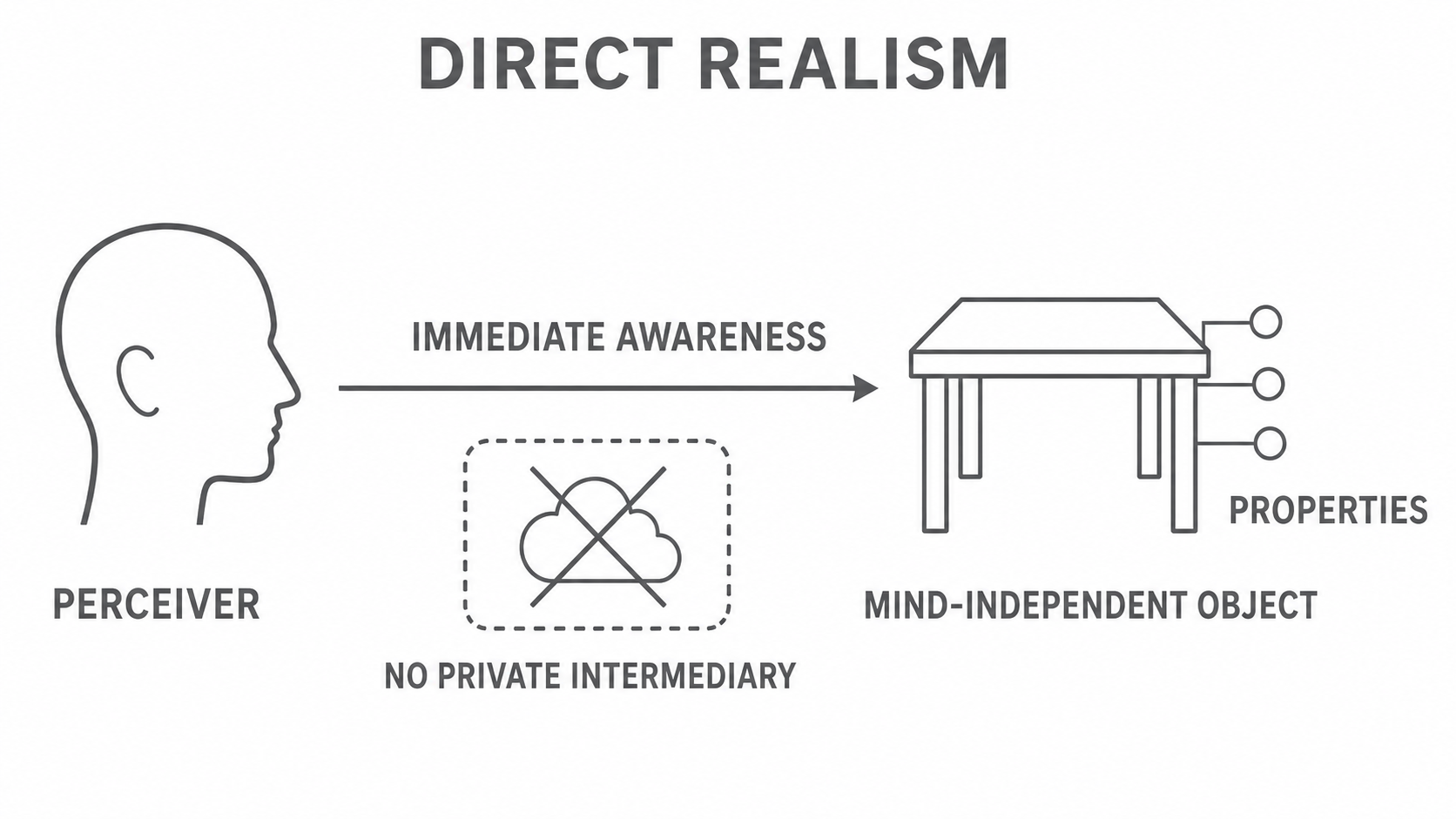
Read the arrow as marking what awareness is directly of, not as denying that light, eyes, nerves, and the brain are involved in perception. The crossed-out intermediary is the kind of private mental item direct realism rejects as the immediate object of perception.
It helps to locate the claim without sliding into later lessons:
| Theory label | Immediate objects of perception | Status in this lesson |
|---|---|---|
| Direct realism | Mind-independent objects and their properties | Main focus |
| Indirect realism | Mind-dependent sense-data caused by and representing mind-independent objects | Contrast only |
| Berkeleyan idealism | Ordinary objects understood as mind-dependent | Contrast only |
A simple reconstruction of the direct realist starting point looks like this:
Claim at issue: In successful perception, we directly perceive ordinary mind-independent objects and their properties.

1. P1: Ordinary perceptual experience presents tables, trees, books, sounds, and textures as things and features in the world around us.
2. P2: In ordinary successful cases, we do not seem to infer those objects from awareness of a separate private object.
3. P3: A theory of perception should preserve this ordinary structure unless there is strong reason to revise it.
4. Therefore, C: Direct realism is initially plausible: mind-independent objects and their properties are the immediate objects of perception.

Hidden assumption: The way experience presents itself gives defeasible evidence about the structure of perception.
Inference type: Abductive and conceptual, not deductive. It argues that direct realism best preserves the ordinary shape of perceptual experience.
Main pressure point: Cases of perceptual error may show that experience is not always a direct presentation of objects as they really are.
Initial Plausibility
Direct realism is attractive because it begins from the ordinary role perception seems to play in life. You reach for the mug, step around the chair, read the page, and hear the door close. In those cases, perception appears to put you in contact with public objects in a shared world.
The view also has epistemic simplicity. If you directly perceive mind-independent objects, then perceptual knowledge does not begin with a private mental object that must somehow be connected to the world. You can explain many ordinary beliefs by saying that the object itself was perceptually available: the cup looked white because you saw the white cup.
Direct realism also fits the public nature of ordinary perception. Two people can look at the same table from different sides and talk about one shared object. The theory makes that shared object central rather than treating each person's immediate awareness as private.
However, initial plausibility is not proof. Direct realism is strongest at describing successful perception. Its challenge is to explain what is happening when perception misleads, varies, or seems to occur without a matching object.
Four Pressure Points
AQA names four issues for direct realism. In this lesson, treat them as pressure points on the direct realist claim, not as fully developed objections with detailed replies.
| Pressure point | Simple case | Target | Why it creates pressure |
|---|---|---|---|
| Illusion | A straight stick partly in water appears bent. | The link between directly perceiving a property and the object really having that property. | If the stick is straight but appears bent, the critic asks what bentness is immediately presented. |
| Perceptual variation | The same coin looks circular from one angle and elliptical from another. | The idea that perceived properties are simply mind-independent properties as they are. | Incompatible appearances cannot all be the object's actual shape in the same respect. |
| Hallucination | Someone has an experience as of seeing an object when no such object is there. | The claim that perception-like experience always has an ordinary mind-independent object. | If there is no object present, the critic asks what the immediate object of the experience is. |
| Time lag | We see distant stars as they were because light takes time to arrive. | The idea that direct perception gives immediate contact with current mind-independent objects and properties. | If the object has changed or no longer exists, the critic asks whether the current object is really being immediately perceived. |
The shared pressure pattern can be reconstructed like this:
1. P1: If direct realism is correct, then in perception the immediate objects are mind-independent objects and their properties.
2. P2: In illusion, variation, hallucination, and time-lag cases, what experience presents can come apart from the object or property as it mind-independently is.
3. Therefore, C: Direct realism needs an explanation of how such cases are possible.

Hidden assumption: The object or property that experience presents is the immediate object of the experience.
Inference type: Inductive and abductive pressure, not a deductive refutation.
Main pressure point: Whether the direct realist can explain non-veridical experience without replacing ordinary objects with mind-dependent immediate objects.
This is where the next lesson takes over. EPI06 asks how serious these issues are and how a direct realist might reply to each one.
What Remains Unsettled
This lesson establishes the direct realist thesis and the shape of the challenge. It does not yet decide whether direct realism survives the challenge.
Keep three boundaries clear:
| Boundary | Keep inside EPI05 | Leave for later lessons |
|---|---|---|
| Direct realism | Definition, immediate-object claim, initial plausibility. | Detailed responses to illusion, variation, hallucination, and time lag. |
| Indirect realism | Brief contrast: it makes mind-dependent sense-data immediate. | Locke, primary and secondary qualities, scepticism, and Russell's best-hypothesis response. |
| Idealism | Brief contrast: it makes ordinary objects mind-dependent. | Berkeley's arguments, the Master Argument, solipsism, and the role of God. |
This matters in exam answers because a short question on direct realism may ask for accurate explanation rather than full evaluation. If the answer rushes into Locke or Berkeley, it may stop answering the question set. If it ignores the four pressure points entirely, it misses why AQA places direct realism inside a debate about perception as a source of knowledge.
Exam Synthesis
For a 3-mark definition question, aim for the core claim: direct realism says that the immediate objects of perception are mind-independent objects and their properties. Add that these are ordinary objects such as tables, chairs, books, sounds, and textures, not private mental intermediaries.
For a 5-mark explanation question, build in the key distinctions:
1. Define direct realism.
2. Explain immediate object: what perception is directly of.
3. Explain mind-independent object: something whose existence does not depend on being perceived.
4. Give a clean example of successful perception.
5. Add one initial pressure point, such as illusion or hallucination, without turning the answer into a full evaluation.
For a 12-mark explain question, give a controlled account of the theory:
| AO1 move | What to write |
|---|---|
| Definition | State that direct realism makes mind-independent objects and properties the immediate objects of perception. |
| Distinction | Separate immediate object, mind-independent object, property, perception, and belief. |
| Plausibility | Explain why the theory fits ordinary experience, perceptual knowledge, and shared public objects. |
| Pressure | Outline the four named issues as reasons the view needs defence. |
| Scope control | Do not give detailed EPI06 responses unless the question explicitly asks for them. |
A precise final judgement for this lesson is modest: direct realism is the common-sense starting point for perception as a source of knowledge, but its credibility depends on whether it can explain error without giving up the claim that ordinary mind-independent objects are what we immediately perceive.