03 Section A, Key question 2 - Age, identity and digital participation (part 2)
Digital communication can help people explore who they are, maintain relationships and act independently, yet its opportunities are uneven. This age-focused part of Key question 2 explains differences between and within generations, then examines how younger and older people can gain community while facing exclusion or surveillance. The useful question is how people's circumstances shape what they can do online, rather than whether an entire age group is good or bad with technology.
Age patterns and their explanations
Age differences in digital participation need an explanation rather than an assumption about what people of a particular age are like.
Digital participation means being able to take part in online activities, such as communicating, learning or using services. A digital divide is an inequality in opportunities to access and benefit from digital technologies. It includes access to suitable devices and connections, the skills to use them, and the outcomes people achieve. Someone may own a phone yet struggle to complete an online application; another person may use it confidently but face abuse when expressing an identity.
Ofcom's Adults' Media Use and Attitudes Report 2026 draws mainly on a survey of 7,533 UK adults aged 16+, conducted from 29 September to 28 November 2025 through online panels and face-to-face fieldwork. The chart compares reported platform use among social media users in two age groups. These figures do not describe everyone of those ages. Ofcom, report pp7 and 33–34
[DIAGRAM: asset_slug: h580_062_social_media_age; file: h580_062_social_media_age.png; recommended_method: matplotlib; description: Ofcom platform use among social media users aged 16–24 and 75+, using 2025 UK survey data]
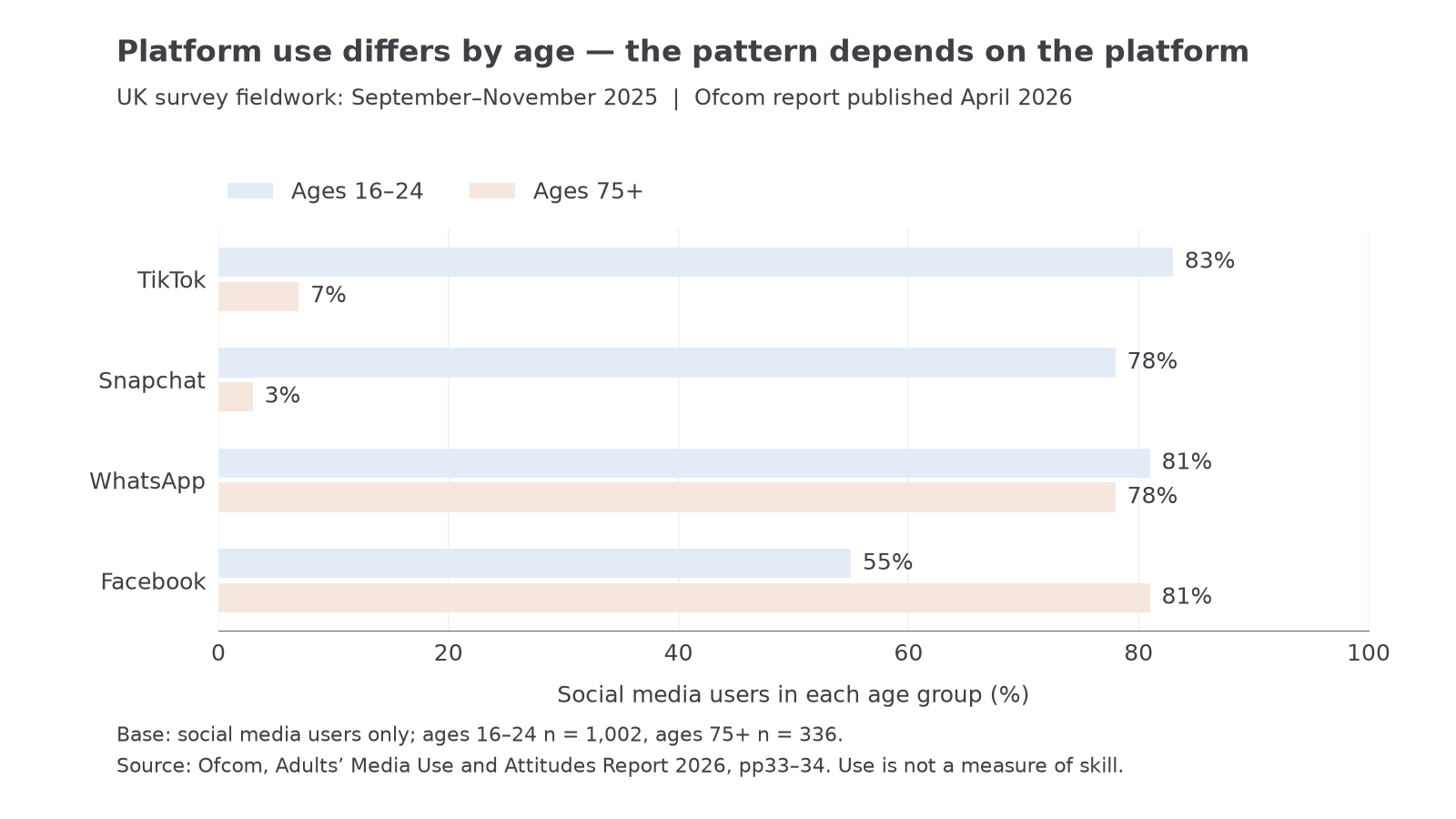
Platform choice varies by age: younger users report much more TikTok and Snapchat use, while Facebook use is higher in the older group. WhatsApp use is similar.
For TikTok, the difference is 83 − 7 = 76 percentage points. This is a difference between percentages, not a claim that the younger group's use is 76% greater. The Facebook and WhatsApp comparisons also prevent the misleading conclusion that older people never participate online. Platform use measures neither skill nor whether participation improves someone's life.
Three processes can help explain an age pattern:
- A cohort effect concerns shared historical experience among people born around the same time. Encountering digital communication at school or throughout working life can provide repeated practice. A group whose friends already use a platform also has a reason to join it.
- A life-course effect concerns changes in roles and circumstances as people move through life. Starting work, becoming a carer or retiring can change the time, support and reasons someone has for communicating online. Such changes can increase participation as well as reduce it.
- Resources and opportunities vary within every age group. Income, accessible design, language, disability, education and people who can help affect what a device enables. Age does not determine these conditions by itself.
A survey comparing different age groups at one time cannot separate these explanations on its own. A 75-year-old today has a different history from a 20-year-old today; the younger person's future behaviour is not established by the older person's current behaviour. Following people over time and asking about changing circumstances would strengthen the explanation.
Unequal skills within generations
Growing up around digital technology does not give everyone the same skills or opportunities.
The label digital native suggests that people born into a digital environment are naturally competent users. Familiarity can matter, but competence is learned and task-specific. Editing a short video, identifying a misleading claim, changing privacy settings and completing a financial form involve different knowledge. Success at one does not establish success at all the others.
Eszter Hargittai's 2010 study Digital Na(t)ives? analysed a paper survey collected in winter 2007 from 1,060 first-year students at a US urban public university. The students were mostly 18–19. Even within this connected, similarly educated group, reported web know-how varied systematically with social background and opportunities to use the internet. Higher measured know-how was associated with a wider range of online activities. This challenges the claim that youth guarantees equal competence. Hargittai, pp97–100 and 108–109
The study's skill index used respondents' ratings of their understanding of 27 internet terms; it was not a direct practical test of every task. A single university sample cannot represent all young people, and 2007 findings do not measure today's platforms. Its value here is evidence of variation within a young cohort. Associations also leave open the possibility that varied use builds skills as well as skills encouraging varied use.
Consider an original teaching scenario. Two 17-year-olds use messaging every day. Amal has a laptop, reliable broadband, a quiet workspace and someone who can help with unfamiliar forms. Jo relies on a shared phone and limited data. A lengthy college application requiring document uploads is easier for Amal to attempt, correct and complete. Equal enthusiasm for social media does not remove the difference in resources. These names and circumstances are illustrative, not research participants.
Resources can produce a reinforcing process: easier access permits practice; practice builds skills and confidence; successful use opens further opportunities. Barriers can produce the reverse, particularly if someone avoids a difficult service after an unsuccessful attempt. This is a mechanism that needs investigating, not proof that every disadvantaged person lacks skills. Experienced young users may devise effective workarounds, and well-equipped users can still make mistakes.
Ask what a person can do, under what conditions, and with what consequences. Age and device ownership alone cannot answer those questions.
Self-presentation and mixed audiences
Digital spaces allow people to present identities to others, but those audiences can also constrain how they express themselves.
Identity concerns how people understand themselves and are understood by others. Self-presentation means managing the impressions others form of us. From an interactionist perspective, identity develops through social interaction: people interpret others' reactions and adjust what they say or do. A profile, photograph or group conversation can therefore be part of identity formation, rather than merely a record of an identity fixed elsewhere.
Continue this lesson.
You’re previewing NovaLearn without an account. Create a free account to read the rest.
Create free account