4.3.1 - Realist Theories of Crime
Realist theories of crime matter because they insist that crime is not just a statistical label or a moral panic: it causes real harm, especially to people with the least power. In this lesson, you will learn how Left Realists and Right Realists explain crime differently, how they think social order should be maintained, and how to evaluate their claims in short answers and essays.
Left realism and the causes of crime
Left realism developed in the 1980s as an attempt to be both sociological and practical. John Lea and Jock Young (1984) argued that crime is a real social problem, not just an invention of police statistics, and that it falls heavily on working-class communities, minority ethnic groups, and women living with fear of victimisation. That starting point already separates left realism from approaches that seem to downplay everyday street crime.
Relative deprivation
A feeling of unfair disadvantage that comes from comparing your situation with that of others, rather than from poverty alone.
For left realists, crime is often rooted in relative deprivation. A person may see consumer lifestyles presented as normal and desirable, yet face blocked opportunities through unemployment, low pay, or discrimination. This creates frustration because the culture encourages people to want success, but the social structure does not distribute the means to reach it equally.
Marginalisation
Being excluded from political influence and organised representation, so grievances are felt strongly but lack legitimate channels for expression.
Lea and Young also stress marginalisation. Groups with weak political voice may feel powerless, and that frustration can feed anger or disorder. A third element is subculture: people facing similar deprivation and exclusion may form group norms that make offending seem justified, normal, or even necessary. Left realism therefore connects crime to inequality, identity, and social exclusion rather than to individual wickedness alone.
A useful way to remember the three causes is to see them as a chain. Relative deprivation creates resentment, marginalisation weakens lawful outlets for that resentment, and subculture can give collective support to deviant responses.
| Left realist cause | What it means | Why it may increase crime |
|---|---|---|
| Relative deprivation | Feeling unfairly deprived compared with others | Creates frustration and a sense that the system is unjust |
| Marginalisation | Lack of political voice or representation | Makes legal solutions feel unavailable or ineffective |
| Subculture | Group norms formed in response to shared problems | Can normalise offending as a response to exclusion |
Young later argued that late modern societies can be understood as bulimic societies. People are culturally pulled in through consumerism and the promise of success, but many are economically pushed out through insecurity, exclusion, and unstable work. This sharpens relative deprivation because people are encouraged to want more at the same time as many feel less able to achieve it legitimately.
Victims, research and left realist solutions
Left realism is also distinctive because it takes victims seriously. Lea and Young argued that official crime statistics do not tell the whole story, especially in deprived areas where people may not report offences or may feel the police will do little. That is why left realists used local victim surveys such as the Islington Crime Survey. These ask people in a specific area about their experiences of crime, fear of crime, and attitudes to policing.
Square of crime
The left realist idea that crime must be explained through the relationship between offenders, victims, the public, and formal agencies of social control such as the police.
The square is easiest to remember as a simple visual model rather than as a sentence to memorise.
[DIAGRAM: asset_name: 3_1_06_realist_theories_crime__diagram_01; asset_slug: 3_1_06_realist_theories_crime__diagram_01; recommended_method: retained_png; description: Square of crime shown as a simple square with four labelled corners: top left "Offender", top right "Victim", bottom right "Police / criminal justice agencies", bottom left "Public / community". Put two-way arrows along the sides of the square to show that each part shapes the others. Keep the diagram very clean, with no extra examples.]
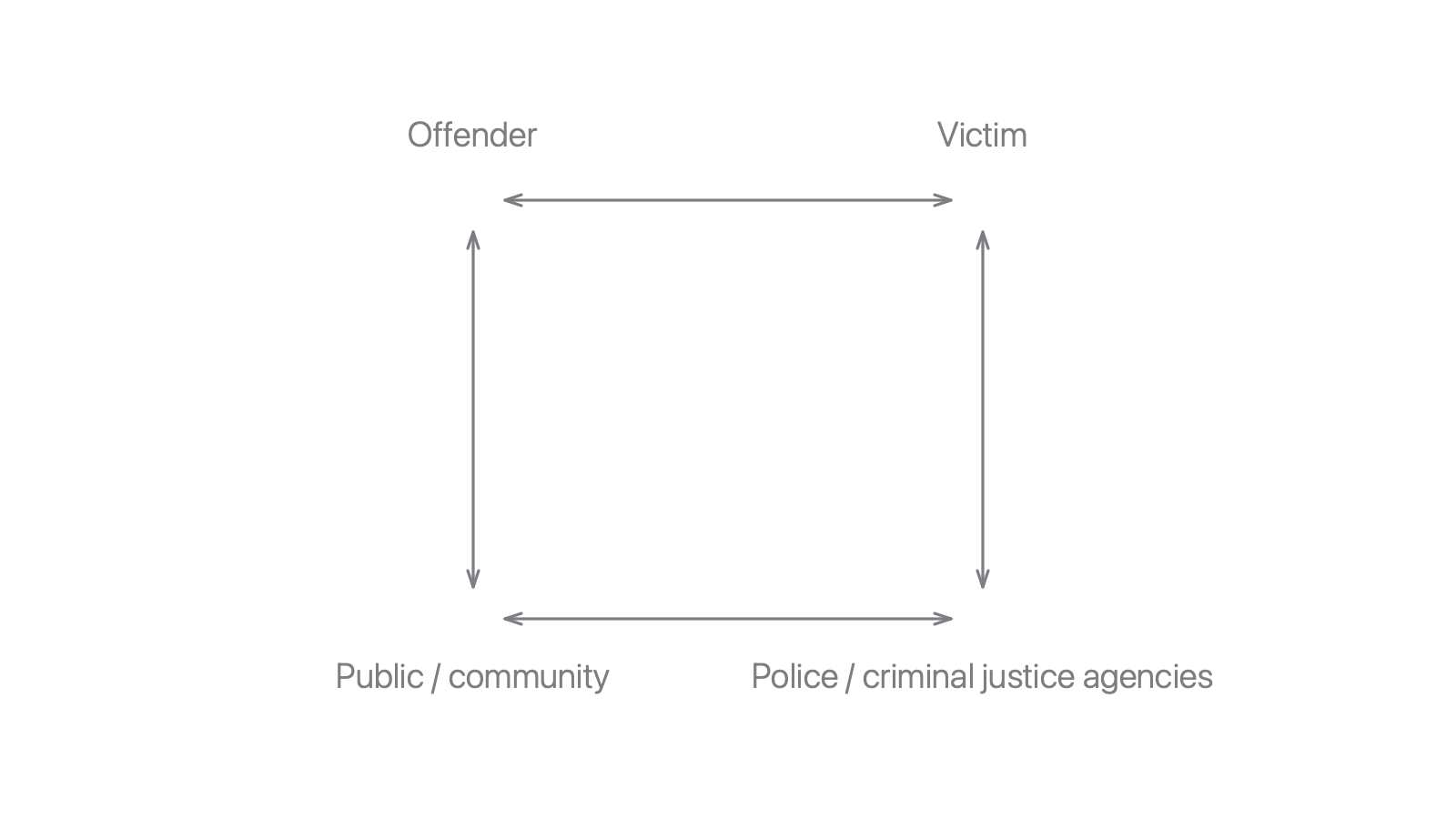
If you can picture those four corners, you can usually explain left realism much more clearly.
This method fits the wider left realist idea of the square of crime. Crime cannot be understood by looking only at the offender. Sociologists also need to consider the victim, the public, and the police or other agencies of social control. In other words, crime is shaped by relationships between offenders, victims, communities, and the state.
| Feature of local victim surveys | Why left realists value it | Limitation |
|---|---|---|
| Focus on victims | Reveals who actually suffers from everyday crime | Tells us less about offenders' motives |
| Local detail | Shows how crime is concentrated in particular neighbourhoods | Findings may not be representative of everywhere |
| Hidden crime | Captures some offences missed by official statistics | Depends on memory, honesty, and willingness to disclose |
The policy side of left realism follows from this evidence. If crime is linked to inequality and exclusion, then tackling crime means more than punishment. Left realists favour reducing inequality, improving housing, schools, and employment opportunities, and using multi-agency approaches in which police, councils, schools, and community organisations work together. They also support democratic policing, because communities are more likely to report crime when they believe the police act with fairness and consent.
Imagine a local survey finds that residents on an inner-city estate fear robbery, harassment, and poor police response far more than official figures suggest. A left realist response would not stop at tougher sentencing. It would combine better policing with youth provision, housing improvement, and closer cooperation between residents and local agencies.
Right realism, choice and social control
Right realism shares the view that crime is a real problem, but it explains that problem very differently. James Q. Wilson argued that offenders are rational actors who weigh up costs and benefits. If crime seems easy, rewarding, and low-risk, more people will choose it. Right realism therefore focuses on deterrence, control, and prevention rather than on inequality as the main cause.
Continue this lesson.
You’re previewing NovaLearn without an account. Create a free account to read the rest.
Create free account