4.3.1 - Interactionist - Labelling Theory of Crime
This lesson explains why interactionists argue that crime is not simply a fixed set of bad acts waiting to be counted. What matters, they say, is who has the power to make rules, apply labels, and turn suspicion into an official record. That gives you a clear chain of knowledge for short questions and a clear evaluative debate with realist and Marxist criticisms.
Deviance as a social label
Interactionist sociology begins with meanings. Instead of assuming that some acts are naturally criminal, it asks how behaviour comes to be defined as criminal in the first place. Howard Becker argues that deviance is not an inbuilt quality of an act. It is the outcome of social groups making rules and then applying those rules to particular people. In that sense, crime and deviance are socially constructed.
Labelling
The process by which other people or agencies define an act or person as deviant or criminal.
This does not mean that nothing harmful ever happens. It means that sociology should pay attention to the process of definition. A fight in a boxing ring is legitimate sport, while a fight on a street corner may be called assault. The physical act may look similar, but the social meaning is different because the context, audience, and power to judge are different. Labelling theory therefore shifts attention from rule-breaking alone to rule-making and rule-enforcement. Social order is maintained not just by shared values but by agents of social control such as police, courts, teachers, welfare professionals, and the media.
Becker also highlights the role of moral entrepreneurs. These are people or groups who campaign to create new rules or enforce existing ones more aggressively. They often present their cause as a defence of the public good, but their success depends on power, resources, and influence. This matters because not every group has an equal ability to define what counts as deviant.
Moral entrepreneurs
Individuals or groups with enough influence to campaign for new rules, tougher enforcement, or new definitions of deviance.
Imagine a group of teenagers regularly gathering outside a shopping centre. Some adults may see ordinary socialising, while others describe it as threatening or gang-related. If local newspapers, councillors, and police adopt the second definition, patrols increase and minor incidents are more likely to be recorded as evidence of a crime problem.
The key interactionist claim is that deviance is relative to time, place, audience, and power. That is why labelling theory is especially useful for explaining social control: it shows who gets defined as troublesome, who gets left alone, and how some behaviours become public problems while others stay normalised or invisible.
From reaction to deviant career
Edwin Lemert makes a crucial distinction between primary and secondary deviance. Primary deviance is the initial rule-breaking act. It may be minor, occasional, or unnoticed, and it does not necessarily change how a person sees themselves. Many people break small rules at some point, but most are never publicly identified as deviant.
The sociological turning point comes with the social reaction. Once other people publicly define someone as deviant, the label can start to reshape identity and opportunity. Lemert calls the resulting behaviour secondary deviance.
Secondary deviance
Further deviance that results from society's reaction to an initial act and the label attached to the person.
Becker develops this argument by showing how a label can become a master status. A master status is a label that dominates all other identities. Instead of being seen as a student, worker, sibling, or neighbour, the individual is mainly seen as a delinquent, thief, addict, or offender. This matters for identity because people build their self-concept partly through the reactions of others.
Master status
A label or status that becomes a person's dominant social identity and shapes how others see them.
Once the label sticks, a self-fulfilling prophecy can begin. The person may be excluded from conventional opportunities, distrusted by authority figures, and pushed towards others with similar experiences. Rejection from school, work, or friendship networks can make deviant groups look like the only place where respect and belonging are available. Inside those groups, peer approval and alternative norms may encourage further rule-breaking. Identity acceptance, loss of conventional opportunities and peer reinforcement are related but distinguishable mechanisms. This is how labelling theory explains the deviant career: not as an inevitable result of one act, but as a process in which social control can deepen the very behaviour it claims to prevent.
The chain below is useful because labelling theory works as a sequence rather than as a single definition.
[DIAGRAM: asset_name: 3_1_05_labelling_theory_crime__diagram_01; asset_slug: 3_1_05_labelling_theory_crime__diagram_01; recommended_method: retained_png; description: Flowchart showing the labelling sequence from left to right: "Primary deviance" -> "Social reaction / label applied" -> "Master status" -> "Exclusion from conventional opportunities" -> "Secondary deviance" -> "Deviant career". Keep it as one clean chain with short labels.]
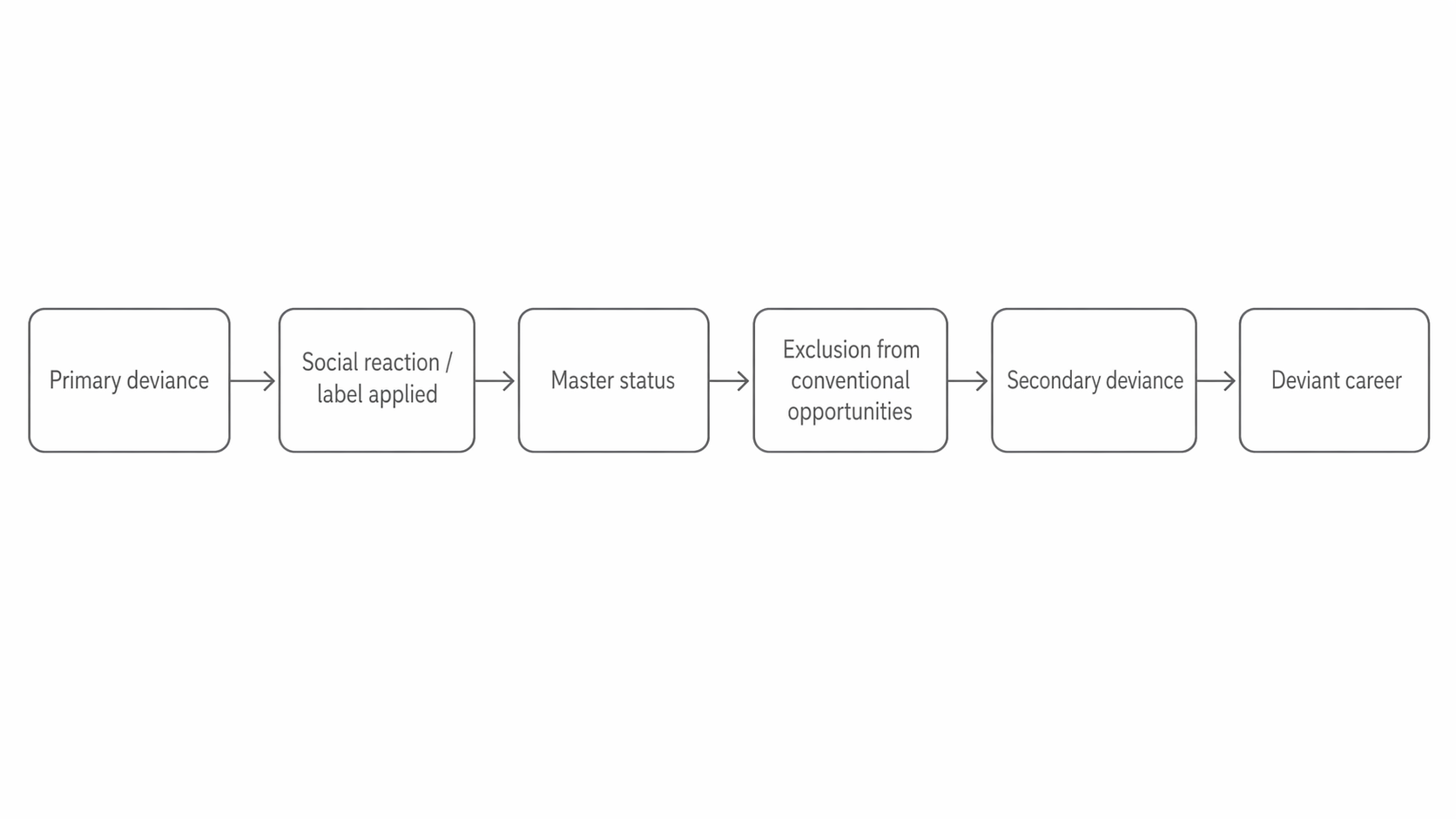
If you can follow that sequence, you can usually explain why interactionists focus so strongly on reaction and stigma.
This is why interactionists say the important question is not only "Why did the act happen?" but also "What did the reaction do next?" Their answer keeps identity, stigma, and social exclusion at the centre of the explanation.
Typifications and crime statistics
Aaron Cicourel applied interactionist ideas to the juvenile justice system. He showed that officials do not simply discover delinquency in a neutral way. They work with assumptions about what a "typical delinquent" looks like, how they speak, where they live, how they behave towards authority, and what kind of family background they come from.
Continue this lesson.
You’re previewing NovaLearn without an account. Create a free account to read the rest.
Create free account